

TL;DR:
- Negotiation in Southern California covers price, closing costs, repairs, credits, and timing.
- Proper pricing and market knowledge strengthen sellers' leverage during negotiations.
- Creative concessions like credits and flexible timelines often yield better results than price reductions.
Most sellers walk into a home sale thinking negotiation means one thing: fighting over the asking price. In reality, negotiation covers closing costs, repairs/credits, and rate buydowns across the entire transaction. Southern California markets like Los Angeles, San Diego, and Upland each carry their own norms around who pays what, how inspection credits get handled, and where sellers hold the most leverage. If you only focus on price, you leave real money on the table. This article breaks down the full scope of negotiation in Southern California home sales, from closing cost splits to pricing strategy, so you can walk away with the strongest possible outcome.
Table of Contents
- Understanding negotiation in Southern California home sales
- Key negotiation topics: Closing costs, repairs, and credits
- Pricing strategy and negotiation leverage in Southern California
- Applying negotiation strategies: Tips for sellers and investors
- Unpacking the negotiation myths: What most sellers miss
- Connect with top Southern California real estate resources
- Frequently asked questions
Key Takeaways
| Point | Details |
|---|---|
| Negotiation power | Effective negotiation directly influences your home sale's outcome and profitability. |
| Local cost splits | In Southern California, sellers pay title insurance while escrow fees are split, so knowing these norms is essential. |
| Pricing strategy | Strategic pricing helps maximize leverage and avoids the pitfalls of overpricing. |
| Repair negotiation | Post-inspection repairs and credits are key negotiation points that can change the final sale terms. |
| Preparation advantage | Preparing documents and responses in advance gives sellers a strong edge in negotiations. |
Understanding negotiation in Southern California home sales
Negotiation in real estate is not a single moment. It is a process that runs from the first offer through the final closing signature. Sellers who understand this have a clear advantage over those who treat it as a one-time price debate.
One of the biggest misconceptions is that the listing price is the only number that matters. In Southern California, the final sale outcome depends on a web of negotiated terms. A buyer might accept your asking price but push hard for $15,000 in closing cost credits. Another might offer slightly below asking but waive all repair requests after inspection. Both deals look different on paper, but the net result to you as the seller can be nearly identical.
So what exactly can be negotiated? Here is a breakdown of the most common negotiation points:
- Purchase price: The most visible number, but not always the most impactful.
- Closing cost contributions: Sellers often contribute to buyer closing costs as a concession.
- Repair credits: After inspection, buyers request credits in lieu of actual repairs.
- Rate buydowns: Sellers can offer to buy down the buyer's mortgage rate to close the deal faster.
- Contingency timelines: Inspection, appraisal, and loan contingency deadlines are all negotiable.
- Personal property: Appliances, fixtures, and even furniture can be included or excluded as leverage.
- Possession date: Flexibility on move-in timing can make or break a deal.
Local market conditions in Southern California add another layer. In high-demand neighborhoods in Los Angeles, sellers often receive multiple offers and hold significant leverage. In slower suburban markets like parts of the Inland Empire, buyers tend to push harder on credits and repairs. Understanding your specific submarket matters enormously.
Pro Tip: Before listing, review comparable sales in your zip code to see which concessions sellers have been making. This tells you what buyers in your area expect, so you are not caught off guard during negotiations.
Sellers who invest in home sale preparation before listing tend to negotiate from a stronger position because their home has fewer vulnerabilities for buyers to exploit. Similarly, understanding the role of open houses in generating competitive offers can shift the negotiation dynamic entirely in your favor. For sellers managing the process from a distance, a solid remote selling guide can help you stay on top of every negotiation move without being physically present.
Key negotiation topics: Closing costs, repairs, and credits
Closing costs are one of the least glamorous parts of a home sale, but they are one of the most negotiated. In Southern California, the split between buyer and seller is not fixed by law. It is determined by local custom, market conditions, and what both parties agree to.
Here is a snapshot of what typical closing costs look like and who generally pays them:
| Cost Item | Typical Range | Who Pays (SoCal Norm) |
|---|---|---|
| Escrow fees | $2,000 to $3,500 | Split between buyer and seller |
| Title insurance | $800 to $2,500 | Seller-paid in most SoCal counties |
| Transfer tax | 0.11% of sale price | Seller (varies by city) |
| Home warranty | $400 to $700 | Often seller-paid as concession |
| Natural hazard disclosure | $100 to $150 | Seller |
| Loan payoff fees | Varies | Seller |
As noted in Southern California real estate norms, escrow fees run $2,000 to $3,500 and are typically split, while title insurance between $800 and $2,500 is most often seller-paid. These numbers shift slightly by county. In Los Angeles, custom leans more toward the seller covering title. In San Diego, some buyers negotiate to share that cost.
Key insight: Closing cost negotiations are where many sellers unknowingly give up thousands of dollars. A buyer asking for $10,000 in closing cost assistance on a $750,000 home is essentially asking for a 1.3% price reduction, but it shows up differently on the settlement statement. Know what you are agreeing to before you sign.
Post-inspection negotiations are equally significant. Once the buyer's inspector submits a report, the real bargaining begins. Buyers typically request one of three things: the seller makes repairs before closing, the seller provides a credit at closing, or the seller reduces the price. Credits are often the cleanest solution because they avoid contractor delays and disputes over workmanship quality.
Common inspection items that trigger negotiation in Southern California include:
- Roof condition: One of the most expensive repairs and a frequent negotiation point.
- HVAC systems: Older units often prompt credit requests.
- Plumbing and sewer lines: Especially in older Los Angeles homes.
- Foundation issues: More common in hillside properties.
- Electrical panels: Outdated panels can be a lender requirement to fix.
Understanding what your closing agent duties include helps you track how these credits and costs flow through the transaction. Your closing agent coordinates the financial adjustments, so knowing their role keeps you from being surprised at the settlement table.
The smartest sellers address obvious issues before listing. A pre-listing inspection costs around $300 to $500 but can prevent a buyer from using unknown defects as leverage to chip away at your net proceeds.

Pricing strategy and negotiation leverage in Southern California
Your listing price is not just a number. It is a negotiation signal. Price too high, and you attract skeptical buyers who assume you will drop. Price strategically, and you create urgency that shifts leverage firmly to your side.
Overpricing loses leverage and is one of the most common seller mistakes in Southern California. When a home sits on the market for more than 30 days, buyers start asking why. They assume something is wrong, even if nothing is. That perception alone weakens your negotiating position before a single offer comes in.
Here is a comparison of how different pricing strategies affect your negotiation outcomes:
| Pricing Strategy | Days on Market | Offer Dynamics | Seller Leverage |
|---|---|---|---|
| Overpriced (5%+ above market) | 45 to 90+ days | Single lowball offers | Very low |
| At market value | 10 to 25 days | Standard offers, some negotiation | Moderate |
| Slightly under market | 3 to 10 days | Multiple offers, possible bidding | High |
| Significantly underpriced | 1 to 5 days | Bidding war, but risk of leaving money behind | Variable |
The sweet spot for most Southern California sellers is pricing at or just slightly below true market value. This generates interest quickly, which creates competition, which gives you the power to choose the strongest offer rather than accept whatever comes in.
Here are the steps to set a price that maximizes your negotiation position:
- Pull recent comparable sales within a half mile and 90 days. Focus on similar square footage, condition, and lot size.
- Adjust for condition differences. A renovated kitchen adds value. A 20-year-old roof subtracts it.
- Study active listings. These are your competition. Price to stand out.
- Consult local data. Neighborhood-level trends matter more than county-wide averages.
- Revisit after 14 days. If you have not received serious offers, recalibrate before the listing goes stale.
Pro Tip: Ask your agent the right questions about pricing strategy before you list. A good agent will show you data, not just tell you what you want to hear.
Understanding why homes linger on the market is just as important as knowing how to price correctly. Stale listings are negotiation liabilities. The advantages of working with an experienced agent become especially clear during pricing decisions, where local knowledge and data access can mean tens of thousands of dollars in your favor. For investors evaluating multiple properties, understanding why Southern California remains a strong investment market provides the broader context that shapes every pricing and negotiation decision.
Applying negotiation strategies: Tips for sellers and investors
Knowing the theory is one thing. Applying it under pressure, with real money at stake, is another. Here are five essential strategies that work in the Southern California market right now.
1. Respond, do not react. When a buyer submits a low offer or a long repair list, take 24 hours before responding. Emotional reactions lead to poor counteroffers. A calm, data-backed response signals confidence and keeps the deal alive.
2. Use multiple offers as leverage. Even one competing offer changes the dynamic. If you receive two offers simultaneously, inform both parties professionally. This is not a manipulation tactic. It is transparency that naturally encourages buyers to put their best foot forward.
3. Offer credits instead of price reductions. A $5,000 repair credit costs you the same as a $5,000 price reduction but feels different to both parties. Credits keep the headline price intact, which matters for appraisal and neighborhood comps.
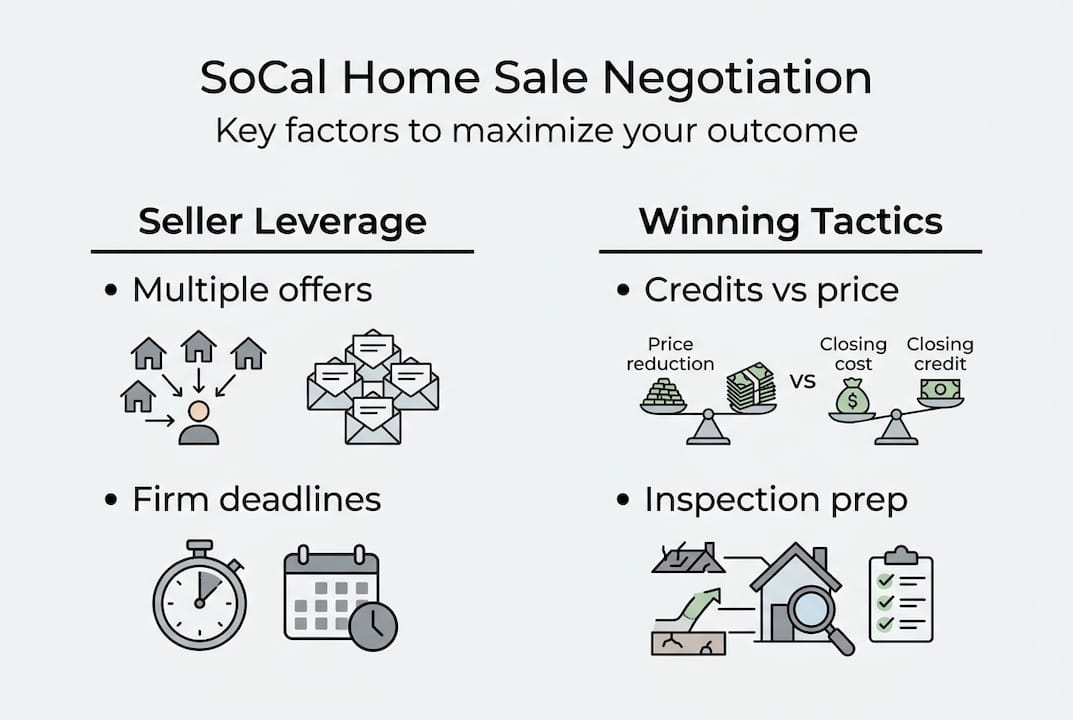
4. Control the timeline. Sellers who set firm contingency deadlines move deals forward. Buyers who sense urgency are less likely to drag out the inspection period fishing for additional concessions.
5. Know your walk-away number. Before any negotiation, define the minimum net proceeds you will accept. This prevents you from making emotionally driven concessions in the final hours of a deal.
For investors managing multiple properties, these tactics scale well. Skilled negotiation maximizes seller outcomes across a portfolio, particularly when you standardize your response process and use consistent credit and pricing frameworks across transactions.
Pro Tip: Prepare your inspection response package before you even list. Have contractor quotes ready for the most likely repair requests. This lets you respond to inspection demands within 48 hours instead of scrambling for a week, which keeps buyers engaged and reduces the risk of deal fallout.
Statistic callout: Sellers who negotiate actively on closing costs and credits, rather than just price, consistently improve their net proceeds. Even small adjustments, like shifting $2,000 in escrow fees to the buyer or declining a minor repair request, add up across the full transaction.
Understanding how a buyer's agent guides homebuyers through negotiations helps you anticipate the tactics being used on the other side of the table. And if you are selling to first-time buyers, know that they often rely heavily on their agent's guidance, which means your responses set the tone for the entire negotiation.
Unpacking the negotiation myths: What most sellers miss
Here is something most real estate articles will not tell you: the sellers who negotiate best in Southern California are not the ones who push hardest on price. They are the ones who understand what the buyer actually needs and use that knowledge strategically.
Conventional wisdom says hold firm on price and concede on the small stuff. In 2026, that approach is outdated. Buyers are dealing with higher mortgage rates and tighter budgets. What they often need is not a lower price but a rate buydown or a credit that reduces their upfront cash requirement. Sellers who recognize this can offer creative concessions that cost less than a price cut but close the deal faster.
Timing is another overlooked lever. A seller who can close in 21 days versus 45 days is offering real value to a buyer who has already given notice at their rental. Flexibility on possession dates, or offering a leaseback arrangement, can be worth more than $5,000 in price negotiations.
The uncomfortable truth is that most sellers focus on what they want to keep rather than what the buyer needs to move forward. Understanding what makes homes sit on the market reveals that inflexibility, not just overpricing, is a primary reason deals fall apart.
Editorial perspective: Negotiation is not a battle. It is a problem-solving exercise. The sellers who treat it that way close faster, net more, and leave both parties satisfied.
In 2026, with inventory still constrained in many Southern California submarkets, sellers have real power. The key is knowing how to use it without overplaying your hand.
Connect with top Southern California real estate resources
Negotiation strategy only works when it is grounded in accurate, local market data and guided by someone who knows the terrain. That is exactly what Irvin Nierras and the team at IN Realtors bring to every transaction in Los Angeles and Orange County.

Whether you are ready to sell your home and want a negotiation-focused strategy from day one, or you are still exploring your options, the right resources make all the difference. Browse current homes for sale to understand what buyers in your market are seeing, and get a personalized home value evaluation to anchor your pricing strategy in real data. With the right foundation, every negotiation conversation becomes an opportunity to protect and grow your proceeds.
Frequently asked questions
What are the most commonly negotiated items in Southern California home sales?
The most commonly negotiated items are closing costs, repairs, and credits after inspection, along with strategic pricing adjustments. Rate buydowns have also become increasingly common as buyers manage affordability in 2026.
How do closing costs typically get split between buyer and seller?
In Southern California, escrow fees of $2,000 to $3,500 are generally split between buyer and seller, while title insurance between $800 and $2,500 is most often covered by the seller. These norms vary slightly by county and market conditions.
What happens if a home is overpriced during negotiations?
Overpricing loses negotiation leverage and typically results in longer days on market, which signals weakness to buyers and invites lower offers. Strategic pricing at or near market value keeps you in control of the negotiation.
Can buyers negotiate repairs after the inspection?
Yes, buyers routinely negotiate credits or repairs after the inspection period, and this is one of the most impactful phases of the entire transaction. Sellers who prepare in advance with contractor quotes can respond quickly and protect their net proceeds.
How can sellers maximize their negotiation outcomes?
Sellers who maximize outcomes through negotiation typically combine strategic pricing, prepared documentation, and flexibility on credits and timelines rather than focusing solely on holding the line on price.