

Southern California real estate stands at a crossroads in 2026, offering investors a unique combination of rapid market dynamics and long-term appreciation potential. With cities like Irvine leading the nation in sales velocity and commercial cap rates shifting across asset classes, understanding local market mechanics has never been more critical. First-time buyers and seasoned investors alike face a landscape where preparation, regional knowledge, and strategic timing separate profitable ventures from costly missteps. This guide breaks down the essential factors driving Southern California's investment appeal, from residential hotspots to commercial property valuations, equipping you with actionable insights to navigate one of America's most competitive real estate markets.
Table of Contents
- The Southern California real estate landscape in 2026
- Understanding commercial real estate cap rates in Southern California
- Comparing Southern California with other U.S. real estate markets
- Practical tips for investing in Southern California real estate in 2026
- Explore Southern California real estate opportunities
- Frequently asked questions
Key takeaways
| Point | Details |
|---|---|
| Irvine leads California markets | Irvine ranks #1 among large California cities with homes pending in just 51 days and steady price growth around $1.5 million. |
| Cap rates reshape valuations | Commercial cap rates rose across Southern California in 2025, with industrial properties in the Inland Empire climbing from 5.3% to 5.6% and LA office space jumping from 5.8% to 6.4%. |
| Regional advantages persist | Primary markets like Southern California score 3.08 on real estate prospect indexes, outperforming the national average of 2.81 for 2026. |
| Speed demands preparation | Competitive markets require pre-approved financing, swift decision-making, and strong legal protections to avoid rushed mistakes. |
| Diversification reduces risk | Spreading investments across residential, commercial, and multifamily assets within Southern California creates portfolio stability. |
The Southern California real estate landscape in 2026
Southern California's real estate market continues to demonstrate exceptional strength in 2026, with certain cities outpacing national trends by significant margins. Irvine ranks as California's hottest large city market, where homes transition from listing to pending status in just 51 days and typical prices hover around $1.5 million with a 0.6% year-over-year increase. This velocity reflects not just local demand but the broader characteristics that make Southern California attractive: constrained geographic supply, robust economic diversity, and demographic patterns favoring high-density coastal regions.
Investors entering this market face a dual reality. On one hand, the region's established infrastructure, employment centers, and lifestyle appeal create enduring value propositions that weather economic cycles better than speculative markets. On the other, the competitive pace demands preparation and decisiveness that casual investors often lack. Properties in premium areas receive multiple offers within days, and buyers without pre-approved financing or clear investment criteria frequently miss opportunities.
"In supercharged markets like Irvine, quick decisions backed by legal protections reduce risks of costly mistakes."
The market snapshot in Irvine, CA illustrates these dynamics in real time, showing inventory levels, price trends, and absorption rates that help investors gauge timing. Understanding these metrics prevents overpaying during temporary spikes and identifies genuine value when market conditions shift. Several factors distinguish Southern California from other high-priced regions:
- Geographic constraints limit new construction, supporting long-term appreciation
- Diverse economic sectors from technology to entertainment create employment stability
- International investment flows maintain demand even during domestic economic uncertainty
- Regulatory environments favor existing property owners through tax structures like Proposition 13
Pro Tip: In supercharged markets like Irvine, quick decisions backed by legal protections reduce risks of costly mistakes. Work with attorneys who specialize in local real estate transactions to review contracts before committing.
These advantages translate into measurable outcomes for investors willing to navigate the complexity. The Irvine real estate market serves as a microcosm of broader Southern California trends, where preparation and local expertise determine success more than raw capital alone.
Understanding commercial real estate cap rates in Southern California
Commercial real estate investors in Southern California must master cap rate analysis to avoid valuation errors that can cost millions. Cap rates express the relationship between a property's net operating income and its market value, providing a standardized metric for comparing investment returns across different assets and regions. In 2026, Southern California commercial cap rates shifted significantly across sectors, reflecting broader economic pressures from interest rate adjustments and evolving tenant demand patterns.
Recent cap rate movements reveal diverging fortunes among asset classes. Industrial properties in the Inland Empire saw rates climb from 5.3% to 5.6%, while Los Angeles office space jumped from 5.8% to 6.4% as hybrid work models reduced demand for traditional office configurations. Orange County retail properties stabilized around 5.8%, and Los Angeles multifamily assets moved from 4.3% to 4.5%. These shifts might seem modest in percentage terms, but a 50-basis-point increase on a $20 million property represents a $2 million valuation adjustment, fundamentally altering deal economics.

| Asset Class | Region | Q4 2024 Cap Rate | Q4 2025 Cap Rate | Change |
|---|---|---|---|---|
| Industrial | Inland Empire | 5.3% | 5.6% | +30 bps |
| Office | Los Angeles | 5.8% | 6.4% | +60 bps |
| Retail | Orange County | 5.7% | 5.8% | +10 bps |
| Multifamily | Los Angeles | 4.3% | 4.5% | +20 bps |
Understanding these trends requires context beyond the numbers themselves. Industrial properties benefit from e-commerce growth driving warehouse demand, yet rising cap rates signal investor caution about future rent growth and potential oversupply. Office assets face structural challenges as companies permanently reduce square footage needs, pushing cap rates higher to compensate for increased risk. Retail properties show resilience in well-located centers with experiential tenants, while multifamily remains relatively stable due to California's persistent housing shortage.
Investors evaluating homes for sale in Southern California should apply similar analytical rigor to residential income properties, calculating cap rates on rental units to compare with commercial alternatives. A single-family rental generating $3,000 monthly rent ($36,000 annually) purchased for $900,000 yields a 4% cap rate before expenses, comparable to multifamily assets but with different liquidity and management profiles.
Pro Tip: Monitor cap rate trends closely when evaluating commercial deals to avoid overpaying in a rising rate environment. A property that seemed fairly priced six months ago may be overvalued today if cap rates have expanded.
The Southern California CRE cap rates analysis provides quarterly updates that sophisticated investors use to benchmark deals and negotiate pricing. Ignoring these trends leads to overpaying during market peaks or missing opportunities when cap rates expand beyond fundamental justification.
Comparing Southern California with other U.S. real estate markets
Placing Southern California within the national real estate landscape reveals both its competitive advantages and the trade-offs investors accept when choosing this region. Primary markets average real estate prospect scores of 3.08, exceeding the national average of 2.81 for 2026, with Southern California contributing significantly to this elevated performance. However, this premium positioning comes with higher entry costs and more intense competition than emerging markets in the Southeast or Midwest.
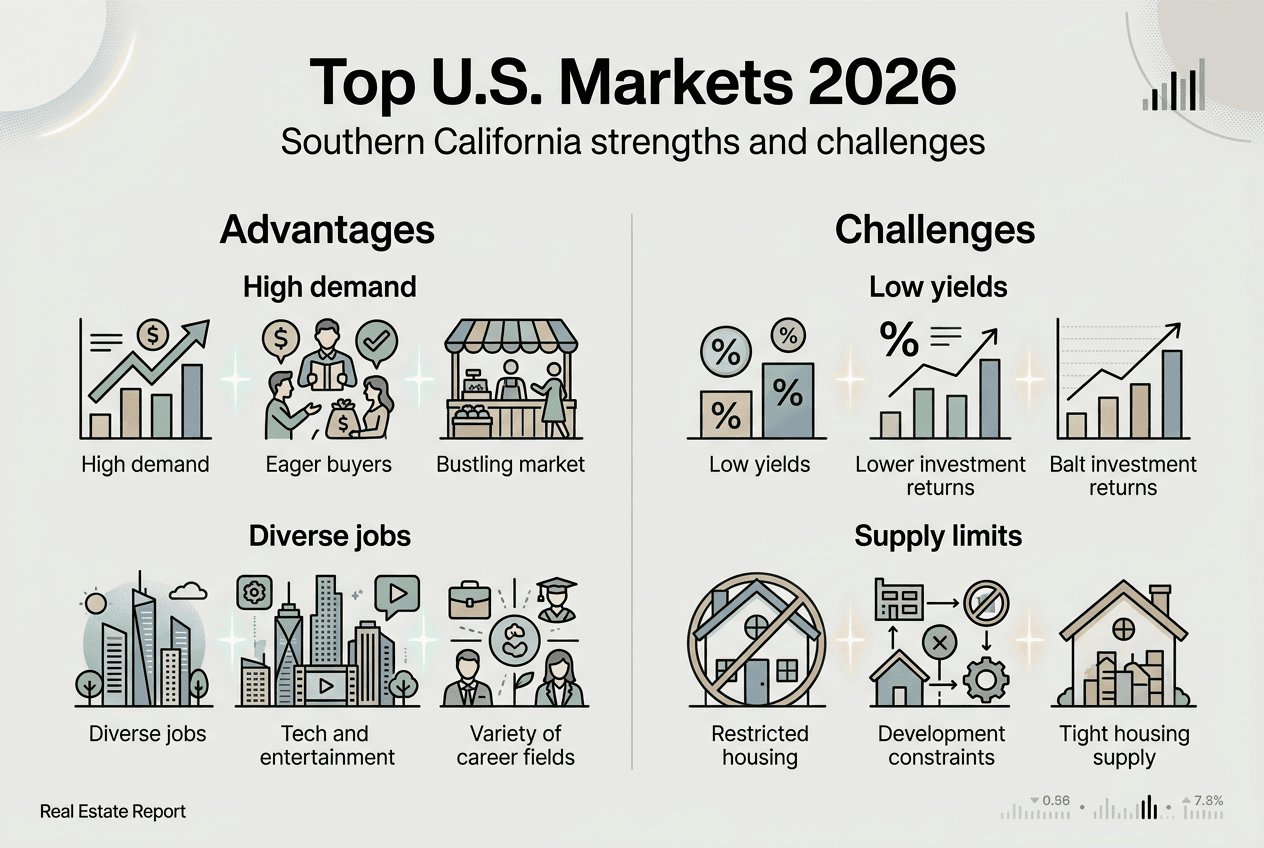
Regional comparisons illuminate strategic choices investors face. Northeast markets benefit from supply constraints similar to Southern California, with limited land availability supporting price stability. Southeast regions like Dallas/Fort Worth demonstrate sector diversity and demographic growth that rival coastal markets while offering lower acquisition costs. Midwest markets provide cash flow opportunities with higher cap rates but face population stagnation that limits long-term appreciation potential.
| Region | Prospect Score | Primary Advantage | Key Challenge |
|---|---|---|---|
| Southern California | 3.15 | Constrained supply, diverse economy | High entry costs, intense competition |
| Northeast | 3.20 | Supply constraints, established infrastructure | Aging building stock, high taxes |
| Southeast | 3.10 | Demographic growth, business-friendly climate | Potential oversupply, weather risks |
| Midwest | 2.65 | Strong cash flow, affordable entry | Population decline, limited appreciation |
Southern California's sector diversity strengthens its investment case compared to single-industry markets vulnerable to economic shocks. The region supports technology, entertainment, international trade, tourism, and professional services, creating employment stability that sustains housing demand across economic cycles. This diversification mirrors successful markets like Dallas/Fort Worth, which blend traditional industries with emerging sectors to maintain resilience.
Investors should weigh these factors against personal objectives and risk tolerance:
- Cash flow prioritization favors Midwest markets with 8% cap rates over Southern California's 4-5% range
- Appreciation potential tilts toward supply-constrained coastal markets with demographic tailwinds
- Portfolio diversification benefits from geographic spread across multiple regions
- Tax considerations vary significantly, with California's higher rates offset by Proposition 13 protections for long-term holders
The single family homes in Southern California market exemplifies these trade-offs, offering lower initial yields than secondary markets but stronger appreciation potential and more liquid exit options. A $1.5 million Irvine home generating $5,000 monthly rent yields 4% gross returns, while a $300,000 Indianapolis property at $2,000 monthly rent yields 8%. The California property likely appreciates faster, but the Indiana asset provides superior cash flow for investors needing immediate income.
National real estate market trends show Southern California maintaining competitive positioning despite cyclical pressures, with institutional investors continuing to allocate capital to the region based on long-term fundamentals rather than short-term yield optimization. This institutional confidence provides stability but also increases competition for quality assets.
Practical tips for investing in Southern California real estate in 2026
Successful Southern California real estate investment in 2026 requires combining market knowledge with tactical execution strategies that address the region's unique challenges. These actionable approaches help both first-time and experienced investors maximize returns while minimizing common pitfalls in competitive markets.
-
Research neighborhoods deeply for growth potential beyond headline prices. Analyze school quality, infrastructure projects, zoning changes, and demographic shifts that signal future appreciation. A $1.2 million home in an emerging area with planned transit access may outperform a $1.5 million property in an established neighborhood with limited growth catalysts.
-
Prepare financing and inspections in advance for swift negotiations. Competitive markets require careful planning to avoid rushed mistakes that cost thousands in repairs or unfavorable terms. Obtain pre-approval letters, identify preferred lenders, and establish relationships with inspectors before making offers.
-
Understand legal and regulatory protections available locally. California's disclosure requirements, contingency periods, and tenant protections differ substantially from other states. Work with attorneys specializing in California real estate to structure transactions that protect your interests while remaining competitive.
-
Diversify portfolios across asset classes including residential, commercial, and multifamily properties. A portfolio combining single-family rentals, small retail centers, and apartment buildings spreads risk across different tenant types and economic drivers. This approach cushions against sector-specific downturns while capturing opportunities across the market spectrum.
-
Partner with experienced local agents and legal counsel to navigate complexity. Agents with deep neighborhood knowledge identify off-market opportunities and provide comparable sales data that prevent overpaying. Legal counsel reviews contracts, identifies red flags, and structures entities that optimize tax treatment.
-
Monitor cap rate trends, tenant demand patterns, and financing costs specific to Southern California. Subscribe to market reports, attend local real estate investor meetings, and build networks with other investors who share insights about emerging opportunities and risks.
Pro Tip: Always conduct thorough due diligence on cap rates, tenant demand, and financing cost trends specific to Southern California. Markets can shift rapidly, and yesterday's assumptions may not hold today.
The home value evaluation services provide baseline data for assessing whether properties are priced appropriately relative to neighborhood comparables and recent sales trends. Use these evaluations as starting points for negotiations rather than final valuations, adjusting for property-specific factors like condition, location within the neighborhood, and unique features.
Investor guidance for Irvine market emphasizes the importance of acting decisively once due diligence confirms a property meets investment criteria. Hesitation in fast-moving markets means losing deals to more prepared competitors, while rushing without proper analysis leads to costly mistakes. Balance speed with thoroughness by completing as much preparation as possible before identifying specific properties.
These strategies apply across Southern California's diverse markets, from Los Angeles to Orange County, though specific tactics may vary by submarket. Coastal properties require different analysis than inland areas, and luxury markets operate under different dynamics than workforce housing. Adapt these principles to your target segments while maintaining disciplined investment criteria.
Explore Southern California real estate opportunities
The insights you've gained about Southern California's real estate dynamics, cap rate trends, and regional advantages position you to make informed investment decisions in 2026. Whether you're targeting single-family rentals in growing neighborhoods or commercial properties with strong tenant fundamentals, the next step involves connecting these concepts to actual opportunities in the market.

Our platform provides updated market snapshot in Irvine and surrounding Southern California communities, delivering real-time data on inventory levels, price trends, and absorption rates that inform timing decisions. Browse single family home listings curated for investors seeking properties with strong rental potential and appreciation prospects. Each listing includes detailed information about neighborhood characteristics, school ratings, and comparable sales that support valuation analysis.
For sellers and investors evaluating portfolio adjustments, home value evaluation services offer complimentary assessments based on recent sales data and current market conditions. These reports help determine optimal timing for acquisitions or dispositions, ensuring you capitalize on market movements rather than reacting to them after opportunities pass. Connect with our team of experienced agents who understand Southern California's competitive landscape and can provide personalized guidance tailored to your investment objectives and risk tolerance.
Frequently asked questions
What are the main benefits of investing in Southern California real estate?
Southern California offers high demand driven by geographic supply constraints, diverse employment sectors, and demographic patterns favoring coastal regions. Investors benefit from steady appreciation potential supported by limited new construction and strong rental demand across both residential and commercial sectors. The region's market velocity creates opportunities for quick gains when investors are properly prepared, though competition requires more sophistication than slower markets.
How do cap rates affect commercial property investments?
Cap rates measure annual return potential by dividing net operating income by property value, with higher cap rates indicating better yields but often signaling increased risk. Small cap rate changes significantly alter valuations; a 50-basis-point increase on a $20 million property reduces its value by approximately $2 million, fundamentally changing deal economics. Investors must monitor cap rate trends across asset classes and regions to avoid overpaying when rates expand or missing opportunities when they compress beyond fundamental justification.
What strategies can first-time investors use in competitive Southern California markets?
First-time investors should prepare financing in advance, obtaining pre-approval letters and establishing lender relationships before identifying specific properties. Work with knowledgeable local agents and legal advisors who understand California's unique regulatory environment and can guide you through complex transactions. Focus on neighborhoods with growth catalysts like infrastructure projects or demographic shifts rather than chasing established areas where competition is most intense, and diversify across property types to mitigate concentration risk.
Why does Irvine consistently rank among California's hottest markets?
Irvine combines excellent schools, master-planned communities, diverse employment opportunities, and geographic constraints that limit competing supply. The city's 51-day average time from listing to pending status reflects strong demand from both owner-occupants and investors, while steady price appreciation around $1.5 million demonstrates market stability. These factors create a self-reinforcing cycle where quality of life attracts residents, supporting property values that justify continued investment in community amenities.
How does Southern California compare to Southeast markets for real estate investment?
Southern California offers stronger appreciation potential due to supply constraints and established economic diversity, while Southeast markets provide better cash flow through higher cap rates and lower entry costs. Southern California properties typically yield 4-5% cap rates with stronger long-term appreciation, whereas Southeast markets offer 7-8% cap rates but face potential oversupply risks and less predictable appreciation. The choice depends on whether you prioritize immediate cash flow or long-term wealth building through appreciation, with many sophisticated investors maintaining exposure to both regions for diversification.