

Many first-time buyers and investors believe they can navigate Southern California's real estate market alone, only to discover hidden complexities that cost time and money. A buyer's agent exclusively represents your interests during property search, negotiation, and closing, providing expert guidance through competitive markets like Los Angeles and Orange County. This guide explains how buyer's agents serve first-time homebuyers and investors, covers new California representation laws, and offers practical steps to maximize your agent relationship.
Table of Contents
- Key Takeaways
- Understanding the role of a buyer's agent in Southern California
- Why first-time buyers and investors in Southern California need buyer's agents
- Navigating California's buyer representation laws and agency nuances
- Pros, cons, and economic impact of working with a buyer's agent
- How to effectively work with a buyer's agent in Southern California
- Explore Southern California homes with expert buyer representation
- Frequently asked questions
Key Takeaways
| Point | Details |
|---|---|
| Exclusive buyer advocacy | A buyer's agent represents only your interests throughout search, negotiation, and closing, unlike listing agents who work for sellers. |
| Written representation required | California requires a written Buyer Representation Agreement outlining services and fees. |
| Dedicated vs dual | Dual agency is legal but limits advocacy; a dedicated buyer’s agent provides stronger fiduciary duty. |
| Off market access | In Southern California, agents educate first-time buyers and offer investors off-market access and financial guidance. |
| Closing coordination | Your agent coordinates the closing process, tracks deadlines, reviews title reports, and ensures contractual obligations are met. |
Understanding the role of a buyer's agent in Southern California
A buyer's agent represents only your interests throughout the home purchase process. Unlike listing agents who work for sellers, your agent focuses exclusively on finding properties that match your criteria and negotiating terms that benefit you. Their responsibilities include educating you on the buying process, sourcing properties through MLS and private networks, scheduling showings, and coordinating inspections.
In Southern California's competitive markets, buyer's agents handle market education, property sourcing, negotiation, and inspections coordination from initial search through closing. They guide you through neighborhood research, help interpret disclosure documents, and manage communication with lenders, escrow officers, and inspectors. Your agent's local expertise becomes critical in fast-moving areas like the South Bay, where properties often receive multiple offers within days of listing.
The negotiation phase showcases your agent's value most clearly. They analyze comparable sales to determine fair offer prices, structure contingencies to protect your interests, and advocate for repairs or credits after inspections. Buyer's agents guide through home search, negotiations, and closing representing buyer interests exclusively, ensuring you understand each contract term before signing. Their experience navigating Southern California's unique market conditions, from coastal premium pricing to inland investment opportunities, helps you avoid costly mistakes.
Your agent coordinates the closing process by tracking deadlines, reviewing preliminary title reports, and ensuring all contractual obligations are met. They attend the final walkthrough with you, verify agreed-upon repairs were completed, and confirm the property's condition matches your expectations. This comprehensive support from HomeSmart Evergreen Realty transforms a complex transaction into a manageable process.
Pro Tip: Communicate your must-haves and deal-breakers clearly during your first meeting. This allows your agent to filter properties efficiently and focus showings on homes that truly match your criteria, saving everyone time in competitive markets.
Why first-time buyers and investors in Southern California need buyer's agents
First-time homebuyers face a steep learning curve navigating mortgage pre-approval, neighborhood selection, and offer timing. Buyer's agents educate first-time buyers on budgeting, local markets like South Bay, and competitive bidding strategies that increase offer acceptance rates. Your agent explains how earnest money deposits work, what contingencies protect you, and when to waive them strategically in multiple-offer situations common throughout Los Angeles and Orange County.
The competitive nature of Southern California real estate demands strategic guidance. Properties in desirable neighborhoods often sell above asking price, making it essential to understand market velocity and pricing trends. Your agent provides context on whether a property is fairly priced based on recent comparable sales, days on market, and local demand factors. They help you craft compelling offers that stand out without overpaying, balancing competitive positioning with financial prudence.
Real estate investors require different expertise from their buyer's agents. Real estate investors get off-market access, cap rate analysis, and due diligence support in San Diego and throughout Southern California. Agents with investor experience identify properties with strong cash flow potential, analyze rental comps, and connect you with property managers and contractors. They understand 1031 exchanges, depreciation schedules, and how to structure offers that accommodate your investment timeline.
Investors working with experienced agents follow a systematic approach:
- Define investment criteria including property type, target cap rate, and geographic focus
- Source deals through MLS listings, pocket listings, and agent networks
- Conduct financial due diligence analyzing rent rolls, operating expenses, and market rents
- Negotiate purchase price, contingency periods, and closing timelines
- Coordinate inspections, appraisals, and loan approval before closing
Whether you're buying your first home or adding to an investment portfolio, a home valuation report helps establish baseline expectations for property values in your target areas. This data-driven approach ensures your offers align with current market conditions rather than outdated assumptions.

Pro Tip: First-time buyers should ask agents to explain comparable sales in detail, while investors should demand expertise in cap rates, cash-on-cash returns, and local landlord-tenant laws. The right questions reveal whether an agent truly understands your specific needs.
Navigating California's buyer representation laws and agency nuances
California implemented significant changes to buyer representation requirements in 2025. Written Buyer Representation Agreements are required before submitting offers, limited to maximum 3 months for individual buyers. This contract outlines your agent's services, compensation structure, agreement duration, and termination terms. The law aims to increase transparency by requiring upfront disclosure of how agents are paid and what services buyers receive in exchange.
Buyer Representation Agreements specify whether you'll pay your agent directly or if compensation comes from seller concessions. Fees are fully negotiable, and the agreement must clearly state the amount or percentage. Some buyers negotiate flat fees, while others agree to percentage-based compensation tied to purchase price. Understanding these terms before authorizing offer submissions prevents confusion and ensures alignment on expectations.
Commission structures vary significantly across transactions. While average total real estate commissions in California hover around 5.03%, individual buyer agent compensation ranges from 2% to 3% depending on local customs and negotiation. The elimination of mandatory seller-paid buyer agent commissions means you may need to negotiate this directly or request seller concessions to cover your agent's fee as part of the purchase agreement.
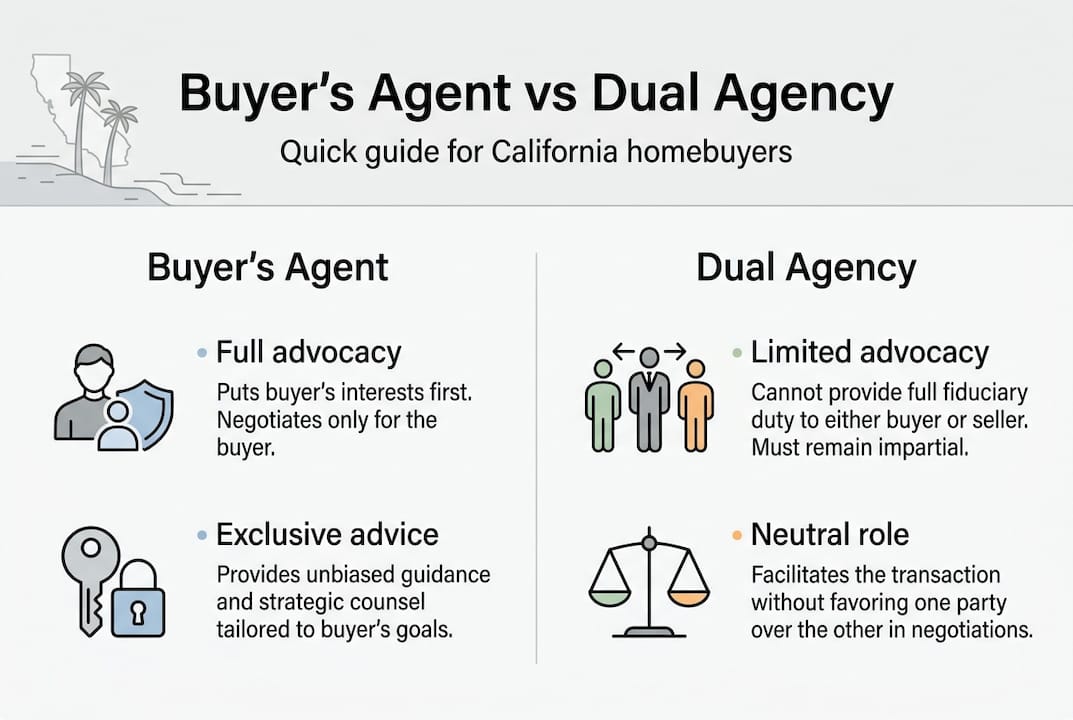
| Agency Type | Fiduciary Duty | Negotiation Advocacy | Confidentiality | Best For |
|---|---|---|---|---|
| Dedicated Buyer's Agent | Full duty to buyer | Aggressive buyer advocacy | Full confidentiality | Most buyers seeking maximum representation |
| Dual Agency | Limited neutral duty | Must remain neutral | Cannot share confidential info | Rare situations with informed consent |
| No Agent | Self-representation | Buyer negotiates directly | No professional guidance | Experienced buyers in simple transactions |
Dual agency is allowed only with disclosure and consent; dual agents cannot fully advocate for buyers or share confidential information from either party. When one agent represents both buyer and seller, they must remain neutral and cannot negotiate aggressively on your behalf. This limitation significantly reduces the value of representation, as your agent cannot advise you on negotiation strategy or share insights about the seller's motivation or flexibility.
Dual agency situations arise when you want to purchase a property your agent also has listed. While legal with proper disclosure, this arrangement creates inherent conflicts of interest. Your agent cannot tell you if the seller would accept a lower price or share that the property has been on market longer than disclosed. For these reasons, most buyers benefit from dedicated representation through the home selling process rather than dual agency arrangements.
Pro Tip: Always request and review a copy of your Buyer Representation Agreement before authorizing your agent to submit any offers. Understanding the terms, fees, and duration prevents surprises and ensures you're comfortable with the arrangement before committing to specific properties.
Pros, cons, and economic impact of working with a buyer's agent
Empirical research reveals significant price differences between agent-assisted and unassisted home sales. Agent-assisted homes sell for higher median prices than FSBO homes; buyer agents earn about $38 billion in excess profits annually according to Federal Reserve analysis. The median agent-assisted sale price reaches approximately $425,000 compared to $360,000 for FSBO transactions, though this gap reflects both agent value and selection bias toward higher-value properties using agents.
Commission structures directly impact market dynamics and seller behavior. Lower-commission homes take 33% longer to sell; switching to cost-based commissions could boost economic welfare by reducing friction in the housing market. Properties offering below-market buyer agent compensation experience fewer showings and longer marketing periods, as some agents steer clients toward listings with higher commission rates. This steering behavior, while problematic, reflects economic incentives built into traditional commission models.
| Metric | High Commission (3%) | Low Commission (2%) | FSBO |
|---|---|---|---|
| Median Sale Price | $430,000 | $415,000 | $360,000 |
| Average Days on Market | 28 | 37 | 45 |
| Buyer Agent Showings | 12 | 8 | 3 |
Working with a buyer's agent offers several advantages:
- Saves time by pre-screening properties and scheduling coordinated showings
- Improves negotiation outcomes through market knowledge and comparable sales analysis
- Provides access to off-market listings and agent networks
- Handles complex paperwork and coordinates multiple service providers
- Offers objective advice on property condition and value
However, buyer representation also carries potential downsides:
- Commission costs increase overall transaction expenses
- Risk of agent steering toward higher-commission listings
- Possible conflicts of interest in dual agency situations
- Variable agent quality and experience levels
- Contractual obligations limiting flexibility to switch agents
Economic researchers suggest that commission reform could benefit consumers:
Transitioning from percentage-based to cost-based compensation structures could generate substantial welfare gains by reducing steering behavior and aligning agent incentives with client interests rather than transaction size.
Understanding these dynamics helps you make informed decisions about representation. A home price advantages analysis shows how professional representation typically delivers value despite commission costs, particularly in competitive Southern California markets where negotiation expertise and market access justify the investment.
How to effectively work with a buyer's agent in Southern California
Engaging a buyer's agent effectively requires following a structured process that maximizes the relationship's value. Buyer agency process includes signing BRA early with negotiated fees, agent manages MLS access, showings, offers, inspections, and escrow through closing. Begin by interviewing multiple agents to assess their experience in your target neighborhoods, understanding of your buyer type (first-time or investor), and communication style.
Follow these steps to work successfully with your buyer's agent:
-
Interview and select your agent: Research agents specializing in your target areas, review their recent sales, and interview at least three candidates. Ask about their experience with buyers like you, average days to close, and how they handle multiple-offer situations.
-
Sign your Buyer Representation Agreement: Review all terms carefully, negotiate fees upfront, and clarify the agreement duration and termination provisions. Ensure you understand whether you're paying your agent directly or if compensation comes from seller concessions.
-
Define your criteria clearly: Provide detailed specifications including must-haves, nice-to-haves, and absolute deal-breakers. Share your budget, preferred neighborhoods, property type, and timeline to enable efficient searching.
-
Schedule showings and evaluate properties: Attend showings prepared with questions, take notes and photos, and provide honest feedback to your agent after each property. This helps refine the search and ensures subsequent showings better match your preferences.
-
Draft and submit offers strategically: Work with your agent to analyze comparable sales, determine competitive offer prices, and structure contingencies appropriately. Your agent will submit offers, communicate with listing agents, and negotiate terms on your behalf.
-
Coordinate inspections and due diligence: Once in contract, your agent schedules inspections, reviews reports with you, and negotiates repairs or credits with the seller. They track all contingency deadlines and ensure you meet contractual obligations.
-
Navigate escrow and closing: Your agent coordinates with escrow officers, reviews closing documents, and attends the final walkthrough. They ensure all agreed-upon repairs are completed and the property matches your expectations before closing.
Southern California has specific regional customs affecting transactions. Escrow fees are typically split equally between buyer and seller, while sellers usually pay for the owner's title insurance policy. Understanding these local conventions helps you budget accurately and recognize when terms deviate from standard practice.
Explore current home listings in your target areas to familiarize yourself with available inventory, pricing trends, and property features. This market knowledge makes you a more informed buyer and enables more productive conversations with your agent about value and opportunity.
Pro Tip: Negotiate commission fees upfront during the Buyer Representation Agreement signing rather than waiting until you've found a property. This prevents awkward conversations later and ensures both parties understand compensation expectations from the start.
Explore Southern California homes with expert buyer representation
Now that you understand how buyer's agents guide homebuyers through Southern California's complex market, it's time to explore available properties with professional support. Access a wide range of homes for sale including single family homes and condos in Southern California tailored to first-time buyers and investors alike.

Our experienced team provides personalized buyer agent support customized to your specific goals, whether you're purchasing your first home or expanding an investment portfolio. We guide you through every step from initial property search through final closing, leveraging deep knowledge of Los Angeles and Orange County markets. Connect with us today to begin your buying journey with expert representation and insider market insights that give you a competitive advantage in Southern California real estate.
Frequently asked questions
What is a buyer's agent and how do they differ from a listing agent?
A buyer's agent exclusively represents the buyer's interests throughout the home purchase process, while a listing agent represents the seller. Buyer's agents focus on finding suitable properties, negotiating favorable terms, and protecting buyer interests during due diligence. Listing agents market the property, screen potential buyers, and negotiate on the seller's behalf to maximize sale price and favorable terms. These distinct roles create a system where each party has dedicated representation advocating for their specific interests.
Do I have to pay my buyer's agent in California?
Payment depends on terms negotiated in your Buyer Representation Agreement, which must specify compensation structure and amount. Buyer Representation Agreements specify fees; it can be negotiated who pays; sellers no longer must pay buyer agent commission under 2025 California law. You may pay your agent directly, negotiate seller concessions to cover the fee as part of your purchase offer, or structure a combination approach. All fees are fully negotiable, so discuss options upfront before signing the agreement.
What are the risks of dual agency for buyers?
Dual agency significantly limits the fiduciary duty your agent owes you because they must remain neutral between buyer and seller. Dual agents must remain neutral, cannot share confidential information, or negotiate assertively for either side, reducing the value of representation. Your agent cannot advise you on negotiation strategy, share insights about seller motivation, or tell you if the seller would accept a lower price. For maximum advocacy and protection, most buyers benefit from dedicated buyer representation rather than dual agency arrangements.
How long does a Buyer Representation Agreement last in California?
California law limits Buyer Representation Agreements for individuals to a maximum of 3 months to protect consumers from extended commitments. The agreement specifies the exact duration, termination terms, and whether it automatically renews or expires. You can negotiate a shorter period if preferred, and many agreements include provisions for early termination under specific circumstances. Always review the duration and termination clauses carefully before signing to ensure you're comfortable with the commitment length.