

TL;DR:
- High property values in SoCal don't guarantee high ROI due to market nuances.
- Specialized ROI metrics like Cap Rate and Cash-on-Cash are essential for accurate analysis.
- Long-term appreciation often outweighs current yields, influencing investment strategies.
High property values in Los Angeles and Orange County don't automatically mean high returns. Many investors assume that buying in a premium market guarantees strong ROI, but the reality is more nuanced. The way you measure return on investment (ROI) can make or break your property strategy. Using the wrong formula leads to overconfidence, poor acquisitions, and missed opportunities. ROI for rental properties goes beyond the basic net profit divided by total investment calculation, requiring specialized metrics like Cap Rate, Cash-on-Cash Return, and total return including appreciation. This guide covers the exact metrics, calculation steps, and market-specific factors you need to make smarter investment decisions across SoCal's residential market.
Table of Contents
- What is real estate ROI and why it matters
- ROI metrics for rental properties: Cap Rate, Cash-on-Cash, and more
- How to calculate and interpret ROI for SoCal residential properties
- What impacts ROI in Los Angeles and Orange County
- Common mistakes SoCal investors make with ROI (and how to avoid them))
- Get expert help maximizing your SoCal real estate ROI
- Frequently asked questions
Key Takeaways
| Point | Details |
|---|---|
| ROI means real profit | Real estate ROI reveals how much you truly earn on each dollar invested, not just property price gains. |
| Special SoCal metrics | Cap Rate and Cash-on-Cash Return work best for LA and OC rentals, where appreciation is a key factor. |
| Apply step-by-step math | Walk through actual ROI calculations for better investment decisions in the Southern California market. |
| Know what impacts returns | Market trends, property type, and local expenses all shape SoCal ROI outcomes—plan for each. |
| Avoid common ROI errors | Many investors miscalculate ROI; choosing the right formula and inputs leads to better results. |
What is real estate ROI and why it matters
ROI, or Return on Investment, tells you how efficiently your capital is working in a given property. In real estate, it answers one question: for every dollar you put in, how many cents come back as profit? That sounds simple, but the inputs and context change dramatically depending on your property type, financing structure, and investment timeline.
The core ROI formula is straightforward: (Net Profit / Total Investment) x 100. For a quick example, imagine you purchase a single-family home in Anaheim for $750,000. You put down $150,000, spend $15,000 on closing costs and repairs, and after one year of renting, you net $18,000 in profit after all expenses. Your basic ROI would be ($18,000 / $165,000) x 100, which equals roughly 10.9%. That number gives you a starting point, but it doesn't tell the whole story.
ROI is fundamentally different from cash flow and appreciation. Cash flow is simply what's left after you pay all monthly expenses from rental income. Appreciation is the increase in your property's market value over time. ROI bundles these elements together into a percentage that lets you compare one investment against another on equal footing.
Here's why ROI matters more than just watching your bank account:
- It lets you compare a rental condo in Irvine against a duplex in Long Beach on the same scale
- It reveals whether leverage (using a mortgage) is amplifying or shrinking your returns
- It forces you to account for ALL costs, not just the ones that feel obvious
- It gives lenders and partners a clear picture of your investment's performance
- It helps you decide when to sell versus hold based on changing market dynamics
SoCal's high-value market creates a unique risk and reward profile. Property prices in Los Angeles County and Orange County regularly exceed $900,000 for median single-family homes. That means your total capital invested is enormous, which can suppress ROI percentages even when absolute dollar returns look solid. A 4% ROI on a $1 million property generates $40,000 in net profit, which many investors in the Midwest would need a much cheaper property to match in real dollars.
For tips for SoCal real estate ROI that match the scale of these markets, you need to factor in appreciation potential heavily. Ignoring that side of the equation leads investors to reject perfectly solid SoCal deals because they benchmark only against markets where cash yields are higher but growth is slower. Checking out top SoCal investment locations before you commit to any property can save you from comparing the wrong neighborhoods.
| Metric | What it measures | Best used for |
|---|---|---|
| Basic ROI | Net profit vs. total investment | Quick comparisons |
| Cash flow | Monthly income minus expenses | Liquidity check |
| Appreciation | Value growth over time | Long-term planning |
| Total return | Combined yield and growth | Full picture analysis |
ROI metrics for rental properties: Cap Rate, Cash-on-Cash, and more
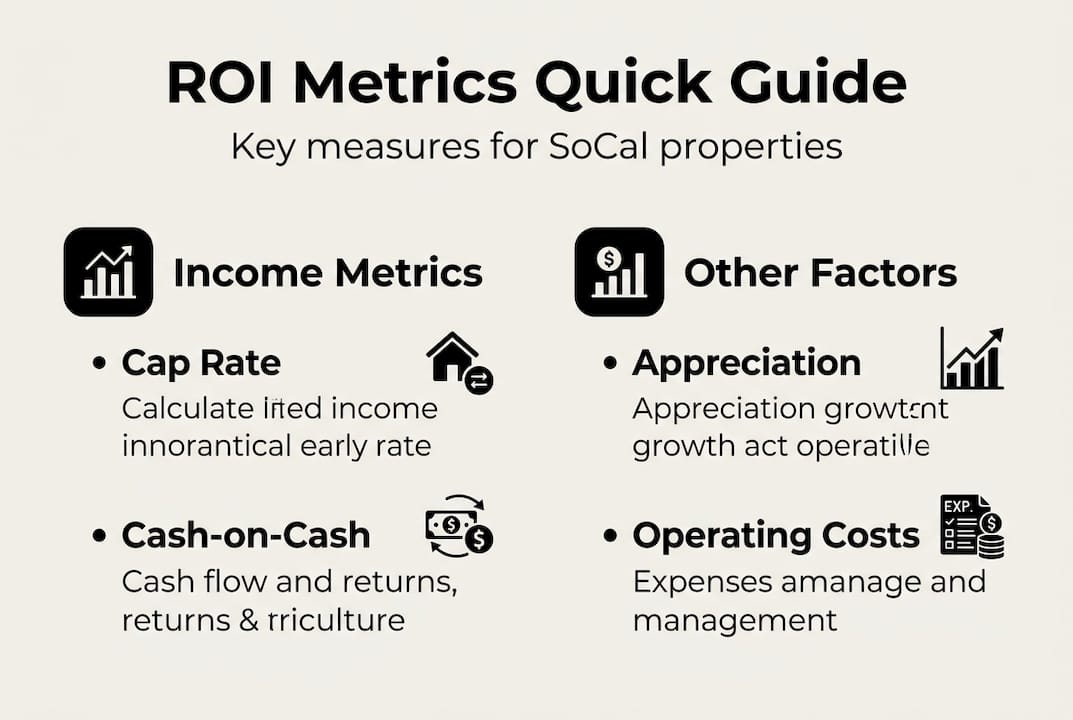
Once you move past the basic ROI formula, four specialized metrics become your real working tools as a SoCal investor. Each one answers a different question about your property's performance.
Cap Rate (Capitalization Rate) measures a property's return assuming you paid all cash with no mortgage. The formula is: Net Operating Income (NOI) / Property Value x 100. For example, a property in Torrance generating $36,000 in annual NOI and priced at $800,000 has a Cap Rate of 4.5%. This metric is unlevered, meaning Cap Rate excludes debt, making it ideal for comparing properties regardless of how they are financed.
Cash-on-Cash Return measures the cash income earned against the actual cash you invested, including your down payment and closing costs. The formula is: Annual Cash Flow / Total Cash Invested x 100. If you put $180,000 into a property and receive $10,800 in net annual cash flow, your Cash-on-Cash Return is 6%. Nationally, targets of 8-12% are common benchmarks, but in high-appreciation markets like Los Angeles and Orange County, 3-6% is widely accepted because property values tend to rise significantly over time.
Out-of-Pocket ROI is a variation that uses only your equity invested, useful when you've refinanced or pulled equity. Total Return combines all sources: cash flow, appreciation, and loan paydown, giving you the most complete performance picture over a multi-year hold.
Here's how to apply each one step by step:
- Gather your annual gross rental income
- Subtract all operating expenses (taxes, insurance, maintenance, management fees, vacancy allowance)
- The result is your NOI, used to calculate Cap Rate
- Subtract your annual mortgage payment from NOI to get annual cash flow
- Divide annual cash flow by total cash invested to get Cash-on-Cash Return
- Add estimated appreciation to annual cash flow, then divide by total cash invested for Total Return
| Metric | Formula | Includes debt? | Best for |
|---|---|---|---|
| Cap Rate | NOI / Property Value x 100 | No | Property comparison |
| Cash-on-Cash | Annual Cash Flow / Cash Invested x 100 | Yes | Leveraged returns |
| Basic ROI | Net Profit / Total Investment x 100 | Depends | Simple analysis |
| Total Return | (Cash Flow + Appreciation) / Cash Invested x 100 | Yes | Long-term strategy |
Why do target returns trend lower in SoCal? Because SoCal real estate market trends show that price appreciation here routinely outpaces markets in the Sun Belt or Midwest. Investors accept a thinner annual yield in exchange for larger equity gains. That trade-off is real and historically supported, though it requires patience and adequate reserves.
Pro Tip: Match your ROI metric to your strategy. If you're using a mortgage, Cash-on-Cash is your primary lens. If you're buying all-cash or comparing markets, use Cap Rate. If you're evaluating whether to hold for five-plus years, calculate Total Return. Mixing metrics without awareness can make a weak deal look strong and vice versa. For alternative structures, learning about real estate crowdfunding can also give you perspective on how professional platforms benchmark returns.
How to calculate and interpret ROI for SoCal residential properties
Let's walk through a realistic example using a two-bedroom condo in Irvine, Orange County. This is where theory becomes actionable.
Sample property details:
- Purchase price: $680,000
- Down payment (20%): $136,000
- Closing costs: $12,000
- Initial repairs and updates: $8,000
- Total cash invested: $156,000
Here's the step-by-step calculation process:
- Calculate annual gross rent: $2,900/month x 12 = $34,800
- Estimate vacancy (5%): $34,800 x 0.95 = $33,060 effective gross income
- List all annual operating expenses: Property taxes ($8,500), insurance ($1,800), HOA fees ($4,200), maintenance ($2,000), property management (8% of rent = $2,645)
- Total expenses: $19,145
- Net Operating Income (NOI): $33,060 minus $19,145 = $13,915
- Annual mortgage payment (544,000 at 6.8%, 30 yr): approximately $42,600
- Annual cash flow: $13,915 minus $42,600 = negative $28,685 (negative leverage scenario)
- Cap Rate: $13,915 / $680,000 x 100 = 2.05%
That Cap Rate looks low. But here's the interpretation: the property isn't generating strong current income, which is common in high-cost SoCal condos. The bet here is on appreciation. If this Irvine condo gains 5% annually, that's $34,000 in equity growth per year. Add loan paydown of approximately $7,000 in year one, and your total return picture changes significantly.
Real estate ROI for rentals requires these additional layers of analysis to avoid misreading a deal as a loser when it's actually a long-term winner.
Common calculation pitfalls to avoid:
| Missed input | Impact on ROI |
|---|---|
| Closing costs excluded | Overstates returns by 5-10% |
| HOA fees omitted | Misses $200-600/month expense |
| Vacancy not modeled | Inflates gross income projections |
| Maintenance underestimated | Skews net cash flow positively |
| Tax benefits ignored | Understates true return |
Pro Tip: Always benchmark your calculated ROI against neighborhood averages before making a decision. A 2% Cap Rate looks weak in isolation, but if comparable properties in the same Irvine zip code average 1.8%, your deal is actually above market. Off-market property deals often carry better cap rates simply because competition is lower. Use the LA & OC investment tips available to get neighborhood-level data before you finalize any numbers. For a personalized read on your specific property's value, a SoCal property evaluation gives you a grounded starting point.
What impacts ROI in Los Angeles and Orange County
Calculating ROI is vital, but equally important is understanding the factors that can change your return in this market. SoCal is not a monolithic market. A rental in Santa Ana performs very differently than one in Beverly Hills, even if they carry similar price tags.
Here are the core factors that shape ROI across LA and OC:
- Property type: Single-family homes tend to appreciate faster but have higher price-to-rent ratios. Condos offer lower entry costs but come with HOA fees. Multi-family properties often generate stronger cash flow but require more active management.
- Rent growth: Orange County has seen consistent rent increases in recent years, supporting stronger Cash-on-Cash returns over time for properties bought at the right basis.
- Rent control: Los Angeles city and county rent control ordinances cap annual rent increases for qualifying units, directly limiting your income growth and therefore your ROI ceiling. Knowing whether your target property falls under AB 1482 (California's statewide rent cap) is essential before buying.
- Maintenance and capital expenditure: Older properties in neighborhoods like Inglewood or Whittier may carry deferred maintenance that eats into returns far more than investors model upfront.
- Property taxes: California's Proposition 13 protects existing owners, but when you buy, your assessment resets to purchase price. On an $800,000 property, that means roughly $8,000-10,000 per year in property taxes alone.
As noted in recent market analysis, a 3-6% Cash-on-Cash return is acceptable in high-appreciation markets like SoCal, because total return over a five-to-ten year hold can dramatically outperform markets with higher current yields.
"In Southern California, chasing high cash-on-cash returns alone will price you out of the best-appreciating neighborhoods. The smart play is modeling total return across a realistic hold period, not just what the property earns in year one."
The appreciation versus cash flow trade-off is real and regionally specific. In cities like Cleveland or Memphis, investors target 8-12% Cash-on-Cash with minimal appreciation. In SoCal, you often accept 2-4% current yield in exchange for 4-7% annual appreciation, which can compound dramatically. Exploring prime investment areas helps you find which micro-markets are currently delivering the best balance of both.

Common mistakes SoCal investors make with ROI (and how to avoid them)
After seeing dozens of deals play out across LA and Orange County, certain patterns in investor missteps show up repeatedly. The most common mistake is using the wrong metric for the situation. An investor comparing a leveraged rental against a cash-purchased property using Cap Rate is comparing completely different risk profiles as if they're identical. That mismatch leads to bad decisions every time.
The second big error is underestimating holding and operating costs. SoCal properties carry high transaction costs on both entry and exit. Agent commissions, title fees, and transfer taxes on an $800,000 property can easily exceed $50,000. If you're not modeling those into your total investment figure, your ROI calculation is inflated from the start. Similarly, investors routinely underestimate maintenance and capital expenditure, assuming modern properties need little upkeep. Reality hits differently after your first major repair.
Overvaluing appreciation potential is another trap. Appreciation in SoCal has been strong historically, but it is not guaranteed. Banking on 6-8% annual growth without stress-testing your numbers against a flat or declining market is wishful thinking. The investors who consistently outperform are those who model conservative appreciation scenarios.
Pro Tip: Always compare apples to apples when benchmarking ROI. Don't mix Cash-on-Cash with Cap Rate in the same comparison. Define your benchmark clearly, stick to it, and adjust only your inputs. Reviewing LA & OC investment advice from professionals familiar with local nuances can sharpen your benchmarking process considerably. Adjusting your expectations to fit SoCal market realities, rather than fighting them, is what separates long-term winners from frustrated investors who exit too early.
Get expert help maximizing your SoCal real estate ROI
Moving from understanding ROI concepts to applying them confidently in a live deal requires the right tools and the right guidance. Southern California's residential market rewards investors who act on accurate data, not assumptions.

Start with a free property evaluation to get a grounded sense of what a target property is actually worth in today's market. From there, pull the latest market snapshot to see how current conditions in LA and OC are affecting pricing, rent trends, and investment performance. When you're ready to act on what you've learned, browsing current homes for sale gives you a live look at available opportunities. Irvin Nierras and the IN Realtors team specialize in helping Southern California investors find, evaluate, and close on residential properties that align with real ROI targets, not wishful projections.
Frequently asked questions
What is the typical ROI on rental property in Los Angeles?
Typical cash-on-cash ROI for LA rentals ranges from 3-6%, reflecting both the high property values and the strong long-term appreciation potential that offsets lower current yields.
Which ROI metric should I prioritize for my SoCal property?
Use Cash-on-Cash return for leveraged rentals, Cap Rate for unlevered or cash purchases, and always compare against neighborhood averages. Mixing Cap Rate with Cash-on-Cash without accounting for debt distorts your analysis and can lead to poor comparisons.
How does SoCal appreciation impact ROI calculations?
Appreciation makes lower annual ROI acceptable because total return over a five-to-ten year hold can be significantly higher. A 3-6% cash-on-cash return paired with 4-6% annual appreciation creates a total return that competes favorably with higher-yield markets that offer little growth.