

Picking a profitable property in Los Angeles or Orange County is not like investing anywhere else in the country. Prices are high, competition is fierce, and the wrong move can cost you years of capital growth. But the investors who win here are not necessarily the ones with the most money. They are the ones with the clearest strategy. This guide walks you through the exact criteria, property comparisons, and financial metrics you need to make smart, evidence-backed decisions in two of California's most dynamic real estate markets.
Table of Contents
- Define your investment criteria: What matters most in LA & OC
- Evaluate property types: Multifamily vs. single-family vs. condos
- Analyze financial metrics: Cap rates, cash flow, and appreciation
- Make smart decisions in a tight market
- The hidden edge: What most new investors overlook in LA and OC
- Ready to invest? Get local expert guidance
- Frequently asked questions
Key Takeaways
| Point | Details |
|---|---|
| Set clear investment criteria | Define your budget, property type, and risk tolerance before searching in LA or OC. |
| Compare local property types | Evaluate multifamily, single-family, and condos based on vacancy, rents, and accessibility. |
| Use objective financial metrics | Rely on cap rates and cash flow to compare properties and reduce decision bias. |
| Be proactive in a tight market | Network, move quickly, and seek value-add deals to secure the best investments. |
Define your investment criteria: What matters most in LA & OC
Before you browse a single listing, you need a clear picture of what you are actually trying to achieve. That sounds obvious, but most first-time investors skip this step and end up chasing properties that look good on paper but do not fit their actual goals. Start by asking yourself three foundational questions: How much capital can I deploy? What is my target holding period? And how much monthly cash flow do I need to cover costs and generate profit?
In LA and OC, these questions carry extra weight because entry prices are significantly higher than the national average. A budget that would buy a solid multifamily building in the Midwest might only get you a small condo here. That is not a reason to walk away. It is a reason to be precise.
Here are the core criteria to lock in before you start shopping:
- Budget and financing: Know your maximum purchase price and have pre-approval ready. Sellers in this market move fast.
- Property type preference: Multifamily, single-family, or condo? Each has different risk and return profiles.
- Timeline: Are you looking for short-term cash flow or long-term appreciation? Your answer shapes everything.
- Risk tolerance: Can you handle a vacancy period, or do you need consistent rental income from day one?
- Target neighborhoods: Focus on areas with job growth, transit access, and upcoming infrastructure projects.
One factor that catches many new investors off guard is how quickly inventory moves. The Orange County housing supply sits at just 2.6 to 3.5 months, which firmly favors sellers in desirable areas. That means you cannot afford to spend weeks deliberating once a good property appears. Browsing homes for sale regularly and reviewing condo listings will help you develop a feel for pricing before you need to act fast.
Pro Tip: Research neighborhoods with approved development projects or transit expansions nearby. Properties near future infrastructure often appreciate faster than the surrounding market, giving you a built-in advantage on resale.
Evaluate property types: Multifamily vs. single-family vs. condos
Once your criteria are clear, the next step is matching them to the right property type. Each option in LA and OC comes with its own set of trade-offs, and the best choice depends entirely on your goals, not on what is trending.
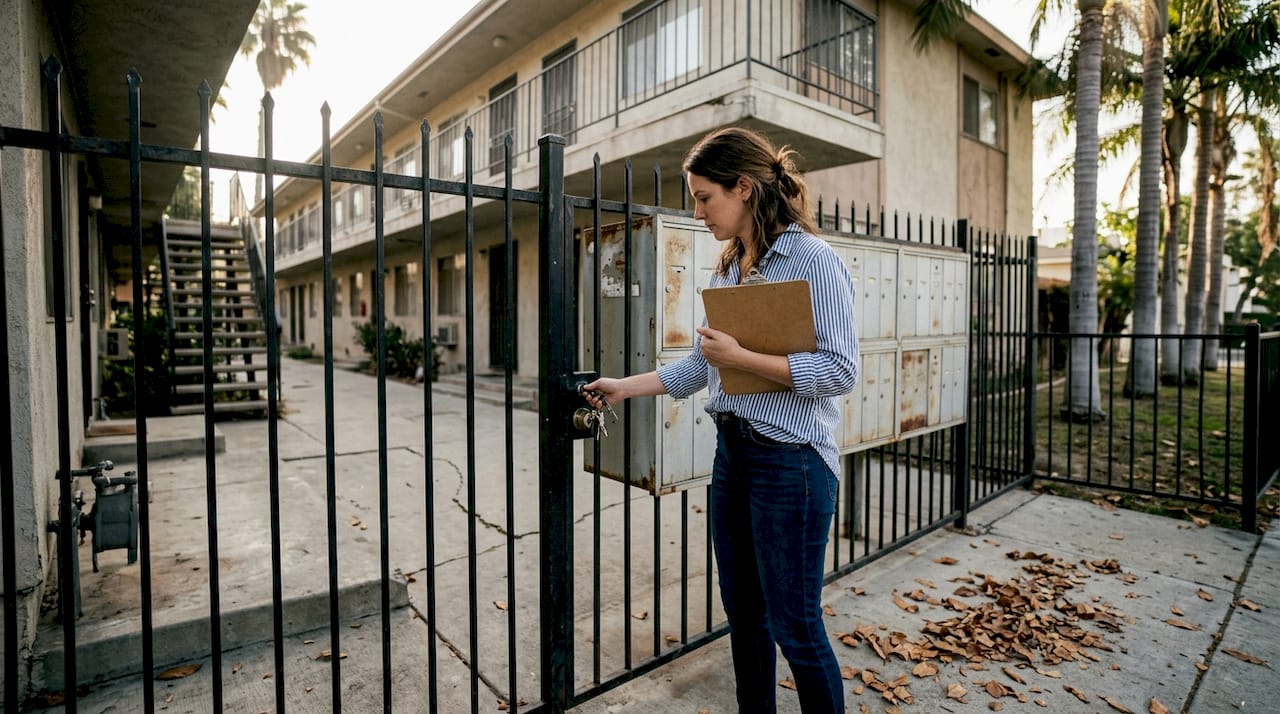
Multifamily properties are the go-to choice for investors focused on income. Multiple units mean multiple rent checks, which reduces the financial hit of a single vacancy. According to the multifamily strategy guide, vacancy rates sit at 3.6 to 3.8% across OC and LA, with average rents reaching $2,702 per unit in Orange County during Q4 2025. That is a compelling income story. You can explore multi-family listings to see what is currently available in your target range.
Single-family homes offer something different: stable, long-term appreciation in neighborhoods where demand consistently outpaces supply. They are easier to manage, attract longer-term tenants, and tend to hold value well through market cycles. The trade-off is that one vacancy means zero rental income. Browse single-family homes to compare pricing across LA and OC submarkets.
Condos are often the most accessible entry point for new investors. Lower purchase prices and shared maintenance responsibilities make them attractive, but HOA fees can erode cash flow significantly. Always factor in monthly dues before running your numbers. Check available condos to understand current price points.
Here is a quick comparison to put these options side by side:
| Property type | Avg. vacancy | Income potential | Entry accessibility | Management complexity |
|---|---|---|---|---|
| Multifamily | 3.6 to 3.8% | High | Moderate to high cost | Higher |
| Single-family | Low | Moderate | Moderate cost | Lower |
| Condo | Very low | Moderate | Lower cost | Low (HOA handles exterior) |
Pro Tip: Look for Class B or C multifamily buildings in workforce housing areas. These properties often need cosmetic upgrades, but the renovation investment can unlock meaningfully higher rents and yields.
Analyze financial metrics: Cap rates, cash flow, and appreciation
Knowing what type of property you want is only half the equation. The other half is understanding the numbers that determine whether a deal actually works. Three metrics matter most: cap rate, cash flow, and appreciation potential.
Cap rate (capitalization rate) measures a property's annual income relative to its purchase price. A higher cap rate generally means more income per dollar invested, but it can also signal higher risk. In Southern California, cap rates vary significantly by asset class. Current cap rate data shows OC Class A at 4.2 to 4.8%, Class B/C at 5.5 to 7.0%, and LA Class A at 4.7 to 5.2%. That gap between Class A and Class B/C is where value-add strategies become attractive.
| Market segment | Cap rate range | Risk level | Best for |
|---|---|---|---|
| OC Class A multifamily | 4.2 to 4.8% | Lower | Stable income seekers |
| OC Class B/C multifamily | 5.5 to 7.0% | Moderate | Value-add investors |
| LA Class A multifamily | 4.7 to 5.2% | Lower to moderate | Growth-focused investors |
Cash flow is what remains after all expenses, including mortgage, taxes, insurance, maintenance, and vacancy reserves. In high-price markets like LA and OC, positive cash flow is harder to achieve but not impossible. Multifamily properties with strong occupancy rates tend to perform best here.
Appreciation is where Southern California has historically shined. Long-term price growth in desirable LA and OC neighborhoods has consistently outpaced most U.S. markets. Even properties with modest cash flow can deliver strong total returns when appreciation is factored in.
Workforce housing renovations on Class B/C buildings can generate 100 to 200 basis points higher yields compared to stabilized Class A assets, making value-add a compelling strategy in this market.
Use the market snapshot to track current pricing trends by neighborhood before you commit to a property. Running your numbers against real-time data is non-negotiable in a market this competitive.
Make smart decisions in a tight market
Mastering the metrics is essential, but in LA and OC, execution matters just as much as analysis. Knowing a deal is good and actually securing it are two very different things. Here is how to sharpen your tactics.
With inventory at just 2.6 to 3.5 months in Orange County, sellers hold the advantage in most desirable neighborhoods. Buyers who hesitate lose.
Follow these steps to act decisively without cutting corners:
- Get pre-approved before you search. In this market, a verbal commitment from a lender is not enough. Have your full pre-approval letter ready so you can submit a clean offer immediately.
- Build relationships with local agents. Many of the best deals never hit the public market. Agents with deep local networks often know about properties before they are listed.
- Set your walk-away price in advance. Decide your maximum bid before you tour a property, not during the emotional heat of a bidding war.
- Target value-add opportunities. As the multifamily strategy guide confirms, Class B/C renovations can yield 100 to 200 basis points more than stabilized assets, making them worth the extra effort.
- Monitor the market daily. Use the latest market snapshot to track inventory shifts and pricing movements in your target neighborhoods.
Speed and preparation are your biggest competitive advantages. Investors who show up with clean financing, clear criteria, and a pre-set offer strategy consistently outperform those who are still figuring things out mid-process. Check current market trends regularly so you always know where the market stands.
The hidden edge: What most new investors overlook in LA and OC
Here is something most investment guides will not tell you: the best deals in LA and OC rarely come from scrolling listings. They come from relationships. The investors who consistently find properties at favorable prices are not smarter or richer than everyone else. They are better connected.
Off-market deals happen when a seller trusts someone enough to skip the public listing process. That trust is built over time through consistent communication, professional reputation, and genuine community involvement. Most new investors focus entirely on finding the right property. The experienced ones focus on finding the right people first.
This is where local expertise becomes a genuine competitive advantage, not just a marketing phrase. An agent who has spent years building relationships in specific LA or OC neighborhoods can surface opportunities that never appear on any platform. That kind of access is worth more than any algorithm.
The uncomfortable truth is that patience and relationship-building are the highest-return activities for a new investor in this market. The deals that look obvious to everyone are usually already overpriced by the time you see them.
Ready to invest? Get local expert guidance
Putting these strategies into practice is far easier with someone who knows the LA and OC markets from the inside out.

Whether you are searching for single-family homes in established neighborhoods or evaluating available condos as an entry-level investment, Irvin Nierras and the team at INC Realtors bring the local knowledge and network you need to move with confidence. Start by reviewing the free market snapshot to understand current pricing, inventory levels, and neighborhood trends across Southern California. Then reach out to get personalized guidance tailored to your investment goals and budget.
Frequently asked questions
What is the average rent for multifamily properties in Orange County in 2026?
In late 2025, average OC multifamily rent reached approximately $2,702 per unit, reflecting strong rental demand across the county.
Why are cap rates important for real estate investors?
Cap rates let you compare income potential relative to purchase price across different properties. In OC, Class A cap rates currently range from 4.2 to 4.8%, giving investors a clear benchmark for evaluating deals.
What makes the Southern California market so competitive?
Low inventory and persistent rental demand create a seller-favored environment where well-priced properties move fast. With OC supply at 2.6 to 3.5 months, buyers have little room to delay.
Are value-add strategies effective for multifamily investing in LA and OC?
Yes. Upgrading Class B or C buildings can generate 100 to 200 basis points more yield than stabilized Class A assets, making renovations a smart play in workforce housing submarkets.