

TL;DR:
- Off-market properties are privately sold homes not listed on public MLS platforms, offering exclusivity.
- Buyers need strong agent relationships and pre-approval to access and succeed in off-market deals.
- These transactions carry risks like limited disclosures, but they can provide faster closings and less competition.
Most buyers assume every home for sale in Los Angeles or Orange County shows up on Zillow or Redfin. That assumption costs them deals. A growing share of residential transactions in Southern California happen entirely outside public listings, moving through private agent networks, quiet referrals, and direct seller outreach before most buyers even know a property exists. These are off-market properties, and understanding how they work could be the single biggest competitive edge you gain this year. This guide breaks down exactly what off-market properties are, how California law treats them, and the practical steps you can take to access them before the crowd.
Table of Contents
- What is an off-market property?
- Off-market property in California: Laws, risks, and misconceptions
- Off-market vs. FSBO vs. pending off-market: Key differences
- How to find and buy off-market property in Southern California
- Our take: What most buyers miss about off-market properties
- Ready to explore exclusive off-market opportunities?
- Frequently asked questions
Key Takeaways
| Point | Details |
|---|---|
| Off-market defined | Off-market properties are homes for sale that aren't advertised on the public MLS, offering privacy and exclusivity. |
| California regulations | Buying and selling off-market in California is legal with written seller consent but carries distinct risks. |
| Not always cheaper | Off-market deals aren't guaranteed discounts—pricing depends on seller motivation and market trends. |
| Finding opportunities | Access relies on strong agent networks, word-of-mouth, and quick, credible offers in Southern California. |
| Due diligence required | Buyers and investors must do their homework on valuation and disclosures since details can be limited. |
What is an off-market property?
An off-market property is a home or real estate asset for sale that is not publicly listed on the Multiple Listing Service (MLS) or major real estate websites. You may also hear these called pocket listings or quiet sales. The seller, often working with a trusted agent, markets the property privately through agent networks, word-of-mouth, or direct outreach to qualified buyers.
The appeal is simple: exclusivity. Sellers get privacy and control. Buyers get access to properties before competition arrives. For investors in LA and Orange County, that head start can mean the difference between securing a deal and watching it go to someone else.
Off-market homes are not a niche phenomenon. In highly competitive markets, they can account for a significant portion of investor transactions, particularly in neighborhoods where inventory is tight and demand is fierce. Understanding the MLS guide for SoCal buyers helps you see just how much of the market you could be missing if you only search public portals.
Here is a quick comparison of how MLS-listed and off-market properties differ:
| Feature | MLS-listed property | Off-market property |
|---|---|---|
| Public visibility | High | Low to none |
| Competition level | High | Low |
| Price transparency | Strong | Varies |
| Speed to close | Standard | Often faster |
| Access method | Public portals, agents | Agent networks, referrals |
| Disclosure requirements | Standardized | Requires extra diligence |
Off-market deals are typically sourced through:
- Agent-to-agent networks: Agents share opportunities with trusted colleagues before listing publicly
- Word-of-mouth: Sellers quietly test buyer interest through community connections
- Direct outreach: Investors send letters or make calls to homeowners in target neighborhoods
- Wholesalers: Middlemen who contract properties and assign them to end buyers
Knowing how MLS shapes the market in Southern California gives you the context to appreciate why stepping outside it can be so powerful. And if you want a broader view of your options, reviewing the full range of real estate listing types in SoCal is a smart starting point.
Off-market property in California: Laws, risks, and misconceptions
California allows off-market sales, but the rules matter. A seller can legally exclude their property from the MLS with written seller consent under the NAR Clear Cooperation Policy. That policy requires agents who are MLS members to submit a listing within one business day of marketing it publicly. A seller who signs a written exclusion can bypass that requirement and keep the sale private.

That said, legal does not mean risk-free. There are real pitfalls buyers and sellers need to understand before pursuing this path.
Key risks in off-market transactions:
- Limited exposure: Without MLS visibility, sellers may receive fewer offers, which can result in a lower final sale price
- Fiduciary concerns: Dual agency situations, where one agent represents both buyer and seller, raise conflict-of-interest questions
- Disclosure failures: Off-market deals sometimes skip standard disclosure steps, leaving buyers exposed to undisclosed property issues
- Valuation gaps: Without public comps generated by a listed sale, pricing can be harder to verify
One of the biggest misconceptions is that off-market automatically means discounted. It does not. Pricing depends entirely on seller motivation. A seller who wants privacy or speed may price at or above market. An off-market vs FSBO comparison shows these motivations clearly differ by transaction type.
"Off-market is not inherently cheaper but offers flexibility. In California, ensure your agent has errors and omissions insurance and prioritize pre-approval for quick offers." Garmo Law
Pro Tip: Before making any off-market offer, request recent comparable sales (comps) in the same neighborhood and have your financing pre-approved. Sellers in private deals move fast, and showing up prepared signals you are a serious buyer.
When you meet with an agent, ask them directly: How do you source off-market listings? Do you have E&O insurance? How do you handle disclosures in private sales? The answers will tell you a lot. Knowing the right questions to ask real estate agents before you start can save you from costly mistakes. And understanding the value of a local agent in a market as nuanced as LA or OC is not something to overlook.
Off-market vs. FSBO vs. pending off-market: Key differences
Not all private sales are the same. Buyers and investors often confuse pocket listings, for sale by owner (FSBO) transactions, and pending off-market deals. Each works differently and carries its own set of risks and responsibilities.
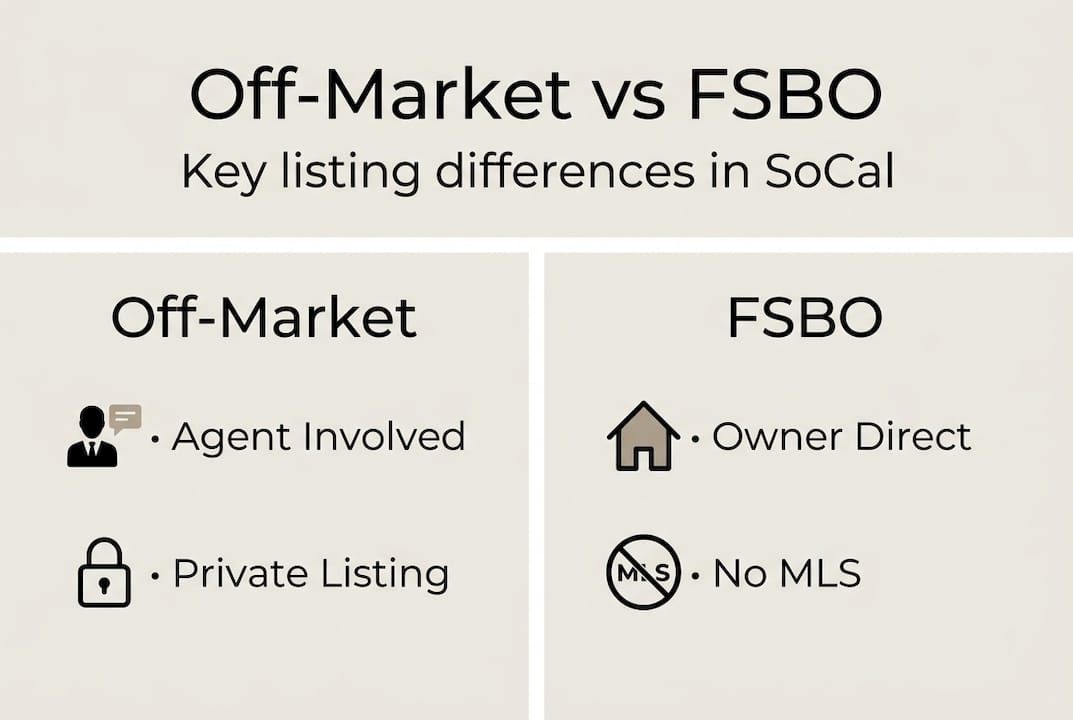
Pocket listings differ from FSBO and pending off-market in important ways. Here is a breakdown:
| Type | Agent involved | MLS listed | Seller controls marketing | Legal complexity |
|---|---|---|---|---|
| Pocket listing | Yes | No | Partially | Moderate |
| FSBO | No | No | Fully | Higher for seller |
| Pending off-market | Sometimes | Was listed | No | Lower |
Definitions you need to know:
- Pocket listing: A property marketed privately by an agent, never publicly listed on the MLS. The seller signs a written exclusion.
- FSBO (for sale by owner): The seller handles the entire transaction without an agent. No MLS listing, no agent commission, but also no professional guidance.
- Pending off-market: A property that was listed on the MLS and went under contract, but the listing was removed before closing. It is no longer actively marketed.
Step-by-step process by type:
- Pocket listing: Seller signs exclusion agreement, agent markets to private network, qualified buyers submit offers, standard escrow and closing process follows
- FSBO: Seller prices and markets the home independently, buyer and seller negotiate directly, both parties manage disclosures and paperwork, escrow is typically handled by a title company
- Pending off-market: Property goes under contract through a standard MLS process, listing is removed, deal closes privately
For buyers, the safest path is usually the pocket listing route because a licensed agent is still involved and professional standards apply. FSBO deals carry the highest risk for buyers because disclosure obligations fall entirely on a seller who may not know what they are legally required to share.
Reviewing the full range of types of listings in Southern California helps you navigate these differences with confidence. If you are weighing FSBO specifically, the SoCal FSBO guide lays out the process and risks in detail.
How to find and buy off-market property in Southern California
Finding off-market deals in LA and Orange County is not about luck. It is about positioning yourself correctly and building the right relationships before you need them.
Step-by-step: How to source off-market opportunities
- Build agent relationships early: Connect with agents who specialize in specific LA or OC neighborhoods. The best off-market deals circulate through tight agent networks, and you want to be on the list.
- Join investor networks: Local real estate investment groups, both in-person and online, are where wholesalers and agents share opportunities before they go public.
- Use direct outreach: If you have a target neighborhood, consider sending direct mail to homeowners expressing interest. This works especially well in areas with aging housing stock.
- Work with wholesalers: Wholesalers contract properties at a discount and assign them to buyers for a fee. They are a fast path to off-market inventory, though due diligence is critical.
- Monitor expired and withdrawn listings: Properties that were listed and pulled can sometimes be approached directly through an agent.
- Stay ready with financing: Pre-approval is not optional in this space. Sellers in private deals want certainty, not contingencies.
Reduced bidding wars, privacy, and faster closes are the real advantages for buyers and investors who access off-market deals. But sellers risk lower prices from limited exposure, and buyers face less transparency on property history. That trade-off is real.
Key advantages for buyers and investors:
- Less competition means stronger negotiating position
- Privacy for both parties throughout the transaction
- Faster timelines when sellers want a quick close
- Potential to secure properties before prices are driven up by bidding wars
Risks to manage:
- Limited property history and fewer public disclosures
- Harder to verify fair market value without active comps
- Potential for inflated pricing if seller motivation is not aligned with speed
Pro Tip: Move fast, but move smart. Have your pre-approval letter ready, know your maximum budget, and work only with agents who have a proven off-market track record in your target area. Checking the current market snapshot for LA and OC before you make an offer will anchor your pricing expectations.
If you are also considering selling property in Los Angeles, understanding the off-market process from the seller's side gives you a more complete picture of how these deals actually come together.
Our take: What most buyers miss about off-market properties
Here is the uncomfortable truth most buyers learn too late: chasing off-market deals because you expect a discount is the wrong strategy. The buyers who consistently win in LA and Orange County off-market transactions are not the ones hunting for bargains. They are the ones who have built credibility with the right agents and show up ready to close.
Off-market success in Southern California comes from access, not aggression. The best pocket listings never reach buyers who cold-call agents or submit lowball offers. They go to buyers who have an established relationship, a clean pre-approval, and a reputation for following through. Sellers in private deals value certainty above almost everything else.
Another thing most buyers miss: off-market does not mean undervalued. In high-demand LA neighborhoods, a pocket listing can actually price at a premium because the seller knows serious buyers will pay for exclusivity and speed. Focusing on working with top listing agents in your target area is far more effective than trying to find deals on your own.
The smartest approach is to treat off-market deals as a relationship game, not a search game. Invest time in building your agent network now, before you need it. When the right property surfaces, you want to be the first call, not the fifth.
Pro Tip: When you find an off-market opportunity, lead with proof of funds or a pre-approval letter and offer flexibility on the closing timeline. That combination closes more deals than price alone.
Ready to explore exclusive off-market opportunities?
If you are serious about finding properties in LA or Orange County before they hit the open market, the most effective step you can take is connecting with an agent who already has those relationships in place.

At increaltors.com, Irvin Nierras works with buyers and investors across Southern California to surface both on-market and off-market opportunities tailored to your goals. Whether you are searching for single-family homes, exploring condos for sale, or want a clear read on where the market stands right now with the latest market snapshot, the resources are here for you. Book a consultation to discuss your target neighborhoods, budget, and timeline. The right deal may already be in the network, waiting for a prepared buyer.
Frequently asked questions
Are off-market properties always cheaper than MLS listings?
No. Off-market pricing depends on seller motivation and market conditions, not the listing method. Some off-market homes price at or above comparable MLS listings.
Is buying an off-market home legal in California?
Yes. California allows off-market sales when the seller provides written consent to exclude the property from the MLS, in compliance with the NAR Clear Cooperation Policy.
What risks do buyers face with off-market properties?
Buyers face less transparency on property history and fewer public disclosures, so thorough due diligence and a qualified agent are essential to protect your investment.
How do buyers find off-market real estate in LA or Orange County?
The most reliable methods are building strong agent relationships, joining local investor networks, and leveraging agent networks and word-of-mouth channels that circulate deals before they ever reach public listings.