

TL;DR:
- Orange County real estate is highly competitive with limited inventory and frequent bidding wars.
- Buyers need thorough financial preparation, including understanding taxes, fees, and loan options.
- Assembling a local expert team enhances chances of success in this fast-moving market.
Buying a home in Orange County feels like entering a race where the rules change every few months and everyone else seems to know a shortcut you don't. Prices are high, inventory is tight, and the moment a desirable listing hits the market, you're competing against dozens of other buyers, many of them cash-heavy investors or seasoned move-up buyers. First-time buyers and out-of-area investors often find themselves overwhelmed before they've even toured a single property. This guide cuts through the noise. You'll get a realistic look at the local market, a clear financial roadmap, guidance on building the right team, and a step-by-step walkthrough of the offer and closing process, all grounded in Orange County's specific rules, fees, and competitive dynamics.
Table of Contents
- Understand the Orange County market landscape
- Get financially prepared: Budgeting and loan options
- Assemble your home buying team
- Navigate the offer, escrow, and closing process
- What most buyers miss about Orange County real estate
- Ready to buy in Orange County? Get expert help
- Frequently asked questions
Key Takeaways
| Point | Details |
|---|---|
| Market fundamentals matter | Understanding Orange County's unique pricing, taxes, and competition is crucial for buyers. |
| Financial prep is essential | Review your budget, loan options, and assistance programs before searching for homes. |
| Choose your team wisely | Having a skilled agent and support network can make or break your purchase. |
| Local rules affect closing | Special taxes, Prop 13/19, and escrow details are unique to the OC market. |
| Insider guidance saves money | Expert advice and local knowledge help avoid costly mistakes and win in a competitive market. |
Understand the Orange County market landscape
Orange County is one of the most sought-after real estate markets in the country, and the numbers back that up. Median home prices vary widely depending on where you're looking. Coastal cities like Newport Beach, Laguna Beach, and Dana Point regularly see median prices above $2 million. Inland cities like Anaheim, Santa Ana, and Garden Grove tend to be more accessible, with medians ranging from $700,000 to $900,000. Cities like Irvine and Mission Viejo sit in the middle, offering planned communities with strong schools and prices between $1 million and $1.5 million.
Here's a quick snapshot of approximate 2026 median home prices by area:
| Area | Approximate median price | Loan type likely needed |
|---|---|---|
| Newport Beach / Laguna Beach | $2,000,000+ | Jumbo |
| Irvine / Mission Viejo | $1,000,000 to $1,500,000 | Jumbo or Conventional |
| Anaheim / Santa Ana | $700,000 to $900,000 | FHA or Conventional |
| Garden Grove / Orange | $750,000 to $950,000 | Conventional or Jumbo |
One of the biggest financial surprises for new buyers is how property tax and loan considerations differ between coastal and inland communities. Coastal properties frequently require jumbo loans, which have stricter income and credit requirements than conventional loans. Mello-Roos fees, also called Community Facilities District (CFD) taxes, are an additional annual charge layered on top of your base property tax in many newer planned communities. These fees fund schools, parks, and infrastructure and can add anywhere from $1,000 to $5,000 or more per year to your housing costs.
Understanding why buy Orange County real estate matters for investors too, because the long-term appreciation trends here are strong, even if entry costs are high.
Prop 13 limits how much your assessed property value can increase each year (capped at 2%), which keeps taxes predictable once you own. However, when you purchase, your tax is reset to the new purchase price. Prop 19 changed the rules around inheriting property with a low tax base, which affects estate planning for families. Always verify your projected annual tax bill before making an offer.
Key things to check before buying in any OC city:
- Mello-Roos/CFD fees via the OC Treasurer's office
- HOA fees and restrictions (many planned communities have both)
- School district boundaries (they affect both lifestyle and resale value)
- Flood zone or fire risk designation (affects insurance costs significantly)
- Zoning and ADU rules (important for investors adding rental units)
Inventory remains tight across most of Orange County, and top investment locations in SoCal are seeing continued demand from both local and out-of-state buyers. Bidding wars are common, especially for move-in-ready homes priced under $1.2 million. Expect competition.
Get financially prepared: Budgeting and loan options
With an understanding of the market, it's time to get your finances dialed in before house hunting. The biggest mistake buyers make is calculating only the purchase price. Your true monthly cost includes the mortgage payment, property taxes, homeowner's insurance, HOA dues, and any Mello-Roos or CFD fees. In some OC communities, those add-ons can push your monthly payment $800 to $1,500 higher than the mortgage alone.

Here's how the three most common loan types compare for OC buyers:
| Loan type | Min. down payment | Credit score needed | Best for |
|---|---|---|---|
| FHA | 3.5% | 580+ | First-time buyers, lower credit |
| Conventional | 3% to 20% | 620+ | Buyers with solid credit and income |
| Jumbo | 10% to 20% | 700+ | Homes above $806,500 (2026 limit) |
For first-time home buyer tips specific to Southern California, knowing your loan options early saves you from falling in love with a home that's outside your qualifying range.
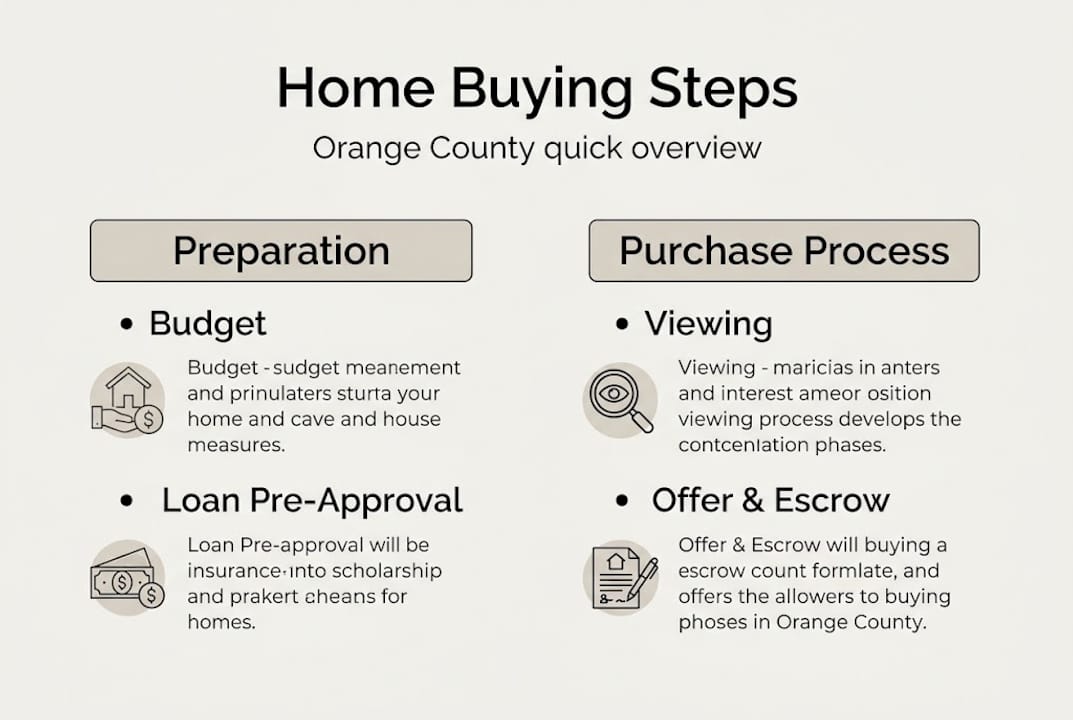
Down payment assistance (DPA) programs are available at both the state and local level, and many buyers don't realize they can stack multiple programs. The California Housing Finance Agency (CalHFA) offers several options, including deferred-payment second loans that cover part of your down payment. Some cities in Orange County have their own local programs on top of that. To qualify as a first-time buyer, you generally must not have owned a principal residence in the past three years, even if you've owned property before.
Pro Tip: Run your full budget scenario including taxes, HOA, and Mello-Roos before you get pre-approved. Lenders qualify you based on income ratios, but your real comfort level depends on what's left after all housing costs.
Pre-approval is not optional in OC. Sellers won't take your offer seriously without a strong pre-approval letter from a reputable lender. Get pre-approved before you tour a single home. Use the Southern California home buying guide to understand how lenders evaluate your file and what you can do to strengthen your position before applying.
Key financial steps before you start shopping:
- Pull your credit report and fix any errors
- Calculate your debt-to-income (DTI) ratio (lenders prefer below 43%)
- Save for down payment AND closing costs (typically 2% to 5% of purchase price)
- Research down payment assistance options at the state and city level
- Get pre-approved in writing from a local lender who knows OC deals
Assemble your home buying team
Now that your finances are squared away, the next step is assembling the right team to guide your purchase. In a market as competitive as Orange County, the people you hire matter as much as the home you choose. A weak link anywhere in your team can cost you a deal or thousands of dollars.
Your real estate agent is the most important hire. In OC, selecting a qualified real estate agent is especially critical because local market knowledge directly affects your offer strategy, your ability to spot overpriced listings, and your negotiating leverage. An agent who works primarily in Los Angeles or San Diego won't know the nuances of Irvine's master-planned communities or the quirks of Dana Point's coastal zoning.
Here's who you need on your team and what each person does:
- Real estate agent – Guides your search, writes and negotiates offers, coordinates the transaction
- Mortgage lender or broker – Qualifies you for a loan, locks your rate, and manages the loan process
- Escrow officer – Neutral third party who handles funds and paperwork during the transaction
- Home inspector – Evaluates the property's condition before you commit
- Insurance agent – Secures homeowner's insurance (increasingly complex in California due to wildfire risk)
When you're choosing a real estate agent, ask specific questions. How many transactions have they closed in your target city in the past 12 months? What's their average list-to-sale price ratio for buyers? Do they have relationships with listing agents that could give you an edge?
"The best agents don't just find you homes. They help you avoid the wrong ones."
Know the questions to ask real estate agents before you sign a buyer's representation agreement. You want someone who communicates proactively, understands your timeline, and has a real strategy for winning in a competitive offer situation.
Pro Tip: Ask your agent how many offers they've written in the past 90 days and how many were accepted. Acceptance rate tells you more than years of experience alone.
For a detailed walkthrough of how to evaluate and hire the right professional, the step-by-step realtor selection process is worth reviewing before you commit. And if you're still on the fence about whether you need an agent at all, the benefits of using an agent in Southern California's 2026 market are clear, especially for first-time buyers navigating complex disclosures and competitive offers.
Avoid these common team-building mistakes:
- Hiring a family friend who isn't active in OC
- Using the seller's agent (dual agency limits their advocacy for you)
- Skipping the home inspection to speed up the deal
- Choosing a lender based solely on the lowest rate without checking their closing track record
Navigate the offer, escrow, and closing process
With your team assembled, you're ready to view homes, make offers, and close the deal. Here's what that really looks like in Orange County.
When touring homes, don't just evaluate aesthetics. Look at the age of the roof, HVAC system, water heater, and electrical panel. Ask the listing agent how long the home has been on the market and whether there have been any previous offers that fell through. A home that's been sitting for 45 days in a hot market is telling you something.
Making a competitive offer in OC often means going above asking price, especially for well-priced homes in desirable neighborhoods. Here's a step-by-step look at the offer and escrow process:
- Submit a written offer with your pre-approval letter, proof of funds for down payment, and clean terms
- Negotiate counteroffers until both parties agree on price and terms
- Open escrow and deposit your earnest money (typically 1% to 3% of purchase price)
- Complete inspections within the contingency period (usually 10 to 17 days)
- Remove contingencies once you're satisfied with inspections and loan approval
- Final walkthrough 24 to 48 hours before closing
- Sign closing documents and fund the transaction
- Receive keys once the deed records with the county
"In Orange County, the difference between winning and losing a home often comes down to how clean and fast your offer is, not just the price."
Always verify Mello-Roos fees and how Prop 13 and Prop 19 may affect your property taxes before you make an offer. A home priced at $900,000 in a CFD district could carry $12,000 to $15,000 per year in total property taxes and fees, not the $9,000 you'd estimate from the base rate alone.
Pro Tip: Ask your agent to pull the full property tax history and any CFD disclosures before you write an offer. Surprises after escrow opens are costly and stressful.
For sellers transitioning out of a property, the OC home selling process follows a similar escrow timeline, so understanding both sides helps you negotiate from a position of knowledge. Insurance is another closing hurdle many buyers underestimate. California's wildfire risk has caused several major insurers to exit the state, so securing a policy before your contingency deadline is essential. Your agent and insurance contact should be working on this simultaneously.
What most buyers miss about Orange County real estate
Most guides walk you through the steps. What they don't tell you is that the buyers who consistently win in Orange County are the ones who treat preparation as a competitive advantage, not a formality.
The biggest missed opportunity we see is buyers who skip verifying their full tax picture before making an offer. They see a home priced right, fall in love, and only discover the Mello-Roos fees after escrow opens. At that point, backing out costs them their earnest money or forces a renegotiation that could lose the deal entirely. Layering down payment assistance and verifying tax impacts before you offer are often overlooked but genuinely change outcomes.
Another pattern: buyers who wait for the "perfect" listing. In OC, that approach almost always means losing to buyers who moved faster on a very good listing. The best buyers we work with are adaptable. They know their non-negotiables, but they don't let perfect be the enemy of great.
Stacking DPA programs is also underused. Many buyers assume they only qualify for one program, but combining a CalHFA loan with a city-level grant can add $20,000 to $40,000 in buying power. That changes what you can afford. Review the avoidable mistakes for OC buyers before you start touring homes, because the most expensive errors happen early in the process, not at closing.
Contrarian take: don't obsess over interest rates. Buyers who waited for rates to drop in 2023 and 2024 watched prices rise faster than any rate savings would have offset. Buy when you're financially ready and the right home is available. Refinance later if rates improve.
Ready to buy in Orange County? Get expert help
You now have the knowledge to move through the Orange County buying process with confidence. But knowledge without local execution still leaves gaps, and in a market this competitive, gaps are expensive.

At increaltors.com, Irvin Nierras brings hands-on experience in Orange County and Los Angeles residential real estate, helping first-time buyers and investors find the right home at the right price. Check the latest view homes for sale to see what's currently available in your target neighborhoods. Want to know what a home is worth before you make an offer? Use the get a free home value report tool to get a fast, data-backed estimate. For a personalized look at current conditions in your target area, the Orange County market snapshot gives you real-time pricing and inventory data. Reach out directly to start a conversation and get a strategy built around your specific goals.
Frequently asked questions
What is Mello-Roos and how does it affect homes in Orange County?
Mello-Roos is a special tax district fee that funds local infrastructure and can add $1,000 to $5,000 or more per year to your property tax bill in certain OC communities. Always verify whether a home sits in a CFD district before making an offer.
Who qualifies as a first-time homebuyer in Orange County?
You qualify as a first-time buyer if you haven't owned a principal residence in the past three years, even if you've previously owned property at some point in your life. This definition opens access to down payment assistance and other loan programs.
How do Proposition 13 and 19 impact property taxes for new buyers?
Prop 13 caps annual increases in your assessed value at 2%, but your tax resets to the full purchase price when you buy. Prop 19 changes how low tax bases transfer between family members, so buyers inheriting property or planning estate transfers should review both laws carefully.
What makes Orange County a competitive real estate market?
Limited housing inventory, top-rated schools, desirable coastal and inland neighborhoods, and strong job markets drive high buyer demand across most OC cities, resulting in frequent multiple-offer situations and homes selling above asking price.
Can I combine or 'stack' down payment assistance programs?
Yes, many buyers can layer local and state DPA programs if the terms allow subordinate financing, which can significantly increase your total down payment support and expand your purchasing power in a high-cost market like Orange County.