

Buying a house in Los Angeles can feel overwhelming, especially for first-time buyers and investors navigating one of the most competitive real estate markets in the country. Rising home prices, limited inventory, and complex financing requirements create significant barriers to entry. However, understanding the step-by-step process, leveraging available assistance programs, and making informed decisions based on current market conditions can transform this challenge into a successful investment. This guide walks you through every essential stage, from financial preparation and mortgage pre-approval to closing the deal and exploring investment opportunities like ADUs, ensuring you approach the LA housing market with confidence and clarity.
Table of Contents
- Key Takeaways
- Preparing to buy: finances, goals, and market conditions
- Step-by-step buying process in Los Angeles
- Leveraging assistance programs and navigating local nuances
- Investment opportunities: multifamily properties and ADUs in Los Angeles
- Explore homes for sale and expert real estate services in Los Angeles
- Frequently asked questions about buying a house in Los Angeles
Key Takeaways
| Point | Details |
|---|---|
| Stepwise financing to closing | The LA process guides buyers from financial prep and mortgage pre approval to closing in a clear step by step sequence. |
| Down payment assistance | First time buyers may qualify for down payment assistance programs that reduce upfront costs. |
| 2026 market balance | In 2026 the market is expected to balance with median prices around 740K to 970K and rising inventory. |
| Buy and hold ADUs | Investors are focusing on buy and hold strategies and adding accessory dwelling units rather than flips due to market risks. |
| Location HOA structural checks | Success hinges on checking location nuances, HOA rules, and structural conditions before buying. |
Preparing to buy: finances, goals, and market conditions
Before you start touring properties, establishing financial readiness sets the foundation for success. The standard process begins with assessing your credit score and debt-to-income ratio, both critical factors lenders evaluate during mortgage pre-approval. Most lenders require a credit score of at least 620, though higher scores unlock better interest rates. Your debt-to-income ratio should ideally fall below 36%, though some programs accept up to 50%.
Securing mortgage pre-approval early demonstrates to sellers that you're a serious buyer with verified financing. This step involves submitting financial documents like pay stubs, tax returns, and bank statements to a lender who will issue a pre-approval letter stating the maximum loan amount you qualify for. In LA's competitive market, sellers often prioritize offers from pre-approved buyers because it reduces the risk of financing falling through.
Next, clarify your buying purpose. Are you purchasing a primary residence, or is this an investment property? Your answer shapes everything from loan options to property search criteria. First-time homebuyers often qualify for special programs and lower down payment requirements, while investors need to evaluate rental income potential and long-term appreciation.
Understanding 2026 market conditions helps you time your purchase strategically. The LA market shows median prices around $740K-$970K with increased inventory creating a more balanced environment compared to previous years. Months of supply have risen to 6-7.7 months, giving buyers more negotiating power. However, well-priced homes in desirable neighborhoods still sell quickly, so preparation remains essential.
Key financial preparation steps include:
- Review your credit report and dispute any errors that could lower your score
- Reduce existing debts to improve your debt-to-income ratio
- Save for down payment, closing costs, and emergency reserves
- Gather financial documents early to streamline the pre-approval process
- Research current mortgage rates and loan programs suited to your situation
Pro Tip: Check the updated market snapshot regularly to identify emerging trends and pricing shifts in your target neighborhoods. This real-time data helps you recognize good deals and avoid overpaying.
Step-by-step buying process in Los Angeles
Once financially prepared, follow these seven essential steps to navigate the LA home buying process successfully:
-
Complete financial assessment and secure mortgage pre-approval. Beyond checking your credit score, calculate how much house you can realistically afford by factoring in property taxes, homeowners insurance, HOA fees, and maintenance costs. Obtain pre-approval letters from multiple lenders to compare rates and terms.
-
Define your buying purpose clearly. Determine whether you're buying a primary residence, second home, or investment property. This decision affects loan eligibility, down payment requirements, and tax implications. First-time buyers may qualify for assistance programs unavailable to investors.
-
Launch your property search and attend open houses. Work with a knowledgeable agent who understands LA's diverse neighborhoods. Visit properties in person to assess condition, location advantages, and potential issues not visible in photos. Take notes and photos to compare options later.
-
Submit a competitive offer with appropriate contingencies. In LA's market, offers often include inspection, appraisal, and financing contingencies. Your agent will research comparable sales to determine fair market value and craft an offer that stands out without overpaying. Be prepared to negotiate on price, repairs, or closing timeline.
-
Conduct thorough home inspection and appraisal. Hire a licensed inspector to evaluate the property's structural integrity, systems, and potential problems. The lender will order an appraisal to confirm the home's value supports the loan amount. Use inspection findings to negotiate repairs or price adjustments.
-
Finalize loan details and negotiate closing terms. Review the Loan Estimate and Closing Disclosure carefully. Lock in your interest rate when favorable. Coordinate with the title company and escrow officer to ensure all documents are accurate and deadlines are met.
-
Close escrow and record the deed. The typical closing timeline in LA runs 45-60 days from accepted offer to final closing. During the final walkthrough, verify that agreed-upon repairs are completed and the property is in expected condition. Sign all documents, transfer funds, and receive the keys to your new home.
| Step | Timeline | Key actions |
|---|---|---|
| Pre-approval | 1-3 days | Submit financial docs, receive approval letter |
| Property search | 2-8 weeks | Tour homes, compare neighborhoods, identify targets |
| Offer and negotiation | 3-7 days | Submit offer, negotiate terms, reach agreement |
| Inspections and appraisal | 2-3 weeks | Conduct inspections, complete appraisal, negotiate repairs |
| Loan finalization | 2-4 weeks | Underwriting review, clear conditions, lock rate |
| Closing | 1-2 days | Final walkthrough, sign documents, transfer ownership |
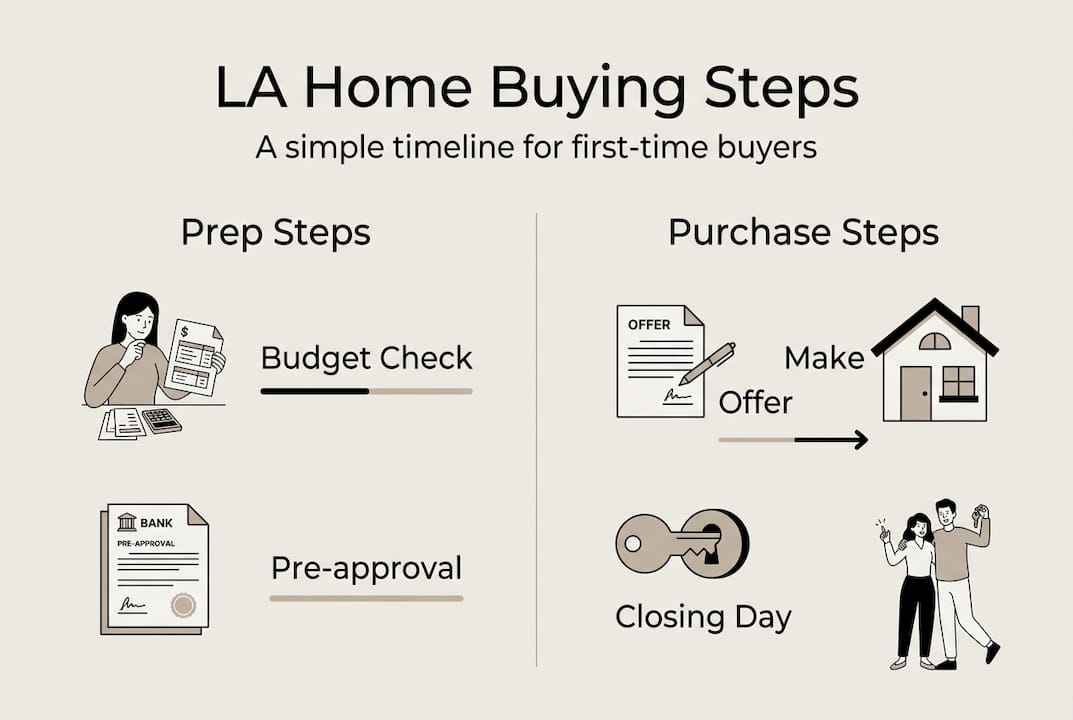
Pro Tip: The overview of the home buying process on our site provides additional resources and checklists to keep you organized throughout each stage.
Leveraging assistance programs and navigating local nuances
First-time buyers in Los Angeles have access to substantial financial assistance through city-sponsored programs. The LA City offers LIPA and MIPA down payment assistance up to $161,000 for qualifying buyers with low to moderate income. These programs provide deferred loans with shared appreciation terms, meaning you repay the assistance plus a percentage of home value appreciation when you sell or refinance.
Eligibility requirements include:
- First-time homebuyer status or not owning property in the past three years
- Income limits based on household size and area median income
- Credit score minimums, typically 640 or higher
- Completion of mandatory homebuyer education courses
- Purchase of property within LA city limits
The shared appreciation component means if your home increases in value, the city receives a proportional share when you sell. For example, if you received 20% assistance and your home appreciates 50%, the city claims 20% of that appreciation. This structure allows the city to recycle funds for future buyers while keeping your initial costs manageable.
Beyond financial assistance, understanding LA's local market nuances protects you from costly mistakes. Checking micro-locations, HOA rules, title status, and structural issues is essential before finalizing any purchase. Neighborhoods can vary dramatically block by block, affecting property values, safety, and quality of life.
Critical verification steps include:
- Review HOA governing documents to understand fees, restrictions, and financial health
- Order a preliminary title report to identify liens, easements, or ownership disputes
- Verify zoning classifications and permitted uses, especially for investment properties
- Inspect for earthquake retrofitting, foundation issues, and deferred maintenance
- Research school districts, crime statistics, and planned development projects
"Skipping professional realtor guidance in LA's competitive market significantly increases your risk of overpaying, missing red flags, or losing out to better-prepared buyers. Local expertise helps you navigate complex transactions and avoid pitfalls that cost thousands."
The impact of micro-location and HOA considerations cannot be overstated. Two similar homes just blocks apart can differ by hundreds of thousands in value based on school boundaries, street noise, or neighborhood amenities.

Investment opportunities: multifamily properties and ADUs in Los Angeles
Property investors should approach the LA market with clear strategies focused on long-term value creation. Investors should prioritize buy-and-hold strategies over flips due to market volatility and carrying costs. Flipping requires precise timing, extensive renovation expertise, and tolerance for risk, making it less attractive in 2026's balanced market conditions.
Instead, focus on multifamily properties or single-family homes with ADU potential. ADUs cost $150-$400 per square foot to build, generate monthly rents between $1,500 and $4,200 depending on size and location, and typically provide 8-12% annual returns. LA's streamlined permitting process now approves most ADU applications within 60 days, significantly reducing development timelines.
ADU investment advantages include:
- Increased rental income from a single property without buying additional real estate
- Flexibility to house family members or use as home office space
- Property value appreciation from adding livable square footage
- Potential for house hacking by living in the main home and renting the ADU
- FHA loan eligibility for owner-occupant investors with lower down payments
Before purchasing a property for ADU development, verify lot size meets minimum requirements, typically 5,000 square feet for detached ADUs. Check setback requirements, utility capacity, and neighborhood compatibility. Some areas command significantly higher ADU rents, making location selection critical for maximizing returns.
| Investment strategy | Typical returns | Risk level | Timeline |
|---|---|---|---|
| Buy-and-hold multifamily | 6-10% annual | Moderate | 5-10+ years |
| Single-family with ADU | 8-12% annual | Moderate | 3-7 years |
| House hacking | 10-15% effective | Low to moderate | 2-5 years |
| Fix and flip | Variable, often negative | High | 6-12 months |
Pro Tip: Browse homes for sale listings, single family home listings, and condo listings to identify properties with ADU potential or existing income-generating units. Look for larger lots, detached garages, or underutilized yard space.
Carrying costs for flips including mortgage payments, property taxes, insurance, and utilities quickly erode profit margins if the property sits unsold. Market volatility in 2026 means homes can take longer to sell than anticipated, creating financial pressure. Unless you have substantial renovation experience and cash reserves, buy-and-hold strategies offer more predictable returns with lower stress.
Explore homes for sale and expert real estate services in Los Angeles
Now that you understand the complete home buying process, financial assistance options, and investment strategies, take the next step by exploring current opportunities in the LA market. Browse our homes for sale listings to discover properties matching your budget and goals, whether you're seeking a primary residence or investment property.
Stay informed about market trends and pricing shifts by checking our updated market snapshot regularly. This resource provides real-time data on inventory levels, median prices, and neighborhood-specific insights that help you make confident decisions.

If you're specifically interested in traditional housing, explore our single family home listings featuring properties across Los Angeles and Orange County. Our experienced team understands the nuances of Southern California real estate and provides personalized guidance throughout your buying journey, from initial search to successful closing.
Frequently asked questions about buying a house in Los Angeles
How much credit score is needed for mortgage pre-approval in LA?
Most lenders require a minimum credit score of 620 for conventional loans, though FHA loans may accept scores as low as 580 with higher down payments. Scores above 740 typically qualify for the best interest rates. Improving your score before applying can save thousands over the loan's lifetime.
What are typical closing timelines for houses in Los Angeles?
The standard closing timeline in LA runs 45-60 days from accepted offer to final deed recording. Cash purchases can close faster, sometimes within 2-3 weeks. Delays often occur during inspection negotiations, appraisal scheduling, or loan underwriting, so building buffer time into your timeline reduces stress.
Can first-time buyers apply for down payment assistance multiple times?
No, LIPA and MIPA programs are designed for one-time use by first-time buyers or those who haven't owned property in three years. Once you receive assistance and purchase a home, you're ineligible for these specific programs on future purchases. However, selling and waiting three years may restore eligibility depending on program rules.
What neighborhoods offer the best ADU investment potential?
Neighborhoods with strong rental demand, good schools, and proximity to employment centers provide the best ADU returns. Areas like Silver Lake, Echo Park, Highland Park, and parts of the San Fernando Valley combine reasonable property prices with high rental rates. Research local rent comparables and verify zoning permits ADU construction before purchasing.
Is it necessary to have a realtor when buying in LA's competitive market?
While not legally required, working with an experienced realtor significantly improves your chances of success and protects you from costly mistakes. Realtors provide market expertise, negotiation skills, access to off-market listings, and guidance through complex paperwork. Their commission is typically paid by the seller, making their services essentially free to buyers while delivering substantial value.