

Most homeowners assume a listing agent's job is simple: snap some photos, post the home online, and wait for offers. That assumption costs sellers thousands of dollars every year. A skilled listing agent in Southern California does far more than list a property. They price it strategically, market it aggressively, negotiate on your behalf, and guide you through a legal process that can get complicated fast. This guide breaks down exactly what a listing agent does, why their role matters in Los Angeles and Orange County markets, and how to choose the right one for your situation.
Table of Contents
- What is a listing agent?
- Step-by-step: Listing agent duties from start to finish
- Key differences: Full-service vs. discount listing agents
- How listing agents maximize home value and minimize seller stress
- Frequently asked dual agency questions in California
- Explore top-rated listing agent services in Southern California
- Frequently asked questions
Key Takeaways
| Point | Details |
|---|---|
| Listing agents’ core functions | A listing agent manages pricing, marketing, and negotiating for the seller’s benefit. |
| Dual agency cautions | In California, dual agency is allowed with disclosure but risks split loyalties and lower advocacy. |
| Full-service vs. discount tradeoffs | Traditional agents may cost more but often get better results and less seller stress than discount options. |
| Maximizing home value | Experienced agents use market expertise and negotiation to boost final sale prices and minimize surprises. |
| Finding the right support | Choosing a reputable local agent provides tailored service and guides you through every sale step. |
What is a listing agent?
A listing agent is a licensed real estate professional who represents the home seller in a transaction. Their job is to get you the best possible price, in the shortest reasonable time, with the fewest headaches. That sounds straightforward, but the actual scope of work is substantial.
Listing agents carry a fiduciary duty to their clients. In plain terms, that means they are legally required to act in your best interest at all times. They must be honest, loyal, and keep your information confidential. This is not optional. It is the law in California.
Here is a snapshot of what a listing agent handles day to day:
- Conducting a comparative market analysis to set the right asking price
- Coordinating professional photography, staging, and property prep
- Writing and distributing compelling listing descriptions across MLS and major platforms
- Scheduling and managing showings and open houses
- Reviewing and presenting all incoming offers
- Negotiating price, contingencies, and repair requests
- Managing escrow timelines and coordinating with title companies
- Reviewing disclosures and legal documents before you sign
One concept worth understanding early is dual agency. This happens when one agent represents both the buyer and the seller in the same transaction. California law requires written disclosure and consent before dual agency can proceed, and for good reason. It creates divided loyalties that can hurt both parties, especially buyers who need dedicated advocacy.
Step-by-step: Listing agent duties from start to finish
Now that you know what a listing agent is, let's see how their support unfolds throughout your home sale. The process is more layered than most sellers expect.
A listing agent's involvement covers everything from evaluation to paperwork after closing. Here is how that typically breaks down:
- Initial consultation and home evaluation. Your agent visits the property, assesses its condition, and reviews comparable sales to recommend a pricing strategy.
- Pre-listing preparation. They coordinate repairs, staging, and professional photography. This phase directly impacts buyer perception and final sale price.
- MLS listing and marketing launch. Your home goes live on the Multiple Listing Service and is syndicated to Zillow, Realtor.com, and other platforms. Your agent also promotes it through their personal network.
- Showings and open houses. They manage scheduling, gather buyer feedback, and keep you informed after every visit.
- Offer review and negotiation. When offers arrive, your agent breaks down each one, explains the tradeoffs, and negotiates terms that protect your bottom line.
- Escrow and contingency management. They track deadlines, coordinate inspections, and push back on unreasonable repair demands.
- Closing and post-sale paperwork. Your agent ensures all documents are signed correctly and that the transaction closes on time.
You can explore more about the selling process support available for Southern California homeowners to understand what a full-service experience looks like in practice.

Pro Tip: Most sellers focus on curb appeal but overlook the interior flow. Buyers form opinions within the first 30 seconds of walking through a door. Ask your agent which two or three rooms will have the biggest impact on offers, and invest there first.
Key differences: Full-service vs. discount listing agents
Choosing the right agent also means understanding your options. Not all listing agents operate the same way, and the fee model you choose has real consequences.
Traditional agents often justify higher fees by delivering higher sale prices, while discount models attract sellers who are primarily focused on cutting commission costs. Both have their place, but the tradeoffs are real.
| Feature | Full-service agent | Discount agent |
|---|---|---|
| Commission rate | Typically 2.5% to 3% | As low as 1% |
| Marketing budget | High (professional photos, ads) | Limited or basic |
| Negotiation support | Hands-on and aggressive | Often minimal |
| Availability | Dedicated, responsive | May be volume-based |
| Network access | Broad (contractors, stagers, buyers) | Narrower |
| Best for | Competitive markets, complex sales | Simple transactions, experienced sellers |
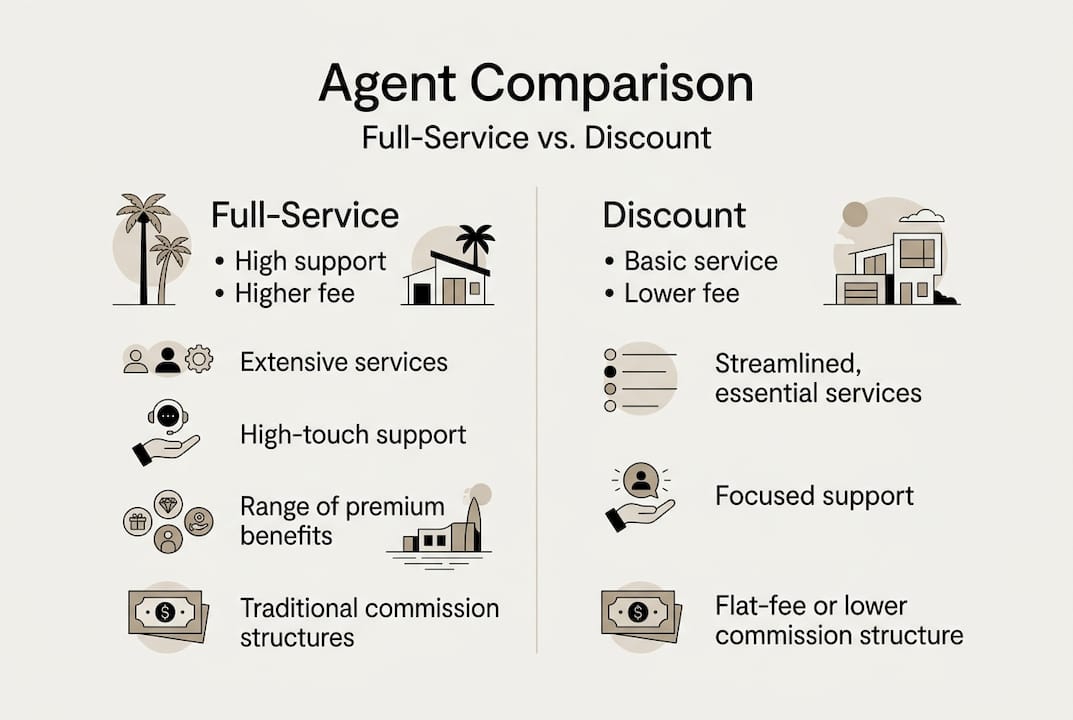
Following the National Association of Realtors settlement in 2024, commission structures became more flexible and negotiable. However, data continues to show that sellers who work with experienced, full-service realty professionals tend to net more after fees than those who go the discount route. A lower commission does not automatically mean more money in your pocket if the home sells for less.
The right choice depends on your priorities. If speed and simplicity matter most and your home is in a hot zip code, a discount agent might work. If you want maximum return and expert guidance through a complex negotiation, full-service is worth the investment.
How listing agents maximize home value and minimize seller stress
Once you have chosen your preferred agent model, here is what you actually gain from an experienced, motivated listing agent working in your corner.
A strong listing agent does more than show up at closing. Negotiation advocacy, local market insight, and buyer screening all contribute to better seller outcomes. Here is how that plays out in practice:
- Accurate pricing prevents your home from sitting too long or leaving money on the table
- Professional marketing attracts more qualified buyers, which creates competition and drives up offers
- Buyer screening filters out unqualified or low-intent buyers before they waste your time
- Negotiation skill protects your net proceeds when buyers push back on price or repairs
- Legal document review reduces the risk of costly errors or post-closing disputes
- Vendor network connects you with trusted contractors, stagers, and inspectors at fair prices
"The difference between a good listing agent and a great one often comes down to what happens after the first offer arrives. Skilled negotiators know when to hold firm and when to move, and that judgment is worth far more than any commission savings."
Pro Tip: Ask your agent for a list of their preferred vendors before you list. A well-connected agent can get you faster appointments and better pricing on repairs and staging, which directly affects your timeline and net proceeds.
You can also check real-time market insights for Southern California to understand current pricing trends before your first agent conversation. Knowing your market gives you a stronger foundation for every decision that follows.
Frequently asked dual agency questions in California
Dual agency is a unique California concern, and it trips up a lot of sellers and buyers who do not fully understand what they are agreeing to.
In California, dual agency is legal but tightly regulated. Dual agency requires written consent and full disclosure before it can happen. The agent must inform both parties that they are representing both sides of the deal. What many people do not realize is what they give up when they agree to it.
Here are the key things to understand about dual agency in California:
- Confidentiality is limited. Your agent cannot share your private motivations with the other party, but their ability to fully advocate for you is restricted.
- Negotiation is compromised. An agent cannot aggressively negotiate for you when they also represent the person on the other side of the table.
- It often happens without sellers realizing it. If a buyer contacts your listing agent directly and wants to make an offer, dual agency can arise quickly.
- Forced dual agency is illegal. Agents cannot pressure either party into accepting dual agency as a condition of the transaction.
- Complex or contested deals carry the most risk. If there are disputes over repairs, price reductions, or contingencies, you want a dedicated advocate, not a shared one.
For most sellers and buyers, dedicated representation is the safer and smarter choice. If you want expert California listing support with clear, single-party representation, working with a local specialist protects your interests from day one.
Explore top-rated listing agent services in Southern California
Selling a home in Los Angeles or Orange County is not a one-size-fits-all process. Local market knowledge, neighborhood-level pricing insight, and a strong buyer network make a measurable difference in your final outcome.

At increaltors.com, Irvin Nierras brings hands-on experience in Southern California residential sales, a personalized approach, and deep community knowledge to every transaction. Whether you are ready to list now or just exploring your options, you can start your home sale with a free consultation, browse current Southern California listings to understand your competition, or check the latest market snapshot to see where prices are heading. The right agent makes the process faster, less stressful, and more profitable. Let's find out what your home is worth.
Frequently asked questions
What's the difference between a listing agent and a buyer's agent?
A listing agent represents the home seller and works to maximize the seller's net proceeds. A buyer's agent exclusively advocates for the buyer's interests, including price, terms, and contingencies.
Is dual agency legal in California?
Yes, but only with written disclosure and consent from both parties. The risks include limited negotiation advocacy and reduced confidentiality for both the buyer and seller.
Do full-service listing agents really help homes sell for more?
Full-service agents typically achieve higher net seller outcomes through better marketing, sharper pricing, and stronger negotiation, even after accounting for higher commission rates.
How much does a listing agent in Southern California cost?
Listing agent fees in Southern California typically range from 1% for discount models to around 3% for full-service representation, and many fee structures are now negotiable following recent industry changes.
Can I represent myself and skip a listing agent?
You are legally allowed to sell your home without an agent, but you will take on all pricing, marketing, negotiation, and legal responsibilities yourself, which significantly increases your risk of leaving money on the table or making costly errors.