

Most buyers and investors assume all property listings are created equal. They are not. On-MLS homes in San Francisco sold for $302,000 more on average than off-MLS homes between 2022 and 2024, and Southern California markets follow similar patterns. If you are buying, selling, or investing in Los Angeles or Orange County, understanding how the Multiple Listing Service works is not optional. It is the difference between getting the best deal and leaving serious money on the table. This guide breaks down exactly how MLS functions, why it matters in SoCal, and how you can use it to your advantage.
Table of Contents
- What is the MLS and why does it matter?
- How MLS works in Southern California
- MLS vs. off-MLS: Does it really matter?
- What homebuyers and investors gain from MLS access
- Find your next Southern California property with local MLS expertise
- Frequently asked questions
Key Takeaways
| Point | Details |
|---|---|
| MLS maximizes visibility | Listings in the MLS are seen by the most buyers, benefiting both sellers and investors. |
| Higher sale prices | On-MLS homes consistently sell for more than off-MLS private listings in Southern California. |
| Agent partnership is essential | Working with an MLS-connected agent gives you full access to listings and deeper market insight. |
| Southern California uses several MLSs | CRMLS, SDMLS, and regional systems cover different parts of SoCal—know which matters for your property. |
What is the MLS and why does it matter?
The Multiple Listing Service is a regional database where licensed real estate agents and brokers share property listings with one another. Think of it as a private wholesale market for homes. Agents list properties there first, and that data then flows out to consumer-facing sites like Zillow and Realtor.com. Without MLS, you would be shopping from a fraction of what is actually available.
The core value is visibility. When a home hits the MLS, every agent in the network can see it and bring their buyers. That competition drives prices up for sellers and gives buyers a complete picture of the market. The Council of MLS states that MLS promotes market efficiency and fairness by sharing nearly all listings, which is something no private listing platform can claim.
Here is a quick look at what MLS delivers for each party:
- Sellers: Maximum exposure to qualified buyers through every participating agent
- Buyers: Access to nearly every available property in a given market
- Investors: Reliable pricing data and days-on-market stats for smarter decisions
- Agents: A shared, standardized platform that keeps transactions transparent
You can explore the advantages of MLS platforms and see how they translate into real outcomes for Southern California buyers and sellers.
"MLS is the backbone of a fair and efficient real estate market. Without it, buyers and sellers would be operating with incomplete information, and that gap always costs someone money."
| Benefit | Without MLS | With MLS |
|---|---|---|
| Listing visibility | Limited to one agent's network | Entire regional agent network |
| Pricing accuracy | Guesswork or limited comps | Full comparable sales data |
| Buyer competition | Low, fewer offers | High, multiple offers common |
| Transaction speed | Slower, less urgency | Faster, more competitive |
How MLS works in Southern California
Southern California is not served by a single MLS. It has several overlapping systems, and knowing which one covers your target area matters more than most buyers realize.

The key MLS systems in Southern California include CRMLS (California Regional MLS), SDMLS (San Diego MLS), and TheMLS, which covers the LA Westside and surrounding areas. CRMLS is the largest MLS in the country, serving most of Los Angeles, Orange County, the Inland Empire, and beyond. SDMLS handles San Diego County, while TheMLS focuses on high-value coastal and urban LA markets.
Here is a breakdown of the major SoCal MLS networks:
| MLS Name | Primary Coverage | Approximate Listings |
|---|---|---|
| CRMLS | LA, Orange County, Inland Empire, Ventura | 100,000+ active |
| SDMLS | San Diego County | 10,000+ active |
| TheMLS | LA Westside, Beverly Hills, Santa Monica | 5,000+ active |
Some properties fall under overlapping MLS coverage, meaning an agent in one system may not automatically see listings from another. This is why agent selection matters so much. Your agent's MLS affiliations directly affect what you can access.
MLS syndication is the process by which listings automatically push out to third-party sites. Here is how a listing typically moves through the system:
- Agent enters the property into their local MLS
- MLS validates and publishes the listing to all member agents
- Syndication feeds push the listing to Zillow, Realtor.com, and similar platforms
- Buyers and their agents receive alerts based on saved search criteria
- Showings, offers, and negotiations happen through the MLS-connected agent network
You can visit the SDMLS official site to see how San Diego's system is structured and what it covers.
"In Southern California, your agent's MLS access is your market access. The two are inseparable."
MLS vs. off-MLS: Does it really matter?
Some sellers are tempted to skip the MLS. They want privacy, a faster close, or they have a buyer lined up already. These are understandable reasons, but the data tells a different story.
On-MLS homes sold for $302,000 more on average than off-MLS homes in the San Francisco market from 2022 to 2024. That is not a rounding error. That is a life-changing difference in net proceeds. Southern California markets, with their intense buyer competition in cities like Irvine, Pasadena, and Long Beach, show similar dynamics.
Common reasons sellers avoid MLS and why the data pushes back:
- "I already have a buyer": Pre-arranged buyers rarely offer top dollar because there is no competition
- "I want privacy": MLS allows delayed entry and limited disclosure options in many cases
- "It is faster off-MLS": Speed often comes at the cost of price, not a trade most sellers want to make
- "Agent commissions are too high": Research from the Richmond Fed shows that while commission structures are debated, MLS-listed homes consistently outperform private sales in net outcomes
For buyers and investors, off-MLS deals can look attractive on the surface. But without MLS data, you cannot accurately assess whether the price is fair. You are negotiating blind.
Here is how the two approaches compare on key metrics:
| Metric | On-MLS | Off-MLS |
|---|---|---|
| Average sale price | Higher (more competition) | Lower (limited exposure) |
| Days on market | Shorter in competitive markets | Varies, often longer |
| Buyer pool | All active buyers via agents | Only seller's direct network |
| Pricing transparency | Full comp data available | Limited or no comp access |
| Agent accountability | MLS rules enforced | No standardized oversight |
Whether you are looking at recent market results, browsing condos for sale, checking out vacant land listings, or exploring single family homes, MLS data is what makes those numbers meaningful. You can also browse all available listings to see the full range of what MLS-connected searches can surface.
What homebuyers and investors gain from MLS access
MLS access is not just about seeing more listings. It reshapes how you make decisions, negotiate, and close.
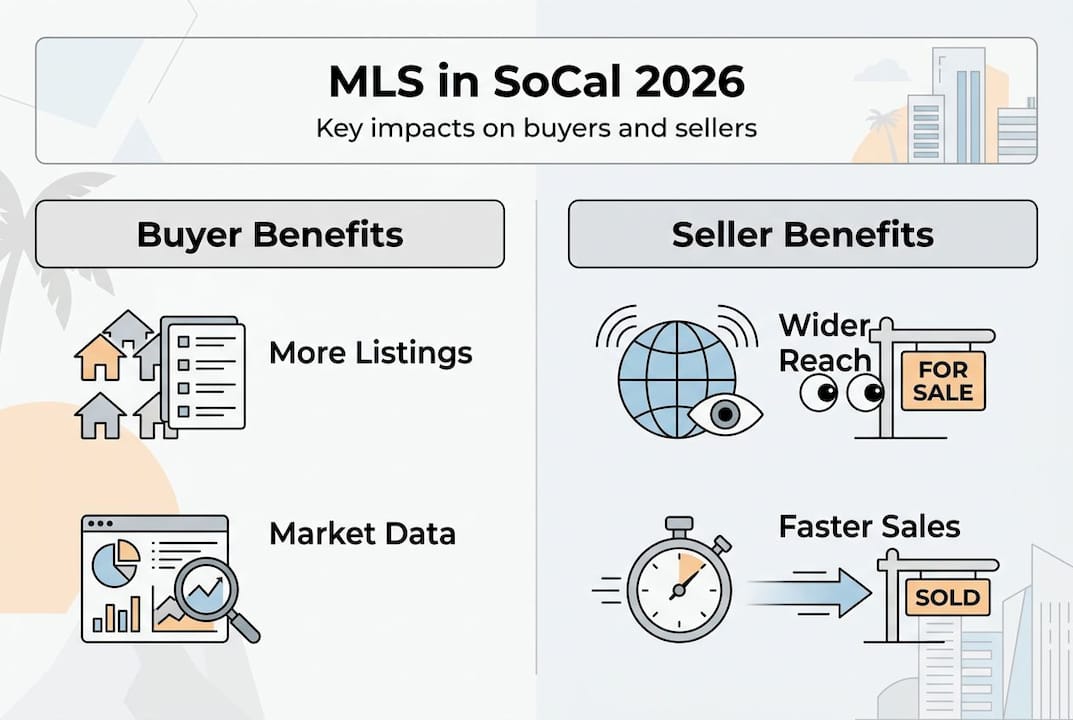
SDMLS and CRMLS enable quick sales and robust pricing tools like comparative market analysis (CMA) in competitive markets. A CMA pulls recent sales data for similar properties in the same area, giving you a defensible number to anchor your offer or listing price. Without MLS, a CMA is incomplete at best and misleading at worst.
Here is what MLS access actually gives you as a buyer or investor:
- Complete inventory: You see virtually every active listing, not just what one agent or platform chooses to show you
- Days-on-market data: Knowing how long a home has sat unsold gives you negotiating leverage
- Price reduction history: MLS tracks every price cut, revealing seller motivation
- Sold price records: You know what comparable homes actually closed for, not just what they were listed at
- Market velocity: You can see whether a neighborhood is moving fast or cooling off, which shapes your offer strategy
For investors, this data is especially powerful. Identifying underpriced assets, spotting emerging neighborhoods, and timing entry and exit points all depend on accurate, real-time MLS data.
Pro Tip: Always insist on working with an agent who holds active membership in the MLS covering your target subregion. An agent licensed in LA but not affiliated with TheMLS may miss key Westside listings entirely.
You can use pricing strategies with MLS to position your offer competitively, and tools like home valuation tools to cross-check what the market is actually saying before you commit.
Find your next Southern California property with local MLS expertise
Understanding MLS is one thing. Having an agent who knows how to use it in your specific corner of Southern California is another. Irvin Nierras at increaltors.com brings hands-on experience across Los Angeles and Orange County, with direct access to the MLS systems that cover these markets.

Whether you want to track the latest market trends snapshot, search single family home listings in your target neighborhood, or explore vacant land in SoCal for your next investment, the right MLS-connected agent makes every step faster and more informed. Reach out today to get a personalized property search built around your goals, your budget, and the neighborhoods where you want to be.
Frequently asked questions
What is the MLS, and can the public access it directly?
The Multiple Listing Service is a private database for real estate agents and brokers. Consumers can view listings on public sites, but full access and transaction guidance require working with a licensed agent.
Why do homes listed on the MLS sell for higher prices?
MLS listings reach every active buyer through the agent network, creating competition that drives prices up. On-MLS homes sold for $302,000 more on average than off-MLS homes in recent data.
Is every property listed on the same MLS in Southern California?
No. Southern California has several major systems including CRMLS and SDMLS, and coverage depends on where the property is located and which MLS your agent belongs to.
Can I buy a property in SoCal without using an agent and MLS?
Private transactions are possible, but MLS promotes fairness by sharing nearly all listings. Skipping it often means a smaller selection and weaker pricing data, which can cost you significantly on either side of the deal.