
There is no legal substitute for the California Department of Real Estate lookup at www2.dre.ca.gov. It is the state's exclusive official record for license status, disciplinary history, and broker affiliation. No private website, app, or third-party directory can replace it. That said, the DRE itself recommends pairing that lookup with several supplemental checks before you sign anything. Here is exactly what to do:
Start here, in this order:
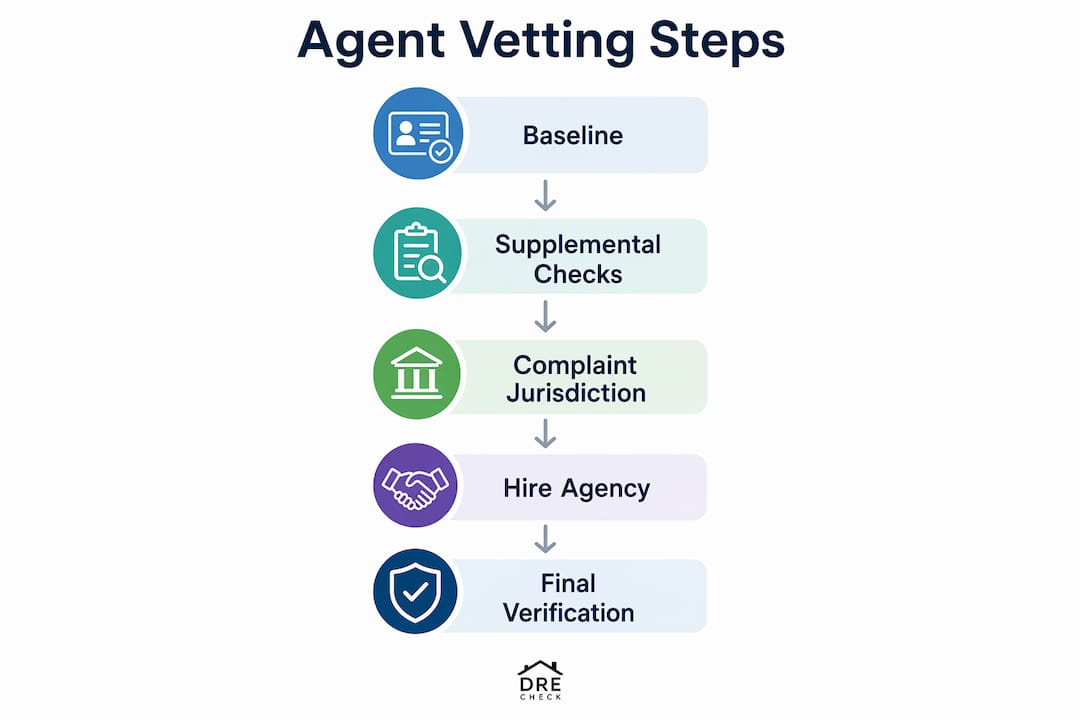
- Pull the agent's license on the DRE public lookup — confirm active status, license number, and broker name.
- Check the Better Business Bureau (BBB) profile for complaints and resolution history.
- Search county court records for civil judgments or active litigation.
Immediate red flags to record:
- An "H" hearing number in the DRE record (signals past or pending discipline)
- A broker name on the DRE record that does not match what the agent told you
- Unresolved BBB complaints or a pattern of similar grievances
Pro Tip: If you cannot find an agent by full name, the DRE Name Help page explains how to search by partial last name or "Last, First" format — a small trick that saves a lot of frustration.
Table of Contents
- Why no other site can replace the DRE for license verification
- What supplemental checks actually tell you beyond the DRE
- How to verify an agent before signing anything
- Which agency handles which type of complaint?
- Should you run these checks yourself or hire a vetted agency?
- Key Takeaways
- The check that most buyers skip
- Increaltors connects you with vetted agents in Southern California
- Useful sources
Why no other site can replace the DRE for license verification
The DRE administers and enforces California Real Estate Law. That statutory role means it holds the only legally authoritative record of who is licensed, what their current status is, whether discipline has been imposed, and which broker they are affiliated with. A Yelp page, a Zillow profile, or a LinkedIn bio can say anything. The DRE record is the ground truth.
Private sites are useful for reputation signals, but they do not have access to the state's disciplinary database. They cannot tell you whether a license is suspended, revoked, or flagged for a hearing. The DRE Consumer Alerts page warns explicitly that unlicensed individuals sometimes use the names and credentials of real licensees to conduct transactions. That risk is exactly why real-time DRE verification matters.
The DRE lookup is a compliance and status database, not a performance tracker. It tells you whether someone is legally authorized to represent you. It does not tell you whether they are good at their job, how many deals they have closed, or whether past clients were happy. Those signals come from supplemental checks — which the DRE's own RE16 consumer guide recommends running alongside the official lookup.
What the DRE provides:
- Current license status (active, suspended, revoked, expired)
- License type (salesperson vs. broker)
- Broker affiliation and mailing address
- Disciplinary history, including hearing numbers
What the DRE does not provide:
- Transaction volume or sales history
- Client reviews or satisfaction ratings
- Loan officer or mortgage servicer licensing (that falls under DFPI)
What supplemental checks actually tell you beyond the DRE
Think of the DRE lookup as your baseline. These checks fill in the picture the DRE was never designed to paint.
| Resource | What it reliably tells you | What it does not cover |
|---|---|---|
| DRE lookup | License status, broker affiliation, disciplinary record | Performance, reviews, transaction history |
| Better Business Bureau | Complaint history, resolution behavior, accreditation | License status, court judgments |
| County court records | Civil suits, judgments, lis pendens | License status, complaint behavior |
| Local MLS / realtor profile | Recent transaction volume, active listings | Disciplinary history, civil litigation |
| Escrow/title company records | Confirmed closings, broker involvement | Complaints, court history |
Running each check quickly:
- BBB profile: Search the agent's name at bbb.org. Look at the rating, the number of complaints, and whether complaints were resolved or left open. A pattern of unresolved complaints in the same category is a meaningful signal.
- County court records: In Los Angeles County, use the LA Court case access portal. In Orange County, use the Superior Court's online case search. Search the agent's full name as both plaintiff and defendant.
- MLS/realtor profile: Cross-reference the broker name shown on the DRE record with the broker listed on the agent's MLS or realtor.com profile. A mismatch is worth a direct question.
- News search: A quick Google search of the agent's name plus "lawsuit," "complaint," or "fraud" takes two minutes and occasionally surfaces public records that formal databases miss.
Pro Tip: Supplemental checks like court records and BBB searches are free and typically take under 30 minutes total. For investors running multiple agent checks, a deal analysis tool like RentrIQ's deal analyzer can help you track vetting notes alongside property financials in one place.
How to verify an agent before signing anything
This workflow takes 10–30 minutes and covers everything a buyer or seller in LA or Orange County needs before committing to an agency agreement.
- Go to the DRE public lookup at www2.dre.ca.gov. Enter the agent's name or license number. Confirm: status is "Licensed," the license type matches what they claimed, and the broker name is correct.
- Record the license number and broker name in writing. You will reference these in step 6.
- Check for an "H" hearing number in the license record. If one appears, ask the agent directly what it relates to and verify the outcome on the DRE disciplinary actions page.
- Run the BBB search. Note the rating and any open complaints. One complaint resolved professionally is different from three unresolved complaints about the same issue.
- Search county court records under the agent's full name. Look for civil judgments, active suits, or lis pendens filings tied to properties they represented.
- Ask the agent these questions directly:
- "Can you confirm your license number and your broker's full name?"
- "Which escrow or title company handled your last three closings?"
- "Can you provide two or three references from clients who closed in the past 12 months?"
- Confirm recent closings with the escrow or title company the agent names. A quick call or email asking whether the agent was involved in a specific transaction is usually enough.
- Request written broker affiliation if anything in the DRE record or the agent's answers seems inconsistent.
For first-time buyers who want a deeper look at questions to ask real estate agents before signing, that resource walks through the full interview process.

Which agency handles which type of complaint?
The DRE's jurisdiction ends at California real estate licensing. When a problem involves mortgage lending, federal fair-housing law, or deceptive marketing, a different agency is the right call.
| Agency | Handles | Typical action |
|---|---|---|
| California DRE | Agent/broker licensing, disciplinary issues, unlicensed activity | File complaint, license investigation |
| California DFPI | Finance lenders, mortgage servicers, consumer finance licensing | File complaint, licensing inquiry |
| CFPB / HUD | Federal mortgage issues, RESPA/TILA violations, fair lending | File federal complaint, request investigation |
| FTC | Deceptive advertising, fraud, identity theft | File complaint, consumer alert |
| County recorder / court | Title disputes, civil judgments, lis pendens | Public records search, legal action |
The DRE's Who Do You Call? guide maps these jurisdictions clearly. If your issue involves a loan officer rather than a licensed real estate agent, DFPI is the starting point. If it involves a federally backed mortgage or a fair-lending concern, CFPB and HUD are the right contacts. The DRE does not enforce RESPA, TILA, or federal mortgage servicing rules.
Should you run these checks yourself or hire a vetted agency?
DIY verification works well when you:
- Have prior experience buying or selling in California
- Are comfortable navigating government portals and court databases
- Have time to run each check and follow up on inconsistencies
DIY has real limits when you:
- Are buying or selling for the first time in Southern California
- Are relocating from out of state and lack local market context
- Are managing a tight timeline and cannot afford to miss a red flag
A vetted local agency handles the verification layer for you. Agents at a reputable brokerage have already been credentialed, their licenses are confirmed active, and their broker affiliations are on record. You also gain access to neighborhood profiles, local market data, and escrow/title introductions that take weeks to build independently. Understanding why using a real estate agent in Southern California makes sense in 2026 comes down to exactly that combination of verified credentials and local expertise.
Pro Tip: If your transaction involves a property in LA or Orange County and you are not already familiar with local comps, escrow norms, and neighborhood pricing, the time cost of DIY vetting often outweighs the benefit. A vetted agency pays for itself in avoided mistakes.
Key Takeaways
The DRE lookup is the only official source for California agent license verification. No private site replaces it, but pairing it with BBB checks, county court searches, and direct reference calls gives you a complete picture before you commit.
| Point | Details |
|---|---|
| DRE is the exclusive official source | No private site legally replaces www2.dre.ca.gov for license status and disciplinary records. |
| Watch for the "H" hearing number | An "H" in the DRE record signals past or pending discipline — always follow up before proceeding. |
| Supplemental checks are free and fast | BBB, county court records, and escrow confirmation typically take under 30 minutes combined. |
| Know which agency to call | DRE handles licensing; DFPI covers finance lenders; CFPB/HUD handles federal mortgage and fair-lending issues. |
| Increaltors for managed vetting | Buyers and sellers in LA and Orange County can work with Increaltors for pre-vetted agents, listings, and local market guidance. |
The check that most buyers skip
Most buyers run the DRE lookup and stop there. That is a reasonable start, but "Licensed" on a DRE record is not the same as a clean record. An agent can hold an active license while also carrying an unresolved hearing number, a civil judgment from a prior transaction dispute, or a string of BBB complaints that never made it into the state database.
The piece that gets overlooked most often is the broker affiliation cross-check. An agent might tell you they work under one brokerage while the DRE record shows a different broker name. That mismatch does not always mean fraud, but it always warrants a direct question. In a market as competitive as Los Angeles or Orange County, where transactions move fast and pressure to skip steps is real, that one question can surface a problem before it becomes your problem.
The DRE lookup is the foundation. The supplemental checks are what make it useful.
Increaltors connects you with vetted agents in Southern California
Spending 30 minutes on DRE lookups and court searches is worth it. But if you would rather work with an agent whose credentials are already confirmed and whose local track record is established, Increaltors offers exactly that for buyers and sellers across Los Angeles, Orange County, and nearby Southern California markets.
Increaltors, led by Irvin Nierras of HomeSmart Evergreen Realty, gives you access to pre-vetted agent representation, active property listings, a free home valuation, and a current market snapshot for your target neighborhood. Every agent in the network carries a verified, active DRE license with confirmed broker affiliation. You get neighborhood profiles, escrow and title introductions, and transaction coordination without having to build that network from scratch.
Ready to skip the manual checks and work with a team you can trust? Browse current listings or request a free home evaluation at Increaltors.com.
Useful sources
- DRE Public License Lookup — Search by name or license ID for current status, broker affiliation, and disciplinary history.
- DRE Name Help — Formatting tips for name searches when a full-name lookup returns no results.
- DRE RE16 Consumer Guide — The DRE's official checklist for finding and vetting a real estate agent, including supplemental checks.
- DRE Consumer Alerts — Warnings about imposter activity and guidance on real-time verification.
- DRE Who Do You Call? — Maps complaint types to the correct agency (DRE, DFPI, CFPB, HUD, FTC).
- DRE Consumers Hub — Central page for verification tools, complaint forms, and consumer resources.
- Multiple Jurisdiction License Lookup — One-stop resource covering DRE, DFPI, and BREA license types in California.
- Increaltors: Questions to Ask Real Estate Agents — Sample interview questions for SoCal buyers vetting a new agent.
- Increaltors: How a Buyer's Agent Guides SoCal Homebuyers — Practical checklist that complements the verification workflow above.
This article is general consumer information, not legal or professional advice. Verify current license status and regulatory requirements directly with the DRE or a qualified real estate attorney for your specific situation.