

TL;DR:
- Diversification spreads investments across property types and locations, reducing risks and improving long-term returns.
- It enhances risk-adjusted performance, stabilizes income, and lessens exposure to localized downturns and regulatory shifts.
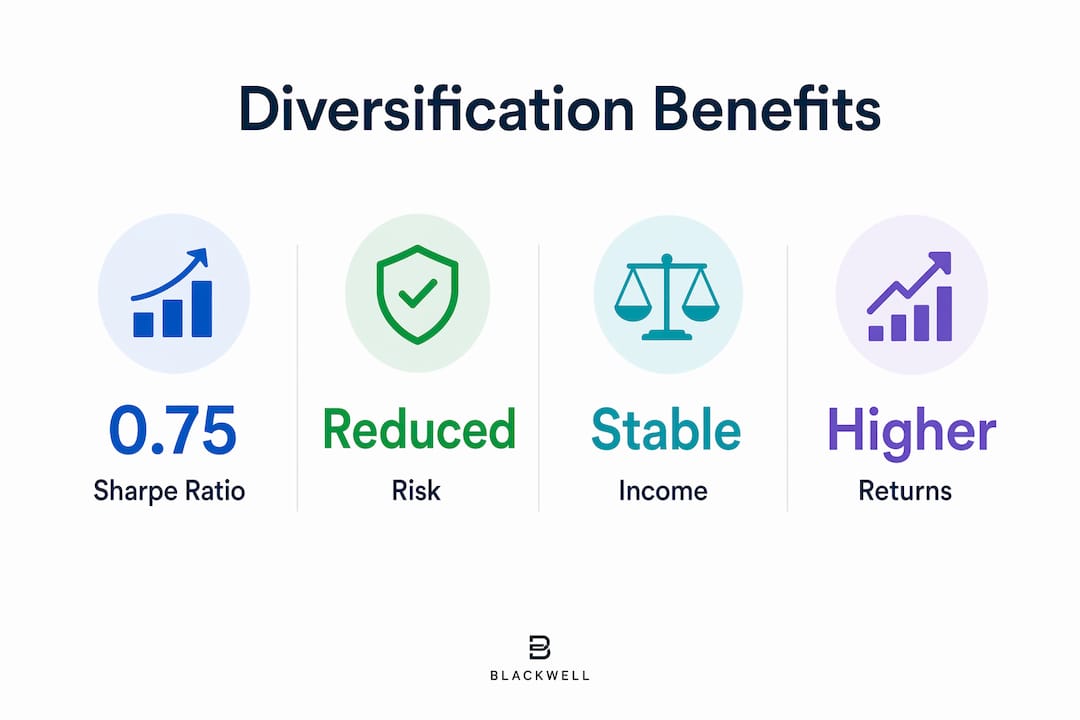
Real estate portfolio diversification is the practice of spreading investments across multiple property types, geographic markets, and investment vehicles to reduce risk and improve long-term returns. Investors who concentrate all capital in a single asset class or market expose themselves to localized downturns, regulatory shifts, and tenant vacancies that can devastate income overnight. Incorporating real estate alongside traditional assets improved the Sharpe ratio from 0.55 to 0.75, a measurable jump in risk-adjusted efficiency. That number tells you diversification is not just a theory. It produces real, quantifiable results that show up in your annual performance.
Why diversify real estate portfolio holdings to reduce risk?
Concentrated portfolios carry correlation risk. When all your properties sit in the same market or asset class, they respond to the same economic forces at the same time. An interest rate spike, a local employer leaving town, or a new rent control ordinance can hit every asset simultaneously. Diversification reduces correlation risk by mixing properties that respond differently to macro drivers like interest rates and demographics. The result is a portfolio where losses in one segment are offset by stability or gains in another.
Geographic risk is one of the most underestimated threats in real estate. Investors who own only in Los Angeles, for example, face the same rent laws, the same employer base, and the same wildfire insurance pressures across every property. Geographic diversification acts as a multi-anchor approach that stabilizes portfolios by capturing growth in some markets while others slow down. Spreading holdings across primary, secondary, and tertiary markets gives your income streams different economic engines.
Operational risk is the third category most investors ignore. A single property manager, a single lender, or a single lease structure creates a single point of failure. Effective diversification requires spreading management teams, debt profiles, and operational strategies, not just adding more properties to the same playbook.
The most common risks that diversification directly reduces include:
- Vacancy concentration: One empty building does not collapse your entire income.
- Market-specific downturns: A recession in one city does not erase gains in another.
- Regulatory exposure: Rent control or zoning changes affect only a portion of your holdings.
- Tenant credit risk: Mixing residential and commercial tenants diversifies who pays you.
- Interest rate sensitivity: Varied debt structures reduce the impact of rate cycles on cash flow.
Pro Tip: Track the correlation between your properties' vacancy rates quarterly. If two assets move in lockstep, they are not truly diversifying your risk.
What are the key strategies to diversify a real estate portfolio effectively?
Property type is the most accessible starting point. Residential properties, including single-family homes and multifamily units, generate consistent rental income tied to housing demand. Commercial properties, including retail, office, and mixed-use buildings, carry longer lease terms and often higher yields. Industrial assets, including warehouses and distribution centers, have become high-demand holdings as e-commerce drives logistics growth. Each type responds to different economic cycles, so owning across two or more categories reduces your exposure to any single sector downturn.

Geographic spread is the second major axis. Primary markets like Los Angeles and Orange County offer liquidity and demand depth. Secondary markets like Riverside or San Bernardino offer higher cap rates with growing population bases. Tertiary markets carry more risk but can deliver outsized returns when timed correctly. A resilient portfolio should diversify across 2–3 geographic markets and 2 property types by the 10th property to mitigate localized economic and regulatory risks. That benchmark gives investors a concrete target to work toward.
Investment vehicles add a third layer of diversification that many investors overlook. Direct ownership gives you control and tax benefits but requires active management. Real estate investment trusts, known as REITs, offer liquidity and passive exposure to large commercial portfolios. Real estate syndications pool investor capital to access institutional-grade assets that individuals could not buy alone. Blending direct equity with indirect vehicles like REITs or private lending balances liquidity, control, and returns across a single portfolio.
Capital stack positioning is the fourth strategy. Equity positions carry the highest risk and the highest upside. Preferred equity and mezzanine debt sit in the middle, offering fixed returns with some downside protection. Senior debt carries the lowest risk and the lowest return. Allocating roughly 60–70% of capital to stable rentals and reserving smaller buckets for higher-risk or short-term strategies balances risk and liquidity across the full portfolio.
A practical sequence for building a diversified portfolio:
- Master one market first. Understand local rent trends, vacancy rates, and regulations before expanding.
- Add a second property type. If you own single-family homes, add a small multifamily or commercial unit.
- Enter a second geographic market. Choose a market with different economic drivers than your primary location.
- Layer in an indirect vehicle. Add a REIT or syndication position to gain exposure without active management.
- Review debt structure. Mix fixed-rate and adjustable-rate loans across properties to reduce rate sensitivity.
- Rebalance annually. Sell underperforming assets and redeploy capital into higher-conviction positions.
Pro Tip: Use the Debt Service Coverage Ratio (DSCR) as a filter when entering new markets. A DSCR above 1.25 signals that a property generates enough income to cover its debt, which is the minimum threshold for a resilient portfolio.
What are the benefits of diversification for portfolio returns and stability?
The Sharpe ratio improvement from 0.55 to 0.75 cited earlier is not an abstract number. It means you earn more return for every unit of risk you take. That efficiency compounds over time, producing materially better outcomes than a concentrated portfolio with the same gross return. Diversified real estate strategies blending property types, geographies, and vehicles deliver consistent preferred returns of 8% or more, amplified further by tax advantages. Those tax advantages include depreciation deductions, 1031 exchanges, and cost segregation studies that reduce taxable income across the portfolio.
Income stability is the benefit investors feel most directly. A single-family rental with one tenant produces binary income: either the rent arrives or it does not. A portfolio of ten properties across three markets and two asset classes produces income from dozens of sources. When one tenant vacates, the other nine properties continue generating cash flow. That consistency makes financial planning more reliable and reduces the pressure to sell assets at the wrong time.
Private real estate's operational fundamentals, including rent collection and occupancy rates, provide portfolio stability that public equity markets cannot match. Stock prices move on sentiment and headlines. Rental income moves on lease agreements and local demand. That difference makes real estate a stabilizing anchor in any investment portfolio, and diversification within real estate amplifies that effect.
The table below compares the key metrics of a concentrated versus a diversified real estate portfolio:
| Metric | Concentrated portfolio | Diversified portfolio |
|---|---|---|
| Sharpe ratio | ~0.55 | ~0.75 |
| Preferred return target | Below 8% | 8% or more |
| Vacancy impact on income | Severe | Moderate |
| Geographic risk exposure | High | Low to moderate |
| Tax optimization options | Limited | Multiple (depreciation, 1031) |
What common pitfalls should investors avoid when diversifying?
"Di-worsification" is the term for over-diversification that spreads capital too thin. Over-diversification increases costs and dilutes returns without reducing risk in any meaningful way. Owning 30 properties across 15 markets sounds impressive until you realize you cannot manage any of them well. The goal is meaningful diversification across a manageable number of positions, not maximum spread for its own sake.
Shallow distribution is a related trap. Buying five single-family homes in five different zip codes within the same metro area is not geographic diversification. Those properties share the same employer base, the same rent laws, and the same economic cycle. True diversification requires assets that respond to genuinely different economic conditions.
A phased diversification approach is the most reliable path forward. Investors who master one market or asset class before adding new ones build the operational knowledge needed to manage complexity. Jumping into three new markets simultaneously without deep due diligence on local conditions is a common mistake that leads to underperformance.
The most damaging pitfalls to avoid:
- Ignoring management complexity: Each new market adds legal, tax, and operational requirements that demand time and expertise.
- Chasing yield without due diligence: High cap rates in unfamiliar markets often signal higher vacancy or deferred maintenance.
- Neglecting liquidity: Locking all capital in illiquid direct ownership leaves no room to act on opportunities or cover emergencies.
- Skipping debt diversification: Concentrating all loans with one lender or in one rate structure creates refinancing risk.
- Treating diversification as a one-time decision: Markets change, and portfolios need annual review to stay properly balanced.
How does diversification apply to Southern California real estate markets?
Southern California presents a unique case for real estate investors. Los Angeles, Orange County, and the Inland Empire each operate as distinct sub-markets with different price points, tenant profiles, and regulatory environments. An investor who owns only in West Los Angeles faces high entry costs, strict rent control under the Los Angeles Rent Stabilization Ordinance, and concentrated exposure to the entertainment and tech industries. Adding a property in Orange County or the Inland Empire immediately introduces different economic drivers and a different regulatory framework.
Property type diversification within Southern California is equally powerful. Investment tips for LA and OC consistently point to the value of mixing single-family rentals with condos, multifamily units, or commercial properties across the region. Single-family homes in suburban Orange County attract long-term family tenants. Condos near employment centers in Los Angeles attract young professionals with shorter lease cycles. Each profile produces different vacancy patterns and different income timing.
Southern California also offers access to freehold property ownership structures and investment vehicles that suit different risk appetites, from direct ownership of single-family homes to participation in larger syndicated deals targeting multifamily assets across the region. Blending local focus with broader geographic exposure, such as adding a position in a secondary market like Temecula or the Inland Empire, captures growth in areas where multifamily investment options are expanding rapidly.
Pro Tip: Before expanding outside Southern California, build a detailed market comparison using cap rates, population growth trends, and local rent laws. Markets that look similar on paper often behave very differently during economic contractions.
Key Takeaways
A diversified real estate portfolio consistently outperforms a concentrated one by reducing correlation risk, stabilizing income, and improving risk-adjusted returns through the Sharpe ratio benchmark.
| Point | Details |
|---|---|
| Sharpe ratio improvement | Diversification raised the Sharpe ratio from 0.55 to 0.75, proving better risk-adjusted returns. |
| Geographic spread matters | Owning across 2–3 markets by your 10th property significantly reduces localized economic exposure. |
| Preferred returns target | Blended diversification strategies consistently deliver preferred returns of 8% or more. |
| Avoid di-worsification | Spreading capital too thin increases costs and dilutes returns without meaningful risk reduction. |
| Phased approach wins | Master one market or asset class before adding new ones to build operational knowledge and control. |
Why I believe diversification is non-negotiable for serious investors
By Irvin Nierras
Most investors I work with in Southern California come to me after a painful lesson. They concentrated everything in one market, one property type, or one tenant relationship, and when conditions shifted, they had no buffer. The conversation I have with them is always the same: diversification is not about owning more properties. It is about owning properties that do not all fail at the same time.
The conventional wisdom says to "know your market deeply." I agree with that completely. But knowing your market deeply does not mean staying in it exclusively. The investors I have seen build real wealth over a decade are the ones who mastered Los Angeles or Orange County first, then deliberately added exposure to a secondary market or a different asset class. They did not abandon their expertise. They extended it.
The hardest part of diversification is not finding the right assets. It is accepting that you cannot control every variable in every market. That loss of control feels uncomfortable. But the alternative, a portfolio where one bad quarter can wipe out years of gains, is far more dangerous. Disciplined, phased diversification is the only approach I have seen work consistently over time. Start with what you know, add one layer at a time, and review your allocation every year without exception.
— Irvin Nierras
Real estate opportunities across Southern California with Increaltors
Building a diversified property portfolio starts with having the right assets to choose from.

Increaltors offers listings across multiple property types in the Los Angeles, Orange County, and surrounding Southern California markets, giving investors the range they need to build a genuinely balanced portfolio. Whether you are adding a single-family home as a stable rental anchor, a condo for urban tenant demand, or vacant land as a longer-term position, Irvin Nierras and the Increaltors team provide the local market knowledge to match each asset to your investment goals. Reach out directly to discuss which property types and locations fit your current portfolio structure.
FAQ
What does it mean to diversify a real estate portfolio?
Diversifying a real estate portfolio means spreading investments across multiple property types, geographic markets, and investment vehicles so that no single asset or location determines your overall performance.
How many markets should I own in before I am truly diversified?
A resilient portfolio targets 2–3 geographic markets and at least 2 property types by the time you reach your 10th property, according to DSCR-based portfolio guidance.
What is the biggest risk of not diversifying real estate holdings?
Concentration risk is the primary danger. A single market downturn, regulatory change, or major vacancy can severely damage income when all assets share the same economic drivers.
What is di-worsification and why does it matter?
Di-worsification is over-diversification that spreads capital too thin, increasing management costs and diluting returns without meaningfully reducing risk. Quality and manageability matter more than maximum spread.
Can I diversify within Southern California alone?
Yes, to a degree. Los Angeles, Orange County, and the Inland Empire each have distinct economic drivers and regulatory environments. Mixing property types and sub-markets within the region provides meaningful diversification, though adding exposure to a second major metro strengthens the portfolio further.