

TL;DR:
- A short sale allows homeowners to sell their property for less than the mortgage balance with lender approval to avoid foreclosure. It often takes three to nine months, requiring full documentation, patience, and realistic expectations from both buyers and sellers. Proper preparation and understanding of the process help prevent surprises and facilitate a successful short sale.
A short sale is defined as a real estate transaction where a homeowner sells their property for less than the outstanding mortgage balance, with the lender's approval required to proceed. The term "short" refers to the sale proceeds falling short of the debt owed, not the length of the transaction. Short sales exist as a structured alternative to foreclosure, offering sellers a less damaging path out of financial hardship. Understanding the short sale process matters whether you are buying a distressed property or trying to exit a mortgage you can no longer afford. Increaltors works with Southern California homeowners and buyers navigating exactly these situations.
What is a short sale in real estate?
A short sale occurs when a homeowner owes more on their mortgage than the home is currently worth, a condition known as being "underwater" or having negative equity. The homeowner cannot pay off the full loan balance through a standard sale, so the lender agrees to accept less than what is owed. This lender approval requirement is what separates a short sale from any other discounted property transaction.
Short sales typically arise from financial hardship events such as job loss, divorce, medical expenses, or a significant drop in local property values. The homeowner must demonstrate genuine inability to continue mortgage payments, not simply a preference to sell at a loss. Lenders evaluate each case individually and retain full authority to reject any offer, regardless of what the seller accepts.
The credit impact of a short sale is measurably less severe than foreclosure. A short sale lowers credit scores approximately 100–150 points, compared to a 200–300+ point drop from foreclosure. That difference can determine how quickly a seller qualifies for a new mortgage after the transaction closes.
Why do short sales happen and who benefits from them?
Short sales happen when three conditions align: the property value has dropped below the mortgage balance, the homeowner faces documented financial hardship, and the lender calculates that a short sale costs less than a full foreclosure proceeding. All three parties involved, the seller, the buyer, and the lender, can benefit when the process works correctly.
Benefits for sellers
- Foreclosure avoidance. Foreclosure prevention is the primary benefit for sellers, offering shorter credit recovery periods and avoiding legal complications such as eviction proceedings and public court records.
- Less credit damage. A short sale causes significantly less credit score damage than a foreclosure, which means sellers can qualify for a new mortgage sooner.
- Control over the exit. Sellers participate in the listing and negotiation process rather than losing the home through a court-ordered foreclosure auction.
- Potential deficiency waiver. In some cases, lenders agree to forgive the remaining balance after the sale, releasing the seller from further financial obligation.
Benefits for buyers
- Below-market purchase price. Short sale properties are often listed below comparable market values, creating an opportunity for buyers willing to accept a longer closing timeline.
- Standard property condition. Unlike foreclosure auctions, short sale homes are typically still occupied and maintained, reducing the risk of severe deferred maintenance.
Benefits for lenders
Lenders avoid the legal costs, property management expenses, and reputational risks that come with foreclosure proceedings. A negotiated short sale typically recovers more net value for the lender than a distressed auction sale. That financial logic is why lenders approve short sales at all.
A common misconception is that short sales are "deals" in the traditional sense. The lender controls the final price, not the seller, and the lender's goal is to recover as much of the loan balance as possible, not to offer the buyer a bargain.
How does the short sale process work?
The short sale process follows a defined sequence, but typical process duration ranges 3–9 months, often with unpredictable delays. Buyers and sellers who treat this as a standard 30-day closing will be frustrated. Understanding each phase reduces that frustration significantly.
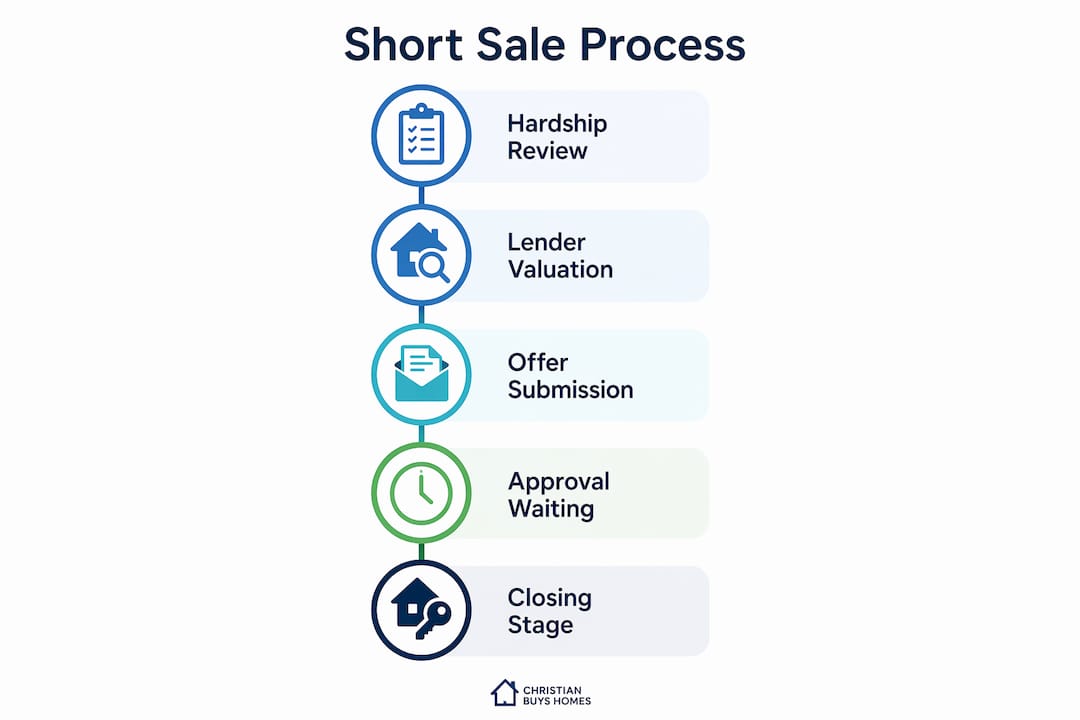
Step-by-step short sale process
- Seller qualifies for hardship. The homeowner contacts their lender and requests short sale consideration. They must prove financial hardship with documentation including a hardship letter, recent bank statements, tax returns, pay stubs, and monthly expense records.
- Lender opens a short sale file. The lender assigns a loss mitigation specialist to review the case. This review typically takes 2–8 weeks and determines whether the seller meets the lender's criteria.
- Property is listed for sale. The seller works with a real estate agent to list the home. The listing price is set to attract offers while reflecting realistic market value.
- Buyer submits an offer. A buyer makes an offer, which the seller can accept or counter. The accepted offer then goes to the lender for approval. The lender is not bound by the seller's acceptance.
- Lender orders a valuation. The lender commissions a Broker Price Opinion or a full appraisal to verify the offer reflects fair market value. This lender valuation step takes 4–12 weeks and introduces significant unpredictability.
- Investor consent is obtained. If the loan has been sold to an investor such as Freddie Mac, that investor must also approve the reduced payoff. This adds another layer of review.
- Lender issues approval letter. Once all parties agree, the lender issues a written approval letter specifying the accepted sale price, closing deadline, and any conditions.
- Closing occurs. The transaction closes like a standard sale. The lender receives the net proceeds, and the seller walks away with no equity but, ideally, a deficiency waiver in hand.
Short sale timeline at a glance
| Phase | Typical duration |
|---|---|
| Hardship review | 2–8 weeks |
| Lender review and valuation | 4–12 weeks |
| Investor consent | 1–4 weeks |
| Closing | 2–6 weeks |
| Total estimated range | 3–9 months |
Pro Tip: Submit a complete hardship package on day one. Complete hardship packages improve lender approval chances and speed processing. Missing documents are the single most common cause of avoidable delays.
Multiple lienholders add another layer of complexity. If the property carries a second mortgage, a home equity line of credit, or a tax lien, each lienholder must consent to accept less than what they are owed. Negotiating with three separate creditors simultaneously is common in Southern California markets where homeowners frequently tapped home equity during peak price years.
For a broader picture of what the home sale timeline looks like from listing to closing in Southern California, the steps share some overlap with a standard sale but diverge sharply once lender approval enters the picture.
What are the risks and downsides of short sales?
Short sales carry real risks for both sellers and buyers. Understanding those risks before entering the process prevents costly surprises.
Risks for sellers
- Credit score damage. Even though a short sale causes less damage than foreclosure, a 100–150 point drop still affects loan eligibility for years. FHA loan waiting periods after a short sale run approximately 3 years with a 10% down payment, while conventional loan waiting periods can be shorter with documented extenuating circumstances.
- Deficiency liability. If the lender does not waive the deficiency, the seller may owe the difference between the sale price and the original loan balance. That gap can reach tens of thousands of dollars. Sellers should insist on written deficiency waivers to avoid future legal or financial exposure.
- Tax consequences. Forgiven debt may be treated as taxable income under IRS rules, depending on the seller's circumstances and applicable exemptions. Consulting a tax advisor before closing is not optional.
- Loss of sale proceeds. The seller receives no money from the transaction. Every dollar goes to the lender.
Risks for buyers
- Deal cancellation. The lender can reject the offer even after the seller accepts it. Buyers face risks including possible deal cancellation, lender-required higher offers, and long approval timelines. A buyer who has already paid for an inspection and appraisal can lose those costs with no recourse.
- Extended waiting periods. Buyers who need to move by a specific date are poorly suited for short sales. The timeline is controlled by the lender, not the parties at the table.
- Property sold as-is. Most lenders require short sale properties to be sold without repairs or credits. Buyers accept the home in its current condition.
The short sale vs foreclosure comparison consistently favors the short sale for sellers on credit impact and legal exposure. For buyers, foreclosure auctions can offer steeper discounts but carry far greater property condition risk and no inspection contingency.
How can buyers and sellers prepare for a short sale successfully?
Preparation is the single biggest factor separating short sales that close from those that collapse. Most sellers mistakenly expect short sales to be fast and simple, but they require transparency, patience, and full documentation due to lender control.
Pro Tip: Hire a real estate agent who has closed multiple short sales, not just one who has heard of them. Experienced agents and legal advisors improve negotiation success, mitigate risks, and help buyers and sellers set realistic expectations.
For sellers
- Gather all financial documentation before contacting the lender. Bank statements, tax returns, pay stubs, and a written hardship letter should be ready on day one.
- Understand your state's deficiency laws before signing anything. Some states limit lender recourse after a short sale; others do not.
- Price the home realistically. An inflated listing price wastes months and invites lender rejection. Review the current market snapshot for your area to set an accurate baseline.
- Communicate with your lender's loss mitigation department regularly. Silence creates delays.
For buyers
- Get pre-approved for financing before submitting an offer. Lenders take pre-approved buyers more seriously and process their files faster.
- Avoid lowball offers. The lender's valuation will anchor the acceptable price range, and offers far below that range are rejected outright.
- Build flexibility into your moving timeline. Assume the process will take longer than the estimate.
- Conduct a thorough inspection before the lender issues final approval. Discovering major defects after approval leaves you with limited options.
Understanding proper timing when selling also applies to short sales. Listing during peak buying seasons in Southern California can attract stronger offers and reduce the time the lender file sits idle.
Closing a short sale successfully also depends on how well the parties close real estate deals under pressure. The negotiation dynamics differ from a standard transaction, and preparation on both sides determines the outcome.
Key Takeaways
A short sale is a lender-controlled transaction that protects sellers from foreclosure but demands patience, full documentation, and realistic expectations from both buyers and sellers.
| Point | Details |
|---|---|
| Definition and purpose | A short sale lets a homeowner sell below mortgage balance with lender approval to avoid foreclosure. |
| Credit impact | A short sale drops credit scores 100–150 points, far less than the 200–300+ point drop from foreclosure. |
| Process timeline | Expect 3–9 months from listing to closing due to lender review, valuation, and investor consent steps. |
| Deficiency risk | Sellers must obtain a written deficiency waiver to avoid owing the remaining loan balance after closing. |
| Buyer preparation | Buyers should get pre-approved, avoid lowball offers, and build a flexible timeline before entering a short sale. |
Short sales are not shortcuts: what I've learned from the field
After working with homeowners across Los Angeles and Orange County, the pattern I see most often is this: sellers come to me after months of denial, hoping a short sale will resolve everything quickly. It rarely does. What it does do, when handled correctly, is give a seller a dignified exit from a situation that would otherwise end in foreclosure.
The most underestimated part of the process is the lender's internal timeline. You can submit a perfect hardship package, price the home correctly, and find a motivated buyer within two weeks. Then you wait. The lender's loss mitigation department operates on its own schedule, and no amount of follow-up will change that. What you can control is the quality of your documentation and the experience of your agent.
I have seen short sales fall apart at the final stage because the seller did not secure a deficiency waiver in writing. The lender approved the sale, the deal closed, and then the seller received a collection notice six months later for the remaining balance. That outcome is avoidable. Get the waiver in writing before you sign anything.
For buyers, my honest advice is to treat a short sale offer like a lottery ticket with good odds. The property may be priced attractively, but the lender controls the outcome. Stay patient, stay pre-approved, and do not cancel your other property searches while you wait. The buyers who succeed in short sales are the ones who stay ready without becoming emotionally attached to a single outcome.
Short sales are not the right solution for every distressed homeowner. But for sellers who have the time, the documentation, and the right guidance, they remain one of the most effective ways to avoid foreclosure and protect long-term financial recovery.
— Irvin Nierras
Buying or selling a home in Southern California? Increaltors can help.
Navigating a short sale or any complex property transaction requires local expertise and access to current listings. Increaltors, led by agent Irvin Nierras of HomeSmart Evergreen Realty, specializes in residential transactions across Los Angeles, Orange County, and surrounding Southern California markets.

Whether you are a buyer searching for single-family homes for sale or a seller evaluating your options before financial hardship escalates, Increaltors provides personalized guidance at every stage. Browse the full homes for sale listings to see current inventory, or request a free home valuation to understand your equity position before making any decisions. Contact Irvin Nierras directly for a no-pressure consultation tailored to your situation.
FAQ
What does "short" mean in a short sale?
"Short" refers to the sale proceeds falling short of the mortgage balance owed, not the length of the transaction. The process typically takes 3–9 months due to lender review and approval requirements.
How does a short sale affect my credit score?
A short sale lowers a credit score approximately 100–150 points. That is significantly less damage than a foreclosure, which causes a 200–300+ point drop and longer mortgage waiting periods.
Can a lender reject a short sale offer?
Yes. Lenders are not obligated to accept any offer, even one the seller has already agreed to. The lender controls final approval and may require a higher offer based on their property valuation.
What is a deficiency judgment in a short sale?
A deficiency judgment is a court order requiring the seller to pay the difference between the short sale price and the original mortgage balance. Sellers should negotiate a written deficiency waiver before closing to avoid this liability.
How is a short sale different from foreclosure?
A short sale is a voluntary, negotiated transaction where the homeowner participates in the sale. Foreclosure is a legal process where the lender seizes and sells the property, causing greater credit damage and legal consequences for the seller.