
TL;DR:
- A pending sale means the seller has accepted an offer and the property is under contract but not yet closed.
- It indicates the transaction is underway but still could fall through before completion.
A pending sale means the seller has accepted an offer and the property is under contract, but the transaction has not yet closed. The listing is spoken for, but it is not sold. That distinction matters for everyone involved.
For buyers: The home is effectively off the market, though it can still fall through. Backup offers are sometimes possible.

For sellers: You are moving toward closing. Depending on your contract and agent's advice, you may or may not continue showings or accept additional offers.
Quick summary:
- Pending = accepted offer + under contract, not yet closed
- Buyers can sometimes submit backup offers, but odds are slim
- Most pending sales close in 30–60 days
- Sales can still fall through due to financing, inspections, or title issues
- "Pending" is not the same as "contingent" or "sold"
Table of Contents
- What does "pending sale" mean on a listing?
- How does "pending" differ from "contingent" and "under contract"?
- What a pending sale means if you're a buyer
- What a pending sale means if you're a seller
- How long does a pending sale typically last?
- Why do pending sales fall through?
- What happens after pending: steps to closing
- Questions to ask your agent during a pending sale
- How pending status affects pricing and negotiations
- How pending sale procedures vary across U.S. states
- Key Takeaways
- The real difference between "pending" and "sold"
- Ready to navigate your next pending sale with confidence?
- Useful sources and further reading
What does "pending sale" mean on a listing?
When you see a property marked as pending on a listing site, it signals that the seller has accepted an offer and both parties have signed a purchase contract. According to Capital One's real estate guide, a pending sale means the transaction is underway but has not yet reached the finish line.
On most Multiple Listing Service (MLS) platforms, the pending status is applied after the buyer's contingencies are cleared or waived. Some MLS systems apply it immediately upon contract execution, even if contingencies are still active. The exact trigger depends on local MLS rules and how the listing agent updates the status.
A pending listing almost always means there is an accepted and binding contract between buyer and seller. Both parties have signed and are ready to move forward, but boxes still need to be checked before the sale is final.
You will also see sub-labels on some platforms. "Pending — taking backups" means the seller is still open to additional offers. "Pending — do not show" signals the seller and buyer are confident the deal will close and have stopped showings.
Pro Tip: Call the listing agent directly before writing off a pending property. Ask whether contingencies are still active and whether the seller is accepting backup offers. The MLS label alone does not tell the full story.
How does "pending" differ from "contingent" and "under contract"?
These three terms describe different stages of the same process, and confusing them can cost you time or opportunity.
According to Rocket Mortgage, pending status is typically applied after buyer contingencies are cleared or waived, while a contingent listing still has unresolved conditions attached. SoFi's explainer puts it plainly: contingent offers involve unresolved conditions, while pending offers have typically cleared or waived those conditions.
Here is how the three statuses compare in practice:
- Contingent: Seller accepted an offer, but conditions remain (financing approval, home inspection, appraisal, or sale of the buyer's current home). The deal can still unravel easily. Buyers may have an opportunity to submit competing offers.
- Under contract: Often used interchangeably with "contingent" or "pending" depending on the market. Generally means a signed agreement exists, but the specific stage varies by region and MLS.
- Pending: Contingencies are resolved or waived. The sale is in its final processing stage. Backup offers are less commonly accepted, though not impossible.
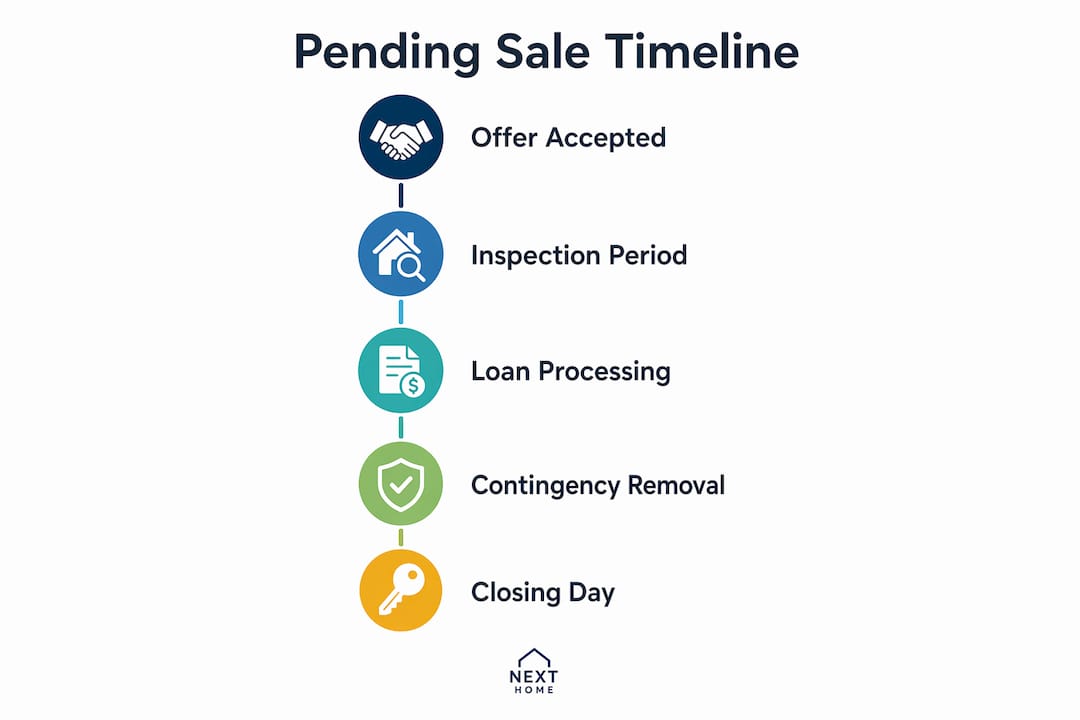
A typical listing moves through these stages in sequence: the buyer makes an offer, the seller accepts, and the listing goes contingent. Once the inspection clears, financing is approved, and the appraisal comes in at value, the listing moves to pending. When the deed records, it becomes sold.
The practical takeaway for buyers: a contingent listing gives you more realistic options than a pending one. A pending listing is closer to the finish line, and the seller is unlikely to entertain new offers unless something goes wrong.
What a pending sale means if you're a buyer
Seeing "pending" on a listing you love is frustrating, but it does not always mean the door is closed. According to Realtor.com, a pending sale can still fall through due to financing denial, appraisal shortfalls, title issues, or missed contingency deadlines.
When it makes sense to pursue a pending property:
- The home has been pending for an unusually long time (more than 60 days), which may signal trouble
- The listing says "pending — taking backups"
- You have strong financing and can move quickly if the deal collapses
- There are few comparable alternatives in the area
How backup offers work: A backup offer is a formal, signed offer that moves to the front of the line if the primary contract falls through. The seller must agree to accept backup offers, and your agent should submit one in writing with all terms clearly stated. You are not obligated to buy if the primary deal closes, but you need to be prepared to act fast if it does not.
Due diligence while you wait: If you submit a backup offer, use the waiting period wisely. Get your financing pre-approval updated, review any publicly available disclosures, and confirm your lender can close quickly. The real estate offer process in Southern California moves fast, and a prepared buyer with clean financing is far more attractive than one who needs extra time.
Pro Tip: When submitting a backup offer, include an expiration date. This protects you from being locked in indefinitely while the primary deal drags on.
What a pending sale means if you're a seller
Once your listing goes pending, your focus shifts from attracting buyers to closing the deal you have. That said, a few strategic decisions still require your attention.
Seller checklist during the pending stage:
- Confirm all agreed repairs are scheduled and completed before the final walkthrough
- Gather required documents: title report, HOA disclosures, permit history, and any seller disclosures not yet delivered
- Stay in close contact with your agent about the buyer's loan status and appraisal timeline
- Decide whether to accept backup offers and communicate that decision clearly through your agent
- Review your seller closing process checklist so nothing surprises you at the table
On showings: whether to keep showing the home depends on how confident you are in the current buyer. If the buyer's financing looks solid and contingencies are cleared, stopping showings makes sense. If the deal feels shaky, keeping the home available and accepting a backup offer gives you a safety net. Rocket Mortgage notes that "pending — taking backups" is a recognized MLS status precisely because sellers sometimes need that option.
Accepting a backup offer does not mean you are abandoning the primary buyer. It means you have a plan if things go sideways. That leverage can also motivate the primary buyer to resolve any outstanding issues promptly.

How long does a pending sale typically last?
Most pending home sales close within 30–60 days, with the industry average for conventional mortgages is typically around six weeks from signed contract to recorded deed. Cash deals can close much faster, often in a matter of a few weeks, because they skip the lender underwriting process entirely.
| Financing Type | Typical Pending Duration | Key Timing Driver |
|---|---|---|
| Conventional loan | 30–60 days | Underwriting, appraisal, title |
| FHA / VA loan | 30–60 days | Additional lender requirements |
| Cash purchase | 7–21 days | Title clearance only |
| Complex / extended | 60+ days | Agreed extensions, repair disputes |
The milestones that control the schedule are predictable. The inspection period usually runs 7–17 days. Loan contingency deadlines typically fall around day 21. The appraisal follows shortly after, and title clearance wraps up in the final week before closing. Federal law requires lenders to deliver a Closing Disclosure at least three business days before signing, which creates a minimum waiting period that cannot be waived for financed purchases.
Pending periods can extend beyond 60 days when both parties agree, such as when a seller is building a new home and needs extra time before vacating. The contract governs the timeline, and no deadline automatically voids the agreement without a formal termination.
Why do pending sales fall through?
Most pending sales close without incident, but a meaningful share do not. The most common failure points are financing denial, appraisal shortfalls, title problems, inspection disputes, and missed contingency deadlines.
- Financing denial: The buyer's loan approval is conditional. A job change, new debt, or a drop in credit score between contract and closing can trigger a denial.
- Appraisal shortfall: If the appraised value comes in below the purchase price, the buyer may need to cover the gap in cash or renegotiate. If neither party budges, the deal can collapse.
- Title issues: Undisclosed liens, boundary disputes, or errors in public records can delay or kill a closing.
- Inspection disputes: Major defects discovered during inspection can lead to repair requests the seller refuses, giving the buyer grounds to exit.
- Missed contingency deadlines: This one carries real financial consequences.
On a home purchase with a typical earnest money deposit, missing a contingency deadline can put the earnest money at risk of forfeiture. If a buyer misses a deadline after it expires, the seller may have a strong legal right to retain that deposit.
Watch for these red flags: a buyer who delays scheduling the inspection, a lender who is slow to issue a loan commitment, or a title report that comes back with exceptions. Any of these signals that the pending period may extend or the deal may unravel.
What happens after pending: steps to closing
Once the pending stage wraps up and the lender issues a "clear to close," the transaction moves into its final sprint. Here is what both parties should expect:
- Clear to close: The lender confirms all underwriting conditions are satisfied. This is the green light.
- Closing Disclosure review: The buyer receives the Closing Disclosure at least three business days before signing. Review every line carefully.
- Final walkthrough: Typically 24 hours before closing, the buyer confirms the property's condition matches the contract and agreed repairs are complete.
- Signing and funding: Both parties sign documents. The buyer wires closing funds. The lender releases the loan proceeds.
- Deed recording: The county records the deed, officially transferring ownership. In most states, keys transfer at recording. In some U.S. states, a practice called "dry funding" delays key handover until funds are confirmed, key handover may be delayed until funds are confirmed by the lender.
Post-closing occupancy agreements, sometimes called rent-backs, allow the seller to remain in the home after closing. These commonly run 30–60 days, and lenders often set limits on buyer-occupied financing arrangements for primary residences, typically around two months. The daily rate is typically calculated from the buyer's monthly mortgage payment divided by 30.
For a detailed buyer closing checklist, review each step with your agent well before the closing date.
Questions to ask your agent during a pending sale
Good agent communication during the pending stage is the single biggest factor in avoiding last-minute surprises. Here is what to ask and what your agent should be monitoring.
For buyers, ask your agent:
- Has the lender issued a loan commitment, or are conditions still outstanding?
- Has the appraisal been ordered, and what happens if it comes in low?
- Are all inspection repairs confirmed in writing?
- What is the current status of the title search?
- What is our contingency deadline, and what happens if we miss it?
For sellers, ask your agent:
- Is the buyer's lender on track, and have they cleared underwriting conditions?
- Has the buyer scheduled and completed the inspection?
- Are there any title exceptions we need to address?
- Should we keep showing the home or accept a backup offer?
In Southern California markets, document turnaround times and escrow coordination move quickly. Los Angeles and Orange County escrow companies typically handle both the title and closing functions, which differs from attorney-closing states on the East Coast. Knowing your escrow officer's name and direct contact from day one keeps communication tight and avoids delays.
How pending status affects pricing and negotiations
A pending listing does not disappear from the market's memory. Pending sales feed directly into comparable sales data, and appraisers use recently pending and closed transactions to establish value for nearby properties. When a home goes pending at a price above asking, it signals demand and can push neighboring sellers to price more aggressively.
For the buyer in the pending transaction, the appraisal is the critical pricing checkpoint. If the home appraises below the contract price, the buyer and seller must negotiate the gap. The seller can lower the price, the buyer can pay the difference in cash, or the deal falls apart. In competitive Southern California markets, buyers sometimes waive the appraisal contingency to strengthen their offer, which removes that renegotiation option entirely.
Sellers should also know that a failed pending sale can affect perception. A home that returns to active status after a lengthy pending period often draws questions from subsequent buyers about what went wrong. Pricing the home accurately from the start and vetting buyer financing carefully before accepting an offer reduces that risk considerably.
How pending sale procedures vary across U.S. states
The pending stage looks different depending on where the property is located. State law, local MLS rules, and regional customs all shape the process.
Attorney vs. escrow states: In states like New York, Massachusetts, and Georgia, attorneys handle the closing process. In California, Arizona, and most Western states, escrow companies manage the transaction. The escrow model tends to be more streamlined for routine residential sales.
Dry vs. wet funding: Most states use wet funding, meaning the lender releases funds at signing. In dry funding states, the lender may take an additional day or two to confirm funds before the deed records and keys transfer. This distinction matters for move-in planning.
Contingency timelines: Standard contingency periods vary by state and even by local market. In California, the standard purchase agreement sets a 17-day inspection contingency and a 21-day loan contingency by default, though these are negotiable. In Texas, the option period (a buyer's right to terminate for any reason) is typically 5–10 days and requires a separate option fee.
MLS status labels: Not every MLS uses identical terminology. Some use "active under contract" instead of "contingent," and others skip the contingent status entirely, moving directly to pending. Always confirm the exact status and its meaning with the listing agent rather than relying on the label alone.
Key Takeaways
A pending sale means the seller has accepted an offer and the transaction is under contract, but the deal is not final until the deed records and both parties have fulfilled every contractual obligation.
| Point | Details |
|---|---|
| Pending vs. sold | Pending means under contract, not closed; the sale can still fall through before the deed records. |
| Typical timeline | Most conventional loan closings take 30–60 days; cash deals can close in as little as two to three weeks. |
| Earnest money risk | Missing a contingency deadline can put the earnest money deposit at risk of forfeiture. |
| Backup offers | Buyers can submit backup offers on pending listings; confirm with the listing agent whether the seller is accepting them. |
| Increaltors guidance | Increaltors, led by Irvin Nierras, provides buyer representation and closing coordination across Southern California to help clients navigate every stage of a pending transaction. |
The real difference between "pending" and "sold"
Most people treat a pending listing as a closed door. In practice, it is more like a door that is almost closed. The gap between "pending" and "sold" is where deals are won and lost, and the agents and clients who understand that gap have a real advantage.
What often goes unnoticed is how much the pending stage reveals about the health of a transaction. A buyer who drags their feet on scheduling the inspection, or a lender who is slow to issue a commitment letter, is signaling risk. Sellers who ignore those signals and stop all showings can find themselves back at square one weeks later. The smarter move is to stay engaged, keep communication open, and treat every pending milestone as a checkpoint rather than a formality.
For buyers on the outside looking in, a pending listing is not always a dead end. In markets where inventory is tight, the willingness to submit a strong backup offer and stay ready to move fast has resulted in buyers landing homes they thought were gone. Preparation and persistence, not luck, tend to determine who gets the call when a deal falls apart.
Ready to navigate your next pending sale with confidence?
Whether you are a buyer hoping to land a backup offer or a seller managing the final stretch to closing, having the right agent in your corner makes all the difference. Increaltors, led by Irvin Nierras, specializes in buyer representation, listing support, and closing coordination across Los Angeles, Orange County, and surrounding Southern California communities. From submitting a competitive backup offer to keeping your escrow on track, the team brings local expertise and personal dedication to every transaction.

If you are ready to search active and pending listings in Southern California, browse current homes for sale or get a free home valuation to understand where your property stands in today's market. Reach out to Irvin Nierras directly to discuss your situation and get a clear, personalized plan.
Useful sources and further reading
These are the primary sources cited throughout this article, along with Increaltors' own guides for buyers and sellers navigating the pending stage.
- LegalClarity: How Long Does a Pending Sale Take to Close? — Covers closing timelines, earnest money risk, and the Closing Disclosure requirement. Useful for understanding the financial and legal mechanics of the pending period.
- Capital One: What Does Pending Mean in Real Estate? — Clear, consumer-friendly definition of pending status and how it differs from a completed sale.
- Rocket Mortgage: What Does Pending Mean in Real Estate? — Explains the contingent-to-pending transition and backup offer mechanics.
- Realtor.com: What Does Sale Pending Mean? — Practical buyer perspective on pursuing pending listings and common failure modes.
- SoFi: Difference Between Pending and Contingent — Side-by-side comparison of contingent and pending statuses with clear definitions.
- Increaltors: Real Estate Listing Types in Southern California — Explains how MLS listing statuses work in the SoCal market specifically.
- Increaltors: House Closing Process for Buyers — Step-by-step buyer closing guide from contract to keys.
- Increaltors: Seller Closing Process Workflow — Detailed seller-side checklist and timeline for the closing process.