

Passive real estate investing means putting your capital into professionally managed property vehicles so you earn income without handling tenants, repairs, or daily operations. The IRS classifies rental income as passive by default under IRC 469(c)(2), which shapes how gains and losses flow through your tax return. As Keith Feinberg notes, even "passive" arrangements often require more involvement than investors expect.
Here's what you need to know upfront:
- Common passive vehicles include publicly traded REITs, real estate syndications, crowdfunding platforms, private funds, and turnkey rentals with property managers.
- Passive does not mean risk-free. Operator quality, market conditions, and illiquidity all affect your outcome.
- A local agent still matters when you're buying or selling residential property in Southern California, even if passive allocations are part of your broader strategy.
Table of Contents
- What is passive real estate investing, and how does it differ from active ownership?
- The main types of passive real estate investments
- Many passive strategies are actually "semi-passive"
- How returns, risks, and U.S. tax rules work for passive investors
- A practical due-diligence checklist for evaluating passive deals
- When to use a local agent versus a passive investment vehicle
- Key Takeaways
- A local agent's perspective on passive investing
- Thinking about buying or selling in Southern California?
- Useful sources for further reading
What is passive real estate investing, and how does it differ from active ownership?
Active ownership means you buy a property, manage it (or manage the manager), make capital decisions, and carry full operational responsibility. Passive investing flips that equation: you contribute capital, a sponsor or fund manager handles operations, and you receive distributions. You own a slice of the economics without owning the headaches.
The gap between the two is wider than most people realize. An active landlord in Los Angeles might spend significant weekly hours on acquisitions, tenant issues, and maintenance. A passive investor in a syndication reviews a quarterly report. Same asset class, entirely different jobs. For Southern California buyers and sellers who already have demanding careers or are mid-transaction on a primary residence, that distinction often determines which path fits.

The main types of passive real estate investments
Each vehicle below differs in minimum capital, liquidity, and how much control you retain. Understanding these differences before committing capital is the most important step you can take.
| Vehicle | Typical Minimum | Liquidity | Best For |
|---|---|---|---|
| Publicly traded REITs / ETFs | $1 (share price) | Daily market liquidity | Any investor; most liquid option |
| Non-traded REITs | — | Limited; periodic redemption windows | Income-focused investors comfortable with lock-ups |
| Private funds | — | Illiquid; multi-year hold | Accredited investors seeking diversification |
| Syndications (LP/GP) | — | Illiquid; 3–7 year hold typical | Accredited investors; real estate syndication seekers |
| Crowdfunding platforms | — | Varies by platform and deal | Smaller investors; early-stage exposure |
| Turnkey rentals + manager | — | Illiquid (sell to exit) | Investors wanting direct ownership with less day-to-day work |
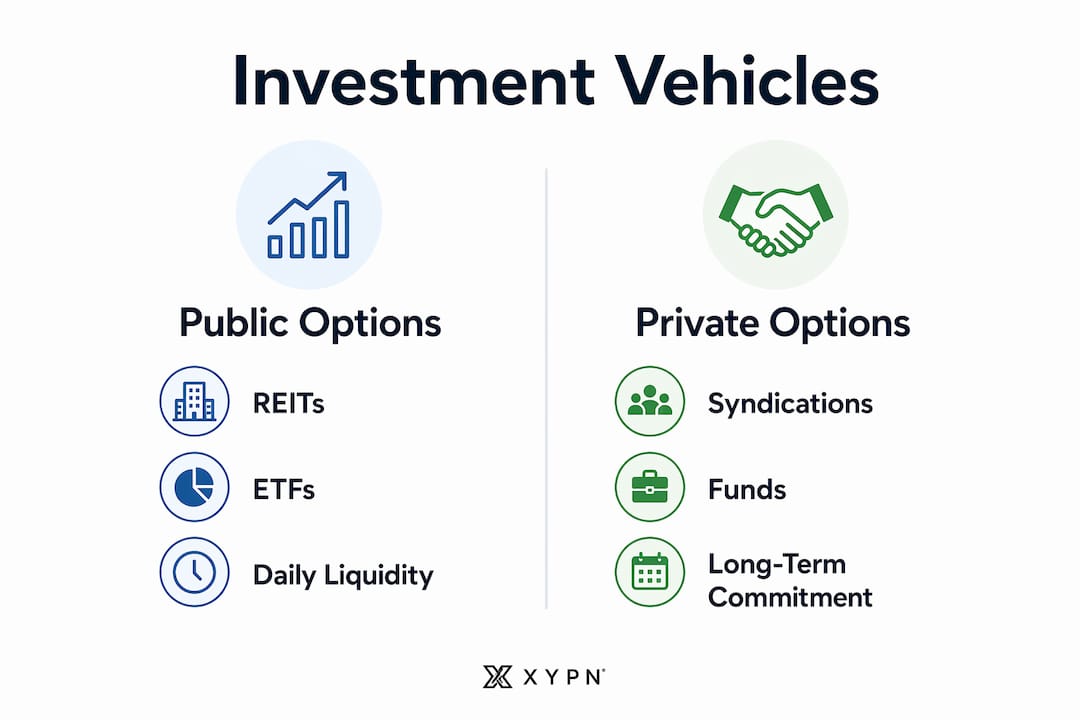
Publicly traded REITs offer the closest thing to truly passive real estate exposure, with daily liquidity similar to buying a stock. Private syndications and funds sit at the opposite end: capital is locked up for years, and your exit depends on the sponsor's timeline. Crowdfunding platforms like those covered in our real estate crowdfunding guide lower the entry bar significantly, though deal quality varies widely.
In a syndication, you invest as a limited partner (LP) while the general partner (GP) or sponsor manages the asset. You receive distributions and a share of appreciation, but you do not vote on operational decisions. That structure shifts operating responsibilities to the sponsor and introduces operator risk in exchange.
Many passive strategies are actually "semi-passive"
The phrase "passive income" sells a lifestyle that the reality rarely delivers in full. Rental income is more accurately described as "semi-passive," because even with a property manager in place, owners still handle entity management, insurance decisions, and oversight of the manager themselves.
Even with a property manager hired, managed rentals typically demand considerable owner oversight each month. Those hours go toward reviewing financials, approving capital expenditures, handling insurance renewals, and making decisions the manager escalates. Syndication LPs have less to do, but they still need to read offering documents, monitor distributions, and stay alert to capital call provisions.
Pro Tip: Before committing to any passive vehicle, ask yourself honestly how many hours per month you can dedicate to oversight. If the answer is truly zero, a publicly traded REIT or ETF is the only vehicle that matches that expectation.
Cassandra Smalley's guidance is worth keeping in mind here: build liquid savings first before locking capital into illiquid real estate. Overallocating to an illiquid deal early can force an unfavorable sale or borrowing during an emergency.
How returns, risks, and U.S. tax rules work for passive investors
Returns and fees
Passive real estate offerings have historically returned average annualized returns in the 7%–12% range, though results vary significantly by vehicle, market cycle, and sponsor quality. Distributions typically arrive quarterly and represent a blend of rental income and return of capital. Appreciation is realized at exit, which may be years away.
Fees erode those returns more than most investors model. Sponsor fees in syndications commonly include acquisition fees, asset management fees, and carried interest of varying percentages. Always model net returns after fees, not gross projections from a sponsor's pitch deck.
Key risks to evaluate
- Operator risk: The sponsor's competence and integrity determine your outcome. A well-underwritten deal can still fail with poor management.
- Liquidity risk: Capital committed to a private fund or syndication is locked until the sponsor exits. Cassandra Smalley's point about illiquid real estate stress applies directly here.
- Market risk: Southern California values and rents respond to interest rates, employment, and migration patterns. Geographic concentration amplifies this.
- Regulatory and insurance risk: Residential assets face rent control rules, insurance cost spikes, and zoning changes that can compress returns unexpectedly.
For broader market context on where capital is flowing in 2026, the 2025 commercial real estate outlook from YieldStack offers useful macro perspective on lender appetite and sector recovery.
U.S. tax basics
Under IRC 469(c)(2), rental income is passive by default. Losses from passive activities can only offset passive income, not your W-2 salary. To deduct passive losses against active income, you must qualify as a Real Estate Professional, which requires 750 hours per year in real estate activities and meeting material participation tests under Reg. 1.469-5T. Most Southern California buyers and sellers with full-time careers will not meet that threshold.
Syndication investors receive a K-1 each year, which reports your share of income, losses, and depreciation. Depreciation is a real benefit, but as CPA Nate Sosa advises, evaluate cash flow and appreciation first. Tax optimization is a secondary layer once the deal fundamentals are sound. Always consult a CPA before committing capital to any passive vehicle.
A practical due-diligence checklist for evaluating passive deals
- Request the offering memorandum or PPM. Read the full private placement memorandum, not just the executive summary. Check the waterfall structure, fee schedule, and capital call provisions.
- Verify the sponsor's track record. Ask for audited financials on prior deals, realized (not projected) returns, and actual exit timelines versus original projections.
- Check references. Speak with investors from prior deals, not references the sponsor hand-picks.
- Review the pro-forma cash flows critically. Ask what assumptions drive the numbers: rent growth, vacancy, cap rate at exit. Stress-test the model at lower rents and higher cap rates.
- Clarify liquidity and exit options. What is the planned hold period? Are there redemption features? Is there a secondary market? What triggers a capital call?
- Scrutinize related-party transactions. Undisclosed fees paid to sponsor affiliates are a red flag. The PPM must disclose all related-party relationships.
- Confirm insurance and reserve policies. Ask for the current insurance coverage summary and the reserve fund balance. Underfunded reserves become investor capital calls.
- Look for co-investing communities. Co-investing groups pool due-diligence work across members, which can sharpen your vetting and surface red flags faster.
When to use a local agent versus a passive investment vehicle
These two paths serve different goals, and for many Southern California buyers and sellers, they work best together.
Use a local agent when you are:
- Buying or selling a primary residence in Los Angeles or Orange County.
- Sourcing off-market investment properties where local relationships matter.
- Planning a 1031 exchange tied to a property sale and need help identifying replacement assets.
- Negotiating in a specific SoCal micro-market where pricing nuance is everything.
Passive investing fits better when you are:
- Fully employed and have no bandwidth for landlord responsibilities.
- Seeking geographic diversification beyond Southern California.
- Allocating capital for a longer time horizon (5+ years) and can tolerate illiquidity.
- Building passive income from California real estate as a complement to your primary residence equity.
The hybrid approach is often the smartest move. Work with a local agent for your transaction, then allocate a portion of net proceeds into a diversified passive vehicle. Local expertise handles the deal; passive exposure handles the long-term wealth building. Our investment tips for LA and OC walk through how to structure that balance practically.
Key Takeaways
Passive real estate investing gives you income from property without operational responsibility, but liquidity, operator quality, and tax rules require careful evaluation before you commit capital.
| Point | Details |
|---|---|
| Default IRS classification | Rental income is passive under IRC 469(c)(2); losses offset only passive income unless you qualify as a Real Estate Professional. |
| Return expectations | Passive vehicles have historically delivered average annualized returns in the 7%–12% range; always model net of sponsor fees. |
| Semi-passive reality | Managed rentals still require considerable owner oversight each month even with a property manager in place. |
| Vet operators first | Request audited financials, realized returns on prior exits, and independent references before committing capital. |
| Increaltors local expertise | For Southern California transactions, 1031 planning, or sourcing investment properties, Increaltors connects you with trusted local guidance in LA and Orange County. |
A local agent's perspective on passive investing
Passive real estate options get a lot of attention right now, and for good reason. Southern California property values mean that many homeowners are sitting on significant equity, and the question of what to do with that capital after a sale is genuinely important. What I see in practice, though, is that passive vehicles work best as a complement to a clear transaction strategy, not a substitute for one.
If you're selling a home in LA or Orange County and considering redeploying proceeds into a syndication or fund, the sequence matters. Getting the sale right, pricing accurately, timing the market, and negotiating effectively, creates the capital base that passive investing then grows. Skipping that step or rushing a sale to chase a passive deal is where I've seen clients leave real money behind.
The other thing worth saying plainly: passive does not mean safe. The deals that look the most effortless on a pitch deck often carry the most operator risk. Before you wire capital to any sponsor, have a CPA review the structure and a local agent help you understand whether a direct SoCal acquisition might serve you better for your specific goals.
Thinking about buying or selling in Southern California?
If you're weighing passive options while also considering a property transaction in Los Angeles or Orange County, Increaltors offers the local market knowledge to help you make that decision clearly. Whether you're looking to browse available homes, explore single-family investment properties, or get a current home valuation before deciding whether to sell and redeploy capital, Irvin Nierras and the Increaltors team are ready to help.

Local expertise, personalized guidance, and a clear next step: that's what we bring to every conversation. Reach out today to discuss your goals and get a market snapshot tailored to your neighborhood.
Useful sources for further reading
- Tax questions: IRC 469 passive activity rules and Real Estate Professional status — The Real Estate CPA's plain-language breakdown of how the IRS classifies rental income and what REPS qualification requires.
- Liquidity and vehicle comparison: Passive vs. DIY rentals — BiggerPockets covers the liquidity spectrum from traded REITs to private syndications.
- Semi-passive reality check: Real Estate Isn't as Passive as Everyone Says It Is — Cassandra Smalley's honest assessment of what "passive" actually demands.
- Operator vetting and due diligence: Passive Investing vs. DIY Landlording — Rooster Equity's comparison of managed rentals and syndication LP structures.
- Return expectations: What is passive real estate investing? — Rocket Mortgage's overview of typical return ranges and vehicle mechanics.
- SoCal passive income tactics: Achieve passive income with California real estate — Increaltors blog post with local examples and action steps.
- Portfolio diversification: Why diversify your real estate portfolio — Increaltors guide on balancing passive and active holdings for better long-term returns.
This article is general information, not legal, tax, or financial advice. Consult a licensed CPA or financial advisor and verify current IRS rules for your specific situation before committing capital to any investment.