
Legal compliance in real estate means adhering to every applicable federal, state, and local law, regulation, and professional standard that governs how you buy, sell, lease, manage, market, and maintain property. For brokers, property managers, agents, and investors, compliance is jurisdiction-specific and demands an active, ongoing program rather than a one-time checklist you file away and forget.
Here is what that looks like in practice:
- Brokers must supervise agents, maintain trust accounts, and meet state licensing requirements.
- Property managers carry Fair Housing obligations, habitability standards, and local rental-registration duties.
- Agents must deliver accurate disclosures, follow advertising rules, and avoid steering or discriminatory practices.
- Investors need to track zoning, environmental rules, and anti-money-laundering obligations tied to transactions.
Two non-negotiable starting points for almost every practitioner: the Fair Housing Act and your local permit and inspection requirements. Get those right first, then build outward.
Table of Contents
- Why does legal compliance matter for real estate professionals?
- Who must comply, and how do jurisdictional layers shape your obligations?
- What federal laws and local rules do most practitioners need to know?
- How do you build a compliance program that actually works?
- What concrete steps should you take right now?
- What do compliance failures actually cost?
- What should you do when you find a compliance gap or receive an enforcement notice?
- Key Takeaways
- A practitioner's perspective on building compliance into daily practice
- Authoritative sources and further reading
Why does legal compliance matter for real estate professionals?
Compliance is not just about avoiding fines. Industry legal experts frame it as strategic risk management that supports market integrity, equitable housing access, and stakeholder protection. The business case is equally clear: compliant transactions close faster, attract better investors, and build the kind of reputation that generates referrals.

The stakes when things go wrong are serious. Under the Fair Housing Act, the U.S. Department of Justice can pursue civil penalties, and private plaintiffs can sue for actual damages, punitive damages, and attorney's fees. License suspension or revocation is a real outcome for repeated or willful violations, not just a theoretical threat. Beyond fines, a single discrimination complaint can stall a closing, trigger a regulatory audit, and generate press coverage that damages your practice for years.

Who must comply, and how do jurisdictional layers shape your obligations?
Every person who touches a real estate transaction carries some compliance duty. The California DRE makes this explicit: a broker of record has a non-delegable duty of reasonable supervision over every salesperson and employee. If a subordinate violates the law, the broker can be held personally liable. That principle applies in most states, not just California.
Federal law sets the baseline floor. State statutes add requirements on top. Local ordinances add another layer, and they vary dramatically from one city to the next.
| Role | Primary compliance duties | Examples of local requirements |
|---|---|---|
| Broker of record | Supervision, trust accounts, licensing | State DRE rules, local trust-account handling |
| Property manager | Fair Housing, habitability, disclosures | Rental registration, short-term rental permits |
| Agent / salesperson | Disclosures, advertising, anti-discrimination | Local MLS rules, city transfer-tax forms |
| Investor / owner | Zoning, environmental, AML obligations | Permit compliance, local rental ordinances |
| Vendor / contractor | Licensing, insurance, code compliance | City contractor licensing, inspection sign-offs |
The key insight here: you cannot rely on a single-state summary to cover all your obligations. A property in Los Angeles carries California DRE rules, Los Angeles city zoning codes, and federal Fair Housing requirements simultaneously. Each layer must be checked independently.
What federal laws and local rules do most practitioners need to know?
Core federal statutes every real estate professional should understand:
- Fair Housing Act (HUD/DOJ): Prohibits discrimination based on race, color, national origin, religion, sex, familial status, and disability in the sale, rental, and financing of housing. Applies to virtually every residential transaction.
- Americans with Disabilities Act (ADA): Governs physical accessibility for commercial properties and common areas. The ADA National Network provides compliance guidance and technical standards.
- RESPA (Real Estate Settlement Procedures Act / CFPB): Requires specific disclosures at loan application and closing, prohibits kickbacks and unearned referral fees, and governs escrow account management.
- Environmental regulations: Federal rules on wetlands (Army Corps of Engineers), asbestos in pre-1978 structures, and lead-based paint disclosure requirements affect transactions and renovations.
- FinCEN / Anti-Money-Laundering (AML): Geographic Targeting Orders require title insurance companies in certain markets to identify the beneficial owners behind cash purchases. Investors and brokers in high-value markets should understand when these obligations are triggered.
Common local requirements to track:
- Building codes and certificate-of-occupancy requirements
- Permit and inspection timelines (especially for renovations and additions)
- Zoning and land-use restrictions, including short-term rental ordinances
- Local rental registration and habitability inspection programs
- Local licensing renewals and continuing-education deadlines
For California practitioners, the 2026 Real Estate Law compilation is the go-to reference for state statutes and DRE regulations. For disclosure obligations specifically, the Increaltors guide on real estate disclosures walks through what buyers and sellers are legally required to receive.
How do you build a compliance program that actually works?
Research from Grant Thornton identifies six essential elements for a real estate compliance program. Here is how each one maps to daily operations:
| Element | Key actions | Compliance KPI to track |
|---|---|---|
| Diagnostics (risk mapping) | Audit current transactions, licenses, and permits for gaps | Number of open compliance gaps identified |
| Policies and procedures | Document written policies for trust accounts, disclosures, and Fair Housing | Policy review completion rate (annual) |
| Role-specific training | Train agents on Fair Housing, RESPA, and local rules quarterly | % of staff with current training certificates |
| Control testing and monitoring | Spot-check transaction files, trust account reconciliations, and ad copy | Monthly reconciliation pass rate |
| Continuous annual review | Update policies when laws change; review after any enforcement contact | Days between law change and policy update |
| Executive sponsorship | Assign a designated compliance officer or broker-in-charge | Escalation response time for compliance issues |
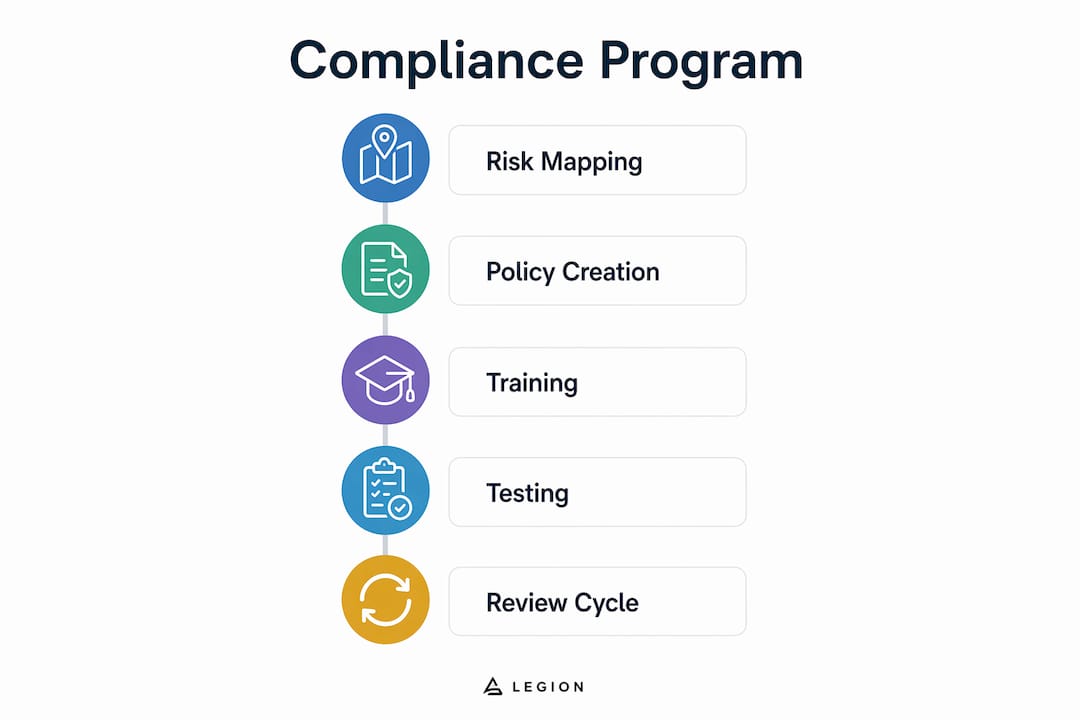
Compliance frameworks fail when treated as static checklists. The cycle of diagnostics, policy creation, training, testing, and annual review must repeat continuously.
Pro Tip: Centralize permit tracking in a single shared dashboard, such as a Google Sheet or a property management platform with task automation. Assign one person to own each permit's deadline and set automated reminders 30 days before expiration. This single habit eliminates most permit-lapse violations.
What concrete steps should you take right now?
Start with a short self-audit using this prioritized checklist:
- Confirm every agent and broker license is current and posted correctly.
- Verify trust account reconciliations are up to date and match ledger records.
- Pull your last three transaction files and check that all required disclosures are signed and dated.
- Review your Fair Housing policy and confirm all agents completed training in the past 12 months.
- List every property under management and confirm local rental registration is current.
- Collect current certificates of insurance from every active vendor and contractor.
- Run a federal tax-lien search on any property where title insurance may not cover post-transfer liens.
Documentation and retention best practices:
- Keep signed disclosure packages, inspection reports, and permit records for at least three years (longer in states with extended statute-of-limitations periods).
- Store transaction files in a centralized, searchable system rather than individual agent folders.
- Maintain a vendor file with current licenses, insurance certificates, and signed contracts for every third-party service provider.
Tool categories worth considering:
- Document management platforms (e.g., Dotloop, DocuSign Rooms): centralize transaction files and create audit trails automatically.
- Permit and inspection trackers: spreadsheet-based or built into property management software; the goal is a single view of every open permit across your portfolio.
- Automated compliance workflows: centralizing documentation and automating vendor-cert collection is now considered a baseline best practice for teams managing more than a handful of properties.
For property management responsibilities that overlap with compliance, Increaltors covers the operational side in detail.
What do compliance failures actually cost?
Common failure modes and their real-world consequences:
Trust fund mishandling is one of the most frequently cited violations in California DRE enforcement actions. Commingling client funds with operating accounts can result in license suspension, civil liability, and criminal referral.
Fair Housing violations carry civil penalties under federal law, plus the cost of litigation, settlement, and mandatory training programs. Reputational damage from a public complaint can reduce referral volume for years.
Missed permits and unpermitted work can block a closing entirely. A buyer's lender may refuse to fund a loan on a property with open permit violations, forcing costly remediation or a price renegotiation at the worst possible moment.
Unlicensed activity in California carries fines up to $20,000 per violation for individuals, and up to $60,000 for corporations, plus potential jail time.
One often-overlooked risk: federal tax liens under 26 U.S.C. § 6323 can survive a property transfer and create post-acquisition liabilities that title insurance does not necessarily cover. Running an independent federal tax-lien search before closing is a straightforward step that protects buyers and investors from an expensive surprise.
For investors, risk management strategies that include insurance layering and attorney-reviewed contracts are the standard approach to shifting exposure on deals with complex compliance profiles.
What should you do when you find a compliance gap or receive an enforcement notice?
Act quickly and methodically. Here is the step-by-step playbook:
- Stop the bleeding. Immediately halt any activity that is causing or worsening the violation (e.g., suspend the advertising campaign, freeze the affected trust account disbursements).
- Preserve all records. Do not delete emails, texts, or documents related to the issue. Create a secure folder and copy everything relevant.
- Identify scope. Determine which transactions, properties, or clients are affected and document the list.
- Notify internal stakeholders. Inform the broker of record and any designated compliance officer immediately. Do not wait for a full picture before escalating internally.
- Acknowledge receipt of any enforcement notice. Meet every deadline stated in the notice. Missing a response deadline almost always makes the outcome worse.
- Produce requested records promptly and completely. Regulators treat incomplete or delayed responses as indicators of bad faith.
- Correct systemic gaps. Once the immediate issue is contained, update the policy or procedure that allowed the violation to occur.
Call an attorney when:
- Criminal exposure is possible (fraud, unlicensed activity, AML violations).
- A license is at risk of suspension or revocation.
- The financial penalty is large enough to threaten the business.
- You receive a formal complaint from HUD, the DOJ, or a state regulatory body.
When you call, bring: the enforcement notice or complaint, the complete transaction file, all communications related to the issue, your current policy documents, and a timeline of events. Counsel will need all of it to assess exposure and advise on a response strategy. Practitioners experienced in real estate risk also recommend being prepared to walk away from transactions where the legal risk cannot be adequately managed or shifted.
Key Takeaways
Legal compliance in real estate requires a continuous, jurisdiction-specific program built on six elements: risk mapping, written policies, role-specific training, control testing, annual review, and clear accountability.
| Point | Details |
|---|---|
| Compliance is continuous | Treat it as a repeating cycle, not a one-time checklist, to stay ahead of law changes. |
| Map jurisdictional layers first | Federal, state, and local rules stack on top of each other; check all three for every property. |
| Centralize documentation | Store all transaction files, disclosures, and vendor certificates in one searchable system. |
| Train staff regularly | Fair Housing and RESPA training should be role-specific and documented multiple times per year. |
| Call counsel early | When license jeopardy or criminal exposure exists, contact a real estate attorney before responding to regulators. |
A practitioner's perspective on building compliance into daily practice
Most compliance problems I see in Southern California real estate don't come from bad intentions. They come from good agents who are moving fast and treating compliance as something to handle after the deal closes. That mindset is exactly backwards.
The six-element framework in this article works because it forces you to build compliance into the front end of every transaction. When your disclosure templates are pre-approved, your trust account reconciliation is automated, and your agents have completed Fair Housing training in the last quarter, you spend almost no time firefighting. The deals close cleaner, clients feel more confident, and your license stays protected.
One thing the framework does not make obvious: the diagnostics step is where most brokerages underinvest. A thorough risk map, done honestly, will surface gaps you did not know existed. That can feel uncomfortable. But finding a gap in your own audit is always better than a regulator finding it first.
[] [] []
Authoritative sources and further reading
Use these primary sources to verify requirements for your specific market and transaction type:
- HUD / Fair Housing Act (DOJ): The primary federal enforcement page for Fair Housing, including complaint procedures and penalty guidance.
- ADA.gov: Official ADA compliance guidance, technical standards, and resources for commercial and multifamily properties.
- California DRE 2026 Real Estate Law: The complete compilation of California statutes and DRE regulations; the authoritative reference for all California practitioners.
- California DRE Enforcement Advisories: Lists the most common enforcement violations the DRE pursues; essential reading for brokers of record in California.
- Grant Thornton: Build a Compliance Program for Today's Risks: The research foundation for the six-element compliance framework used in this article.
- Rimkus Real Estate Compliance Checklist: Practical checklist covering title, environmental, and federal tax-lien due diligence.
- Commercial Real Estate Insurance Requirements: A detailed guide to insurance obligations for commercial property owners, useful for risk-shifting strategies.
This article is general information for educational purposes. Confirm current requirements with the applicable regulatory authority or a qualified real estate attorney for your specific situation.