
TL;DR:
- An investment property is real estate purchased primarily to generate income or profit, not for personal use. It involves stricter financing, active management, and careful tax reporting to succeed in the long run.
An investment property is real estate purchased primarily to generate financial returns through rental income, capital appreciation, or resale profits, rather than for personal occupancy. This definition separates it from a primary residence in the eyes of lenders, the IRS, and courts. The distinction matters because it changes your financing terms, tax obligations, and legal responsibilities from day one. Whether you are a first-time investor or a homeowner considering renting out a second property, understanding this difference is the foundation of every smart real estate decision you will make.
What is an investment property, exactly?
An investment property is defined as real estate bought mainly to earn returns independently from other assets, with performance evaluated on a standalone basis. That standalone evaluation is what makes it different from a home you live in. Your primary residence builds equity, but it does not generate cash inflows. An investment property does, and that income stream is what lenders, the IRS, and courts focus on when they classify it.

The IRS uses a strict definition to protect tax benefits like the Section 121 exclusion, which lets homeowners exclude up to $250,000 in capital gains when selling a primary residence. Incorrectly treating an investment property as a primary residence can cost you those tax advantages and expose you to mortgage fraud charges. Lenders verify classification using utility data, voter registration records, and tax returns. The bar is high, and the consequences of misclassification are serious.
Investment properties earn returns in two main ways: rental income paid by tenants each month, and capital appreciation as the property's market value rises over time. Some investors target one or the other. Most experienced investors plan for both. Knowing which return type you are prioritizing shapes every decision that follows, from property type to location to financing structure.
What types of properties qualify as investment properties?
Investment properties fall into four broad categories: residential, commercial, industrial, and mixed-use. Each carries different income potential, lease structures, and management demands. Choosing the right category depends on your capital, risk tolerance, and how hands-on you want to be.
Residential properties
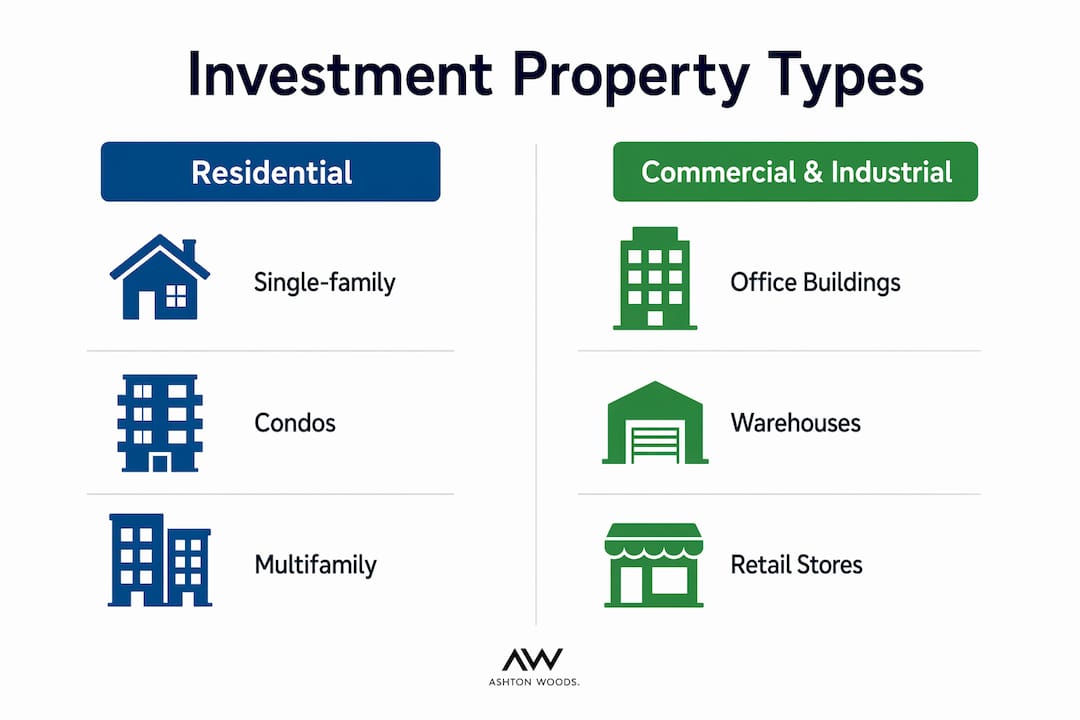
Residential investment properties include single-family homes, condos, and multifamily buildings with two to four units. Single-family homes are the most common entry point for new investors. They are easier to finance, simpler to manage, and attract a large pool of tenants. Condos offer lower maintenance burdens since the homeowners association handles exterior upkeep, though HOA fees reduce your net income. You can browse available single-family homes and condo listings to get a sense of what is available in Southern California right now.
Multifamily properties with two to four units occupy a financing sweet spot. They are classified as residential for lending purposes, which means you can use FHA or conventional loans with lower down payments than commercial financing requires. Multiple tenants also reduce vacancy risk. If one unit sits empty, the others still generate income.
Commercial, industrial, and mixed-use properties
Commercial properties include office buildings, retail storefronts, and shopping centers. Commercial leases typically run 5–10 years or longer, which creates more predictable income than residential leases. Many commercial deals use triple net (NNN) leases, where tenants pay property taxes, insurance, and maintenance directly. That structure shifts operating costs off your plate, but vacancies in commercial properties can last months or years because tenants often need costly buildouts before moving in.
Industrial properties, such as warehouses and distribution centers, have grown in demand alongside e-commerce. Mixed-use properties combine residential and commercial space in one building, spreading income across tenant types.
| Property type | Typical lease length | Financing type | Management intensity |
|---|---|---|---|
| Single-family home | 1 year | Conventional/FHA | Low to moderate |
| Multifamily (2–4 units) | 1 year per unit | Conventional/FHA | Moderate |
| Commercial | 5–10+ years | Commercial loan | Low (NNN) to high |
| Industrial | 3–10 years | Commercial loan | Low to moderate |
| Mixed-use | Varies | Commercial loan | Moderate to high |
How does financing for investment properties differ from primary residences?
Financing an investment property is more demanding than financing the home you live in. Lenders view rental properties as higher risk because borrowers are more likely to default on a second property than on the roof over their heads. That risk shows up in stricter requirements across the board.
The key differences include:
- Down payment: Lenders typically require 20–25% down for investment property loans. Larger multifamily properties often hit the 25% threshold. Primary residences can be financed with as little as 3–5% down.
- Credit score: A minimum score around 620 is the baseline for most investment property loans. A higher score, typically 720 or above, unlocks better interest rates and terms.
- Interest rates: Rates on investment property loans run higher than primary residence rates. That spread directly reduces your monthly cash flow, so factor it into your projections before you commit.
- Loan types: Conventional loans are the most common tool for residential investment properties. FHA loans are available for owner-occupied multifamily properties where you live in one unit and rent the others.
- Debt-to-income ratio: Lenders scrutinize your total debt load carefully. Existing mortgage payments, car loans, and credit card balances all count against you.
One critical mistake new investors make is attempting to use a primary residence loan for a property they plan to rent out immediately. That misrepresentation is mortgage fraud. Lenders verify occupancy intent through signed certifications, and violations carry severe legal and financial penalties.
Pro Tip: Pull your credit report at least six months before applying for an investment property loan. Pay down revolving balances to below 30% of your credit limit and dispute any errors. That preparation alone can move your score enough to qualify for a significantly better rate.
What are the management realities of owning investment properties?
Investment properties require active management. The idea that rental income is purely passive is one of the most persistent myths in real estate. Even if you hire a property manager, you are still responsible for decisions, oversight, and costs.
Here is what active ownership actually looks like on a monthly basis:
- Tenant screening: Running background checks, verifying income, and checking rental history before signing a lease. A bad tenant costs far more than a vacancy.
- Rent collection: Tracking payments, sending reminders, and handling late fees. Consistent collection protects your cash flow.
- Maintenance and repairs: Responding to requests promptly and scheduling preventive maintenance. Deferred maintenance compounds into expensive problems.
- Vacancy management: Marketing the unit, showing it to prospective tenants, and minimizing the gap between leases.
- Tax reporting: Tracking income, deductible expenses, and depreciation. Investment properties require Schedule E on your federal return, and errors invite IRS scrutiny.
Beyond time, ownership carries real financial costs. Property taxes, landlord insurance, mortgage payments, and maintenance reserves all reduce your gross rental income. Net operating income (NOI) and cap rate are the two metrics that cut through the noise and show you what a property actually earns after expenses. Understanding ROI metrics like NOI, cap rate, and cash-on-cash return is not optional. They are the tools that separate informed investors from people who overpay.
Pro Tip: Before closing on any rental property, build a 12-month cash flow projection that includes a 5–10% vacancy allowance and a maintenance reserve of 1% of the property's value per year. If the numbers still work after those buffers, the deal is worth pursuing.
Real estate is not a monolithic asset class. Different property types carry different risk levels, management demands, and capital requirements. Experienced investors often diversify across property types to spread risk rather than concentrating in one category.
How to start buying an investment property
Buying your first investment property is a process, not a single decision. Rushing any step increases the chance of a costly mistake. The investors who do well are the ones who treat the purchase like a business transaction from the start.
Set your investment goals first
Define what success looks like before you look at a single listing. Are you targeting monthly cash flow, long-term appreciation, or tax benefits? Your answer determines the property type, location, and financing structure that fits your plan. A cash flow investor in Southern California will look at different neighborhoods and property types than someone focused on appreciation in a high-growth corridor.
Evaluate locations with discipline
Location drives both rental demand and appreciation potential. Research vacancy rates, median rents, job growth, and school quality in your target area. Increaltors publishes top investment locations in SoCal that break down which markets are performing well for investors right now. Local market knowledge is not a luxury. It is a requirement.
Conduct thorough due diligence
Due diligence on an investment property goes beyond a standard home inspection. You need a full property inspection, a rent roll review if tenants are in place, a title search, and a market rent analysis to confirm the seller's income claims. Skipping any of these steps is how investors inherit problems they did not price in.
The key steps to prepare and execute your purchase:
- Define your budget, including down payment, closing costs, and cash reserves
- Get pre-approved for an investment property loan before making offers
- Identify target neighborhoods based on rental demand and price-to-rent ratios
- Hire a real estate agent with investment property experience
- Order a full inspection and review all lease agreements before closing
- Set up a separate bank account for rental income and expenses from day one
Work with the right professionals
A real estate agent who specializes in investment properties will spot issues that a general agent might miss. A lender who regularly works with investors will know which loan products fit your situation. A property manager, even if you plan to self-manage initially, can give you a realistic picture of local rental rates and tenant expectations. These professionals pay for themselves in time saved and mistakes avoided. Increaltors' investment tips for LA and OC offer practical guidance specific to the Southern California market.
Key takeaways
An investment property is real estate purchased to generate income or profit, and it requires distinct financing, active management, and careful tax reporting from the moment you close.
| Point | Details |
|---|---|
| Core definition | An investment property earns returns through rent, appreciation, or resale, not personal use. |
| Financing is stricter | Expect 20–25% down and a minimum 620 credit score for investment property loans. |
| Property type shapes strategy | Multifamily (2–4 units) offers residential financing with multiple income streams, ideal for new investors. |
| Management is active, not passive | Owners handle tenant screening, maintenance, vacancies, and tax reporting regardless of property type. |
| Due diligence protects returns | Inspect, analyze rents, and review leases before closing to avoid inheriting costly problems. |
What I have learned after years of helping investors in Southern California
Most first-time investors come to me with the same misconception: they think buying a rental property is like buying a stock. You put money in, and income comes out. The reality is closer to running a small business.
The investors I have seen succeed are the ones who did the math before they fell in love with a property. They ran the numbers on vacancy, maintenance, and financing costs before they ever made an offer. The ones who struggled bought on emotion and discovered the real costs after closing.
Here is the uncomfortable truth about Southern California investment properties specifically: the price-to-rent ratios in many LA and Orange County neighborhoods are not favorable for pure cash flow investors. You are often buying appreciation potential, not immediate income. That is not a reason to avoid the market. It is a reason to be honest with yourself about your timeline and your goals.
The investors who build real wealth through real estate treat it as a long game. They buy well-located properties, manage them professionally, and hold through market cycles. They do not panic when a unit goes vacant or when rates rise. They planned for those scenarios in advance.
My advice to anyone starting out: spend as much time learning about property management and local market conditions as you spend looking at listings. The best deal on paper becomes a bad investment if you cannot manage it well. And if you are serious about Southern California, work with someone who knows these specific neighborhoods. Generic real estate advice does not account for the nuances of Pasadena versus Pomona, or Irvine versus Inglewood.
— Irvin Nierras
Increaltors can help you find the right investment property
Increaltors specializes in Southern California real estate, with listings and market expertise across Los Angeles, Orange County, and surrounding communities. If you are ready to move from research to action, the right property is the starting point.

Browse single-family home listings updated regularly across Southern California, or explore the full property catalog to compare options across residential categories. Irvin Nierras and the Increaltors team bring local market knowledge and investment-focused guidance to every transaction. Whether you are buying your first rental or adding to an existing portfolio, Increaltors connects you with properties that match your goals and a team that understands the numbers behind them.
FAQ
What is the simplest definition of an investment property?
An investment property is real estate bought to generate income or profit rather than for personal use. Returns come from rental income, appreciation, or resale gains.
How much do I need to put down on an investment property?
Most lenders require a down payment of 20–25% for investment property loans, with larger multifamily properties typically requiring the higher end of that range.
Can I use an FHA loan to buy an investment property?
FHA loans are available for multifamily properties with two to four units if you occupy one unit as your primary residence. Pure investment properties with no owner occupancy do not qualify for FHA financing.
What is the difference between an investment property and a primary residence?
A primary residence is where you live, while an investment property is purchased to earn returns. The IRS, lenders, and courts each apply specific criteria to classify a property, and misclassifying one as the other carries legal and financial consequences.
What ROI metrics should I track for an investment property?
The four core metrics are cash flow, net operating income (NOI), cap rate, and cash-on-cash return. These figures show what a property earns after expenses and how efficiently your capital is working.