
A probate sale is the court-supervised process of selling real estate from a deceased person's estate to pay outstanding debts, taxes, and administrative costs, with any remaining proceeds distributed to heirs or beneficiaries. It is not a distressed sale in the traditional sense. It is a legally structured transaction overseen by a probate court, which means every step, from pricing to closing, requires court involvement or approval.
Here is what makes a probate sale distinct at a glance:
- The probate court appoints an executor or administrator to manage and sell the property
- The property is typically sold as-is, with no repairs or upgrades before closing
- Sale proceeds first cover debts, legal fees, and estate costs before heirs receive anything
- Court confirmation of the final sale is often required, adding time to the process
- State laws vary, and some states allow simplified procedures when the will grants the executor broad authority
How does a probate sale work, step by step?
The probate sale process follows a specific legal sequence that sets it apart from any standard home sale. Each step builds on the last, and skipping one is not an option.
-
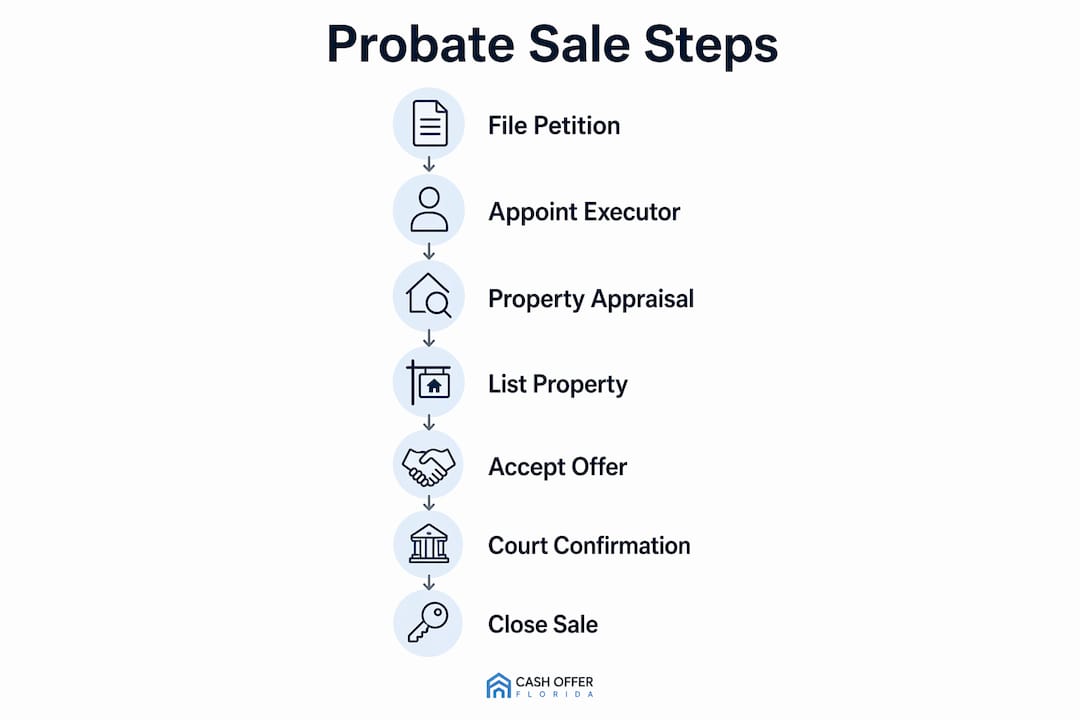
Filing a petition. A family member, attorney, or named executor files a petition with the probate court to open the estate. The court then officially appoints an executor (if named in the will) or an administrator (if there is no will).
-
Property appraisal. The executor arranges a formal appraisal, often conducted by a court-approved probate referee, to establish the property's fair market value. This figure anchors the listing price.
-
Listing the property. The executor, typically working with a licensed real estate agent, lists the property on the open market. Marketing follows standard real estate practices, including MLS listings and showings.
-
Receiving and reviewing offers. Buyers submit offers, usually with a deposit. The executor reviews them and selects the strongest one, subject to court approval.
-
Court confirmation hearing. In many states, the accepted offer goes before a judge for confirmation. At this hearing, other buyers may appear and submit higher bids, a process called overbidding.
-
Overbidding and final acceptance. If overbidding occurs, the property goes to the highest qualifying bidder in the courtroom. The original buyer may lose the sale entirely, which is why patience and preparation matter here.
-
Closing the sale. Once the court confirms the sale, the transaction closes. Proceeds pay closing costs, outstanding debts, legal fees, and estate expenses first. Remaining funds then go to beneficiaries.
Court supervision protects all parties, including creditors, heirs, and buyers, by keeping the process transparent and legally sound. Some states do allow private probate sales without full court hearings when the will grants the executor independent authority, which can shorten the timeline considerably.
Pros and cons of buying a probate property
Probate properties attract a specific kind of buyer, typically someone willing to trade convenience for opportunity. Before you make an offer, weigh both sides clearly.
Potential advantages:
- Properties often sell below market value because estates prioritize speed and debt settlement over top-dollar returns
- Less competition than traditional listings, since many buyers avoid the extra complexity
- Real investment upside for buyers willing to renovate a property purchased at a discount
- Motivated sellers (the estate) with no emotional attachment to holding out for a higher price
Real drawbacks:
- Properties sell as-is with no repairs, meaning you inherit every deferred maintenance issue, code violation, or structural problem
- The process runs longer than a standard sale, requiring extended patience from buyers and coordination with financing timelines.
- Emotional complexity for heirs can slow decisions or create family disagreements that affect the sale
- Overbidding at court confirmation hearings can push the final price above your original offer
- Deposit funds may be tied up for months if the court process drags
The balancing act between buyer opportunity and heir sensitivity is real. Executors and legal counsel play a key role in keeping communication clear and the process moving forward for everyone involved.
How to find and buy probate properties
Locating probate listings takes a bit more effort than browsing a standard real estate app, but the opportunities are worth it for the right buyer.
- MLS listings: Many probate properties appear on the Multiple Listing Service with language like "probate sale" or "court confirmation required" in the listing notes
- Probate court records: County probate courts maintain public records of open estates, which often include real estate assets pending sale
- Specialized real estate agents: Working with an agent who has probate sale experience gives you a real advantage, since they understand court timelines, deposit requirements, and confirmation hearings
- Estate attorneys and administrators: Building relationships with probate attorneys can surface off-market opportunities before they hit public listings
When you make an offer, come prepared. Probate sales typically require a deposit, though exact amounts vary by state and court. Understand that your offer is not final until a judge confirms it.
Financing is possible in probate sales. The myth that these transactions are cash-only is not accurate. Mortgages and conventional loans work, but the extended timeline can create challenges with rate locks and loan expiration dates. Talk to your lender upfront about the expected timeline.

Pro Tip: Consult a real estate attorney before submitting your first probate offer. Understanding your state's specific confirmation and overbidding rules can save you from losing your deposit or missing a better opportunity.

Also, only the executor or administrator has legal authority to sell a probate property. Heirs cannot sell the property independently until the estate formally transfers ownership, so always confirm you are dealing with the right party.
How long does a probate sale typically take?
Patience is not optional in a probate transaction. Most probate sales take 6 to 12 months or longer, compared to the 30 to 60 days typical of a standard home sale. The extended timeline comes from several compounding factors: court scheduling, mandatory notice periods for creditors and heirs, appraisal requirements, and confirmation hearings.
A simplified breakdown of the timeline looks like this. Opening the estate and appointing an executor can take four to eight weeks on its own. Appraisal, listing, and offer collection typically add another one to three months. The court confirmation hearing and any overbidding process add more time, and closing after confirmation takes additional weeks. States that allow independent administration under the will can compress this significantly, sometimes completing the sale in three to four months. California, for example, has a specific Independent Administration of Estates Act that gives executors broader authority and reduces mandatory court appearances.
What documents are required in a probate sale?
A probate sale generates more paperwork than a typical real estate transaction. Both the executor and the buyer need to be ready for the documentation requirements.
The estate side typically requires the original will (if one exists), the court order appointing the executor or administrator, the probate referee's appraisal report, letters testamentary or letters of administration (the court documents that authorize the executor to act), and a court petition for authority to sell real property. The buyer side requires a written purchase offer, proof of deposit funds, and financing pre-approval or proof of funds if paying cash. At closing, the executor signs the grant deed transferring title, and the court issues an order confirming the sale before the deed records.
Working with a title company experienced in probate transactions helps catch missing documents before they delay closing. The notary's role in executing and authenticating these documents is also more involved than in a standard sale.
How probate properties are listed and marketed
Marketing a probate property follows most of the same channels as a traditional listing, but with a few important differences in how the executor and agent approach it.
Executors typically partner with a licensed real estate agent to list the property on the MLS, run open houses, and collect offers within a set window. The listing will usually disclose the probate status and any court confirmation requirement upfront, which filters out buyers who are not prepared for the process. Pricing is anchored to the court-approved appraisal, so the executor cannot simply accept a lowball offer without court scrutiny.
Some probate properties also appear as off-market opportunities before they reach the MLS, particularly when estate attorneys or administrators connect directly with investor networks. For buyers interested in the Southern California market, staying connected with local probate-focused agents gives you earlier access to these listings. The real estate offer process in this region has its own nuances, and having an experienced guide on your side makes a real difference when court confirmation is on the line.
Key Takeaways
A probate sale is a court-supervised real estate transaction that follows a defined legal sequence, typically takes 6 to 12 months, and requires both buyers and heirs to work within strict procedural rules.
| Point | Details |
|---|---|
| Court oversight is required | Every step from appraisal to closing must comply with state probate law and court approval. |
| Timeline runs 6–12 months or longer | Administrative reviews, hearings, and notice periods extend the process well beyond a standard sale. |
| Properties sell as-is | Buyers accept the property's current condition with no repairs or credits from the estate. |
| Financing is allowed | Cash is not required; mortgages work, but buyers must plan for extended rate-lock timelines. |
| Only the executor can sell | Heirs have no authority to transfer title until the court formally concludes the probate process. |