
TL;DR:
- A listing agreement is a binding contract between a property owner and a real estate broker that authorizes the broker to market and sell the property under specific terms. It includes essential details such as the listing price, commission structure, contract duration, and obligations of both parties, with the carryover clause protecting the broker's commission beyond expiration. Sellers should read, negotiate, and fully understand each clause before signing, especially the commission terms and long-term obligations.
A listing agreement is a legally binding contract between a property owner and a licensed real estate broker that grants the broker authority to market and sell the property under specified terms. The contract defines the listing price, commission structure, contract duration, and each party's obligations. The National Association of Realtors (NAR) sets standards that govern how member brokers must draft these agreements, making the listing agreement definition consistent across most American markets. For first-time sellers in Southern California and beyond, understanding this contract before signing is the single most important step in the selling process.
What is a listing agreement and what does it include?
A listing agreement is the foundation of every real estate sale. Without it, a broker has no legal authority to list, market, or negotiate on a seller's behalf. The contract creates a formal relationship and protects both parties by spelling out exactly what is expected.

Listing agreements must be in writing to be enforceable under the statute of frauds. Verbal promises to pay commission carry no legal weight in court. This means any agreement you reach with a broker over the phone or in person means nothing until both parties sign a written document.
The core purpose of a real estate listing contract is straightforward. The seller gives the broker permission to act as their agent. The broker agrees to market the property and work to find a qualified buyer. In exchange, the seller agrees to pay a commission when the sale closes.
Pro Tip: Before signing, ask your broker to walk you through every clause out loud. Agents who hesitate to explain a clause in plain English are a red flag.
Key terms every listing agreement must contain
NAR-affiliated brokers must include specific mandatory terms in every listing agreement for it to be valid. These include a firm start date, a firm termination date, the list price, the exact commission amount or percentage, and clear conditions for when payment is due. Missing any of these elements can make the contract unenforceable.
Here is what you will typically find in a standard listing agreement:
- Start and end dates. The contract must state exactly when the broker's authority begins and when it expires.
- Listing price. The agreed asking price for the property, which you and your broker set together based on market data.
- Commission details. The percentage or flat fee the broker earns, plus the conditions that trigger payment.
- Broker obligations. What the broker will do to market your home, such as MLS listing, photography, open houses, and digital advertising.
- Seller obligations. Your responsibilities, such as keeping the property accessible for showings and disclosing known defects.
- Carryover clause. A protection clause that binds you to pay commission even after the contract expires, under certain conditions.
The carryover clause deserves special attention. Most sellers overlook this clause, which legally requires them to pay a commission if a buyer who toured the home during the listing period purchases the property within 60 to 180 days after the agreement expires. This means your financial obligation to the broker does not automatically end when the contract does.
| Term | What it means | Why it matters |
|---|---|---|
| Start and end dates | Fixed dates defining the broker's authority window | Prevents open-ended obligations |
| Commission rate | Percentage or flat fee paid at closing | Directly affects your net proceeds |
| Listing price | Agreed asking price for the property | Sets buyer expectations and market positioning |
| Carryover clause | Post-expiration commission window of 60–180 days | Can cost you commission after the contract ends |
| Broker obligations | Specific marketing activities the broker must perform | Holds the broker accountable |
What are the different types of listing agreements?
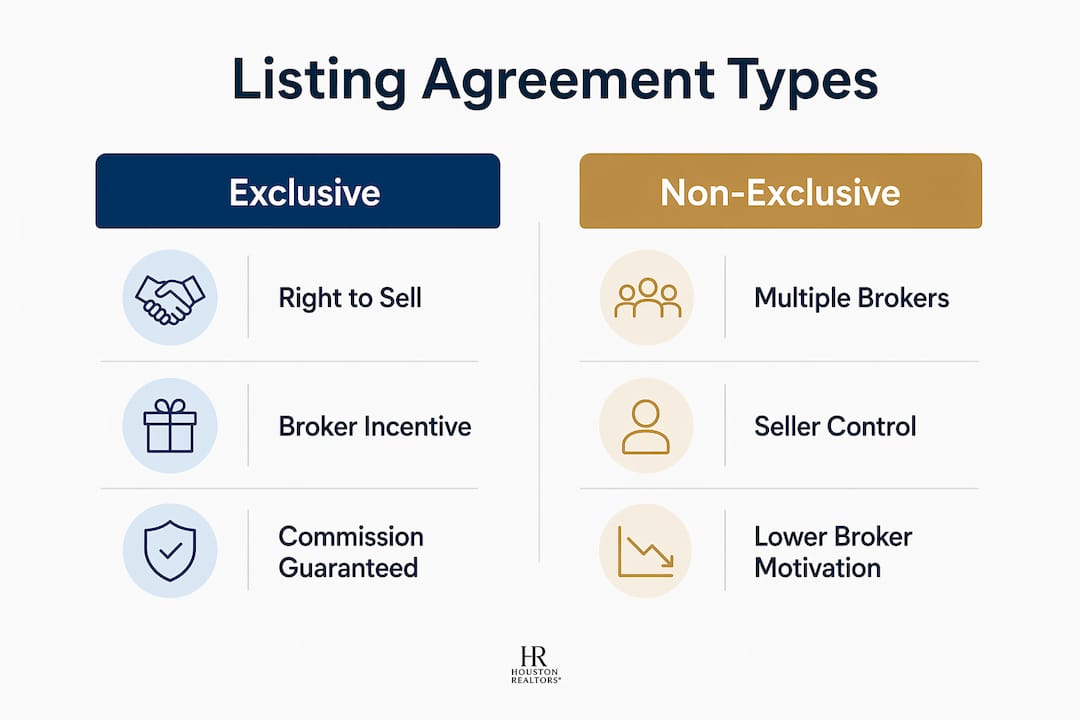
Not all listing agreements work the same way. The type you choose determines how much control you keep, how motivated your broker will be, and how much you may owe in commission. There are three main types used in American real estate, plus one largely prohibited type worth knowing about.
Exclusive right to sell
The exclusive right to sell agreement is the most common structure in the United States. The seller must pay the brokerage a commission if the property sells within the contract period, regardless of who finds the buyer. That includes you finding the buyer yourself. Brokers strongly prefer this structure because it guarantees their compensation for the time and money they invest in marketing your home.
For sellers, this type offers a clear advantage too. Your broker has every incentive to work hard because their commission is protected. You get full marketing effort, MLS access, and professional representation.
Exclusive agency
An exclusive agency agreement gives the broker the right to market your home, but you retain the right to find a buyer on your own. If you find the buyer independently, you owe no commission. If the broker finds the buyer, you pay the agreed commission.
This sounds appealing, but it creates tension. Brokers know they might do all the work and earn nothing if you close a deal through a neighbor or personal contact. As a result, they often invest less time and marketing money into exclusive agency listings compared to exclusive right to sell agreements.
Open listing
An open listing is non-exclusive. You can list your property with multiple brokers simultaneously, and you only pay commission to the broker who actually produces the buyer. If you find the buyer yourself, you pay no commission at all.
Open listings often backfire because brokers are reluctant to invest significant time or marketing money into properties where their payout is uncertain. You may end up with minimal professional marketing and a slower sale. Understanding real estate listing types in Southern California can help you decide which structure fits your situation.
Net listings
A net listing lets the broker keep everything above a minimum price you set. If you agree to net $800,000 and the broker sells for $900,000, the broker keeps $100,000. Net listings are banned or strictly regulated in the vast majority of U.S. states because they create a direct conflict of interest. The broker is incentivized to ignore fair market value and maximize their own cut. Avoid this structure entirely.
| Agreement type | Who can find the buyer | Commission owed | Broker motivation |
|---|---|---|---|
| Exclusive right to sell | Anyone | Always owed if sold in period | Highest |
| Exclusive agency | Broker or seller | Only if broker finds buyer | Moderate |
| Open listing | Anyone, multiple brokers | Only to procuring broker | Lowest |
| Net listing | Broker | Broker keeps proceeds above floor | Conflicted |
How have recent NAR changes affected listing agreements?
The 2024 NAR settlement changed how commissions work inside listing agreements in a fundamental way. Following the settlement, listing agreements now structurally separate listing-side compensation from buyer-side compensation. Before this change, a single commission rate typically covered both the listing agent and the buyer's agent, and sellers paid the full amount.
Since August 2024, new NAR rules have made negotiation more critical for sellers looking to control costs. Your listing agreement now governs only what you pay your own agent. What the buyer's agent earns is negotiated separately, either directly with the buyer or through a separate offer of compensation.
This shift has real consequences for sellers:
- You control your listing-side cost. Your commission to your own agent is negotiable and clearly stated in the listing agreement.
- Buyer agent compensation is separate. You may choose to offer compensation to the buyer's agent as a selling incentive, but it is no longer automatically bundled into your listing agreement.
- Negotiation matters more than ever. Most sellers underestimate their negotiation power over commission rates, often accepting standard rates without discussion.
- Misconceptions are common. Many sellers still assume they are paying a single combined commission. Read your agreement carefully to understand exactly what you are paying and to whom.
Pro Tip: Ask your agent to show you exactly how buyer agent compensation will be handled before you sign. If the answer is vague, ask again until it is clear.
The separation of commissions requires sellers to be more proactive. You need to understand both what you owe your listing agent and how your offer of buyer agent compensation might affect how quickly your home sells. A well-informed seller negotiates both sides of this equation before signing anything.
What should sellers do before signing a listing agreement?
Signing a listing agreement without reading it carefully is one of the most common and costly mistakes first-time sellers make. The contract is legally binding the moment both parties sign, so your negotiating power disappears at that point.
Read every clause before you sign
Start with the carryover clause. Understanding the carryover clause can prevent costly surprises if a buyer finds your property shortly after the listing expires. Know the exact window, whether it is 60 days or 180 days, and keep a list of every buyer who toured your home during the listing period.
Check the broker obligations section carefully. Your agreement should spell out specific marketing activities, not vague promises. Ask for MLS listing, professional photography, digital advertising, and open house scheduling to be written into the contract.
Negotiate the key terms
Commission rates are negotiable. Many sellers accept the first number their agent presents without question. You have the right to discuss the rate, the flat fee alternative, and the conditions under which commission is earned. Essential real estate terms like "net proceeds" and "commission basis" are worth understanding before that conversation.
- Negotiate the commission rate. Ask whether a lower rate or flat fee is available, especially if your home is priced above the local median.
- Set a realistic listing price. Overpricing leads to longer days on market and price reductions that can stigmatize the listing.
- Choose the right contract duration. A typical listing period runs three to six months. A shorter initial term gives you flexibility to change brokers if results are poor.
- Get a fully executed copy. Both parties must sign, and you must keep your signed copy in a safe place.
- Plan for expiration. Decide in advance what you will do if the home does not sell. You can relist with the same broker, switch to a different one, or withdraw the property entirely.
Pro Tip: Request a 90-day initial listing term instead of the standard six months. If your broker resists, ask why. A confident agent should not need six months to prove their value.
Common seller mistakes to avoid:
- Signing without reading the carryover clause
- Accepting the first commission rate offered without negotiating
- Choosing a listing price based on emotion rather than comparable sales data
- Failing to clarify what marketing activities the broker will perform
- Not keeping a record of every buyer who tours the home
Knowing how to choose a realtor before you reach the listing agreement stage puts you in a much stronger position. The right agent will explain every clause without being asked.
Key Takeaways
A listing agreement is a legally binding contract that defines the broker's authority, commission terms, and duration, and signing one without reading it carefully is the most expensive mistake a seller can make.
| Point | Details |
|---|---|
| Written contract required | Verbal commission promises are unenforceable; always get the agreement in writing. |
| Carryover clause risk | You may owe commission 60–180 days after expiration if a buyer toured during the listing period. |
| Exclusive right to sell is standard | This structure gives brokers the most incentive and sellers the most marketing effort. |
| Post-2024 commission split | Listing-side and buyer-side compensation are now negotiated separately after the NAR settlement. |
| Negotiate before signing | Commission rates, listing duration, and broker obligations are all negotiable terms. |
What sellers miss most about listing agreements
Working with sellers in the Los Angeles and Orange County markets, I have seen the same pattern repeat itself. A homeowner signs a listing agreement in under ten minutes, excited to get their home on the market, and then calls me three months later confused about why they owe commission on a deal that fell through after the contract expired.
The carryover clause is the most overlooked piece of paper in residential real estate. Sellers read the commission rate and the listing price, then stop. They never get to the clause that says their obligation to the broker can extend months past the contract end date. I always tell sellers to write down the name of every buyer who tours their home. That list is your protection if a dispute arises later.
The post-2024 commission changes have added another layer of confusion. Sellers now sit across from their agent and see two separate compensation discussions where there used to be one. Many interpret this as paying more. In reality, it is an opportunity to negotiate more precisely. You can now control your listing-side cost independently and decide separately how much, if anything, you want to offer a buyer's agent as a selling incentive.
My honest advice is this: treat the listing agreement like a business contract, because it is one. Read it the night before your meeting with the agent, write down your questions, and do not sign until every answer satisfies you. An agent who rushes you through the signing is not working in your interest.
— Irvin Nierras
Selling in Southern California? Increaltors is here to help
Listing agreements can feel complex, but the right agent makes every clause clear before you sign anything.

Increaltors, led by Irvin Nierras of HomeSmart Evergreen Realty, serves sellers across Los Angeles, Orange County, and surrounding Southern California communities. Whether you are selling a single family home or a condo, Increaltors provides hands-on guidance through every step, from setting the right listing price to negotiating commission terms. Browse current homes for sale to understand the market you are entering, or connect directly with Irvin to get a free home valuation and a plain-English walkthrough of your listing agreement before you commit to anything.
FAQ
What is a listing agreement in real estate?
A listing agreement is a legally binding contract between a property owner and a licensed real estate broker that grants the broker authority to market and sell the property under defined terms, including commission, price, and duration.
How long does a listing agreement last?
A typical listing period runs three to six months. After it expires, the seller can relist with the same broker, switch to a new one, or remove the property from the market entirely.
What is the most common type of listing agreement?
The exclusive right to sell agreement is the most common type. It requires the seller to pay the broker a commission if the property sells during the contract period, regardless of who finds the buyer.
Can I negotiate the commission in a listing agreement?
Yes. Commission rates and flat fees are negotiable. Many sellers accept the first rate offered without discussion, but you have every right to negotiate before signing.
What is the carryover clause in a listing agreement?
The carryover clause, also called a protection clause, requires sellers to pay commission if a buyer who toured the home during the listing period purchases the property within 60 to 180 days after the agreement expires.