

TL;DR:
- A buyer's market occurs when housing supply exceeds demand, giving buyers leverage in negotiations. Recognizing signals like longer days on market and frequent price cuts helps buyers act confidently. Timing offers during peak leverage phases maximizes negotiation benefits and leads to better deals.
A buyer's market is defined as a condition in real estate where housing supply exceeds active buyer demand, giving buyers the upper hand in price negotiations and deal terms. The formal industry term is "buyer's market," and it shows up in metrics like months of supply, days on market, and the frequency of price reductions. When supply exceeds demand, sellers compete for fewer buyers, which means you can negotiate on price, ask for closing cost help, and include contingencies that would be rejected outright in a hotter market. For first-time homebuyers, recognizing these conditions early can mean the difference between overpaying and securing a home at a fair price.
What is a buyer's market, and how do you recognize it?
A buyer's market occurs when housing inventory exceeds active buyers, shifting negotiating leverage firmly toward the buyer. The standard threshold most real estate professionals use is six months of supply. When a market holds more than six months of available inventory, conditions favor buyers. Below that level, sellers gain the advantage.

Months of supply is calculated by dividing the current number of active listings by the average monthly sales rate. A figure above six means homes are sitting on the market longer than sellers would like. That patience costs sellers money, and it creates room for buyers to negotiate.
Key signs that a buyer's market is in effect
Several observable signals confirm buyer's market conditions before you ever look at a months-of-supply report:
- Longer days on market. Homes that would have sold in days now sit for weeks or months. When the median days on market climbs across a neighborhood, buyers have time to think, compare, and negotiate.
- Frequent price reductions. Sellers who listed too high start cutting. A high percentage of active listings showing price cuts is one of the clearest buyer's market signals.
- Seller concessions. Closing cost assistance becomes common. Sellers offer to cover repairs, pay down points, or include appliances to close deals.
- Fewer competing offers. Bidding wars disappear. You can submit an offer below asking price and expect a counteroffer rather than a rejection.
- More choices. High inventory means you can walk away from a property that does not meet your standards and find a comparable one nearby.
Each of these signals reinforces the others. When you see all five together, you are in a genuine buyer's market.
Pro Tip: Set up listing alerts on local real estate platforms and track the same zip codes weekly. When you notice average days on market climbing and price cut frequency increasing, that is your early signal to start making offers with confidence.
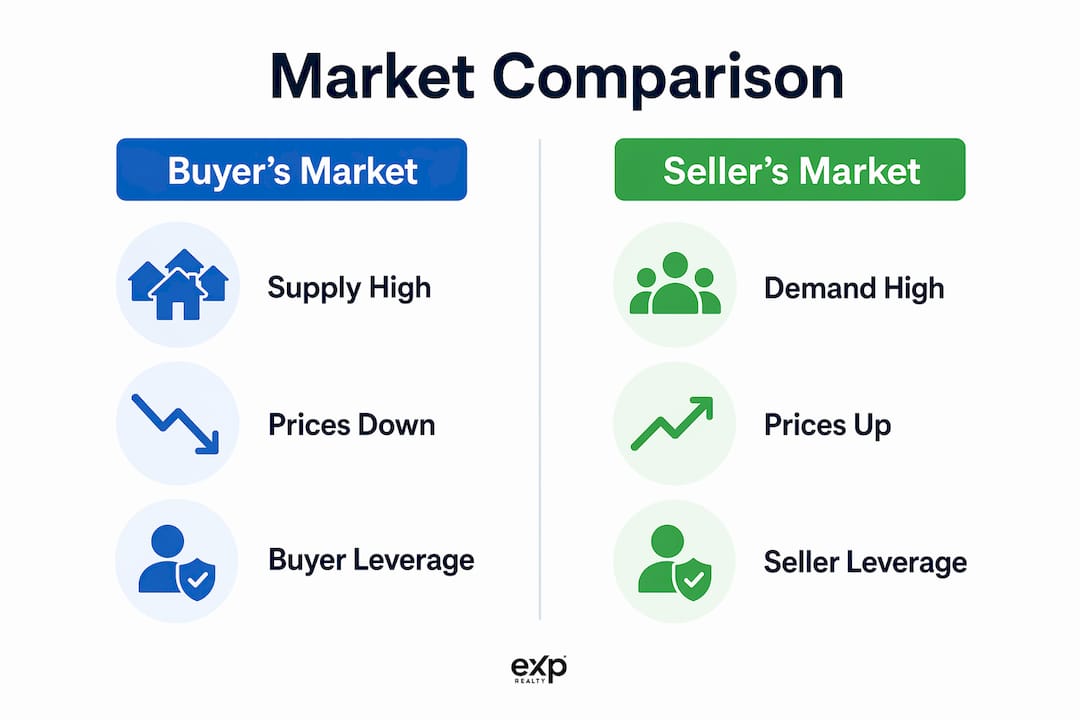
How does a buyer's market differ from a seller's market?
A seller's market is the direct opposite: more buyers than available homes, which drives prices up and compresses the time homes spend on the market. Sellers receive multiple offers, often above asking price, and buyers have little room to negotiate contingencies or concessions.
The practical difference for a first-time buyer is significant. In a seller's market, you may need to waive inspection contingencies, offer above list price, and compete against cash buyers. In a buyer's market, you can negotiate repairs, ask for closing cost credits, and take time to review your options.
Buyer's market vs. seller's market: key indicators
| Indicator | Buyer's market | Seller's market |
|---|---|---|
| Months of supply | Above 6 months | Below 3 months |
| Days on market | Rising or high | Falling or low |
| Price reductions | Frequent | Rare |
| Offer competition | Low, single offers common | High, multiple offers common |
| Seller concessions | Common | Rare |
| Buyer negotiating power | Strong | Weak |
A balanced market sits between these two extremes, typically around 4–6 months of supply. Prices stay relatively stable, and neither side holds a clear advantage.
Pro Tip: National headlines about the housing market rarely reflect what is happening on your specific street. A metro area can show balanced conditions overall while individual neighborhoods swing hard in either direction. Always check local market data before drawing conclusions from national news.
What factors create a buyer's market in real estate?
Several economic and local forces push a market into buyer's territory. No single factor causes it alone. The conditions typically build over months or years before buyers feel the full effect.
Supply-side drivers
Increased new home construction is one of the most direct causes. Rising construction activity adds inventory faster than demand can absorb it, particularly after periods of aggressive building. Periods following housing booms often yield buyer's market conditions as the pipeline of new homes floods the market.
Homeowners who delayed selling during a slow period may also list simultaneously when conditions seem favorable, creating a sudden surge in active listings. That surge, if demand does not keep pace, tips the balance toward buyers.
Demand-side drivers
Rising interest rates reduce the pool of qualified buyers. When mortgage rates climb, monthly payments increase on the same loan amount, pricing some buyers out of the market entirely. Fewer qualified buyers competing for the same homes shifts leverage toward those who remain.
Economic uncertainty, job losses, or a local employer downsizing can also suppress demand in specific markets. Buyers who feel financially uncertain delay purchases, which reduces competition and gives remaining buyers more room to negotiate.
Local and cyclical factors
Leverage is local and varies by property type, price range, and location within metro areas. A city-wide report may show balanced conditions while a specific price tier or neighborhood sits firmly in buyer's territory. Condos in one zip code may favor buyers while single-family homes two miles away attract bidding wars.
Market cycles also matter. Real estate moves through phases: rising inventory, peak buyer leverage, and then a gradual return of demand as prices fall to attractive levels. Recognizing where a market sits in that cycle helps you time your offer strategy correctly.
How should buyers approach purchasing in a buyer's market?
A buyer's market gives you tools that simply do not exist in competitive conditions. Using them well requires a clear strategy, not just awareness that conditions favor you.
Negotiate on multiple fronts
Price is the most obvious lever, but it is not the only one. In a buyer's market, you can negotiate:
- Purchase price. Offer below asking price, especially on homes with extended days on market or visible price reductions. Sellers who have already cut their price once are often willing to cut again.
- Closing costs. Ask the seller to cover a portion of your closing costs. Seller concessions on closing costs are more common in buyer's markets and directly reduce your out-of-pocket expenses at closing.
- Repairs and credits. Use the inspection to request repairs or a credit toward your closing costs. Sellers in a buyer's market are far more likely to accommodate these requests than in a competitive market.
- Contingencies. Keep your financing and inspection contingencies intact. You do not need to waive them to win an offer when competition is low.
- Closing timeline. Ask for a timeline that works for you. Sellers who need to move a property will often accommodate a buyer's preferred schedule.
Evaluate multiple options before committing
High inventory is one of the clearest buyer's market benefits. You can tour several comparable properties and use what you learn to sharpen your offer on the best one. If a seller rejects your offer outright, you have other options. That freedom changes your psychology at the negotiating table.
Pro Tip: Work with a skilled agent who knows how to use negotiation tactics specific to buyer's markets. An experienced agent will know which sellers are most motivated, which listings have been sitting too long, and how to structure an offer that gets accepted without overpaying.
Focus on local data, not national headlines
National real estate data can mask local realities. A national report showing rising inventory does not tell you whether the three-bedroom homes in your target neighborhood are sitting or selling. Track median days on market and the percentage of listings with price cuts in your specific search area. Those two numbers tell you more than any national index.
Time your move within the market cycle
Buyer's market conditions cycle through phases: rising inventory, peak leverage, and then a gradual shift back as demand returns. The best time to buy is during the peak leverage phase, when inventory is high and sellers are most motivated. Waiting too long into the cycle risks buying just as conditions begin to tighten again. Understanding this cycle helps you avoid overreaching when the market begins to swing back toward sellers.
If you are still building your foundation as a buyer, reviewing how to choose a realtor before you start your search will save you significant time and money.
Key Takeaways
A buyer's market gives first-time homebuyers real negotiating power, but only those who track local data and act at the right phase of the market cycle will capture the full advantage.
| Point | Details |
|---|---|
| Definition of buyer's market | Supply exceeds demand, giving buyers leverage on price, concessions, and terms. |
| Key identification metric | Months of supply above 6 signals buyer's market conditions in most markets. |
| Strongest negotiation tools | Price, closing cost credits, repairs, and contingencies are all negotiable in buyer's markets. |
| Local data beats national trends | Neighborhood-level metrics like days on market and price cuts reveal true conditions. |
| Market cycle timing matters | Buy during peak leverage phase; waiting too long risks losing advantage as demand returns. |
What I've learned about buyer's markets after years in Southern California real estate
Most first-time buyers I work with come in thinking a buyer's market means they can lowball every listing and sellers will fold. That is not how it works. A buyer's market gives you leverage, but leverage only works when you use it with precision.
The buyers who get the best outcomes are the ones who do their homework at the neighborhood level. They know which listings have been sitting for 60 days, which sellers have already cut their price twice, and which properties have issues that justify a lower offer. They do not spray offers across every listing. They pick their target, understand the seller's position, and make a clean, well-structured offer that is hard to refuse.
What I have also seen is that buyers who rely on national headlines miss the real picture entirely. Southern California markets like Los Angeles and Orange County can behave very differently from each other, and even within those markets, one zip code can favor buyers while the next one over still sees multiple offers. The local dynamics in Southern California are genuinely distinct from what you read in national reports.
My advice to any first-time buyer: be patient, be specific, and be ready to move when the data supports it. A buyer's market will not last forever. The cycle always turns. The buyers who study their local market, work with an agent who knows how to negotiate, and act decisively during peak leverage conditions are the ones who look back and say they bought at exactly the right time.
— Irvin Nierras
Properties worth exploring while conditions favor buyers
Right now is a strong time to browse available listings and get a clear picture of what your budget can realistically buy in Southern California.

Increaltors maintains updated listings across property types, including single-family homes and condos for sale in Los Angeles, Orange County, and surrounding communities. You can also pull the latest market snapshot to see current inventory levels, days on market, and price trends in your target area. If you want a personalized read on your negotiating position before making an offer, Irvin Nierras at Increaltors provides direct, data-backed guidance with no pressure. Reach out through the site to get started.
FAQ
What is the definition of a buyer's market?
A buyer's market is a real estate condition where housing supply exceeds buyer demand, giving buyers leverage to negotiate lower prices and better terms. The standard indicator is more than six months of available inventory in a given market.
How do you identify a buyer's market?
Track months of supply, median days on market, and the percentage of listings with price reductions. When all three trend upward simultaneously, buyer's market conditions are in effect.
What are the main benefits of a buyer's market for homebuyers?
Buyers gain negotiating power on purchase price, closing costs, repairs, and contingencies. Seller concessions such as closing cost assistance become common, directly reducing out-of-pocket costs at closing.
Can a buyer's market exist in one neighborhood but not another?
Yes. Leverage is local and varies by property type, price range, and location within a metro area. A city-wide report may show balanced conditions while specific neighborhoods or price tiers favor buyers or sellers independently.
How long does a buyer's market typically last?
Buyer's markets cycle through phases and do not last indefinitely. As prices fall to attractive levels, demand returns and conditions gradually shift back toward balance or a seller's market. Buyers who act during peak leverage conditions capture the best outcomes.