
Choose a DFPI- or DRE-licensed escrow holder and open escrow the moment your fully executed purchase agreement is delivered. That single action assigns your transaction number, protects your funds under a neutral officer, and gets the clock running toward closing.
Your immediate next steps:
- Ask your agent for the escrow company's license name and supervising agency (required on all written instructions under California Financial Code §17403.4)
- Request your assigned transaction number once escrow opens — you'll use it for every status inquiry
- Ask for a written estimated closing statement early, before costs surprise you at settlement
- Confirm whether the company is independent (DFPI-licensed) or controlled (DRE- or DOI-supervised), since each carries different disclosure requirements
Pro Tip: The California Escrow Association is a good starting point for finding affiliated escrow officers who follow industry best practices. Increaltors can also help you vet and coordinate with a licensed escrow holder from day one.
Table of Contents
- What does the Los Angeles escrow timeline look like?
- Who pays escrow fees, and how much should you expect?
- How do you choose the right escrow company in Los Angeles?
- What documents does escrow need, and how do you track your file?
- What happens when there's a dispute or discrepancy during escrow?
- How do top escrow providers use technology to speed up your closing?
- Increaltors helps you coordinate escrow with confidence in Los Angeles
- Key Takeaways
What does the Los Angeles escrow timeline look like?
A standard residential escrow in Los Angeles typically runs from opening to closing in about one to one and a half months, though cash transactions can close faster. Here are the key milestones:
- Escrow opens — fully executed purchase agreement delivered; transaction number assigned
- Earnest money deposited — typically within 3 business days of acceptance
- Inspections and disclosures — completed within the first 10–17 days
- Loan contingency removal — usually around day 17–21
- Loan documents sent to escrow — lender delivers docs for signing, often 3–5 days before closing
- Signing and notarization — buyer and seller sign final documents
- Funding and recording — lender funds the loan; county records the deed; escrow closes
Clear, timely communication between your agent and escrow officer is the biggest factor in hitting these milestones. Per the DRE's consumer guidance, if mutual written instructions are unclear or missing, escrow cannot proceed — delays almost always trace back to a communication gap, not a paperwork backlog. For a detailed seller-side view of this workflow, the seller closing process guide walks through each step.
Who pays escrow fees, and how much should you expect?
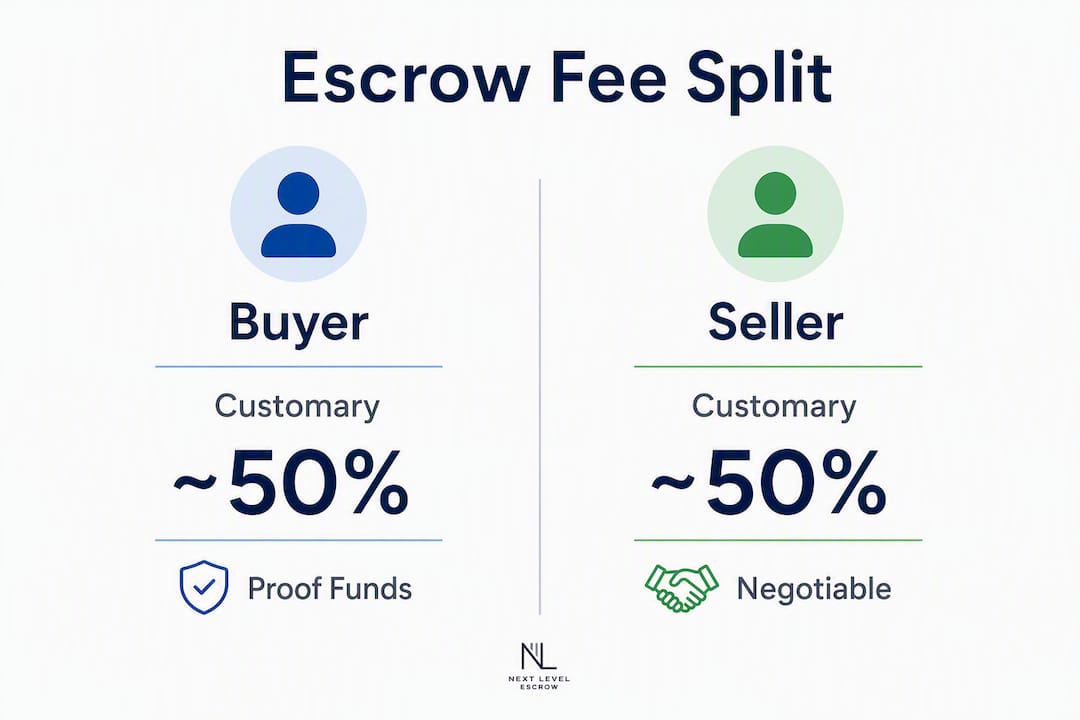
Buyer and seller customarily split escrow fees in Southern California. On a $1.5M purchase, each side typically pays roughly $2,500–$3,500 for their half. The exact split is negotiable and spelled out in the purchase contract.
Title insurance and escrow are separate line items — never assume one fee covers both. Ask your escrow officer for an itemized estimate early. Sellers preparing a home for market often handle pre-closing repairs at the same time; local services like interior door replacement are worth scheduling before escrow closes to avoid last-minute credits.
How do you choose the right escrow company in Los Angeles?
Start with licensing. Independent escrow companies are regulated by the DFPI and carry built-in neutrality. Controlled escrows — operated by brokers or title companies — are regulated by the DRE or Department of Insurance and require explicit disclosure of any conflicts. Neither is inherently inferior, but you deserve to know which type you're working with.
Questions to ask every candidate:
- What is your license number and supervising agency?
- Who is my named escrow officer, and what is their direct contact?
- Do you carry fidelity bonding or membership in the Escrow Agents Fidelity Corporation?
- Can you provide a written fee estimate before I sign escrow instructions?
- Do you offer a client portal for real-time file tracking?
Red flags: vague fee quotes, no named officer, reluctance to share a license number, or pressure to use a specific escrow company as a condition of the sale. Per the DRE, a broker may suggest an escrow holder but cannot make that selection a condition of the transaction. You always retain the right to choose.
What documents does escrow need, and how do you track your file?
Escrow will collect and coordinate a specific set of items from both sides. Buyers typically provide proof of funds or loan approval, identification, and signed escrow instructions. Sellers provide the grant deed, payoff information for existing loans, and any required disclosure documents.

Once escrow opens, use your transaction number for every status inquiry. Top-rated escrow agents in LA now offer secure online portals where you can check document status, pending conditions, and funding milestones without calling in. If your escrow company doesn't offer a portal, ask for a weekly written status update from your named officer. First-time buyers will find the Southern California home buying guide helpful for understanding exactly what to prepare.
What happens when there's a dispute or discrepancy during escrow?
The escrow officer's role is strictly neutral. They follow the mutual written instructions of buyer and seller and cannot offer legal or investment advice, negotiate on anyone's behalf, or take sides. If a discrepancy arises — a credit dispute, a repair holdback disagreement, or a title issue — the escrow officer will pause the file until both parties provide new signed, written instructions.
For unresolved disputes, options include mediation (often required by the California Residential Purchase Agreement before litigation), arbitration if both parties agreed to it in the contract, or, in cases of fraud or fund mishandling, a complaint to the DFPI or DRE. Document every instruction in writing. Verbal agreements don't move escrow forward.
How do top escrow providers use technology to speed up your closing?
The best escrow services in Los Angeles now offer digital signing through platforms like DocuSign or Authentisign, secure client portals for real-time file tracking, and remote online notarization (RON) or mobile notary options for buyers and sellers who can't appear in person. These features aren't just convenient — they materially reduce closing times by eliminating the back-and-forth of paper documents.
When evaluating providers, ask specifically whether they support remote signing and whether a mobile notary is available for your signing appointment. Sellers managing a remote transaction will find the remote home selling guide a practical companion for coordinating these steps.
Increaltors helps you coordinate escrow with confidence in Los Angeles
Working with a knowledgeable local agent makes the escrow process far less stressful. Increaltors, led by Irvin Nierras, helps buyers and sellers across Los Angeles, Orange County, and surrounding Southern California markets vet licensed escrow holders, confirm DFPI or DRE standing, request early written fee estimates, and monitor transaction portals so nothing falls through the cracks.

Increaltors coordinates escrow and recommends licensed escrow providers but does not act as the escrow holder. You always retain the right to choose your own escrow company. What the team does is make sure you're choosing wisely — with a verified license, a named officer, and a written fee estimate in hand before you sign anything. Browse current homes for sale or get a free home valuation to start your transaction with a trusted local partner by your side.
This article is general information, not legal or financial advice. Confirm current licensing requirements and escrow regulations with the DFPI, DRE, or a qualified professional for your specific situation.
How to compare escrow providers: the dimensions that matter
When evaluating the best escrow companies in LA, use these six dimensions as your framework:
- Licensing and regulatory compliance: Confirm the license number and supervising agency (DFPI for independent, DRE for broker-controlled, DOI for title-company escrows). Demand this in writing on your escrow instructions.
- Local Los Angeles residential experience: Ask how many LA residential transactions the officer has closed in the past 12 months. Local market knowledge affects how smoothly they handle county-specific recording requirements and local customs.
- Fee transparency: Request a line-by-line written estimate before signing. Escrow and title are separate charges — get both itemized.
- Responsiveness and file-tracking options: Confirm whether a secure portal is available and what the average response time is for status inquiries. Slow communication is the leading cause of delayed closings.
- Bilingual staff, mobile notary, and remote signing: For LA's diverse buyer pool, bilingual officers and mobile or remote notarization options are practical necessities, not extras.
- References, reviews, and affiliations: Check the California Escrow Association membership, read recent Google reviews, and ask for two agent references who have closed transactions with this officer in the past year.
Key Takeaways
Choosing a DFPI- or DRE-licensed escrow holder and opening escrow immediately upon a fully executed purchase agreement is the single most important step to a smooth Los Angeles residential closing.
| Point | Details |
|---|---|
| License verification first | Confirm the escrow company's license name and supervising agency on all written instructions before signing anything. |
| Transaction number is your tracker | Request your transaction number as soon as escrow opens — every status inquiry starts there. |
| Fees split, but negotiate | Buyer and seller customarily split escrow fees; on a $1.5M purchase, each side typically pays roughly $2,500–$3,500. |
| Get the estimate early | Request an itemized written closing estimate from escrow before settlement to avoid surprises; title and escrow are separate line items. |
| Increaltors coordinates the process | Increaltors helps Los Angeles buyers and sellers vet licensed escrow holders, verify credentials, and monitor the file from opening to close. |