
TL;DR:
- Effective property management preserves property value, boosts occupancy, and provides transparent financial reports for owners. It involves tenant screening, maintenance, legal compliance, and strategic planning, directly impactings long-term investment returns. Owners should actively engage through monitoring reports and building a capital plan to maximize management benefits.
Property management is defined as the professional administration of real estate assets to protect their value, maintain high occupancy, and generate consistent rental income for owners. The role of property management extends far beyond collecting rent. It covers tenant relations, legal compliance, maintenance coordination, and financial reporting. For property owners and investors in competitive markets like Southern California, professional management is the difference between a property that grows in value and one that quietly erodes it. Understanding what property management does, and how it does it, gives you a direct edge in protecting your investment.

What is the role of property management in real estate?
Property management is asset administration, not just tenant placement or rent collection. That distinction matters because it reframes how owners should evaluate the function. A property manager is not a convenience. They are the operational layer that determines whether your investment performs or underperforms year over year.
The core mandate for property managers is to protect asset value, maintain occupancy, and deliver transparent financial reporting to owners. These three goals are interdependent. A vacant unit destroys cash flow. A poorly maintained property loses market value. Opaque financials leave owners unable to make sound capital decisions.
Professional management also shifts owner time. Managing complaints, coordinating maintenance, and handling emergencies is a full-time activity. Outsourcing it lets owners focus on portfolio growth rather than daily operations. That shift in focus compounds over time, especially for investors managing multiple properties.
What are the primary property management responsibilities?
Property management responsibilities span eight distinct functions. Each one affects either tenant satisfaction, financial performance, or legal standing.
Tenant relations and screening
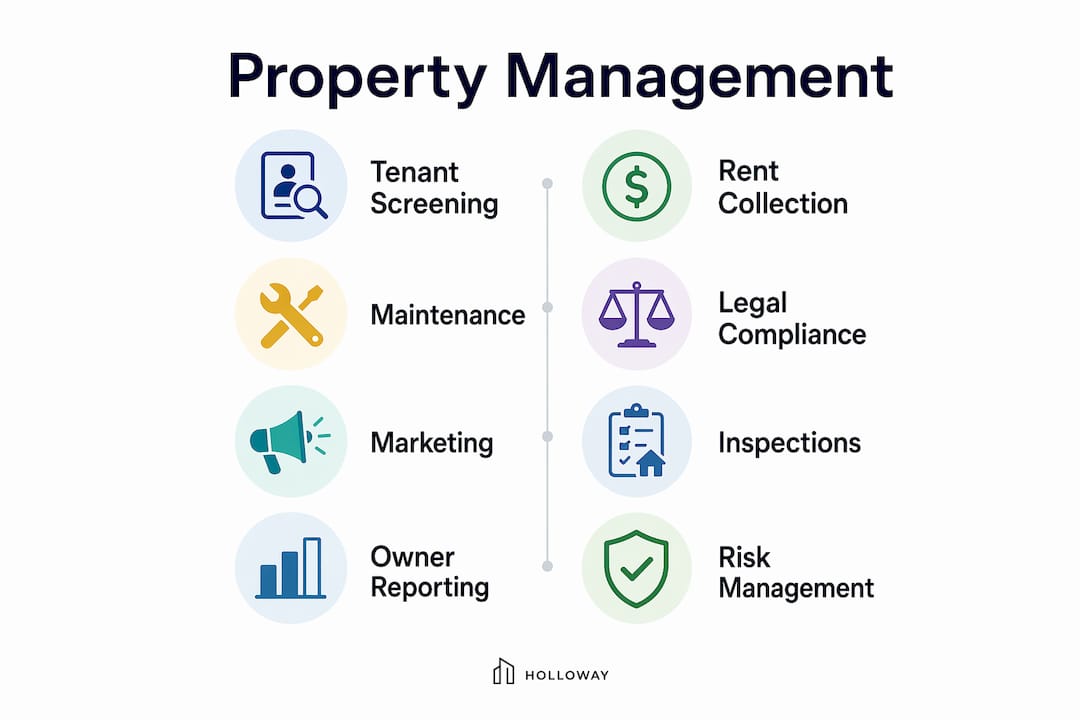
Tenant screening is the first line of defense against vacancy loss and property damage. A thorough screening process includes credit checks, income verification, rental history, and background reviews. Strong tenant relations after move-in, including clear communication channels and prompt responses to concerns, directly influence lease renewal rates.
Rent and financial management
Rent collection, late fee enforcement, monthly owner distributions, and annual budgeting all fall under financial management. Owners receive regular reports covering income, expenses, and net operating income. These reports are the foundation for capital planning decisions.
Maintenance and repairs
Maintenance coordination covers both reactive repairs and preventive maintenance schedules. Property managers oversee vendor selection, work order tracking, and quality control after repairs are completed. Preventive maintenance, such as annual HVAC servicing and roof inspections, reduces the frequency and cost of emergency repairs.
Legal and compliance
Property managers handle lease enforcement, fair housing compliance, and eviction processes when necessary. Fair housing law under the Federal Fair Housing Act prohibits discrimination based on race, color, national origin, religion, sex, familial status, and disability. Violations carry significant financial penalties, making compliance a non-negotiable function.
Marketing and leasing
Vacancy advertising, rental pricing analysis, and lease-up coordination fall under marketing. Effective pricing uses local comparable data to set rents that attract qualified tenants quickly without leaving money on the table.
Property inspections
Move-in and move-out inspections document property condition and protect security deposit decisions. Periodic inspections during tenancy catch maintenance issues before they escalate. Drive-by inspections confirm lease compliance for exterior conditions.
Owner communication and capital planning
Regular owner reporting keeps investors informed about property performance. Capital planning discussions address upcoming major expenses, such as roof replacement or HVAC upgrades, so owners can budget proactively rather than reactively.
Risk management
Insurance oversight, emergency response planning, and vendor liability verification reduce owner exposure to financial loss. A property manager who verifies contractor insurance before authorizing work protects the owner from liability if an uninsured worker is injured on site.
Pro Tip: Ask any prospective property manager to show you a sample owner report before signing a contract. If the report lacks line-item expense detail and occupancy data, the financial transparency you need to make investment decisions will not be there.
How does effective property management impact investment returns?
Professional property management is an investment that preserves property value and increases rental income over the long term. The financial case is concrete and measurable.
Tenant retention is the most direct lever. Turnover costs range from 1 to 2 months of lost rental income per vacancy event. That figure includes lost rent during the vacancy period, cleaning, repairs, and leasing costs. A property manager who retains a tenant for an additional year eliminates that cost entirely. For a unit renting at $2,500 per month, one avoided turnover saves $2,500 to $5,000 in direct costs.
"Well-managed properties age better and require fewer major repairs. Properties managed professionally require 30–50% fewer major capital repairs over 10 years and command higher market rent compared to poorly managed properties."
That maintenance advantage compounds. Fewer emergency repairs mean lower annual operating costs. Lower operating costs mean higher net operating income. Higher net operating income means a higher property valuation when you decide to sell or refinance.
Transparent financial reporting also drives better decisions. When owners receive accurate monthly statements and annual budgets, they can time capital improvements to coincide with lease renewals, adjust rents to match market rates, and plan for major expenses without disrupting cash flow. Understanding real estate ROI in SoCal properties requires exactly this kind of data-driven visibility.
High occupancy is the third financial pillar. A property manager who fills vacancies quickly and renews leases consistently stabilizes cash flow. Stable cash flow makes the property more attractive to lenders and future buyers. For investors building a portfolio, that stability supports financing for the next acquisition.
What challenges do investors face with property management?
Property management presents several challenges that owners underestimate until they cost real money.
Fee structure misalignment
Seasoned owners evaluate lease-up and renewal fee structures critically alongside base management fees. A manager charging a low monthly percentage but collecting a full month's rent as a lease-up fee has a financial incentive to turn over tenants rather than renew them. That incentive works directly against the owner's interest in stable, long-term occupancy.
- Base management fees typically range from 8% to 12% of monthly rent collected.
- Lease-up fees can range from 50% to 100% of one month's rent.
- Renewal fees, when charged, typically run $200 to $500 per lease renewal.
- Maintenance markups on vendor invoices are a hidden cost that owners rarely scrutinize.
Owners should analyze property management fees beyond the base percentage to avoid hidden costs that incentivize rapid tenant turnover. Request a full fee schedule in writing before signing any management agreement.
After-hours emergency response
Firms with slow after-hours emergency response suffer higher tenant turnover rates. A tenant who waits 18 hours for a plumber after a pipe bursts at 9 PM does not renew their lease. Prompt emergency maintenance response after hours is directly correlated with lease renewals and reduces churn significantly. Ask every prospective manager how they handle after-hours calls and who their on-call vendors are.
Vendor quality and accountability
Low-cost vendors often produce low-quality repairs that fail again within months. A property manager with a vetted vendor network delivers better repair outcomes at predictable costs. Owners should ask for references on vendor relationships and confirm that vendors carry liability insurance and workers' compensation coverage.
Digital tool adoption
Digital tools improve maintenance tracking, financial reporting accuracy, and transparency for owners. Managers who still operate on spreadsheets and paper work orders create reporting delays and errors. Owners managing multiple properties need real-time visibility into maintenance status and financial performance. A manager's ability to use digital platforms distinguishes high-performing investments from average ones.
Pro Tip: Before hiring a property manager, call their after-hours emergency line as a test. If no one answers or the callback takes more than 30 minutes, that response time will frustrate your tenants during a real emergency.
How can property owners leverage property management to maximize returns?
Getting the most from professional management requires active owner engagement, not passive delegation. These steps produce measurably better outcomes.
-
Prioritize tenant retention metrics. Ask prospective managers for their average lease renewal rate. A renewal rate above 70% signals strong tenant communication and satisfaction practices. Retention directly reduces your turnover costs.
-
Evaluate the full fee structure. Compare total annual cost across managers, not just the base percentage. Include lease-up fees, renewal fees, maintenance markups, and inspection fees in your calculation. The cheapest manager by base rate is often the most expensive in total annual cost.
-
Require monthly financial reports. Set this expectation before signing. Reports should include gross rent collected, itemized expenses, net owner distribution, and current occupancy status. Use these reports to track performance against your investment goals.
-
Audit vendor response times. Request data on average maintenance response times for both routine and emergency requests. Slow response times predict tenant dissatisfaction and non-renewal.
-
Use management reports for rent adjustments. Review market rent data quarterly. A property manager who proactively recommends rent increases based on comparable data protects your income from falling behind the market.
-
Plan capital improvements proactively. Work with your manager to build a 3-year capital plan covering major systems like HVAC, roofing, and appliances. Planned replacements cost less than emergency replacements and reduce tenant disruption.
Owners who treat property management as a partnership rather than a vendor relationship consistently outperform those who delegate and disengage. Learning the fundamentals of investment property ownership before hiring a manager gives you the context to ask the right questions and hold managers accountable.
| Evaluation Criteria | What to look for |
|---|---|
| Tenant retention rate | Above 70% annual lease renewal rate |
| After-hours response | On-call vendor available within 1 hour |
| Financial reporting | Monthly itemized owner statements |
| Fee transparency | Full written fee schedule before signing |
| Technology adoption | Digital maintenance tracking and owner portal access |
Pro Tip: Ask your property manager for a 12-month trailing report on maintenance costs per unit. If costs are rising without corresponding property improvements, deferred maintenance is accumulating and will become a capital problem.
Key Takeaways
Effective property management is the operational foundation that determines whether a real estate investment grows in value or quietly loses ground over time.
| Point | Details |
|---|---|
| Turnover costs are measurable | Each vacancy event costs 1–2 months of lost rental income, making tenant retention a direct financial priority. |
| Fee structures drive incentives | Evaluate lease-up and renewal fees alongside base rates to ensure your manager's incentives align with long-term occupancy. |
| Maintenance quality compounds | Professionally managed properties require fewer major capital repairs over time and command higher market rents. |
| After-hours response predicts retention | Slow emergency response after hours is a leading cause of tenant non-renewal and higher annual churn. |
| Digital tools improve transparency | Managers using digital platforms deliver more accurate financial reporting and faster maintenance resolution for owners. |
What I've learned about property management that most investors miss
Most investors I work with in Southern California come in thinking property management is an expense line. They want to minimize it. That mindset costs them more than the fee they are trying to avoid.
The investors who build durable portfolios treat property management as a revenue function. They understand that a manager who retains a tenant for an extra year just saved them thousands in turnover costs. They understand that preventive maintenance today avoids a $12,000 roof repair in three years. They read their monthly reports and ask questions. They are not passive.
The most common mistake I see is selecting a manager based on the lowest base fee without reading the full fee schedule. A manager charging 8% with a 100% lease-up fee and a $400 renewal fee will cost more annually than a manager charging 10% with no renewal fee and a 50% lease-up fee. The math is not complicated, but most owners never run it.
Proactive tenant engagement is the other underrated factor. Managers who check in with tenants at the 6-month mark of a lease, address minor concerns before they become complaints, and offer lease renewals 90 days before expiration retain tenants at meaningfully higher rates. That retention is where the real return on management fees shows up.
My advice to every property owner is this: stay engaged. Review your reports monthly. Ask your manager about market rents every quarter. Build a capital plan together. Professional management works best when the owner is an informed partner, not an absentee one. The properties I see perform best in this market are always the ones where the owner and manager are aligned on goals, not just on contract terms.
— Irvin Nierras
Increaltors can help you find the right investment property
Finding a well-priced property in a market where management fundamentals can actually work in your favor is the first step toward building real rental income.

Increaltors serves property owners and investors across Los Angeles, Orange County, and surrounding Southern California markets with detailed listings, local market expertise, and personalized acquisition guidance. Whether you are looking at single-family homes or condos as your next investment, Irvin Nierras can help you identify properties where strong management practices translate directly into better returns. Reach out to Increaltors for a consultation on properties that fit your investment goals and management strategy.
FAQ
What is the main role of property management?
The main role of property management is to protect asset value, maintain high occupancy, and deliver transparent financial reporting to owners. It covers tenant screening, rent collection, maintenance coordination, legal compliance, and capital planning.
How does property management affect rental income?
Professional property management stabilizes rental income by reducing vacancy periods and retaining tenants longer. Each avoided turnover saves 1–2 months of lost rental income, which directly improves annual cash flow.
What should I look for when hiring a property manager?
Evaluate the full fee schedule, not just the base management percentage. Prioritize managers with high tenant renewal rates, after-hours emergency coverage, and digital reporting tools that give you real-time financial visibility.
How does maintenance quality affect property value?
Well-managed properties require fewer major capital repairs over time and command higher market rents than poorly maintained ones. Preventive maintenance programs reduce emergency repair costs and slow the physical depreciation of the asset.
What are the biggest hidden costs in property management?
Lease-up fees, renewal fees, and maintenance markups are the most common hidden costs. Owners who analyze only the base management percentage often underestimate total annual management costs by a significant margin.