
TL;DR:
- Notaries are essential legal witnesses responsible for verifying identities and preventing fraud in real estate transactions.
- Proper notarization of key documents like deeds and trust agreements ensures legal validity and smooth closings.
- Choosing a detailed, experienced notary is crucial to avoid delays, legal issues, and costly mistakes in property deals.
Most people assume a notary just stamps a document and moves on. That assumption has cost buyers and sellers thousands of dollars, delayed closings by weeks, and in some cases, handed fraudsters a window to steal property. In Southern California's fast-moving real estate market, where a single-family home in Los Angeles County can easily exceed $800,000, the notary is far more than a rubber stamp. This guide explains exactly what notaries do, why their role is legally critical, which documents they handle, and how to protect yourself by understanding their function from offer to closing.
Table of Contents
- What does a notary do in real estate?
- Notaries versus real estate agents: Who does what?
- Key documents notaries handle in SoCal property sales
- Notaries at the closing table: How they make or break your deal
- How notaries prevent fraud in property transactions
- Why most people underestimate notaries—and the truth every homebuyer should know
- Ready to buy or sell? Work with trusted Southern California professionals
- Frequently asked questions
Key Takeaways
| Point | Details |
|---|---|
| Notaries verify identities | Notaries confirm all parties are who they say they are to prevent fraud. |
| Distinct from agents | Notaries and real estate agents have separate, crucial duties in every transaction. |
| Certain documents must be notarized | Deeds, affidavits, and powers of attorney usually require notarization. |
| Closing depends on their accuracy | Mistakes in notarization can delay or derail your home sale or purchase. |
What does a notary do in real estate?
To lay the foundation, let's unpack what notaries actually do when a property is bought or sold.
A notary public is a state-appointed official authorized to serve as an impartial witness during the signing of important documents. In California real estate, their responsibilities are precise, legally defined, and non-negotiable. Treating them as a minor administrative step is one of the most expensive mistakes a buyer or seller can make.
Identity verification is the first and most important function. Before any pen touches paper, the notary confirms that the person signing is exactly who they claim to be. This typically involves checking a government-issued photo ID, a passport, or in some cases a credible witness vouching for the signer. No verification, no notarization. It is that simple.
Protection against fraud and coercion is the second pillar. The notary must confirm that the signer is entering the agreement voluntarily, is of sound mind, and is not under pressure to sign. If the notary suspects coercion or confusion, they are legally required to stop the signing. This protection is especially important in transactions involving elderly sellers, power of attorney situations, or complex family-owned properties.
Attesting to the voluntary nature of agreements means the notary's official seal signals to courts, lenders, and government offices that the signature is legitimate. Without this, documents can be challenged, rejected by the county recorder's office, or declared void.
Key responsibilities a notary carries out in real estate include:
- Reviewing each signer's government-issued ID for validity
- Confirming the signer understands the document being signed
- Watching the actual signature take place (no pre-signed documents allowed)
- Completing an official journal entry for every notarization
- Affixing their seal and commission information to the document
Pro Tip: Never pre-sign documents before the notary appointment. California law requires the notary to witness the actual act of signing. A pre-signed document cannot be legally notarized and will have to be redone, which can delay your closing.
California notaries are governed by the California Secretary of State, and their records are public. According to the National Notary Association, notary errors and fraud account for billions of dollars in real estate losses nationally each year. The notary's presence, when done correctly, is one of the most cost-effective legal safeguards in any property sale. Understanding the role of closing agents alongside the notary helps buyers and sellers build a clearer picture of who does what at the closing table.
Notaries versus real estate agents: Who does what?
With the notary's responsibilities clear, it's important to see how their role is distinct from your real estate agent's.
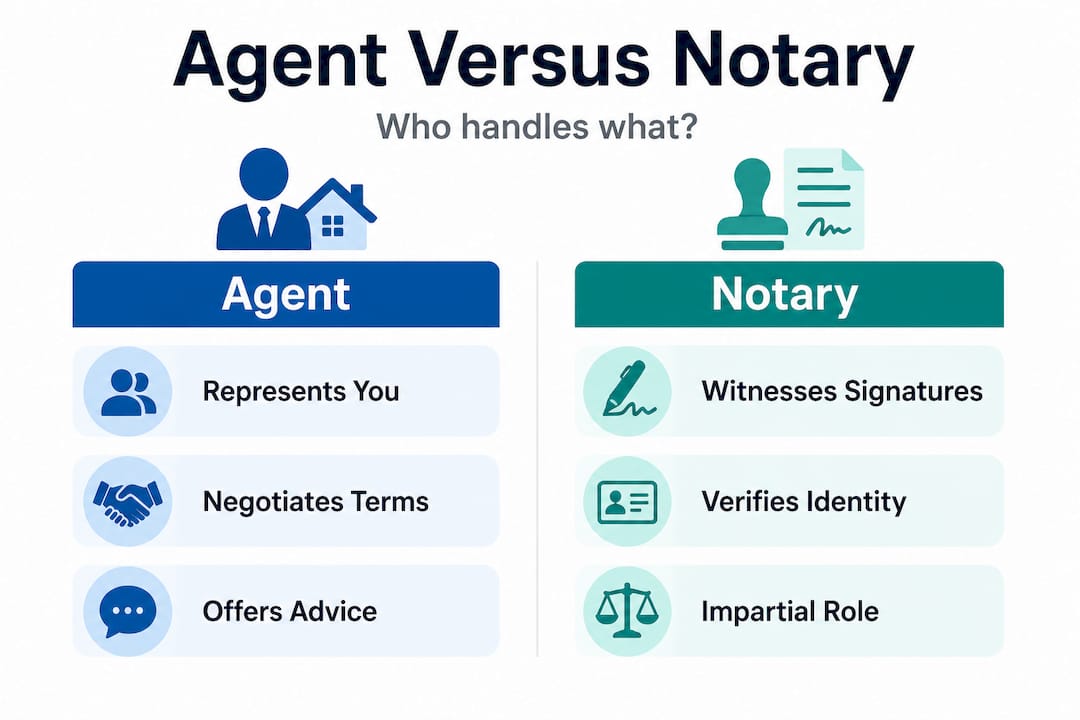
Many buyers assume their agent handles everything, including notarization. Others wonder why they need a notary at all when they already have an agent and an escrow officer. The confusion is understandable, but mixing these roles up can create real problems.
Here is a side-by-side look at how these two essential professionals differ:
| Function | Real Estate Agent | Notary Public |
|---|---|---|
| Represents your interests | Yes | No (impartial) |
| Negotiates price and terms | Yes | No |
| Certifies document authenticity | No | Yes |
| Provides legal witness to signatures | No | Yes |
| Licensed by the state | Yes (DRE) | Yes (Secretary of State) |
| Required at closing | Varies | Required for key docs |
| Can be a fiduciary | Yes | No |
| Advises on market conditions | Yes | No |
The most important takeaway from this table: a notary is impartial. They do not represent you, the other party, or the lender. Their sole job is to confirm that the right person is signing the right document under the right conditions. This neutrality is exactly what makes them legally powerful.
Your real estate agent, by contrast, is your advocate. They negotiate, advise, market your property, and protect your financial interests throughout the transaction. The reasons to use a real estate agent go well beyond paperwork. An experienced Southern California agent knows local market conditions, comparable sales, and how to structure offers that win in competitive bidding situations.
Key distinctions buyers and sellers should keep in mind:
- A notary cannot give you legal or financial advice about the documents they witness
- An agent cannot legally certify the authenticity of your signature for government purposes
- Both are necessary, and neither replaces the other
- Using only one when you need both creates dangerous gaps in your transaction's legal structure
When you are evaluating professionals for your transaction, understanding qualities top real estate agents bring to the table helps you make smarter choices. If you are selling, knowing the specific responsibilities that fall under listing agents in Southern California will give you a clearer view of your full professional support team.
Key documents notaries handle in SoCal property sales
Understanding the separation of duties, let's look at the paperwork notaries are responsible for.
Not every document in a real estate transaction requires notarization. But the ones that do are the ones that carry the most legal weight. Missing notarization on any of these documents will cause serious delays or legal complications.
Here is a breakdown of the primary documents and why they must be notarized:
| Document | What It Does | Why Notarization Is Required |
|---|---|---|
| Grant deed | Transfers ownership from seller to buyer | Required by county recorder for recording |
| Deed of trust | Secures lender's interest in the property | Lender requirement; must be recorded |
| Quitclaim deed | Releases a party's claim to a property | Required for recording and legal validity |
| Power of attorney | Authorizes another party to sign on behalf of the owner | Prevents unauthorized transfers |
| Affidavit of title | Seller certifies no undisclosed claims on title | Required by title companies |
| Loan documents | Mortgage agreement and promissory note | Lender requirement |
| Subordination agreement | Changes priority of liens on a property | Recording requirement |
Deeds of trust are the document that formally gives your lender a security interest in your home until the loan is paid off. California uses deeds of trust rather than traditional mortgages in most transactions. This document must be notarized and recorded with the county. Without proper notarization, the lender cannot legally enforce the agreement.
Grant deeds transfer title from the seller to the buyer. They contain the legal description of the property, the purchase price, and the names of all parties. The Los Angeles County Registrar-Recorder requires these documents to be notarized before they can be officially recorded and the title transferred.
Power of attorney documents are particularly sensitive. If a seller is out of the country or physically unable to attend closing, they may grant power of attorney to a trusted representative to sign on their behalf. Notarization is essential here because it prevents unauthorized parties from signing away someone else's property.
Pro Tip: If you are selling a property as-is, review the requirements for as-is home sales carefully. Even in simplified transactions, all deed transfers and lender documents still require proper notarization for legal validity.
Quitclaim deeds often come up in divorce settlements, inheritance situations, or when adding or removing a spouse from a title. They do not guarantee that the transferring party has clear title, but they do release whatever interest that party holds. Because they affect ownership, they must be notarized and recorded.
Affidavits of title are the seller's sworn statement confirming they have the right to sell the property, that there are no undisclosed liens, and that no one else has a legal claim on the home. The notary's seal turns this sworn statement into a legally binding declaration.
Notaries at the closing table: How they make or break your deal
Armed with knowledge about documents, it's time to examine what happens at the all-important closing meeting.
Closing day is the finish line of your transaction, and the notary is one of the most important people in the room. Everything up to this point, the inspections, the appraisals, the loan approval, can still fall apart if notarization goes wrong at closing.
Here is a step-by-step overview of what notarization at closing actually looks like:
- Identity check first. The notary verifies each signer's ID before the signing begins. This is not optional or casual. A valid, unexpired government-issued ID is required.
- Document review. The notary examines each document to confirm it is complete. Blank spaces in legal documents are a red flag. Any document with unfilled fields cannot be notarized.
- Voluntary confirmation. The notary verbally confirms the signer is acting freely and understands the general nature of what they are signing. This is the coercion check.
- Live signature. The signer signs each document in the notary's presence. No exceptions for documents signed in advance.
- Notary certification. The notary completes the notarial certificate, adds their seal, and records the transaction in their official journal.
- Document submission. Notarized documents are sent to the escrow company, title company, or county recorder as required.
"A notary's job is not to understand the deal. Their job is to make sure the right person is signing the right document freely and intentionally. That distinction protects everyone at the table." This is the legal philosophy behind every notarization in California real estate.
Common consequences when notarization goes wrong:
- County recorder rejects the deed, meaning the title does not transfer
- Lender refuses to fund the loan until documents are corrected
- Closing is delayed by days or weeks while corrected documents are prepared and re-signed
- In severe cases, fraud goes undetected and causes long-term legal battles over ownership
Understanding the full closing process in SoCal gives you a strategic advantage as a buyer or seller. Increasingly, California is seeing the rise of remote notarization, and understanding the remote home selling process helps you prepare for closings that happen digitally. Keep in mind that the SoCal appraisal process also feeds into your closing timeline, and any delays there can affect when your notary appointment is scheduled.
How notaries prevent fraud in property transactions
Beyond paperwork, one of the most critical reasons notaries exist is to protect you from fraud.
Real estate fraud is not a rare occurrence. In California, where property values are among the highest in the nation, fraudsters are highly motivated. Common schemes include deed fraud (where someone forges a signature to transfer a property they do not own), identity theft during closing, and elder financial abuse involving real estate assets.
Common types of real estate fraud notaries help prevent:
- Deed forgery. Someone creates a fake deed to transfer ownership without the owner's knowledge. A notary's identity verification requirement makes this much harder to execute.
- Title fraud. Fraudsters take out loans against a property they do not own. Notarized deeds of trust create a traceable paper trail that flags inconsistencies.
- Impersonation at closing. Someone shows up pretending to be the buyer or seller. The notary's ID check stops this scheme before any document is signed.
- Coerced signings. A vulnerable party, such as an elderly homeowner, is pressured into signing a deed. Notaries are trained to detect signs of coercion and are legally required to stop proceedings if they suspect it.
- Power of attorney abuse. A fake or expired power of attorney is presented at closing to allow an unauthorized person to sign on behalf of the property owner.
Notary protocols that stop these scams:
- Mandatory journal entries that record each signer's ID number, signature, and document type
- Thumbprint requirements for certain high-risk documents in California
- Face-to-face identity verification that cannot be outsourced or skipped
- Independent status, meaning the notary has no financial stake in whether the deal closes
Red flags buyers and sellers should watch for:
- A notary who rushes through ID verification or skips it entirely
- Documents presented with blank fields or last-minute changes the signer has not reviewed
- A notary who explains the legal meaning of documents (this is legal advice, outside their scope)
- Pressure from any party to skip or hurry the notarization step
Pro Tip: After closing, request a copy of the notary's journal entry for your records. In California, notary journals are legal records that can be subpoenaed in disputes. Having a reference to your specific notarization provides an extra layer of protection. Learn more about protecting against real estate fraud to build a stronger defense around your transaction.
Buyers should also take a moment to personally verify that the notary's commission is current and in good standing before the closing appointment. A lapsed commission means the notarization has no legal validity, which creates the same problems as having no notarization at all.
Why most people underestimate notaries—and the truth every homebuyer should know
Here is an uncomfortable truth we have seen play out in Southern California real estate again and again: buyers and sellers spend months obsessing over square footage, school districts, and countertop finishes, and then spend exactly zero minutes thinking about whether their notary is detail-oriented, experienced, or even currently commissioned.
That is backwards.
A notary who misses a middle name discrepancy on an ID, overlooks a blank field in a deed of trust, or fails to record a journal entry properly can unravel a transaction worth hundreds of thousands of dollars. We have seen closings delayed by two weeks because a notary used an expired commission seal. We have seen title companies reject entire loan packages because the notarial certificate used the wrong county. These are not edge cases. They happen in California real estate with regularity.
The myth that notaries are just a bureaucratic box to check is perpetuated by the fact that when everything goes right, you barely notice they were there. That invisibility is actually the sign of a great notary. But when things go wrong, the notary's error becomes the most expensive paperwork mistake you have ever experienced.
What does a reputable, detail-oriented notary look like in practice? They arrive early. They review the document package before you sit down. They flag incomplete fields before asking you to sign. They take time to confirm your ID in detail, not just glance at it. They keep meticulous journal records. They understand the legal difference between a grant deed and a quitclaim deed without confusing the two.
Our strong recommendation: always ask your agent specific questions about who the notary will be and what their track record is. Ask whether they have worked with that notary before. Ask whether the notary specializes in real estate documents versus general notary work. General notary experience is valuable, but real estate notarization has its own specific document types, certificate formats, and compliance requirements that a specialist handles far better.
One more thing that experienced buyers and sellers know: in California, you have the right to request a specific notary or to pause a signing if you feel uncomfortable with the process. Use that right. Never let urgency or social pressure push you through a signing you do not fully understand. A legitimate notary will support you in taking the time you need.
Ready to buy or sell? Work with trusted Southern California professionals
For those ready to take the next step, here's how to ensure your team keeps your interests protected every step of the way.
Navigating a Southern California real estate transaction involves more moving parts than most buyers and sellers expect. The notary is one critical piece of that puzzle, but so is having a knowledgeable local agent who coordinates every detail from listing to closing.

At IN Realtors, we connect buyers and sellers throughout Los Angeles, Orange County, and surrounding markets with the resources and expertise they need for smooth, legally sound transactions. Whether you are browsing single-family homes in SoCal or preparing to list your property, our team ensures that every professional in your transaction, including your notary, meets the standards your investment deserves. Get a clear picture of what your home is worth today with a free home value report, or connect with our team directly to explore your selling options with experienced local guidance every step of the way.
Frequently asked questions
Is notarization required for all real estate documents in California?
Notarization is required for key documents such as grant deeds and deeds of trust, but not for every piece of paperwork in a transaction. Documents like purchase agreements and disclosure forms typically do not require a notary's seal.
Can a real estate agent act as a notary in California?
A California real estate agent can hold a notary commission, but they are prohibited from notarizing documents in any transaction where they have a financial or personal interest. This conflict-of-interest rule protects both parties.
What happens if a document is not properly notarized at closing?
Improperly notarized documents can be rejected by the county recorder's office, causing the title transfer to fail and closing to be delayed. In serious cases, lenders may refuse to fund the loan until corrections are made and documents are re-signed.
How do I verify my notary's commission status in California?
You can search for a notary's active commission using the California Secretary of State online notary database, which provides real-time commission status and expiration dates.