

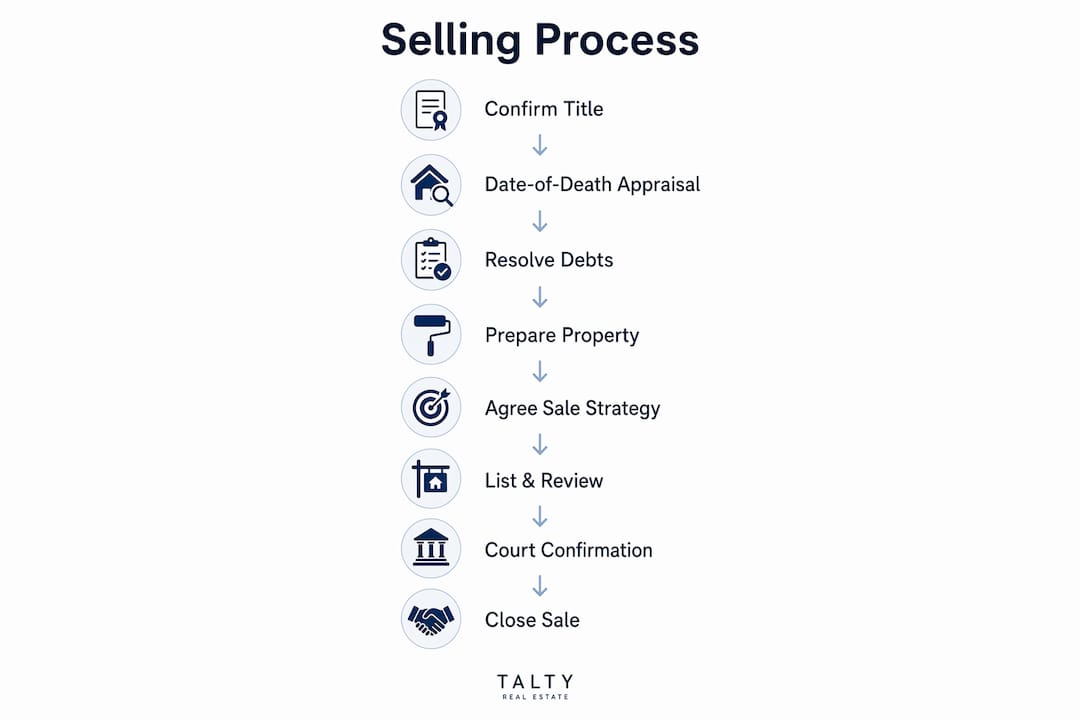
Selling inherited property requires you to confirm legal authority, navigate probate, understand your tax basis, and coordinate with other heirs before you ever list the home. Done in the right order, the process protects you from IRS penalties, title disputes, and costly delays. Here is a clear overview of every major step:
- Confirm authority to sell by verifying the will, trust, or court appointment that gives you or the executor the right to act.
- Open probate (if required) and obtain Letters Testamentary or Letters of Administration from the probate court.
- Order a date-of-death appraisal to establish the stepped-up tax basis and satisfy IRS documentation requirements.
- Resolve outstanding debts and liens, including any federal estate tax lien, before listing.
- Reach written agreement among all heirs on price, timing, and how proceeds will be divided.
- Prepare and list the property, choosing between a private sale and a public auction based on market conditions and probate requirements.
- Accept an offer and, if supervised probate applies, obtain court confirmation before proceeding to closing.
- Close the sale, settle remaining estate obligations, and distribute net proceeds to heirs.
Cooperating with co-heirs and staying ahead of legal and tax requirements at every stage keeps the transaction on track. The sections below walk through each step in full detail.
Table of Contents
- What are the tax implications of selling inherited property?
- How does probate work when selling inherited property?
- Step-by-step process for selling an inherited house
- How do you handle heirs, agreements, and family dynamics?
- What you need to know about estate tax liens and community property basis rules
- How long does it take to sell inherited property?
- Increaltors can guide you through selling an inherited property in Southern California
- Key Takeaways
What are the tax implications of selling inherited property?
The tax treatment of inherited property is genuinely favorable compared to most other asset sales, but only if you document your basis correctly from the start.
How the step-up in basis works
When you inherit property, your tax basis resets to the fair market value (FMV) of the property on the date of the decedent's death, not the original purchase price the deceased paid decades ago. This is the step-up in basis rule under IRC Section 1014. If the home was bought decades ago and was worth considerably more at death, your basis resets to the date-of-death value, not the original purchase price. Selling shortly thereafter means your taxable gain is only the amount above that stepped-up basis.
If a federal estate tax return (Form 706) was filed, the value listed on Form 706 is your official basis, overriding any independent appraisal. The IRS requires that your reported basis be consistent with the estate tax value, and an accuracy-related penalty can apply if you report a higher basis than the estate tax return supports.
Without a Form 706 filing, your basis equals the property's appraised FMV at the date of death for state inheritance or transmission tax purposes. Either way, an accurate appraisal is not optional. Skipping it can lead to inaccurate capital gains calculations and IRS penalties.
Capital gains tax rates and reporting
The IRS treats inherited property as a long-term capital gain asset regardless of how long you personally hold it after inheriting. This matters because long-term rates (0%, 15%, or 20% depending on your income) are lower than short-term rates, which are taxed as ordinary income.
Report the sale on Schedule D (Form 1040) and Form 8949. Your gain is the sale price minus your stepped-up basis minus selling expenses such as agent commissions and closing costs.
| Scenario | Original Purchase Price | Date-of-Death FMV (Basis) | Sale Price | Taxable Gain |
|---|---|---|---|---|
| Example scenarios demonstrate how selling soon after inheritance can minimize capital gains tax, while holding the property longer may increase taxable gain. Selling at a price below basis results in a loss for tax purposes. |
Selling soon after inheritance typically results in little to no capital gains tax because the property has had minimal time to appreciate beyond the stepped-up basis. Waiting years while the market rises increases your taxable gain dollar for dollar.
Surviving spouse and community property rules
If you are a surviving spouse who owned the home as joint tenants with right of survivorship, only your spouse's half of the basis steps up to date-of-death FMV. Your own half retains its original adjusted basis. For a home with an adjusted basis of $50,000 and a date-of-death FMV of $100,000, your new combined basis is $75,000 ($25,000 for your half plus $50,000 for your spouse's half).
Community property states follow a more generous rule. In Arizona, California, Idaho, Louisiana, Nevada, New Mexico, Texas, Washington, and Wisconsin, the entire FMV of community-owned property steps up to date-of-death value for both spouses' shares, not just the decedent's half. That full step-up means, for a home valued at $100,000 at death, the surviving spouse's basis becomes the full $100,000, eliminating capital gains tax almost entirely if the property is sold promptly. For more detail on how this plays out for California sellers specifically, the home sale tax guide for California covers the state-level nuances.
How does probate work when selling inherited property?
Probate is the court-supervised legal process that transfers a deceased person's assets to their heirs or beneficiaries. For real estate, it is the mechanism that gives the executor or administrator the legal authority to sign a deed and transfer clear title to a buyer.
Key roles and documents
The executor (named in the will) or administrator (appointed by the court when there is no will) is the personal representative of the estate. Their authority to sell real property comes from Letters Testamentary or Letters of Administration, issued by the probate court after the will is filed and validated. Without these letters, no title company will insure the transaction.
Key legal steps in the probate process include:
- File the will with the probate court in the county where the decedent lived.
- Petition for appointment as executor or administrator and receive Letters Testamentary or Letters of Administration.
- Inventory and appraise estate assets, including real property.
- Notify creditors and allow the statutory claims period to run (varies by state, commonly 3–6 months).
- Petition the court for authority to sell if the estate is under supervised administration.
- Issue proper legal notices to all interested parties before any confirmation hearing.
The executor must issue proper legal notices to all interested parties before probate court confirmation hearings. Failure to do so commonly causes costly delays and can expose the estate to legal challenges.
Supervised vs. independent administration
Many states offer two tracks. Supervised probate requires court approval at multiple stages, including a formal confirmation hearing before the sale closes. Independent administration (available in states like California under the Independent Administration of Estates Act) gives the executor broader authority to sell without returning to court for each decision, which can cut months off the timeline.
State rules vary considerably. California, Texas, and Florida each have distinct probate codes with different timelines, notice requirements, and sale procedures. Consulting a probate attorney in the property's state is the most reliable way to confirm which track applies and what filings are required.
Common legal obstacles
- Title clouds from missing heirs, undisclosed liens, or prior deeds not properly recorded
- Disputes among beneficiaries that require court mediation
- Creditor claims filed late or contested
- Delays caused by missing or improperly executed wills
- Out-of-state property requiring ancillary probate in a second jurisdiction
Step-by-step process for selling an inherited house
Walking through the full process in sequence prevents the most common and expensive mistakes heirs make.
Step 1: Confirm title authority
Before anything else, verify who legally has the right to sell. If the property passed through a trust, the successor trustee holds authority. If it went through probate, the executor with Letters Testamentary controls the sale. Heirs selling jointly must coordinate with the executor to confirm authority and ensure chain-of-title clarity. Skipping this step causes title insurance problems at closing.

Step 2: Order a date-of-death appraisal
Hire a licensed appraiser to establish the property's FMV as of the date of death. This figure becomes your stepped-up basis for tax purposes. If Form 706 was filed, the estate tax value controls, but an independent appraisal still supports that value and protects you in an audit.
Step 3: Identify and resolve debts and liens
Pull a title report to surface any mortgages, property tax arrears, mechanics' liens, or judgment liens attached to the property. All must be paid or negotiated before closing. Federal estate tax liens require special handling (covered in detail in the section below on estate tax liens).
Step 4: Prepare the property for sale
Clear personal belongings, address deferred maintenance, and consider a professional inspection to identify issues buyers will flag. Staging or a light cosmetic refresh often increases the final sale price more than the cost of the work. For inherited homes that have been vacant, check for utility shutoffs, pest issues, and insurance lapses.
Pro Tip: Order a pre-listing inspection before you set a price. Inherited properties frequently have deferred maintenance the heirs are unaware of, and discovering problems after an offer is accepted can kill the deal or force a last-minute price reduction.

Step 5: Agree on sale strategy with all heirs
Choose between a traditional MLS listing, an off-market private sale, or a public auction. Each has trade-offs on price, speed, and transparency. Get written agreement from all heirs on the asking price, acceptable offer terms, and how proceeds will be split before you list. Verbal agreements fall apart under the pressure of a real offer.
Step 6: List, market, and review offers
Work with a real estate agent experienced in estate sales. Price the property using comparable sales data, not sentimental value. Review each offer carefully for contingencies, financing strength, and closing timeline. The executor has a fiduciary duty to the estate, which means accepting the highest net offer, not necessarily the fastest close.
Step 7: Court confirmation (supervised probate only)
If the estate is under supervised probate, the accepted offer must be filed back to court for formal approval. Bypassing this step risks voiding the sale entirely. At the confirmation hearing, an overbidding process may occur in some states, allowing third parties to bid higher than the accepted offer. Arkansas, for example, requires a 10% deposit for overbids to protect the estate from non-serious bidders.
Step 8: Close the sale and distribute proceeds
At closing, the title company or escrow officer pays off all liens, estate obligations, and closing costs from the sale proceeds. The net amount is then distributed to heirs according to the will, trust, or court order. Get a final accounting from the estate attorney before any distribution to confirm all creditors have been paid.
For a detailed look at the closing workflow, the seller closing process guide covers each stage from accepted offer to funded transaction.
How do you handle heirs, agreements, and family dynamics?
Selling a family property is rarely just a financial transaction. Emotions run high, memories are attached to the home, and disagreements among heirs can stall or derail a sale that everyone ultimately wants to complete.
Start with a family meeting as early as possible, ideally before the property is even listed. Put the key decisions on the table: who has legal authority to sign, what the target price range is, how proceeds will be divided, and what happens if one heir wants to keep the property. Getting these answers in writing, even informally, prevents misunderstandings later.
Practical strategies for managing heir dynamics:
- Appoint a single point of contact among the heirs to communicate with the agent, attorney, and title company. Multiple heirs calling the agent independently creates confusion and delays.
- Use a written heir agreement that covers sale price thresholds, offer acceptance criteria, and distribution percentages before listing.
- Bring in a mediator early if one heir is resistant to selling. A neutral third party is far less expensive than litigation.
- Acknowledge emotional factors openly. An heir who grew up in the home may need time to process the decision. Rushing them often creates more resistance, not less.
- Keep all heirs informed at every stage with written updates. Surprises breed distrust, and distrust breeds disputes.
- Consult a probate attorney if any heir threatens to contest the will or block the sale. Court intervention is a last resort, but knowing your legal options gives you leverage in negotiations.
When disagreements center on price, a second independent appraisal can depersonalize the conversation. When they center on timing, a clear written timeline with agreed milestones gives everyone a shared reference point.
What you need to know about estate tax liens and community property basis rules
Two legal and tax factors catch heirs off guard more than almost any other: federal estate tax liens and the community property full step-up rule. Both can significantly affect your ability to close and your tax bill.
Federal estate tax liens
When a federal estate tax return (Form 706) is required, a federal estate tax lien automatically attaches to all property in the decedent's gross estate. The lien does not need to be publicly recorded to be valid, which means it can exist without appearing in a standard title search. A buyer cannot obtain clear title until the lien is formally discharged.
The IRS provides two paths to discharge. If an executor or administrator is appointed and acting within the United States, submit IRS Form 4422, Application for Certificate Discharging Property Subject to Estate Tax Lien. If the sale proceeds will not fully cover the estate's tax liability, use Form 14135, Application for Discharge of Property from Federal Tax Lien. Both forms require advance planning since IRS processing takes time and closing cannot proceed without the discharge certificate.
IRS guidance states: "The federal estate tax lien doesn't have to be publicly recorded to be valid." This means heirs and buyers can be unaware of the lien until the title company flags it during escrow, which can delay or derail closing if the discharge process has not already been started.
Resolving an estate tax lien before listing, not after accepting an offer, keeps the sale on schedule.
Community property full step-up
In the nine community property states (Arizona, California, Idaho, Louisiana, Nevada, New Mexico, Texas, Washington, and Wisconsin), the entire fair market value of community-owned property steps up to date-of-death value for both spouses' shares, not just the decedent's half. For this rule to apply, at least half the value of the community property interest must be includible in the decedent's gross estate. The result is that a surviving spouse in a community property state who sells promptly after inheriting can often owe little to no capital gains tax, even on significantly appreciated property. For example, if the entire property receives a step-up to $100,000, the basis for the surviving spouse is the full $100,000.
This is a meaningful advantage over the joint tenancy rule that applies in non-community-property states, where only the decedent's half steps up. Heirs in community property states should confirm with a tax advisor that the property qualifies before assuming the full step-up applies.
How long does it take to sell inherited property?
The timeline from inheritance to a completed sale varies widely based on probate complexity, property condition, and market conditions. Here is a realistic range for each phase:
| Phase | Typical Duration |
|---|---|
| Probate and sale timelines vary widely depending on state and case complexity. Phases include probate opening, creditor claims period, appraisal, property prep, marketing, court confirmation if supervised, and closing. Independent administration generally shortens the timeline by eliminating court confirmation. |
Independent administration, where available, cuts the timeline significantly by eliminating the court confirmation hearing. States like California allow independent administration for most estates unless a beneficiary objects, which is why California probate sales often close faster than those in states with mandatory court oversight.
The single biggest source of delay is not the court system. It is unresolved heir disagreements, missing documentation, and undiscovered liens. Addressing those issues in the first 60 days after the decedent's death compresses the overall timeline more than any procedural shortcut.
For heirs selling property in the Los Angeles area, the step-by-step guide to selling property in LA covers local market timing and what to expect from Southern California escrow timelines specifically.
Increaltors can guide you through selling an inherited property in Southern California
Inherited a home in Los Angeles, Orange County, or the surrounding area? Increaltors, led by agent Irvin Nierras of HomeSmart Evergreen Realty, offers personalized real estate guidance built specifically for sellers navigating estate sales. The difference from a standard listing agent is real: Irvin brings local market expertise, familiarity with probate sale requirements, and a direct, supportive approach that keeps heirs informed and aligned at every stage.

Whether you are selling a single-family home that has been in the family for decades or a condo that came to you unexpectedly, Increaltors can help you price it accurately, coordinate with the estate attorney, and get it sold without the stress of managing the process alone. The first step is a free home valuation so you know exactly what the property is worth in today's market. Get your free home value report and connect with Irvin directly to discuss your situation.
Key Takeaways
Selling inherited property successfully requires accurate tax documentation, clear legal authority, and early heir coordination before the property ever hits the market.
| Point | Details |
|---|---|
| Step-up in basis reduces taxes | Your tax basis resets to date-of-death FMV, often eliminating most capital gains tax if you sell promptly. |
| Form 706 controls your basis | If an estate tax return was filed, the value listed there is your official basis and must be reported consistently. |
| Estate tax liens need early discharge | Federal estate tax liens attach automatically with a Form 706 filing and require IRS Form 4422 or Form 14135 to clear before closing. |
| Community property states offer a full step-up | In all nine community property states, both halves of jointly owned property step up to date-of-death FMV, not just the decedent's share. |
| Increaltors supports Southern California estate sales | Irvin Nierras at Increaltors provides personalized guidance for heirs selling inherited property in Los Angeles and Orange County. |