
TL;DR:
- A structured seller closing workflow with clear task ownership ensures on-time home sales and reduces delays.
- Responding promptly and confirming all documents and deadlines minimizes last-minute surprises during the process.
The seller closing process workflow is the structured sequence of steps that moves a home sale from accepted offer to final deed recording and fund disbursement. Most residential closings span 30–60 days and involve roughly eight distinct phases. That timeline sounds manageable until you realize a single missed document or a late payoff request can push your closing date back by days or even weeks. Sellers and agents who follow a documented, phase-by-phase workflow close on time far more consistently than those who rely on memory and scattered emails. This guide covers every phase, every key document, and the exact pre-closing steps that prevent last-minute surprises.
What are the main phases in the seller closing process workflow?
The real estate closing process is formally called the "escrow and settlement period" in most states, though sellers and agents commonly refer to it as the closing workflow. Residential closings involve roughly 8 distinct phases, each with specific tasks, responsible parties, and contractual deadlines.
Phase 1: Contract execution. The listing agent and buyer's agent finalize the purchase agreement. Both parties sign, and the clock starts on all contingency periods.
Phase 2: Earnest money delivery. The buyer deposits earnest money, typically within 1–3 business days of contract acceptance. The title company or escrow holder receives and holds these funds.
Phase 3: Seller disclosure delivery. The seller provides all required disclosures, including the Transfer Disclosure Statement in California. Deadlines vary by state but are usually within 5–7 days of contract execution.
Phase 4: Inspection and due diligence. The buyer orders a home inspection. The seller's role here is access and responsiveness. Repair negotiations happen during this window.

Phase 5: Financing and appraisal. The buyer's lender orders an appraisal. Lender delays, especially underwriting and appraisal issues, are the leading causes of closing delays. Sellers should stay in close contact with their agent during this phase.
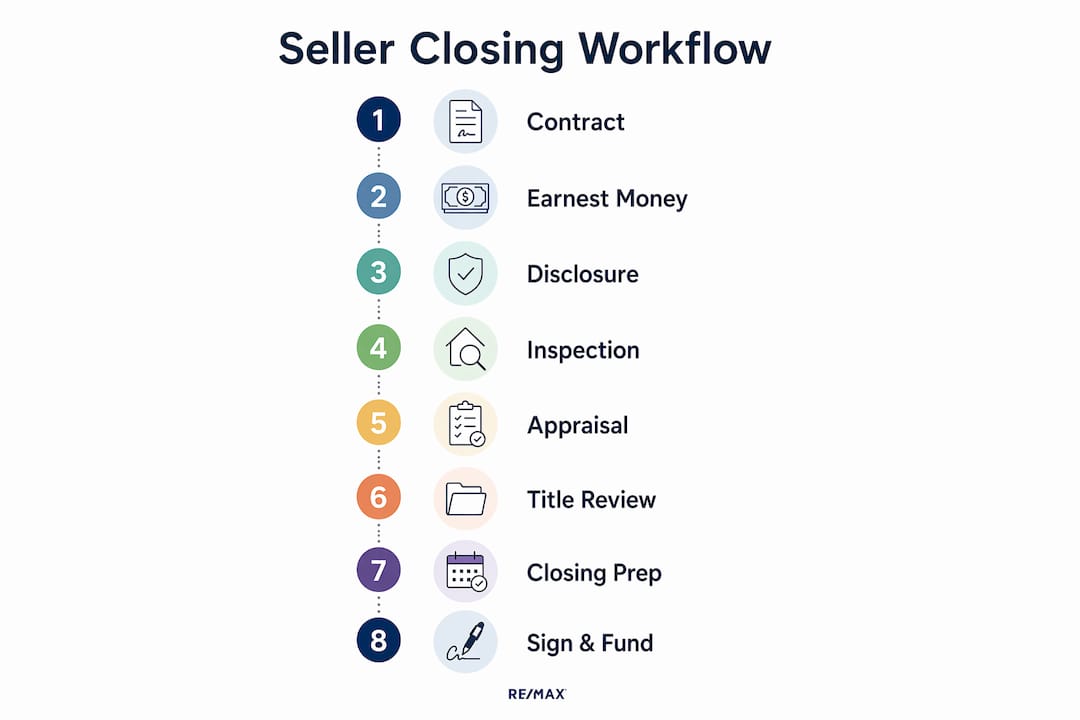
Phase 6: Title review. The title company examines the chain of ownership and issues a title commitment. Any liens, judgments, or encumbrances on the seller's property must be resolved before closing.
Phase 7: Closing preparation. The settlement statement is prepared, payoffs are confirmed, and all parties review final numbers. The seller requests a mortgage payoff statement during this phase.
Phase 8: Signing, recording, and funding. The seller signs closing documents, the deed is recorded with the county, and funds are disbursed. Recording the deed with the county is the official close, not the signing appointment itself.
A typical residential closing involves 6–12 parties, including the buyer, seller, both agents, the lender, the title company, the inspector, and the appraiser. A transaction coordinator often manages communication across all of them. Understanding the home sale timeline from offer to funding helps sellers set realistic expectations before they ever accept an offer.
How do you assign ownership and avoid delays in the seller closing workflow?
Accountability is the single biggest factor separating on-time closings from delayed ones. Assigning specific document ownership early and avoiding scattered email chains significantly improves the odds of closing on schedule. Every task in the workflow needs one named owner, whether that is the listing agent, the title officer, or the transaction coordinator.
The most common breakdown point is communication. Sellers who respond slowly to document requests, repair addenda, or lender conditions create bottlenecks that ripple through every subsequent phase. Centralizing all documents in one shared location, rather than across multiple email threads, eliminates the "I never got that" problem that delays closings.
Milestone-based checklists work better than open-ended task lists. Instead of "get disclosures done," the checklist should read "deliver Transfer Disclosure Statement to buyer by day 5." Specific deadlines create accountability. Teams with repeatable, documented closing workflows close more deals on schedule than those relying on manual follow-up.
The transaction coordinator role is worth understanding here. The transaction coordinator handles all phases and deadlines, which frees the listing agent to focus on negotiations and the signing appointment. For sellers working without a coordinator, the listing agent absorbs those responsibilities, which makes proactive seller communication even more critical.
- Assign one named owner to every document and deadline before the workflow begins.
- Centralize all files in a shared folder, not individual email inboxes.
- Use milestone deadlines tied to contract dates, not vague "soon" language.
- Schedule weekly check-ins with the lender's loan officer to catch underwriting issues early.
- Flag any title issues immediately so the title company has maximum time to resolve them.
Pro Tip: If your agent uses a transaction coordinator, ask for their direct contact information on day one. Direct access to the coordinator cuts response time in half when a deadline is approaching.
Sellers should also review the role of real estate disclosures early in the process. Disclosure delays are a common and avoidable source of workflow disruption, especially in California where disclosure requirements are extensive.
What documents does the seller sign at closing?
A standard seller signing appointment lasts 30–90 minutes. The seller executes several documents during that window, each with a specific legal purpose. Knowing what you are signing before you sit down prevents errors and speeds up the appointment.
The deed is the most important document. It transfers legal ownership from the seller to the buyer. In California, sellers most commonly use a Grant Deed, which carries an implied warranty that the seller has not previously conveyed the property to another party. The deed must be notarized and then recorded with the county recorder's office to make the transfer official.
The ALTA Settlement Statement (or HUD-1 in some transactions) is the financial summary of the entire transaction. Sellers should review this document carefully before the signing appointment, not during it. Check the sale price, mortgage payoff amount, agent commissions, prorations for property taxes and HOA dues, and any seller credits agreed to in the contract. Errors on the settlement statement are common and fixable before signing, but painful to correct after.
Additional documents the seller signs at closing include:
- Owner's affidavit: Confirms the seller has no undisclosed liens, judgments, or pending legal actions against the property.
- FIRPTA affidavit: Certifies the seller is not a foreign national subject to federal withholding requirements under the Foreign Investment in Real Property Tax Act.
- IRS Form 1099-S: Reports the gross proceeds of the real estate sale to the Internal Revenue Service. The title company typically prepares this form.
- State-specific tax forms: California requires additional transfer tax declarations depending on the county.
- Loan payoff authorization: Directs the title company to pay off any existing mortgage from the sale proceeds.
Pro Tip: Request a draft of the settlement statement at least 24 hours before your signing appointment. Review every line item against your original net sheet. Discrepancies are far easier to fix before you sign than after.
Understanding what a closing agent does in Southern California helps sellers know who to call with questions about specific documents during the closing process.
What should sellers do in the final days before closing?
The 72 hours before closing are the highest-risk window in the entire seller transaction workflow. Most last-minute failures trace back to tasks that were assumed to be handled but never confirmed. A structured pre-closing audit eliminates that risk.
Run a pre-closing audit 2–3 days before closing to confirm that all signed documents are in escrow, all contingencies are formally released, the settlement statement is approved, and wire instructions are verified. This audit takes less than an hour and prevents the most common closing-day surprises.
Mortgage payoff and financial preparation
Request your mortgage payoff statement 7–10 days before closing. Payoff amounts change daily because of accruing interest. A late request forces the title company to recalculate at the last minute, which can delay funding. Give your lender enough lead time to produce an accurate figure.
Wire fraud is a serious and growing threat in real estate transactions. Verify wire instructions only by phone, using a number you find independently, never a number provided in an email. Fraudsters intercept email threads and substitute fake wire instructions. One phone call to the title company's main line prevents a potentially catastrophic loss.
Physical and logistical preparation
- Keep your homeowner's insurance policy active through closing day. Canceling coverage too early leaves you exposed if a fire, flood, or liability event occurs before the deed records. Most advisors recommend keeping coverage active until the day after closing.
- Schedule final utility readings for closing day or the day after. Notify each provider of the transfer date to avoid billing disputes with the buyer.
- Prepare a complete handoff package for the buyer: all keys, garage remotes, mailbox keys, alarm codes, appliance manuals, and warranty documents.
- Confirm your moving logistics align with the possession date in the contract. Sellers who remain in the property past the agreed possession date can face financial penalties.
- Do a final walkthrough of the property to confirm its condition matches what the buyer agreed to purchase. Remove all personal property and debris unless the contract specifies otherwise.
Pro Tip: Create a physical folder with every document the buyer will need after closing: HOA contact information, utility account numbers, recent service records, and any permits pulled during your ownership. Buyers remember sellers who make the handoff easy.
Sellers who invest time in home sale preparation before listing tend to have fewer surprises during the closing phase because their documentation is already organized.
Key Takeaways
A documented, phase-by-phase seller closing workflow with named task owners and milestone deadlines is the most reliable way to close on time and avoid costly last-minute delays.
| Point | Details |
|---|---|
| Eight-phase structure | The closing process runs from contract execution through deed recording across roughly 30–60 days. |
| Named task ownership | Assign one responsible party to every document and deadline before the workflow begins. |
| Pre-closing audit | Run a structured audit 2–3 days before closing to confirm documents, contingencies, and wire instructions. |
| Payoff statement timing | Request your mortgage payoff statement 7–10 days early to prevent last-minute funding delays. |
| Wire fraud prevention | Verify wire instructions by phone only, using a number sourced independently from any email. |
What I've learned after watching sellers stumble at the finish line
After working through dozens of closings in Los Angeles and Orange County, the pattern I see most often is not sellers failing at the big things. It is sellers assuming the small things are handled. A disclosure that was emailed but never confirmed received. A payoff statement requested on the wrong day. Wire instructions verified by replying to an email instead of picking up the phone.
The sellers who close without drama are not the ones with the simplest transactions. They are the ones who treat the closing workflow like a project with a hard deadline, not a process that will sort itself out. They ask for the settlement statement 24 hours early. They call the title company directly. They have their moving truck booked before the ink is dry on the contract.
The technology question comes up often. Workflow software and shared document platforms genuinely help, especially for agents managing multiple transactions at once. But the tool is only as good as the habit behind it. I have seen agents with sophisticated systems miss deadlines because no one was assigned to check the system. A simple shared checklist with named owners beats a complex platform that nobody updates.
Wire fraud deserves more attention than it gets in casual conversations about closing. The dollar amounts in real estate transactions make sellers a prime target. The fraudster's method is simple: intercept an email thread, swap in fake wire instructions, and wait. The defense is equally simple: call the title company on a number you look up yourself. That one call is the most important thing a seller can do in the final 48 hours.
My honest advice to any seller reading this: do not wait for your agent to push you through the process. Know the phases, know your deadlines, and ask for confirmation in writing when something is supposed to be done. The closing table is not the place to discover that a contingency was never formally released.
— Irvin Nierras
Selling your home in Southern California? Increaltors can help
Increaltors specializes in managing home sales across Los Angeles, Orange County, and surrounding Southern California markets, with a process built around clear timelines, organized documentation, and direct agent communication.

Whether you are preparing to list or already under contract, Increaltors agent Irvin Nierras guides sellers through every phase of the closing workflow so nothing falls through the cracks. Browse current single family homes for sale or explore available condos on the market to get a clear picture of where the Southern California market stands right now. If you want to know what your home is worth before you commit to selling, get a free home valuation report from Increaltors with no obligation.
FAQ
What is the seller closing process workflow?
The seller closing process workflow is the structured sequence of tasks, documents, and deadlines that moves a home sale from accepted offer to recorded deed and funded proceeds. It typically spans 30–60 days and involves roughly eight distinct phases.
How long does the seller closing process take?
Most residential closings take 30–60 days from contract acceptance to deed recording. Cash transactions can close faster, while financing contingencies and title issues can extend the timeline.
What documents does a seller sign at closing?
Sellers sign the deed, the ALTA Settlement Statement, an owner's affidavit, a FIRPTA affidavit, IRS Form 1099-S, and any state-specific transfer tax forms. The signing appointment typically lasts 30–90 minutes.
What causes the most delays in the seller closing workflow?
Lender underwriting and appraisal issues are the leading causes of closing delays. Seller unresponsiveness on document requests and unresolved title issues are the next most common problems.
When should a seller request a mortgage payoff statement?
Sellers should request a payoff statement 7–10 days before the scheduled closing date. Requesting it later forces last-minute recalculations that can delay funding and push the closing date back.