

TL;DR:
- Real estate syndication pools investor capital to acquire large commercial properties in Southern California.
- It involves a sponsor managing the deal with passive investors receiving regular distributions and tax benefits.
- Success depends on thorough vetting of sponsors, conservative deal analysis, and long-term commitment.
Most people assume you need millions in the bank and a team of attorneys to invest in large commercial properties. That assumption keeps ordinary investors on the sidelines while others quietly build wealth through apartment complexes, retail centers, and storage facilities across Southern California. Real estate syndication changes that equation entirely. It's a legal, time-tested structure where a group of investors pools their capital to buy properties that none of them could afford alone. This guide breaks down exactly how syndication works, who qualifies, what the real risks look like, and how SoCal investors and homebuyers can use it as a path toward long-term financial growth.
Table of Contents
- What is real estate syndication?
- How real estate syndication works: Key steps and process
- Rewards and risks: Is syndication right for you?
- What to look for in a real estate syndication (and sponsor)
- Why due diligence matters more than hype: Our take on syndication
- Get started with real estate syndication or alternative investments
- Frequently asked questions
Key Takeaways
| Point | Details |
|---|---|
| Syndication basics | Real estate syndication lets multiple investors pool funds to buy large properties together under a sponsor's management. |
| Deal structure matters | Most syndications require accredited investors and use LLC or LP setups with clear roles and legal protections. |
| Weigh risks and rewards | Syndications offer passive income and tax perks but carry risks like illiquidity and reliance on the sponsor. |
| Diligence is essential | Thoroughly vet sponsors and deals, especially in competitive markets like Southern California. |
| Local expertise pays | Knowledge of the Southern California market can improve your investment decisions and success with syndications. |
What is real estate syndication?
At its core, real estate syndication is a structure where multiple investors pool capital to acquire, manage, and operate large commercial properties, typically through a General Partner (GP or sponsor) who handles operations and Limited Partners (LPs) who provide passive investment. Think of it like a sports franchise: the owner calls the plays, the investors fund the team, and everyone shares the profits.
In Southern California, syndications commonly target multifamily apartment buildings in cities like Long Beach, Anaheim, or Torrance, where demand consistently outpaces supply. You will also see syndication used for self-storage facilities, retail strip centers, and office buildings. The asset type matters less than the quality of the deal and the reliability of the sponsor running it.
The core structure looks like this:
- General Partner (GP): Sources the deal, manages the property, handles reporting, and makes day-to-day decisions
- Limited Partners (LPs): Invest capital, receive passive income distributions, and have no management responsibilities
- Entity type: Most syndications are structured as LLCs or Limited Partnerships (LPs)
- Regulation: Deals typically operate under Regulation D, which provides exemptions from full SEC registration
Here is a quick comparison to help you place syndication alongside other investment vehicles you may already know:
| Feature | Syndication | Real Estate Crowdfunding | REIT |
|---|---|---|---|
| Ownership type | Direct (fractional) | Fractional (platform) | Shares of a trust |
| Minimum investment | $25,000 to $100,000+ | $500 to $5,000 | Any amount |
| Liquidity | Low (3-10 years) | Low to moderate | High (publicly traded) |
| Control | Sponsor-led | Platform-led | None |
| Tax benefits | Yes (depreciation, 1031) | Limited | Limited |
"Syndication is not passive in the sense that you just hand over money and forget it. You are still a partial owner of a real asset, and that ownership carries both upside and responsibility to vet the deal properly."
For SoCal investors, syndication offers a direct path into the SoCal real estate investment market without requiring you to manage tenants, fix plumbing, or refinance loans on your own. The sponsor handles all of that. Your job is to choose the right deal and the right operator.
How real estate syndication works: Key steps and process
Now that the basics are clear, here is exactly what the process looks like from the moment a deal starts forming to the day you receive your final distribution.
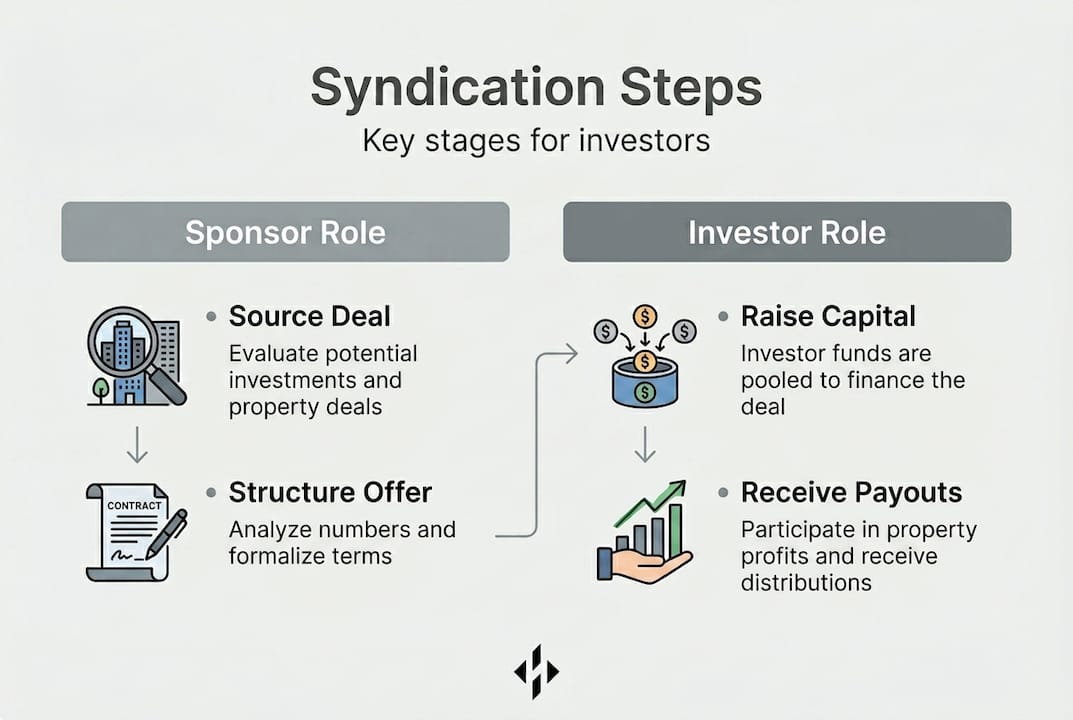
Step 1: The GP sources the deal. A sponsor identifies a target property, negotiates terms with the seller, and performs initial underwriting. In competitive markets like Los Angeles and Orange County, this stage can take months.
Step 2: The GP structures the offering. Syndications are structured as LLCs or LPs under Regulation D exemptions, limited to 99 LPs, requiring accredited investors. The GP hires attorneys to prepare a Private Placement Memorandum (PPM), which outlines all material risks, fees, return projections, and investor rights.
Step 3: Capital is raised. The GP markets the deal to qualified investors. Minimum investments typically range from $25,000 to $100,000. This is not a platform like real estate crowdfunding, where minimums can be as low as $500. Syndication is a more exclusive, relationship-driven process.
Step 4: Acquisition and management. Once the raise closes, the property is acquired. The sponsor then executes the business plan, whether that means renovating units, raising rents to market rate, or improving occupancy at a retail center.

Step 5: Distributions flow to investors. LPs receive regular cash distributions, often quarterly, based on their ownership percentage. In a typical SoCal multifamily deal, preferred returns often sit between 6% and 8% annually before the GP takes its carried interest.
Step 6: Exit and final payout. After a hold period, the sponsor sells or refinances the property. Proceeds are distributed to LPs, often representing the biggest payout in the deal cycle.
Regarding tax benefits: depreciation from the property is passed through to LPs, often offsetting passive income. Some deals also qualify for a 1031 exchange at exit, which lets you defer capital gains by rolling proceeds into a new property.
Pro Tip: Always request a copy of the sponsor's previous deal summaries, including projected versus actual returns. A sponsor who consistently hits or beats projections is worth far more than one with flashy marketing materials.
Rewards and risks: Is syndication right for you?
Syndication is not for everyone. Let's break down the real tradeoffs so you can decide if it fits your financial situation and goals.
The rewards worth noting:
- Passive income: You collect distributions without managing the property
- Diversification: You can spread capital across multiple markets and asset types
- Tax efficiency: Depreciation deductions and potential 1031 exchanges reduce your tax burden
- Access to scale: You participate in a $10 million apartment complex with a $50,000 check
- Reduced workload: No landlord responsibilities, no tenant calls at midnight
Southern California is particularly attractive for syndication targets because of its constrained housing supply, strong population base, and historically stable long-term property values. Best SoCal locations like Irvine, Pasadena, and Long Beach consistently attract institutional capital for exactly these reasons.
Now for the risks you cannot ignore:
Market downturns, execution failure, interest rate hikes, especially when deals carry variable debt, and liquidity lockups lasting 3 to 10 years are all real possibilities. Total loss of principal is not hypothetical. It happens when a sponsor over-leverages, the market shifts, or the business plan simply does not work.
Compare your options side by side:
| Factor | Syndication | Direct ownership | REIT |
|---|---|---|---|
| Control | Low | High | None |
| Liquidity | Low | Moderate | High |
| Hands-on work | None | High | None |
| Return potential | High (13-18% IRR target) | Variable | Lower |
| Risk of loss | Moderate to high | Moderate | Low to moderate |
| Minimum capital | $25,000+ | $100,000+ | Any amount |
Syndications are promoted for passive income and diversification versus stocks, but experts consistently warn about illiquidity and sponsor dependency. If you might need your capital back within two years, syndication is not appropriate. Only commit money you can afford to leave invested for the full hold period.
Pro Tip: Compare syndications vs crowdfunding side by side before committing. Crowdfunding platforms offer lower minimums and sometimes more transparency through standardized reporting. Syndications offer deeper tax benefits and higher potential returns but require more trust in the operator.
The ideal syndication investor is someone with stable income, sufficient liquid reserves outside of this investment, and a long-term mindset focused on wealth accumulation rather than short-term cash needs.
What to look for in a real estate syndication (and sponsor)
If syndication appeals to you, your single most important task is vetting both the deal and the person running it. The Southern California market is competitive and attracts both experienced operators and opportunists.
Vetting the sponsor:
- How many deals have they completed from start to exit?
- Do their actual returns match or exceed original projections?
- Can they provide references from previous investors?
- How do they communicate during downturns or when plans change?
- Are they personally invested in this deal?
Vetting the deal:
- Is the location fundamentally sound? Strong job base, low vacancy, growing demand?
- Are the return projections based on conservative assumptions or best-case scenarios?
- What is the exit strategy, and how realistic is the timeline?
- How is the debt structured? Fixed rate debt is far safer in uncertain rate environments.
- What happens if the property underperforms? Is there a capital reserve?
Ideal for SoCal investors, syndication provides passive access to commercial properties for diversification and tax benefits including depreciation and 1031 exchanges, but it requires rigorous vetting of sponsors via track record, references, and conservative underwriting.
"The deal deck will always look beautiful. What tells you the truth is the sponsor's behavior when things do not go as planned. Ask about a deal that went wrong. How they answer that question reveals everything."
For SoCal-specific deals, watch for off-market deals in SoCal that sponsors bring to investors before public listing. These opportunities often carry better pricing but require existing relationships with experienced operators.
Warning signs you should never ignore:
- Return projections above 20% IRR without a clear explanation of how
- Sparse or infrequent reporting standards
- Pressure to commit before you have reviewed all legal documents
- A sponsor who cannot clearly explain their underwriting assumptions
- No track record from prior completed deals
Always review the PPM with a securities attorney before signing. If you want to ask smarter questions during the process, reviewing questions for SoCal agents can help you build the same critical thinking framework used when evaluating any major real estate decision.
Why due diligence matters more than hype: Our take on syndication
Here is the uncomfortable reality we have observed watching investors engage with the Southern California real estate market over multiple cycles: most problems in syndication do not come from bad luck. They come from poor diligence fueled by excitement and marketing pressure.
A polished pitch deck, a sponsor with a charming presence, and projected returns that look extraordinary are not qualifications. They are sales tools. The investors who consistently do well in syndication are not smarter than everyone else. They are simply more disciplined about asking hard questions before signing anything.
SoCal is a particularly tricky market in this regard. The region's reputation for high property values and strong demand can create a false sense of security. Investors assume that because Southern California real estate always recovers, any deal in the area is inherently safe. That is simply not true. A poorly structured deal in a great market can still destroy capital.
The LA and OC investment tips that actually hold up across cycles share one theme: local knowledge and rigorous underwriting beat optimism every single time. Sponsors who have operated through 2008 and the 2020 disruption understand how to build conservative assumptions into their models. Those are the operators worth trusting.
Our honest take: if you cannot evaluate the sponsor's track record, cannot read the PPM with at least basic comprehension, and cannot afford to lose the capital you are committing, then syndication is not where you should start. Build your real estate foundation first, then graduate to syndication when you have the experience and reserves to do it well.
Get started with real estate syndication or alternative investments
You now have a solid foundation to evaluate whether syndication belongs in your investment strategy. But learning is just the first step. Taking action with the right guidance is what actually builds wealth.

Whether you are considering direct property ownership, exploring syndication as a passive path, or simply want to understand what your options look like in today's Southern California market, we are here to help. Browse single family homes for sale across LA and Orange County to get a feel for active market pricing and investment potential in specific neighborhoods. You can also request a home valuation report to understand the current equity position of any property you own or are considering. Our team brings deep local expertise and a genuine commitment to helping you make informed, confident investment decisions across every stage of your real estate journey.
Frequently asked questions
What does a sponsor do in real estate syndication?
The GP or sponsor manages all aspects, from finding and funding the property to managing it day to day, while investors supply capital and remain passive throughout the hold period.
How is real estate syndication different from a REIT?
Syndications are less liquid but may offer higher returns through direct ownership and tax advantages; REIT shares are publicly traded, providing liquidity but typically delivering lower overall returns.
Do I have to be an accredited investor for syndication?
Yes, most deals require it. Regulation D syndications typically require accredited investors who meet income thresholds of $200,000 annually or a net worth exceeding $1 million excluding primary residence.
What are the typical returns for real estate syndications?
Syndicated deals often target 13-18% annual IRR, which is higher than typical REIT performance. However, syndications offer higher returns alongside greater risk and illiquidity, so projected returns are never guaranteed.
How long will my money be tied up in a syndication deal?
Liquidity lockup can last 3-10 years depending on the business plan, market conditions, and the sponsor's exit strategy, so only invest capital you can commit for the full term.