
TL;DR:
- Effective Southern California real estate networking depends on choosing a core channel, delivering value, and following up consistently over time. Building trust through neighborhood farming, investor meetups, mentorship, and data-driven follow-ups creates lasting relationships that generate referrals and deals. Specificity, consistency, and value-adds are essential to stand out in the hyper-competitive SoCal market.
Southern California's real estate market is one of the most competitive in the country, with thousands of licensed agents and investors competing for a finite pool of buyers, sellers, and off-market opportunities. In that environment, your network is not a nice-to-have. It is your primary business asset. Effective networking mechanics consistently come down to three things: picking a consistent channel, delivering value before asking for business, and following up promptly to convert conversations into deals. This article gives you a practical, step-by-step system for doing exactly that in the LA, Orange County, and surrounding SoCal markets.
Table of Contents
- Choose your core networking channel
- Neighborhood farming: Low-cost, high-trust relationships
- Investor groups and meetups: Building a dealmaker network
- Mentorship: Accelerate your network and expertise
- The crucial follow-up: Turn connections into deals
- Why most networking advice fails in Southern California
- Ready to put smarter networking into action?
- Frequently asked questions
Key Takeaways
| Point | Details |
|---|---|
| Focus networking efforts | Choosing one primary channel like farming or meetups leads to deeper and more successful connections. |
| Value before pitch | Deliver educational market updates or actionable insights before asking for business or referrals. |
| Turn contacts into deals | Prompt, personalized follow-up with relevant value is key to converting relationships into transactions. |
| Mentorship is a force multiplier | Joining mentor-driven communities accelerates trust, learning, and deal-making far beyond casual events. |
Choose your core networking channel
The biggest mistake most real estate pros make is spreading themselves too thin. They attend every event, join every Facebook group, and show up at every mixer without a clear strategy. The result is a lot of business cards and very few closed deals.
The smarter move is to pick one primary networking channel and commit to it for at least six months. Consistency compounds. When people see you repeatedly in the same context, they start to associate your name with expertise and reliability. That association is what generates referrals.
Here are the four main channels worth evaluating:
- Neighborhood farming: Hyper-local, relationship-driven, ideal for residential agents
- Regional investor meetups and REIAs: Transaction-focused, great for investors and investor-friendly agents
- Digital groups and forums: Scalable, lower time commitment, works well as a secondary channel
- Industry events and conferences: Good for building vendor and lender relationships
Use the table below to match your business model to the right channel:
| Channel | Best for | Time commitment | Primary outcome |
|---|---|---|---|
| Neighborhood farming | Residential agents | High, ongoing | Referrals and repeat business |
| REIAs and meetups | Investors, hybrid agents | Medium, recurring | Deal flow and partnerships |
| Digital groups | All professionals | Low to medium | Brand visibility and leads |
| Industry conferences | All professionals | Low, periodic | Vendor and lender connections |
If you are focused on real estate investing in SoCal, meetups and REIAs will likely give you the fastest return. If you are a residential agent building a long-term book of business, farming is your highest-leverage channel. For a deeper look at how to structure your approach, the investment tips for LA and OC market provide useful context for deciding where to focus first.
Pro Tip: Do not evaluate a channel after just two or three events. Most networking relationships take four to six touchpoints before they produce a referral or a deal. Give your chosen channel a full quarter before drawing conclusions.
Neighborhood farming: Low-cost, high-trust relationships
Neighborhood farming is one of the most underrated networking strategies in real estate. The premise is simple: you claim a specific geographic area, show up consistently with useful information, and become the recognized expert in that community. Over time, residents think of you first when they or someone they know needs an agent.
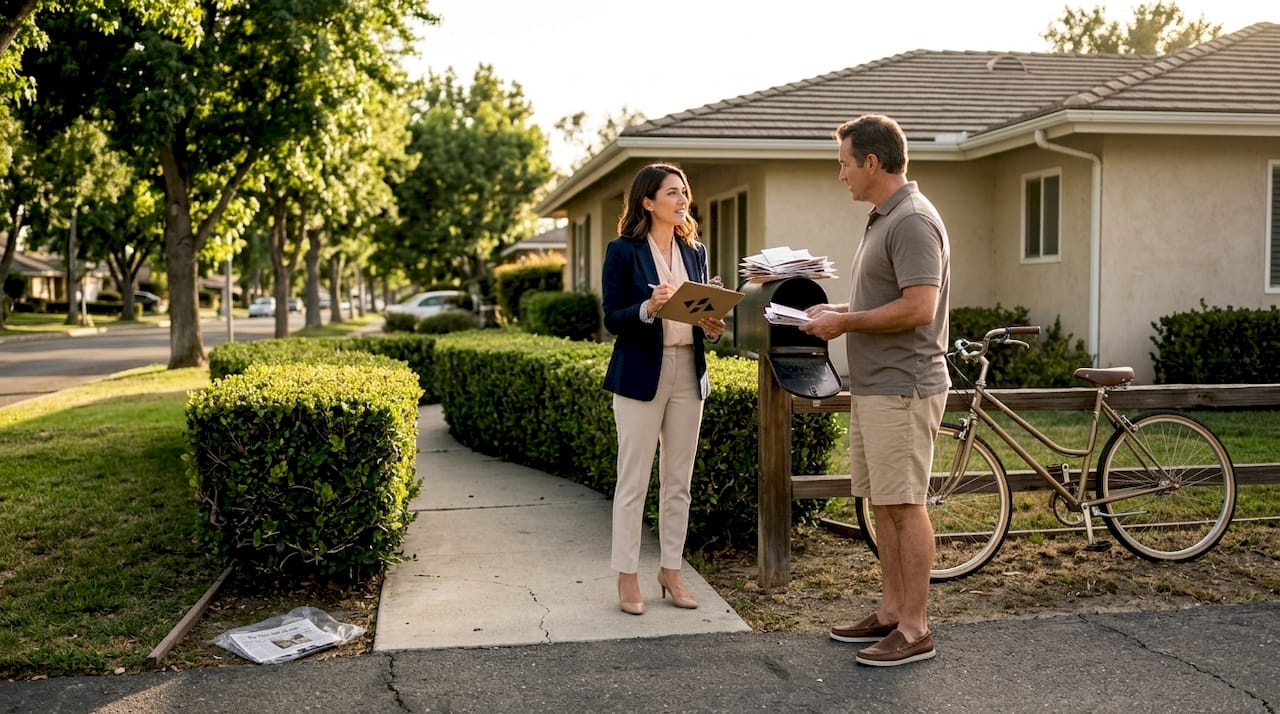
A neighborhood farming approach works as low-cost networking by repeatedly showing up with one-page local market updates and community-facing activities, rather than relying on paid lead generation alone. That distinction matters. Paid leads are expensive and transactional. Farming relationships are durable and self-reinforcing.
Here is a practical setup process for a farming campaign:
- Define your farm area. Choose a neighborhood of 400 to 600 homes where you have some existing connection or genuine interest. Familiarity accelerates credibility.
- Build a contact database. Use county records, door knocking, and community events to compile names, addresses, and where possible, email addresses.
- Create a monthly touchpoint. A one-page market update with recent sales, current inventory, and a local community note is enough. Consistency matters more than production value.
- Attend or sponsor local events. School fundraisers, neighborhood clean-ups, and local business openings are opportunities to be present without a sales agenda.
- Celebrate neighborhood wins publicly. When a local business opens or a park gets renovated, share it on your social channels and in your newsletter. This signals that you care about the community, not just the commissions.
- Track your penetration rate. Aim to have at least 20 to 25 percent of households in your farm area recognize your name within the first year.
The referral numbers support this approach. 66% of sellers find their agent through a referral or prior relationship. Farming is the systematic way to build the kind of trust that produces those referrals organically.
You can amplify your farming results by pairing it with digital marketing for real estate, using targeted social ads and email sequences to stay top of mind between physical touchpoints.
Pro Tip: Showcase hyperlocal data, not just listings. When you share that a specific street in your farm area had three sales in 90 days at 4% over asking, you demonstrate knowledge that no out-of-area agent can replicate. That specificity builds trust faster than any marketing headline.
Investor groups and meetups: Building a dealmaker network
For investors and investor-focused agents, SoCal investor communities like REIAs and meetups are a practical mechanism to meet dealmakers across investors, agents, lenders, contractors, and to create ongoing deal-sharing relationships. These groups exist specifically to facilitate introductions and transactions, which makes them uniquely efficient for business development.
Understanding the difference between group types helps you choose where to invest your time:
| Group type | Attendee mix | Best use | Potential downside |
|---|---|---|---|
| Large REIA groups | Vendors, service providers, mixed investors | Broad connectivity, vendor discovery | Higher sales pressure |
| Small operator groups | Active investors, deal analysts | Deal quality discussions, education | Smaller network reach |
| Deal-specific meetups | Niche investors (flippers, multifamily, etc.) | Targeted deal flow | Limited to one strategy |
Larger REIA-style groups optimize for vendor and services discovery and broad connectivity, while smaller operator-education formats optimize for deal-analysis quality and reduce sales pressure. Neither is better in absolute terms. The right choice depends on what you need most right now.
Here are the best practices for making connections at these events:
- Arrive early and stay late. The most valuable conversations happen outside the formal program.
- Lead with curiosity. Ask what someone is working on before talking about yourself.
- Bring something useful. A deal analysis template, a neighborhood absorption rate, or a contractor referral is worth more than a business card.
- Follow up within 24 hours. More on this in the next section.
If you are exploring real estate crowdfunding in SoCal or looking at the best investment locations in SoCal, REIA meetups are also excellent places to validate your thinking with active operators who are doing deals right now. You may also hear about off-market deals in SoCal before they ever hit the MLS, which is one of the most tangible benefits of consistent group participation.
"Larger REIA-style groups can optimize for vendor and services discovery and broad connectivity, while smaller operator-education formats may optimize for deal-analysis quality and reduce sales pressure."
Mentorship: Accelerate your network and expertise
Most real estate professionals overlook mentorship as a networking strategy. That is a significant missed opportunity. A good mentor does not just teach you. They introduce you to their network, vouch for your credibility, and help you avoid costly mistakes that would otherwise set you back months or years.
Mentorship and structured education communities are positioned as a way to accelerate investor and business networking beyond casual events, by building a trusted team around you. That framing is exactly right. The goal is not just to learn from one person. It is to gain access to an entire ecosystem of relationships that your mentor has built over years.
The benefits of structured mentorship include:
- Faster credibility. When a respected investor or agent introduces you, you inherit some of their reputation. Cold introductions take far longer to build trust.
- Deal team formation. Mentorship groups often include lenders, attorneys, CPAs, and contractors. One relationship can give you access to an entire deal team.
- Continuous education. Markets shift. A mentor who is actively working in SoCal will give you current, relevant intelligence that no course or book can match.
- Accountability. Knowing that someone you respect is watching your progress creates productive pressure to follow through.
Finding the right mentor requires some intentionality. Here is how to approach it:
- Identify two or three professionals whose results you want to replicate.
- Engage with their content, attend their events, and offer genuine value before asking for their time.
- Propose a specific, low-commitment first interaction: a 20-minute call, a coffee meeting, or attending one of their events.
- Bring something to the table. Your time, your research, your skills, or your connections.
Before approaching a potential mentor, it helps to clarify what you are looking for. The questions for SoCal real estate agents framework is a useful reference for thinking through what expertise and relationship qualities matter most to your business.
Pro Tip: Approach mentorship as a two-way value exchange. Mentors are busy. If you show up asking only for their knowledge and introductions, the relationship will stall quickly. Offer your research skills, your time on a project, or your connections in a complementary area. The most productive mentorship relationships feel like partnerships.
The crucial follow-up: Turn connections into deals
Meeting someone at an event is the beginning of a relationship, not the relationship itself. The follow-up is where most networking falls apart and where the biggest opportunity exists for professionals willing to be deliberate about it.
The mechanics are straightforward, but the execution requires discipline:
- Follow up within 24 to 48 hours. The conversation is still fresh. A prompt message signals that you are organized and take the relationship seriously.
- Reference something specific from your conversation. Generic "great to meet you" messages are forgettable. Mentioning a specific deal, neighborhood, or challenge they raised shows you were genuinely listening.
- Add value immediately. Include a market insight, a relevant article, a contractor referral, or a data point that is directly useful to what they told you they are working on.
- Propose a clear next step. A coffee meeting, a property walkthrough, or a shared introduction. Make it easy to say yes.
- Stay in touch on a schedule. Add your new contacts to a simple CRM and set a reminder to check in every 30 to 60 days with something useful, not a sales pitch.
The referral statistic bears repeating here. 66% of sellers work with agents they already know or were referred to. That number reflects relationships that were maintained over time, not just initiated at a single event.
When networking with investor groups specifically, the dynamic requires extra care. Investors can be cautious about agents at networking events, so the recommended approach is to add value and demonstrate numerical competence rather than immediately pitching services. An investor who sees you quote cap rates, analyze cash-on-cash returns, or reference absorption data will trust you far more than one who gets a generic elevator pitch.
Knowing how to use tools like MLS listings in SoCal effectively gives you the kind of data-driven insights that make your follow-up messages genuinely useful to investors and buyers alike.
Pro Tip: Customize your follow-up with a numeric insight relevant to the connection's specific business. If they mentioned they are looking at multifamily in Long Beach, send them the current average cap rate and days on market for that submarket. One specific number does more for your credibility than three paragraphs of general advice.
Why most networking advice fails in Southern California
Here is the uncomfortable truth: most networking advice is written for markets where showing up and being friendly is enough. SoCal is not that market.
Los Angeles and Orange County are hyper-competitive, hyper-local, and populated with professionals who have heard every pitch. Generic scripts, surface-level conversations, and volume-based networking tactics do not move the needle here. They actually damage your reputation, because in a market this connected, people remember who wasted their time.
What actually works is specificity. When you know the types of listings in SoCal well enough to speak intelligently about the difference between a pocket listing and an MLS exclusive, or when you can quote median days on market for a specific zip code without looking it up, you become someone worth knowing. That knowledge signals that you are a real operator, not someone collecting contacts.
The second failure point is inconsistency. Most professionals network in bursts. They attend three events in January, disappear until April, and wonder why their referral pipeline is thin. Relationships require regular contact. The professionals we have seen build the most durable networks in SoCal are the ones who show up to the same REIA every month, send their farming newsletter every four weeks, and follow up with every new contact within 48 hours. Not sometimes. Every time.
The third issue is that most networking is self-focused. Professionals go to events thinking about what they can get: leads, referrals, deals. The ones who actually build powerful networks go thinking about what they can give. A useful introduction, a piece of data, a contractor referral. When you become known as someone who adds value without an immediate agenda, the referrals and deals follow naturally.
SoCal rewards depth over breadth. Ten deep, trust-based relationships will outperform a hundred shallow connections every single time.
Ready to put smarter networking into action?
The strategies in this article are only as valuable as the action you take on them. Whether you are refining your farming campaign, showing up at your first REIA, or building a follow-up system, the next step is having access to the right market intelligence and property data to back up every conversation.
INC Realtors provides the tools and local expertise to support your networking efforts with real substance. Browse current SoCal homes for sale to stay sharp on active inventory, request a home value report to anchor your farming conversations in current data, or pull a market snapshot to bring something genuinely useful to your next investor meetup or client conversation. When your networking is backed by accurate, hyperlocal market knowledge, every introduction becomes a stronger opportunity.
Frequently asked questions
What are the most effective networking events for real estate professionals in Southern California?
Local REIAs and investor meetups like SCREIC and LAC-REIA are the best venues for connecting with investors, agents, lenders, and service providers across the SoCal market. These groups meet regularly and are specifically structured to facilitate deal-making introductions.
How often should I follow up after meeting someone at a real estate event?
It is most effective to follow up within 24 to 48 hours with a value-driven note tied directly to your conversation. Prompt follow-up is one of the three core mechanics that consistently converts networking introductions into actual business.
What's the fastest networking tactic for getting referrals in real estate?
Consistent neighborhood farming, specifically providing local market updates and participating in community activities, builds the kind of trust that generates referral-based business faster than most other approaches. The key word is consistent.
Why are investors sometimes wary of agents at networking events?
Investors value actionable expertise and numbers-based thinking, so agents who pitch services immediately rather than demonstrating market knowledge tend to lose credibility fast. Proving your analytical competence first and adding value before asking for anything is the approach that builds lasting investor relationships.