

TL;DR:
- Skilled real estate negotiation significantly impacts deal value, timelines, and contingencies.
- Higher agent involvement correlates with higher sales prices and shorter market times.
- Reducing commissions can increase the risk of failed sales and longer listing periods.
Most people think a real estate agent's job is to open doors, file paperwork, and collect a check at closing. That's a costly misconception. The negotiation phase of any home transaction is where tens of thousands of dollars are either won or lost, and a skilled agent is the primary reason deals land in your favor. MLS-listed homes sold for $302,000 more on average than off-market properties between 2022 and 2024. For Southern California buyers and sellers navigating one of the most competitive housing markets in the country, that gap is life-changing. This guide breaks down exactly how agents create that advantage, what the research says, how commission structures affect your bottom line, and what steps you can take today to maximize your negotiation outcome.
Table of Contents
- Why negotiation expertise matters in real estate deals
- What agents actually do during negotiation
- How agent involvement shifts outcomes: Evidence and local data
- Unpacking commission controversies: Risks, costs, and efficiency
- How to leverage agents for your best negotiation outcome
- The truth most homeowners miss about agent negotiations
- Unlock negotiation power with a top agent
- Frequently asked questions
Key Takeaways
| Point | Details |
|---|---|
| Agents raise your sale price | MLS-listed homes with agent involvement consistently sell for more in Southern California. |
| Negotiation skill is critical | Expert agents provide leverage and protect your interests during complex deals. |
| Commission strategy impacts outcome | Cutting agent commissions can increase unsold risk and reduce net proceeds. |
| Choose wisely for negotiation power | Selecting the right agent maximizes your chances of a favorable negotiation outcome. |
Why negotiation expertise matters in real estate deals
Real estate negotiation is not a single conversation. It's a layered, ongoing process that begins the moment you set an asking price or make your first offer, and it doesn't end until the keys change hands. Price is only one piece of the puzzle. Agents also negotiate closing timelines, contingencies (conditions that must be met for the deal to proceed), repair credits, seller concessions, and even which fixtures stay in the home. Every one of those terms has a dollar value attached to it.
"The difference between a good deal and a great deal often comes down to who's at the table and how well they understand the local market."
Without professional representation, buyers and sellers often negotiate from an emotional position rather than a strategic one. You're attached to the home. You want the deal to work. That emotional investment can lead to poor decisions, like accepting a lowball offer out of fear, or overpricing because of sentimental value. An agent creates distance between your emotions and the transaction, allowing decisions to be made on data, not feelings.
The benefits of real estate agents extend well beyond showing properties. They include market research, competitive analysis, and the ability to read the other side's motivations. A seasoned agent knows when a buyer is desperate and when a seller is bluffing. That read on human behavior, combined with hard data, is what builds real leverage.
Here's what skilled negotiation in real estate actually involves:
- Market research: Pulling recent comparable sales to anchor pricing arguments in fact
- Strategic timing: Knowing when to move fast and when to wait for a better position
- Contingency management: Structuring offers so your client keeps options open without losing the deal
- Emotional buffering: Keeping negotiations professional when tension rises
- Communication control: Managing what information is shared and when
Agents add value by applying negotiation skills that directly affect outcomes, not just by facilitating paperwork. And in a market like Southern California, where multiple offers are common and inventory is tight, those skills can be the deciding factor between closing and losing the home entirely.
Understanding the qualities of top agents before you hire one also matters. Knowing what to look for helps you choose someone whose negotiation track record actually matches your goals. And if you're unsure where to start, reviewing questions to ask agents before the first meeting gives you a real edge in the selection process.
What agents actually do during negotiation
Now that we appreciate why negotiation skill matters, let's look at what agents are actually doing on your behalf. The process is more structured than most people realize, and understanding it helps you stay aligned with your agent and ask better questions along the way.
- Establishing a negotiation strategy. Before any offer is submitted, your agent should sit down with you to define your priorities. Is price the top concern, or do you need a fast close? Are you flexible on contingencies? That conversation shapes every decision that follows.
- Running the comps. Comparable sales, often called comps, are recently sold homes in the same area with similar size, age, and condition. Your agent uses these to justify your offer price or your asking price with hard evidence, not guesswork.
- Structuring and presenting the offer. An offer is more than a number. A skilled agent structures it to appeal to the seller's specific situation, which might mean a shorter inspection period, a rent-back option for the seller, or a larger earnest money deposit to signal serious intent.
- Managing counteroffers. Most deals don't close on the first offer. Your agent tracks the back-and-forth, advises you on each counter, and keeps the negotiation moving without letting emotion or impatience derail progress.
- Communicating strategically. What your agent says, and what they choose not to say, to the other side matters enormously. Revealing too much about your urgency or budget can shift leverage against you instantly.
Pro Tip: Ask your agent to walk you through a recent negotiation they handled. How they describe the process tells you a lot about their strategic thinking. Agents who focus only on price likely miss the deeper value sitting in terms, timing, and contingencies.
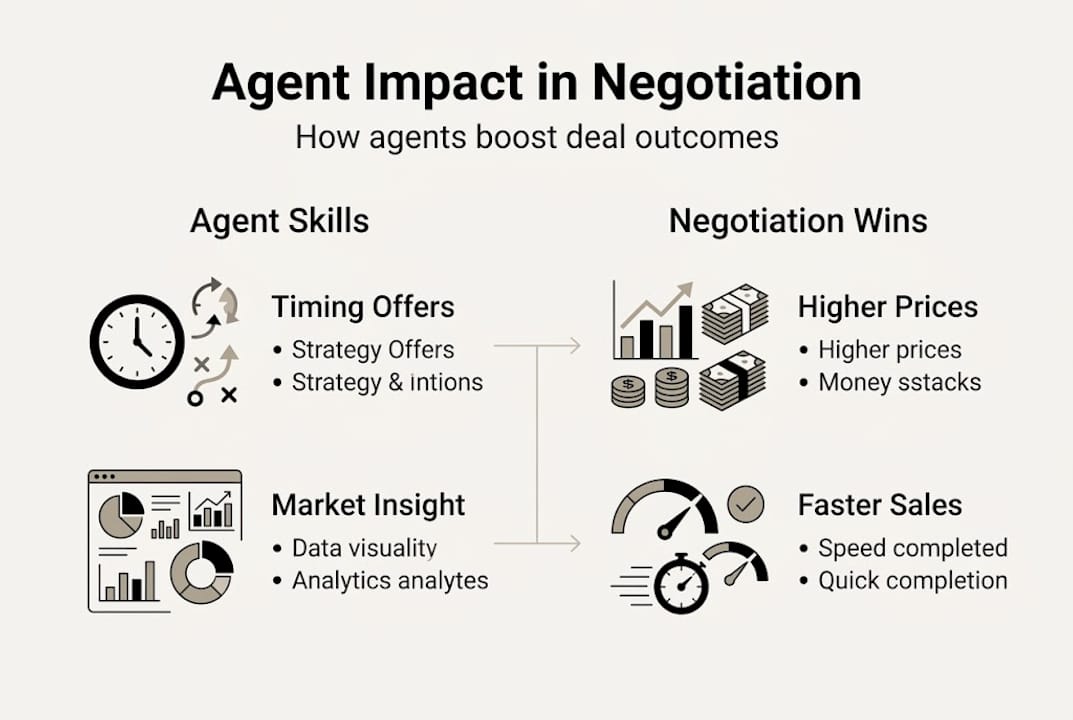
Expert agents can make or break a deal by timing offers and counteroffers strategically. Submitting too early in a hot listing's life cycle can hurt you. Waiting too long can lose you the property entirely. That timing judgment is something experience builds, not something you can Google your way into.
For buyers, understanding how buyer's agents help in this process clarifies how your representation works behind the scenes. For sellers, knowing what listing agents do during negotiations helps you set realistic expectations and hold your agent accountable to a clear standard.
How agent involvement shifts outcomes: Evidence and local data
With clarity on agent actions, let's see if all that expertise truly makes a measurable difference according to the numbers. The short answer is yes. The longer answer involves some surprising specifics that most sellers never hear.
Research on MLS and market outcomes consistently shows that professionally listed properties outperform off-market deals in almost every metric. And in San Francisco, which shares many dynamics with Southern California's top-tier markets, the gap is dramatic. On-MLS listings sold for $302k more on average than off-MLS listings between 2022 and 2024, representing an 18.6% premium.
| Metric | With full agent and MLS | Low commission or off-market |
|---|---|---|
| Average sale price premium | Up to 18.6% higher | Baseline |
| Days on market | Shorter, more competitive | Up to 33% longer |
| Failed sale risk | Lower | Up to 75% higher |
| Negotiation complexity handled | Full service | Limited or none |
The table above illustrates why the commission conversation is more nuanced than it first appears. Sellers who try to cut costs by offering lower buyer-agent commissions often end up with longer listing periods and a far higher chance the deal falls apart entirely. Low buyer-agent commissions were linked to 33% longer sell times and a 75% higher unsold risk.
Statistic callout: Cutting the buyer-agent commission to save money can raise your unsold risk by 75% and keep your home on the market 33% longer.
The benefits of MLS listings for sellers go far beyond exposure. The MLS creates a competitive environment among buyers, which drives up offers and shortens timelines. Without that competitive pressure, sellers negotiate from a weaker position.

Pro Tip: If you're considering off-market deals in SoCal, go in with clear eyes. For buyers, off-market can sometimes mean a unique opportunity. For sellers, it almost always means leaving money on the table.
Unpacking commission controversies: Risks, costs, and efficiency
Given the data, it's vital to address the elephant in the room: commission costs and their real implications. Agent commissions are the most common reason people consider going it alone or using a discount broker. The skepticism is understandable. Paying 5% to 6% of a $1.2 million home in Los Angeles is a real number. But that skepticism deserves a closer look.
National buyer-agent commissions declined from 3% in the 1990s to 2.7% in 2023, reflecting both market pressure and regulatory scrutiny. At the same time, commission-based systems can reduce efficiency and inflate costs in certain scenarios, particularly when agent incentives don't fully align with client outcomes. This is where understanding your options becomes genuinely important.
| Agent model | Typical commission | Services included | Key risk |
|---|---|---|---|
| Full-service agent | 2.5% to 3% per side | Negotiation, marketing, coordination | Higher upfront cost |
| Flat-fee broker | $3,000 to $10,000 fixed | Listing only, limited support | Weak negotiation representation |
| Discount broker | 1% to 1.5% | Partial service | Reduced buyer-agent cooperation |
| FSBO (for sale by owner) | 0% listing side | None | Full negotiation risk on seller |
Here's a practical list of questions to ask any agent before discussing their fee structure:
- What is your average list-to-sale price ratio over the last 12 months?
- How do you handle multiple-offer situations?
- What buyer-agent commission will you recommend offering, and why?
- Can you show me examples where your negotiation directly affected the final price?
- How do you handle a deal that's about to fall apart?
Understanding the closing agent's role in the final transaction also matters, as it's a separate function from your listing or buyer's agent. Knowing who handles what keeps expectations clear across all parties.
The bottom line on commissions is this: the cost of the agent matters far less than the outcome they deliver. A full-service agent who nets you an extra $80,000 on your sale more than covers a 3% commission. A discount broker who leaves you with a failed deal or a weak offer costs you far more than you saved.
How to leverage agents for your best negotiation outcome
Now, let's translate all these insights into concrete steps you can implement to ensure your agent delivers maximum advantage. Hiring an agent isn't enough. You need to hire the right one and then work with them effectively.
Maximizing agent effectiveness comes down to aligning incentives, asking pointed questions, and selecting the right expertise from the start. Here's how to do that in practice:
- Define your goals before the first meeting. Know your walk-away price, your ideal timeline, and your flexibility on contingencies. Agents perform better when they have clear parameters to work within.
- Use a step-by-step agent selection process. Don't hire based on a referral alone. Interview at least two candidates and compare their approach to negotiation specifically.
- Ask for a negotiation track record. Request data: their average sale price compared to listing price, how many deals they've closed in your target zip code, and how many involved multiple offers.
- Establish communication preferences early. Decide how often you want updates and in what format. Poor communication mid-negotiation is one of the most common reasons deals stall.
- Stay emotionally available but strategically removed. Your agent handles the tactics. Your job is to make informed decisions when presented with options, not to manage the conversation yourself.
Pro Tip: For sellers in Southern California, ask your agent specifically how they plan to create competitive pressure among buyers. The strategy varies significantly between markets like Pasadena, Irvine, and Long Beach, and a local expert should tailor their approach accordingly.
For buyers, the parallel step is making sure your agent understands your budget ceiling and your real motivation for each property. That context helps them read the seller's position and craft offers that are compelling without unnecessarily overpaying.
The truth most homeowners miss about agent negotiations
Finally, let's call out the truths that even seasoned homeowners tend to overlook. After years working in the Southern California market, one pattern keeps showing up: sellers fixate on commission cost while completely ignoring risk exposure.
Here's what that means in practice. A homeowner saves $15,000 by using a flat-fee broker, then watches their home sit on the market for four months before accepting an offer $40,000 below their original target. The math doesn't work. But because the commission savings felt concrete and the negotiation losses felt abstract, the decision seemed rational in the moment.
The hidden benefits of agents are not usually found in the contract. They live in the conversations your agent has when you're not in the room, the relationships they've built with other agents in the area, and the reputation they carry into every deal. A well-regarded local agent can move a stalled deal forward simply because the other side trusts them. That's not something you can quantify on a spreadsheet, but it's very real.
The myth that the cheapest agent is the best value is genuinely dangerous in a high-stakes market. When a negotiation gets tense, you want someone who has navigated that specific situation many times. DIY sellers and buyers almost never match the outcomes of those who leverage high-skill representation, not because they're less intelligent, but because experience and relationships compound in ways that knowledge alone cannot replace.
Unlock negotiation power with a top agent
If you're ready to put this knowledge to work, here's how to access expert local help today. Understanding what agents do in negotiations is valuable. But the real advantage comes from working with someone who brings that expertise to your specific situation in Los Angeles, Orange County, or the surrounding Southern California market.

Whether you're buying or selling, the right agent changes the entire dynamic of your transaction. Browse single family homes for sale to see what's currently available in your target neighborhood. If you're planning to sell, connect with our team to sell your home with local experts who know how to position your property for maximum competitive interest. And before you make any move, get a free home evaluation to understand exactly where you stand in today's market. The right information, paired with the right representation, is where great negotiation outcomes begin.
Frequently asked questions
Do real estate agents really make a difference in sale price?
Yes. Empirical research shows that on-MLS homes sold for $302k more on average than off-market sales between 2022 and 2024, representing an 18.6% premium driven largely by professional representation and broader buyer competition.
What is "agent steering" and should I worry about it?
Agent steering occurs when agents direct buyers toward properties with higher commissions rather than the best fit. Academic research flags steering as a risk in commission-based systems, so always ask your agent to clarify their compensation structure upfront.
How do I pick the right negotiation-focused agent?
Interview at least two agents, ask for specific examples of negotiation wins, and request references from past clients who can speak directly to the agent's performance under pressure.
Are lower commissions always better for sellers?
Not at all. Research links low buyer-agent commissions to 33% longer sell times and a 75% higher risk of a failed sale, which typically costs sellers far more than the commission savings.