
TL;DR:
- Open houses are crucial for Southern California buyers to assess competition, neighborhood feel, and property details.
- Attending open houses helps calibrate expectations, refine preferences, and build relationships with agents.
- In SoCal, open houses often attract dozens of visitors, leading to quick sales and multiple offers.
Open houses have a reputation problem. Most people think of them as casual walk-throughs for curious neighbors or weekend window shoppers. But if you're a serious homebuyer in Southern California, especially a first-timer navigating Los Angeles or Orange County prices, they are one of the sharpest tools available. A single open house visit teaches you things that no listing photo ever could: how the light falls in the living room at noon, whether the neighborhood feels right, and just how many other buyers are circling the same property. Open houses are valuable for gauging competition, refining priorities, and understanding the market. This guide walks you through everything, from what open houses actually are to the SoCal-specific factors that can make or break your buying strategy.
Table of Contents
- What is an open house? The basics explained
- Why attend open houses? Insider benefits for SoCal buyers
- Open house process: What to expect before, during, and after
- Southern California nuances: Unique realities every buyer should know
- Open house FAQs: Quick answers for SoCal homebuyers
- Perspective: What nobody tells you about Southern California open houses
- Ready to find your next open house?
- Frequently asked questions
Key Takeaways
| Point | Details |
|---|---|
| Open houses defined | Open houses provide a relaxed way to tour homes and learn about the market, no appointment needed. |
| Competitive SoCal scene | Southern California open houses often reflect high home prices, large crowds, and unique local competition. |
| Essential for first-timers | Attending open houses helps buyers refine their priorities, spot market trends, and prepare swift offers. |
| Nuances matter | Pay attention to SoCal-specific issues like seismic and wildfire risks, crowded events, and broker-only tours. |
What is an open house? The basics explained
An open house is a scheduled window of time, typically one to three hours on a weekend afternoon, when a property for sale is open for anyone to walk through without a private appointment. The listing agent is usually present, available to answer questions, hand out flyers, and collect contact information from visitors. No real estate license or prior approval required. You simply show up, walk through, and form your own impressions.
The setup is usually straightforward. Expect a sign-in sheet at the door, printed property details, and sometimes light refreshments. Rooms are often staged or tidied specifically for the event. You are free to open closets, check storage space, turn on faucets, and look at the backyard. The agent is there to facilitate, not pressure.
Sellers and agents host open houses for two main reasons. First, it creates broad exposure for the property in a short burst of time. Second, it generates competitive energy. When buyers see other buyers touring the same home, urgency tends to follow.
Now, here is where Southern California changes the equation. The role of open houses in SoCal is dramatically different from most US markets. Median home prices in Los Angeles County and Orange County regularly exceed $800,000, and inventory is persistently tight. What that means for buyers:
- Open houses often draw dozens of visitors in a single afternoon
- Multiple-offer situations can develop within 24 hours of an open house
- Homes frequently sell at or above asking price shortly after the event
- First impressions formed at open houses lead directly to fast offer decisions
- Understanding types of real estate listings helps you know which open houses to prioritize
"The median home price in Los Angeles County consistently ranks among the highest in the nation, making open houses a critical low-pressure entry point for first-time buyers trying to calibrate what their budget actually buys."
Open houses offer low-pressure exposure for first-time buyers amid high prices. That matters. You get to absorb the market without being locked into a private showing or committing to a specific home. Think of each visit as tuition paid toward understanding what you actually want and what you can realistically afford.
Why attend open houses? Insider benefits for SoCal buyers
Now that you know what an open house is, here's why making the most of these events matters for your home search. The benefits go well beyond simply seeing a home in person.
1. You calibrate your expectations against reality. Listing photos are optimized. Wide-angle lenses, professional lighting, and careful staging make rooms look larger and brighter than they are. Walking through a property in person quickly corrects those distortions. You learn fast whether a 1,400-square-foot bungalow in Pasadena actually feels spacious or cramped for your lifestyle.
2. You decode the competition. First-time buyers use open houses to understand market competition and refine priorities. Watching how many other buyers show up and how they react gives you real-time market data. If 30 people walked through a home on Saturday, you know you are in a competitive zone.
3. You refine your wish list. You might think you want an open floor plan until you walk through five of them and realize you prefer defined rooms. Open houses accelerate this self-discovery without any financial commitment.
4. You build agent relationships. The listing agent at an open house can tell you things that never appear in the MLS. How many offers have already come in, whether the seller is flexible on timing, and what recent comparable sales looked like. Pair this with using MLS listings to do your own research before each visit.
For practical first-time home buyer tips, here is how to maximize every open house visit:
- Research the property online before you go, including permit history and recent tax records
- Drive through the neighborhood at different times of day before the open house
- Bring a notebook or use your phone to capture observations room by room
- Ask the listing agent specific questions about offers, history, and seller motivation
- Follow up with your own agent the same day while the details are fresh
Pro Tip: Get pre-approved for a mortgage before your first open house visit. In SoCal, homes can go from open house to accepted offer in 48 hours. Knowing your exact budget also tells you which neighborhoods and home types are realistic, saving you from falling in love with something out of reach. A buyer's agent can walk you through the pre-approval process and make sure you are positioned to act quickly.
Open house process: What to expect before, during, and after
With the benefits in mind, let's walk through the step-by-step process so you feel confident before you ever walk in the door.
Before the open house:
- Find listings using your agent or a real estate platform, filtering for upcoming open houses in your target neighborhoods
- Use virtual tours as pre-filters before attending in person, especially for homes that are farther away
- Prepare a list of questions for the listing agent, including days on market, prior price reductions, and HOA fees
- Review the seller's disclosure statement if it has been made available online
- Confirm the address, parking situation, and open house hours the morning of
During the open house:
- Sign in at the door using your real name and contact details
- Walk through every room deliberately, spending time in areas that matter most to you
- Check water pressure, look under sinks, and inspect the garage and attic if accessible
- Ask the listing agent about the offer process, seller preferences, and whether any offers are already in hand
- Note the neighborhood context: traffic noise, proximity to schools, street parking availability
After the open house:
- Share notes and impressions with your buyer's agent immediately
- Request additional disclosures or inspection reports if the home is a strong candidate
- Discuss your offer strategy with your agent, factoring in what you observed about competition
Here is an important distinction: a broker's open is an agent-only event, typically held on a weekday, where listing agents invite buyer's agents to tour the home before the public open house. Broker's opens are for agents only, and a packed broker's open signals that agents are excited about the listing, which is an early warning of competition.
You can also learn a lot from the questions for agents that smart buyers bring to every open house visit.
Pro Tip: If the listing agent mentions they are expecting multiple offers, ask about the offer review date. In high-demand SoCal markets, sellers often set a specific day to review all offers at once. Knowing this date lets you and your agent plan your submission strategically.
Southern California nuances: Unique realities every buyer should know
Of course, not all open houses are created equal. Here's what makes Southern California's real estate scene different from the rest of the country.
| Feature | SoCal open houses | General US open houses |
|---|---|---|
| Average attendees per event | 20 to 50+ visitors | 5 to 15 visitors |
| Offer timeline after open house | 24 to 72 hours | 1 to 2 weeks |
| Wildfire/seismic disclosures | Required in many areas | Rarely required |
| Broker's open house frequency | Very common | Less common |
| Median home price | $800,000+ | Varies widely |
| HOA prevalence | Very high | Moderate |
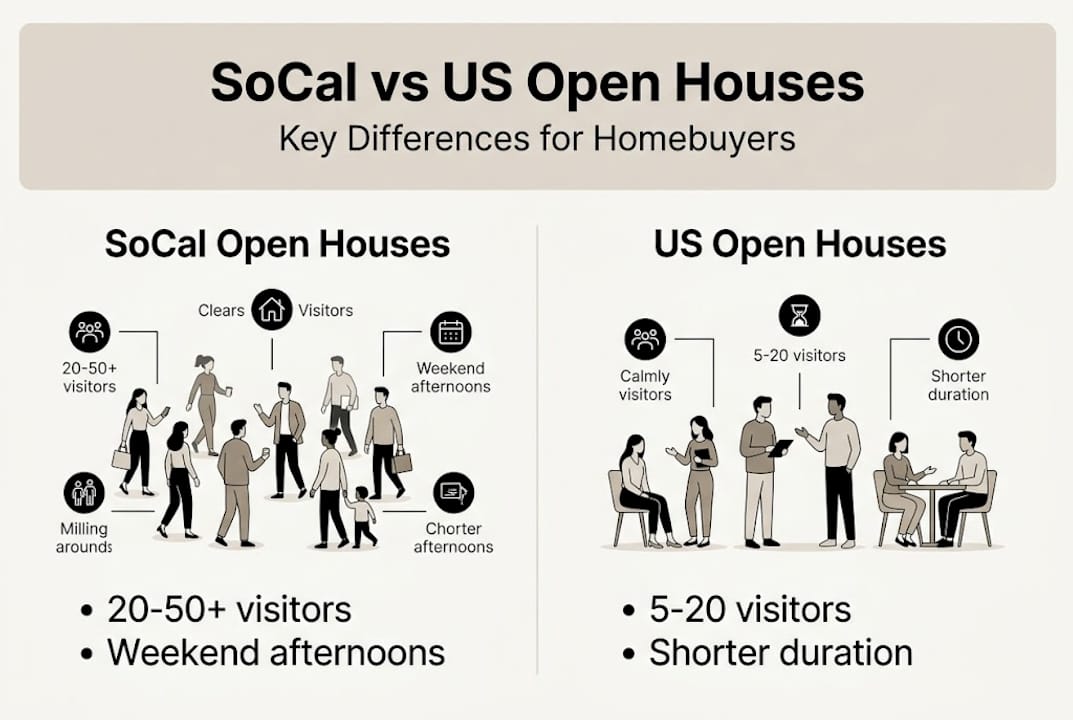
Seismic and wildfire inspections, hillside home insurance, and crowded events are common SoCal nuances that buyers from other states often find surprising. If you are touring homes in hillside areas like Malibu, Altadena, or parts of the San Gabriel Valley, ask the listing agent directly about fire zone designation and whether the home requires special insurance riders.
Common pitfalls SoCal buyers encounter at open houses, and how to avoid them:
- Missing the disclosure packet: Many SoCal sellers provide a seller's disclosure or natural hazard report at the open house. Read it before leaving.
- Underestimating HOA costs: Monthly fees in some OC communities can exceed $500 and directly affect your purchasing power.
- Ignoring deferred maintenance: Cosmetic staging can hide older roofs, aging HVAC systems, or foundation issues. Look past the furniture.
- Skipping the exterior: Walk the full perimeter of the property. Look at drainage, retaining walls, and neighboring properties.
- Not understanding the as-is home sales dynamic: Some SoCal sellers list properties as-is, meaning no repairs after inspection.
For buyers considering homes where the seller is relocating or selling from afar, the remote selling process can affect how negotiations unfold, and knowing this going in gives you a small but real advantage.
Open house FAQs: Quick answers for SoCal homebuyers
Now let's tackle common questions buyers have about open houses, especially for our region. Typical questions relate to making offers after open houses, what pre-approval is needed, and how open houses affect price negotiation.
| Question | Short answer |
|---|---|
| Do I need an agent to attend? | No, but having one working for you is strongly recommended |
| Can I make an offer the same day? | Yes, and in SoCal, same-day offers are common and often smart |
| Is it okay to take photos inside? | Ask the listing agent first; most allow it |
| What if I love it but it needs work? | Factor repair costs into your offer and inspection contingency |
| Can I visit multiple open houses in one day? | Absolutely. Touring 3 to 5 homes in one day is a normal SoCal strategy |
| Will the listing agent share other offers? | They are legally restricted from sharing terms but may confirm competing offers exist |
| What does "offer review date" mean? | A set day when the seller reviews all received offers together |
| How long are open houses typically? | Usually 1 to 3 hours on Saturday or Sunday afternoons |
One pattern worth knowing: homes that hold open houses after already being on the market for several weeks may be signaling a price adjustment is coming. This creates a potential negotiation window. Conversely, a brand-new listing hosting an open house the first weekend almost always expects competition and strong offers. Reading the context matters just as much as touring the home itself.
If a home you love has been sitting on the market for more than 30 days in a neighborhood where turnover is typically fast, that is worth discussing with your agent. It might reflect a pricing issue, a disclosure concern, or simply bad timing. The open house is your chance to read those signals firsthand.
Perspective: What nobody tells you about Southern California open houses
Here's the honest truth that most guides skip over. The open house itself is only half the game. The real intelligence comes from reading what is happening around you while you tour.
Watch the agent closely. Is the listing agent working the room, answering questions quickly, and referencing multiple interested buyers? That is not just salesmanship. It is a real signal about demand. When you see the agent handing out disclosure packets proactively and mentioning an offer review date, the clock is already running.
Crowd behavior tells you even more. A packed open house with buyers moving quickly and asking pointed questions means you are in a competitive pocket. An empty open house on a sunny Sunday in a good neighborhood? That is worth investigating. Something is keeping buyers away, and you need to know what it is before you fall in love with the property.
One of the biggest mistakes we see buyers make is treating open houses as isolated events rather than data points in a pattern. After visiting five or six homes across different neighborhoods, you start to recognize which areas move fast, which sellers are realistic about price, and which homes are genuinely worth urgency. That pattern recognition is what separates buyers who win homes from buyers who keep losing them.
Understanding seller and agent strategies gives you a more complete picture of what is really happening at any given event. The buyers who walk out of an open house with a clear next step, whether that is drafting an offer or walking away, are the ones who come prepared.
Ready to find your next open house?
If you're feeling ready to experience your first open house or want to see what is available now, the next step is simpler than most buyers expect. The Southern California market moves fast, and having the right resources in your corner makes a measurable difference.

Browse available SoCal single family homes to find properties with upcoming open house events in LA, Orange County, and surrounding communities. If you want to understand what the market looks like before you commit, start with our market snapshot for up-to-date pricing and inventory data. Already own a home and thinking about making a move? Get a quick home value estimate to understand your equity position before buying again. Our team, led by Irvin Nierras, is here to guide you through every open house and every offer, with local knowledge that makes the SoCal market feel a lot less overwhelming.
Frequently asked questions
Do you need pre-approval to attend an open house?
No, pre-approval is not required to walk through an open house. That said, getting pre-approved first means you can make a competitive offer the same day if you find the right home, which matters enormously in SoCal.
Can open houses help you negotiate a better price?
Yes, they can. Crowded open houses signal strong demand and less room to negotiate, while a quiet event may indicate leverage for buyers willing to move quickly with a clean offer.
What safety or disaster issues should I check at a SoCal open house?
Always review wildfire zone designation, seismic hazard disclosures, and hillside insurance requirements. Seismic and wildfire considerations are standard in many SoCal regions and can significantly affect your insurance costs and long-term risk.
Is a broker's open house different from a public open house?
Yes, completely different. Broker's open houses are reserved for real estate agents only and typically happen on weekdays before a public open house weekend, giving agents early access to evaluate the property for their clients.