
TL;DR:
- Preparing a strong offer in Southern California requires pre-approval, proof of funds, and thorough understanding of the California Residential Purchase Agreement.
- Effective strategies include writing personal offer letters, increasing earnest money, shortening inspection periods, and demonstrating professionalism to stand out in competitive markets.
You've found the home. Your heart is racing, your notes are scattered across three apps, and your agent just texted asking if you're ready to move. This is the moment first-time buyers and new investors dread most: making an offer. One wrong move and you lose the property. One missing document and the seller moves on. The good news is that the offer process follows a clear, learnable structure. This guide walks you through every stage, from gathering your paperwork to popping the champagne after closing, so you can act with confidence instead of panic.
Table of Contents
- What you need before making an offer
- Step-by-step guide to the offer process
- How to win in a competitive market
- Common mistakes and how to avoid them
- What to expect after your offer is accepted
- Why mastering the offer process matters more than price alone
- Ready to make your next move in Southern California?
- Frequently asked questions
Key Takeaways
| Point | Details |
|---|---|
| Get fully prepared | Pre-approval and proof of funds are essential before making an offer in Southern California. |
| Follow all steps | Stick to required forms and respond quickly to keep your offer competitive and valid. |
| Stand out strategically | A professional, well-presented offer often wins over a higher price alone in a crowded market. |
| Watch for pitfalls | Avoid mistakes like incomplete paperwork or missing deadlines to boost your chances of success. |
What you need before making an offer
Understanding what's expected up front will put you in a stronger position for the next steps. Think of this stage as building your toolkit before the game starts. Walking into an offer situation without these essentials is like showing up to a job interview without a resume.
Mortgage pre-approval
Pre-approval is not optional in Southern California. Sellers in Los Angeles, Orange County, and the surrounding areas receive multiple offers regularly, and an offer without a pre-approval letter goes straight to the bottom of the pile. Your pre-approval letter shows the seller you've already been vetted by a lender, that a specific loan amount has been confirmed, and that you're serious enough to have done the financial legwork.
Getting pre-approved means submitting your tax returns, W-2s, bank statements, pay stubs, and credit history to a lender. The process typically takes two to five business days. Do this before you even start touring homes. If you're a new investor using financing, the same rule applies.
Proof of funds
Even with pre-approval, you'll need to show you have the cash for your down payment and closing costs. This usually means a recent bank statement or investment account statement showing sufficient funds. Sellers and their agents scrutinize this carefully, especially in competitive situations. Make sure the statement is dated within the last 30 to 60 days.
Pro Tip: If your down payment funds are spread across multiple accounts, consolidate them into one account at least 60 days before making an offer. This simplifies your paper trail and avoids questions from underwriters later.
The C.A.R. Residential Purchase Agreement
The California Home Purchase Contract uses the California Association of Realtors Residential Purchase Agreement (RPA) as the standard offer form. This is not a simple one-page document. The RPA is a detailed, multi-page contract that covers price, terms, contingencies, timelines, and disclosures all in one place.
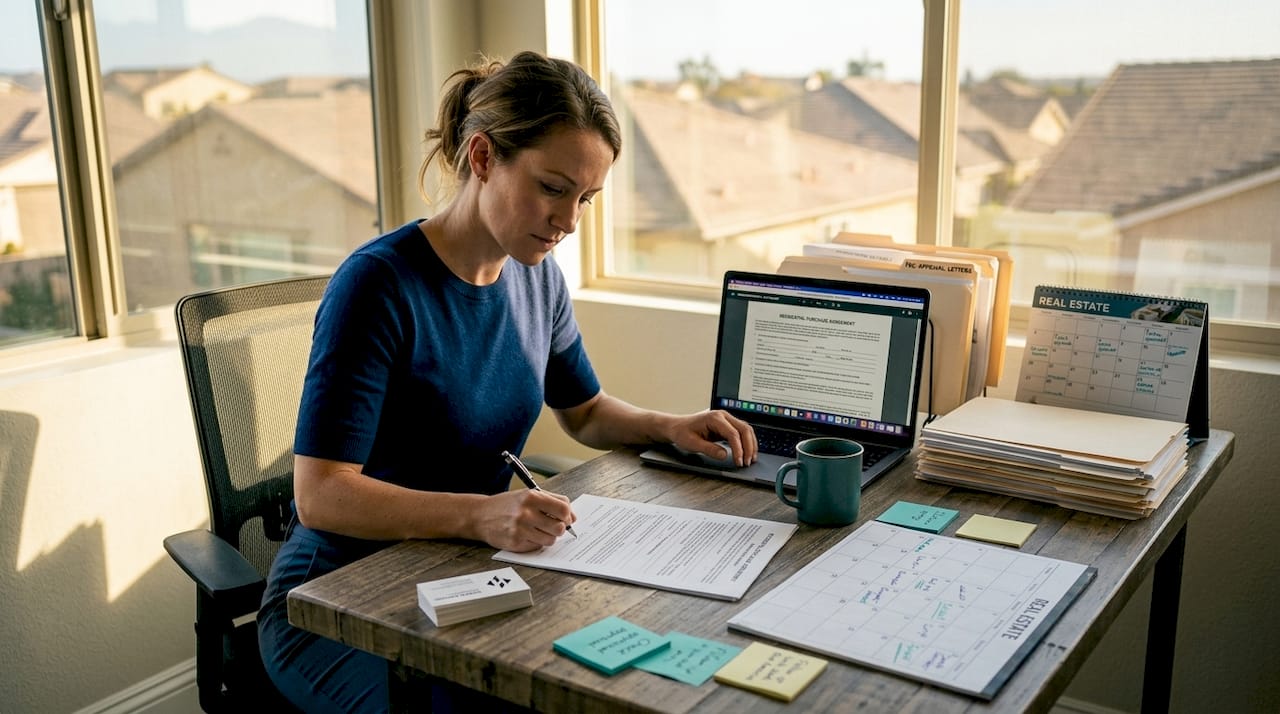
Your real estate agent will prepare this form on your behalf. But you should understand what's in it. Key sections include the purchase price, earnest money deposit, loan contingency terms, inspection periods, and the proposed closing date.
Checklist of documents to gather quickly
Having these items ready before you make an offer will speed up the process significantly:
- Mortgage pre-approval letter (dated within 90 days)
- Proof of funds (bank or investment statement, within 60 days)
- Government-issued photo ID
- Contact information for your lender
- Any gift letter documentation if part of your down payment is a gift
- Entity documents if purchasing as an LLC or trust (common for investors)
For more guidance tailored to your situation, reviewing first-time home buyer tips specific to Southern California can help you avoid regional pitfalls that national guides miss. It also helps to know the right questions to ask your agent before you begin.
| Document | Who provides it | Timeline to obtain |
|---|---|---|
| Pre-approval letter | Your lender | 2 to 5 business days |
| Proof of funds | Your bank/brokerage | Same day to 1 business day |
| Photo ID | You | Immediate |
| Entity documents | Attorney or you | 1 to 5 business days |
| Gift letter | Donor and lender template | 1 to 2 business days |
Step-by-step guide to the offer process
With all your prep materials ready, it's time to submit your offer and navigate the response phases. Here's exactly what happens, in order.
Step 1: Determine your offer price and terms. Your agent will pull comparable sales, known as "comps," to help you understand what the property is worth in the current market. In a hot market, offering at or above list price may be necessary. In a slower market, there's room to negotiate. Beyond price, you'll also decide on your earnest money deposit (typically 1% to 3% of the purchase price), your desired closing timeline, and which contingencies you want to include.
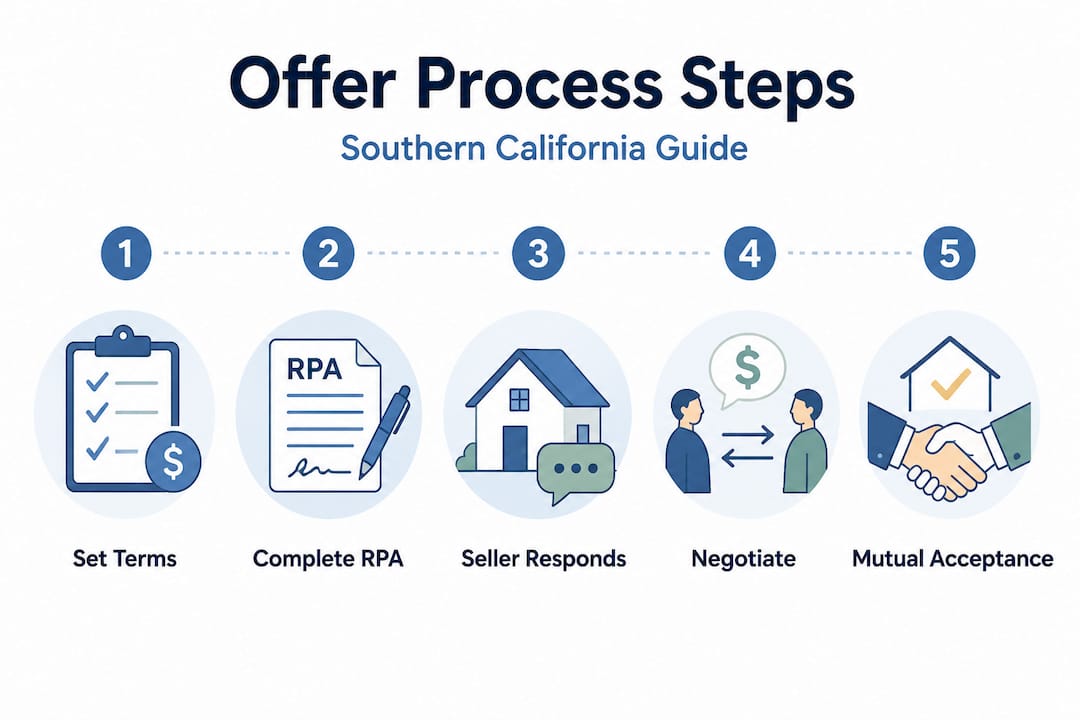
Step 2: Complete the C.A.R. RPA. As noted, the RPA functions as offer, contract, and escrow instructions all in one. Your agent fills this out electronically. You review and sign it digitally. It then gets submitted to the listing agent along with your pre-approval letter and proof of funds.
Step 3: Wait for the seller's response. Sellers typically have 24 to 72 hours to respond, though this window is negotiable and stated in the RPA. They have three options: accept your offer as written, reject it outright, or issue a counteroffer.
Step 4: Review and respond to a counteroffer. Most transactions involve at least one round of negotiation. The seller's counteroffer might adjust the price, change the closing date, or modify contingency terms. Your agent will advise you on how to respond. You can accept, counter back, or walk away.
Step 5: Reach mutual acceptance. Once both parties sign the same version of the agreement, you have mutual acceptance. This is the official start of the escrow period.
Step 6: Open escrow. Your agent or the listing agent will open escrow with a title or escrow company. You'll wire your earnest money deposit within the timeframe specified in the RPA, usually within three business days.
Step 7: Complete inspections and appraisal. During the contingency period (typically 17 days by default in the RPA), you'll schedule a home inspection, review disclosures, and wait for your lender's appraisal.
Step 8: Remove contingencies and close. Once you're satisfied with the inspection and the appraisal comes in at or above the purchase price, you remove your contingencies. Your lender finalizes the loan. You sign closing documents and fund the transaction.
Pro Tip: Ask your agent to request a "seller's preferred closing date" before submitting your offer. Matching the seller's timeline can make your offer more attractive even if it's not the highest bid.
Understanding the role of a buyer's agent throughout this process is critical. A skilled buyer's agent does far more than submit paperwork. They track deadlines, negotiate on your behalf, and flag issues in disclosures before they become expensive problems. It's also helpful to understand types of real estate listings in Southern California, since the approach to making an offer can differ between standard sales, short sales, and REO properties.
| Offer stage | Typical timeline | Who acts |
|---|---|---|
| Offer preparation | Same day | Buyer and agent |
| Seller response window | 24 to 72 hours | Seller and listing agent |
| Counteroffer negotiation | 1 to 3 days | Both parties |
| Escrow opening | Within 3 days of acceptance | Escrow company |
| Inspection period | 17 days (default) | Buyer |
| Appraisal | 7 to 14 days | Lender |
| Contingency removal | Day 17 to 21 | Buyer |
| Closing | Day 30 to 45 | All parties |
How to win in a competitive market
In Southern California's market, it often takes more than just the highest bid to win. Price matters, but sellers also care about certainty. They want to know the deal will close. A lower offer from a well-prepared buyer often beats a higher offer from a disorganized one.
Strategies that actually work
- Write a personal offer letter. A short, genuine letter explaining why you love the home can create an emotional connection with the seller. Keep it to one page. Focus on the home's features, not your financial situation.
- Increase your earnest money deposit. Offering 2% to 3% instead of the standard 1% signals commitment and financial strength.
- Shorten your inspection period. Instead of the default 17 days, offering a 10-day inspection period shows you're motivated and organized.
- Offer a rent-back option. If the seller needs time to move, offering them 30 to 60 days to remain in the home after closing at no cost can be a powerful differentiator.
- Limit contingencies where appropriate. In very competitive situations, some buyers waive the appraisal contingency (if they can cover a gap in cash) or shorten the loan contingency period. This is a risk-based decision that should be made carefully with your agent.
"Professional presentation, including pre-approval and proof of funds, can win over price alone in multiple-offer situations."
This is a point many buyers miss. Sellers are not just looking at the number on the page. They're evaluating the entire package. An offer that arrives with a clean RPA, a strong pre-approval letter, a solid proof of funds statement, and a professional cover from your agent reads as a low-risk transaction. That peace of mind has real value to a seller.
Pro Tip: In escalation clause scenarios, where your offer automatically increases to beat competing bids up to a cap, always ask your agent to verify that competing offers are real and documented. Some listing agents will not provide this verification, which tells you something important about how that transaction is being managed.
Understanding exactly how a real estate agent helps in competitive situations is worth your time before you start submitting offers. The difference between a great agent and an average one becomes most visible when there are five other buyers at the table.
Common mistakes and how to avoid them
Even a strong offer can fail if you fall into these common traps. Some of these mistakes are obvious in hindsight, but they happen constantly in real transactions.
The most frequent offer mistakes
- Submitting incomplete paperwork. A missing signature, a blank field, or an unsigned disclosure can cause the listing agent to pass on your offer entirely. The seller doesn't want to chase you for paperwork.
- No pre-approval letter attached. This is the single most common reason an otherwise good offer gets ignored. Never submit an offer without it.
- Slow responses to counters. If the seller issues a counteroffer and you take three days to respond, they may accept another offer in the meantime. Treat every response window as urgent.
- Ignoring seller protocols. In multiple-offer situations, listing agents often set specific instructions for how offers should be submitted, what format the proof of funds should be in, and by what deadline. Ignoring these instructions signals that you or your agent aren't detail-oriented.
- Skipping a thorough review of disclosures. California law requires sellers to provide extensive disclosures. Buyers who skip reviewing these documents can end up surprised by material defects, HOA issues, or neighborhood conditions after closing.
"All steps must follow the proper procedures outlined in the C.A.R. RPA and escrow process."
This matters especially for investors who may be used to processes in other states. California's real estate transaction protocols are specific and legally binding. Cutting corners on paperwork or timelines can expose you to legal liability or result in losing your earnest money deposit.
For sellers reading this to understand the buyer's perspective, reviewing a guide on selling property in LA can help you see both sides of the negotiation table. Understanding what buyers are required to submit helps sellers evaluate offers more effectively.
One often-overlooked mistake is failing to communicate your financing situation clearly. If your loan requires a longer closing timeline because of the loan type (FHA loans, for example, often take longer than conventional loans), your agent needs to disclose that upfront. Surprises mid-escrow erode seller confidence and can lead to cancellations.
What to expect after your offer is accepted
Once your offer is accepted, your journey is not quite over. The period between acceptance and closing involves several critical steps, each with its own deadline.
The escrow process
Escrow is a neutral third-party process where a title or escrow company holds funds and documents until all conditions of the sale are met. Once your offer becomes an executory contract after signing, it guides every step of the escrow and closing process. You'll receive escrow instructions that outline your responsibilities, including when to deposit funds and when to sign documents.
Inspections and appraisals
Within your contingency period, you'll hire a licensed home inspector to evaluate the property's condition. Inspections typically cost between $400 and $700 in Southern California, depending on the size of the home. The inspector will check the roof, foundation, plumbing, electrical systems, HVAC, and more.
Your lender will order an independent appraisal to confirm the home's market value supports the loan amount. If the appraisal comes in below the purchase price, you'll need to negotiate with the seller, make up the difference in cash, or exercise your appraisal contingency to cancel the deal.
Removing contingencies
After inspections and appraisal are complete and you're satisfied, you'll sign a Contingency Removal form. This is a significant step. Once contingencies are removed, your earnest money deposit is generally at risk if you cancel the transaction without a valid reason.
Common causes of delays
- Appraisal comes in below purchase price
- Inspection reveals major structural or mechanical issues
- Lender requests additional documentation
- Title search uncovers liens or ownership disputes
- Buyer's employment or financial situation changes
| Post-acceptance milestone | Typical timing | Risk if missed |
|---|---|---|
| Earnest money deposit | Within 3 business days | Offer may be voided |
| Home inspection | Within 10 to 17 days | Lose inspection contingency |
| Appraisal completion | Within 14 to 21 days | Loan may be delayed |
| Contingency removal | Day 17 to 21 | Seller may cancel |
| Final walkthrough | 1 to 5 days before close | Undiscovered issues |
| Closing and funding | Day 30 to 45 | Transaction fails |
In Southern California, the average escrow period runs 30 to 45 days for conventional loans. FHA and VA loans can take 45 to 60 days. Cash transactions can close in as few as 7 to 14 days, which is one reason cash offers are so competitive in this market.
Why mastering the offer process matters more than price alone
Stepping back from the step-by-step, let's look at the big picture. We've seen buyers in the Los Angeles and Orange County markets lose homes they could have easily afforded, not because someone outbid them, but because their offer was messy, slow, or incomplete. That's a painful and entirely avoidable outcome.
There's a persistent myth in real estate that the highest offer always wins. In reality, sellers are making a risk assessment. They're asking: "Will this deal actually close?" A buyer offering $850,000 with a clean pre-approval, solid proof of funds, and a track record of fast responses is more attractive than a buyer offering $875,000 with a pre-qualification (not pre-approval), no proof of funds, and an agent who takes 48 hours to respond to emails.
This is especially true in Southern California, where deals fall out of escrow at a higher rate than the national average due to appraisal gaps, financing issues, and buyer cold feet. Sellers who've been burned before are acutely aware of this. They price that risk into their decision.
The buyers and investors who consistently win in SoCal's competitive market share a few traits. They're prepared before they start touring. They have their financial documentation ready to submit within hours. They work with agents who communicate professionally and promptly. And they understand that expert buyer guidance is not a luxury but a competitive advantage.
There's also the escalation clause trap. Many buyers use escalation clauses thinking they're a guaranteed win. But as the research confirms, you should always verify competing offers before your escalation kicks in. Some listing agents inflate competing bids or fail to disclose them properly. A good buyer's agent knows how to navigate this and will protect your interests.
The bottom line is this: the offer process is a skill. Like any skill, it improves with preparation and the right guidance. First-time buyers who invest time in understanding this process before they need it close faster, stress less, and often pay less than buyers who try to figure it out on the fly.
Ready to make your next move in Southern California?
You now have a clear picture of what it takes to submit a winning offer, navigate negotiations, and close with confidence. The next step is putting that knowledge into action with the right support behind you.

Browse homes for sale in Southern California to find your next home or investment property across Los Angeles, Orange County, and beyond. Not sure what your current home is worth before you buy your next one? Get a free home evaluation to understand your equity position before making a move. And when you're ready to work with someone who knows these neighborhoods inside and out, the local real estate experts at INC Realtors are here to guide you from first offer to final close.
Frequently asked questions
What form is used to submit an offer in Southern California?
Buyers use the C.A.R. Residential Purchase Agreement to submit offers, which serves as the standard offer form across California real estate transactions.
How long does the offer process usually take?
Making and responding to an offer generally takes 3 to 5 days, but negotiations and escrow can extend the full timeline to 30 to 45 days or longer.
What can strengthen my offer in a competitive market?
Pre-approval, proof of funds, and professional presentation help your offer stand out and can win over price alone in multiple-offer situations.
What happens after my offer is accepted?
Your purchase enters escrow, where inspections, appraisals, and removing contingencies must be completed before closing, as the signed contract guides all escrow and closing steps.
What are some common reasons an offer might be rejected?
Incomplete paperwork, lack of proof of funds, missing pre-approval, and slow responses to counters are the most typical reasons sellers pass on an otherwise competitive offer.