

TL;DR:
- Temecula offers a safer, more affordable lifestyle compared to many Southern California cities, with a strong family-oriented community and thriving tourism industry. Its moderate wildfire risk, car-dependent infrastructure, and hot summer climate require careful planning for prospective movers. Knowing neighborhood zoning, property values, and community resources ensures a smooth transition to this burgeoning city.
Most people assume that moving to California means draining your savings, sitting in brutal traffic, and hoping your neighborhood is safe. Temecula quietly breaks every one of those assumptions. With a crime rate 38% below the national average, a booming wine country that funds local jobs, and home prices that look reasonable next to Los Angeles or Orange County, this Inland Empire city has quietly become one of Southern California's smartest relocation decisions for families and professionals alike. Here is what you actually need to know before you make the move.
Table of Contents
- Key takeaways
- Why people move to Temecula California
- Housing market and cost of living in Temecula
- Pros and cons of relocating to Temecula
- Practical moving tips for Temecula
- My honest take on moving to Temecula
- Find your Temecula home with Increaltors
- FAQ
Key takeaways
| Point | Details |
|---|---|
| Safety above average | Temecula's crime rate is 38% below the national average, making it one of Southern California's safer cities. |
| Housing is affordable by California standards | The median home value sits at $659,297, with a median household income of $120,784 to support it. |
| Family demographics dominate | Over 28% of residents are under 20, and 53.9% are married, creating a strong family-oriented community. |
| Commutes are manageable | The average commute runs just under 28 minutes, but nearly all residents drive since public transit is minimal. |
| Moving costs vary by home size | Studio moves start around $499, while larger homes can run $1,600 or more depending on labor needs. |
Why people move to Temecula California
Temecula sits in Southwest Riverside County, about 60 miles north of San Diego and 85 miles southeast of Los Angeles. That positioning matters more than most people realize. You get inland pricing with coastal proximity, which is a combination that is genuinely hard to find in Southern California.
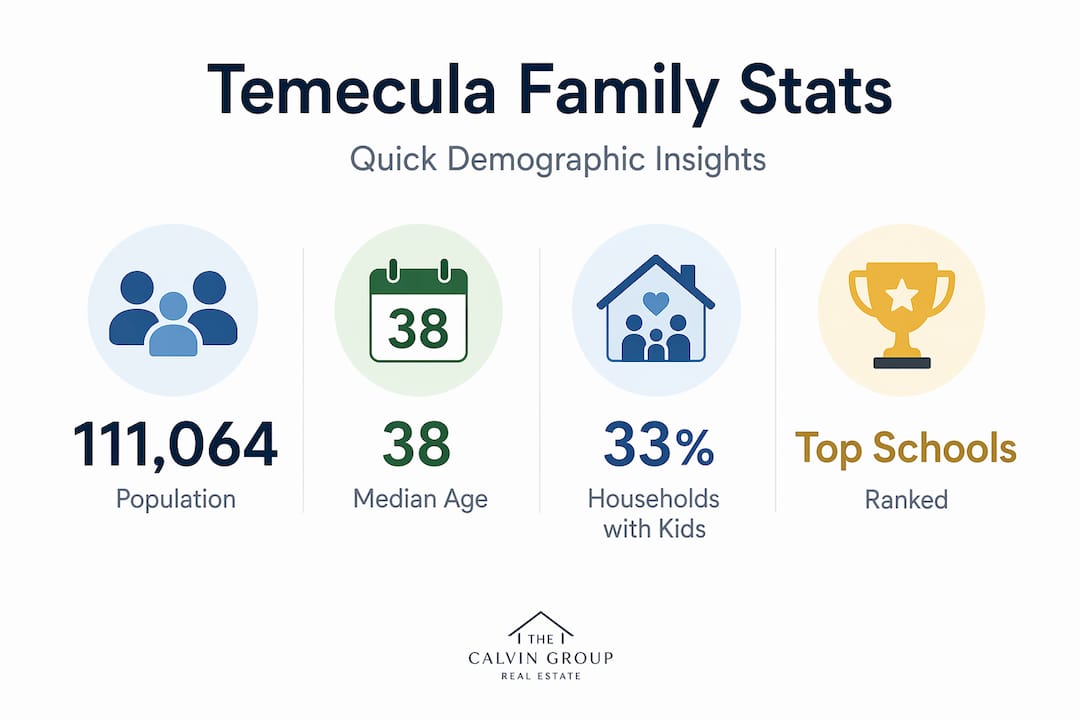
The city's population of 111,064 skews family-oriented in a way that shapes daily life in meaningful ways. The median age is 37.2, and 28% of residents are under 20 years old. That translates into packed youth sports leagues, well-funded school programs, and a community culture that takes neighborhood safety seriously.
Beyond demographics, what actually draws people to Temecula is the variety. On a weekend, you can tour the wine country vineyards along Rancho California Road, catch a hot air balloon ride over the valley, hike the Santa Rosa Plateau Ecological Reserve, or browse the massive Old Town Farmers Market. The Temecula Valley generates $1.137 billion in annual tourism spending, which supports nearly 9,570 local jobs. That economic vitality shows up in well-maintained parks, local restaurants, and community events that make the city feel genuinely alive.
Safety is one of the first things families ask about, and the answer here is straightforward. Temecula consistently ranks well below national crime averages, which makes it a legitimate contender for families leaving higher-crime urban environments.
- Wildfire risk: Temecula is in a moderate fire hazard zone. Residents in hillside communities should take seasonal fire preparation seriously.
- Transportation: The average commute is 27.63 minutes, and about 80% of commuters drive. Public transit use sits at just 0.6%, so owning a car is not optional here.
- Healthcare and community support: The city has been expanding behavioral health resources, including town halls designed to help families access mental health support before situations reach crisis levels.
Pro Tip: If you have school-age children, look specifically at communities zoned for Temecula Valley Unified School District. It consistently ranks among the top public school districts in Riverside County, and neighborhood zoning can make a significant difference in school assignment.
Housing market and cost of living in Temecula
Here is where things get genuinely interesting for anyone relocating to Temecula from a higher-cost metro area. The numbers look very different depending on where you are coming from.
As of May 2026, the median home value is $659,297 against a median household income of $120,784. That puts the price-to-income ratio at roughly 5.5x, which is still high by national standards. But compare it to Los Angeles, where median home prices regularly exceed $800,000 with similar income levels, and Temecula starts looking like a real opportunity.
| Metric | Temecula | Los Angeles Metro | National Average |
|---|---|---|---|
| Median home value | $659,297 | $800,000+ | $415,000 |
| Median household income | $120,784 | ~$75,000 | ~$74,000 |
| Average commute time | 27.63 min | 31+ min | 27 min |
| Crime rate vs. national avg | 38% lower | Near average | Baseline |
Rental prices in Temecula have followed the same regional upward trend. Expect to pay between $2,000 and $2,800 per month for a two-bedroom apartment depending on the area and amenities. That is not cheap, but it is substantially below comparable units in coastal Orange County or San Diego proper.
When it comes to Temecula California neighborhoods, a few stand out depending on your priorities. Redhawk and Paloma del Sol are established master-planned communities with good access to schools, parks, and shopping. Morgan Hill and Crowne Hill tend to attract buyers looking for newer construction with larger lots and some elevation. De Luz, a rural residential area northwest of Old Town, appeals to buyers who want acreage and privacy.
You can get a more detailed breakdown by reading this Temecula neighborhood guide from Increaltors, which breaks down communities by price range, school access, and lifestyle fit.
One factor worth monitoring: the proposed Golden Pacific Powerlink transmission line has sparked significant local opposition. Residents and tourism operators have raised concerns about wildfire risk and property values along the proposed corridor. If you are considering property near that route, it is worth following the regulatory process carefully before committing.
Pro Tip: Use a home value estimator specific to Temecula before making an offer. The Increaltors home value estimator tool can help you understand what comparable properties have sold for recently, which gives you a stronger negotiating position.
Pros and cons of relocating to Temecula
No city is perfect, and Temecula is no exception. What sets it apart is that its advantages tend to be the things people care most about: safety, schools, space, and affordability relative to Southern California norms. Its disadvantages are real but manageable if you plan around them.
What works in your favor
Temecula is genuinely family-friendly in a way that goes beyond marketing language. The combination of low crime, strong schools, outdoor recreation, and a median age that reflects an active working-age population creates a community where raising kids feels supported. The wine country and Old Town tourism infrastructure also means you have dining, events, and weekend activities without driving to San Diego or Los Angeles.
The partly rural yet growing setting also offers something increasingly rare in Southern California: space. Newer developments in Temecula feature larger lots and more square footage per dollar than you will find in most coastal cities.
Community support resources are also expanding. Town halls focused on behavioral health and family support reflect a city that is actively investing in resident wellbeing, not just infrastructure.
What to weigh carefully
- Traffic on I-15: The Interstate 15 corridor through Temecula is notoriously congested, especially during morning and evening commute windows. If you will be driving north toward Riverside or south toward San Diego daily, budget extra time.
- Wildfire risk: While Temecula is not in a high-risk fire hazard zone by state classification, the surrounding terrain and dry summers mean fire preparedness matters. This is especially true in hillside and rural residential areas.
- Infrastructure debates: The proposed 500-kilovolt transmission line is the most visible current controversy. Long-time residents actively track zoning and land-use proposals, and new residents should develop that same awareness quickly.
- Limited public transit: If you are accustomed to metro rail or frequent bus service, Temecula will feel isolated. The city is car-dependent by design.
- Summer heat: Inland valley temperatures regularly exceed 100°F in July and August. If you are relocating from a coastal city, the summer climate is a genuine adjustment.
Practical moving tips for Temecula
Getting the logistics right before your move saves more money than most people expect. Here is a practical sequence to follow when planning your relocation to Temecula.
-
Determine your move size and get quotes early. Moving costs in Temecula vary significantly by home size. Studio apartments run $499 to $699. A one or two bedroom move typically costs $749 to $949. Three to four bedrooms will run $999 to $1,600 or more. If you want labor only without a truck, hourly rates range from $69 to $99 per mover.
-
Choose your moving window carefully. Summer is peak moving season and also the hottest period in Temecula. Moving in late spring (April through May) or early fall (September through October) tends to offer better availability, lower prices, and far more bearable weather.
-
Confirm your mover's insurance coverage. Moving service pricing transparency and adequate insurance coverage are the two factors that separate reliable movers from problematic ones. Always request proof of liability coverage and ask specifically what happens if an item is damaged in transit.
-
Line up your registrations in advance. California requires vehicle registration transfer within 20 days of establishing residency. You will also need to update your driver's license, voter registration, and, if you have children, school enrollment paperwork before the school year starts.
-
Connect with Temecula's community resources early. The city offers various onboarding resources for new residents, including parks and recreation guides, school district enrollment information, and local emergency preparedness programs that are worth reviewing before your first fire season.
-
Visit the neighborhood at different times of day. Traffic, noise, and neighborhood activity shift significantly between morning, midday, and evening hours. Do not buy based solely on a Saturday afternoon visit.
Pro Tip: Book your moving crew at least 6 to 8 weeks before your target move date if you are planning to relocate during June, July, or August. Summer availability in Temecula fills fast, and last-minute bookings often cost 20 to 30 percent more than early reservations.
My honest take on moving to Temecula
I have worked with buyers relocating to Temecula from Los Angeles, Orange County, and even out of state, and the pattern I see consistently is this: people who do their homework love it here. People who buy based on price alone and ignore the nuances sometimes feel blindsided six months later.
What most people overlook is the community engagement piece. Temecula is a city where showing up to city council meetings, neighborhood HOA sessions, and local planning discussions genuinely matters. The controversy around the proposed transmission line is a perfect example. Residents who got involved early influenced the conversation in real ways. Residents who did not are now reacting instead of shaping outcomes.
I also think people underestimate how much the Temecula Valley's wine country identity protects local property values. The $1.137 billion in annual tourism that runs through this region keeps the local economy diversified and supports commercial development that makes the city more livable over time. That is not an accident. It is a product of residents and local leaders treating the valley's character as worth protecting.
When I advise clients on neighborhood selection here, I tell them the same thing every time. Focus on school district zoning, proximity to the I-15 without being directly adjacent to it, and lot size relative to price. Those three factors predict long-term satisfaction better than any surface-level feature. And if you are a first-time buyer, I strongly recommend reviewing these Southern California buying tips before you start touring properties, because the Temecula market moves fast and preparation is everything.
Temecula is not a hidden gem anymore. But it is still a genuinely good place to build a life, and the families I have helped settle here rarely regret the decision.
— Irvin
Find your Temecula home with Increaltors
If you are ready to move from researching to actually making your move to Temecula California happen, Increaltors is here to make that process straightforward. Agent Irvin Nierras specializes in Southern California residential real estate with a focus on giving buyers the local market knowledge they need to make confident decisions in competitive conditions.
Whether you are looking for a single-family home in an established community like Redhawk, a lower-maintenance condo near Old Town, or vacant land for a custom build, Increaltors maintains updated listings across all property types. You can browse current Temecula homes for sale directly on the site, or filter by type to find single-family homes that match your family size and budget. Every listing includes neighborhood context, pricing insights, and direct access to Irvin for questions. No runaround. No generic responses. Just honest guidance from someone who knows this market.
FAQ
Is Temecula a safe place to live?
Yes. Temecula's overall crime rate is 38% lower than the national average, making it one of the safer mid-size cities in Southern California. It consistently ranks well for families with children.
What is the cost of living in Temecula like?
The median home value is $659,297 and the median household income is $120,784, which is high by national standards but significantly more affordable than Los Angeles or coastal Orange County. Rental prices for a two-bedroom unit typically range from $2,000 to $2,800 per month.
What are the best schools in Temecula?
Temecula Valley Unified School District is the primary public school system and ranks among the top districts in Riverside County. School assignment depends on which neighborhood you live in, so verifying zoning before purchasing or renting is important.
How much does it cost to move to Temecula?
Moving costs depend on home size. Studios run $499 to $699, one to two bedroom homes cost $749 to $949, and larger homes of three to four bedrooms range from $999 to $1,600 or more. Labor-only services start at $69 per mover per hour.
What should I know about Temecula neighborhoods before relocating?
Communities like Redhawk, Paloma del Sol, and Morgan Hill offer established infrastructure and good school access. If you prioritize space and newer construction, look at Crowne Hill. For rural acreage, De Luz is the most notable option, though it requires comfort with limited nearby amenities.