

TL;DR:
- Luxury real estate offers 4 to 8% annual yields, higher than standard properties.
- Tax strategies like 1031 exchanges and cost segregation can significantly increase after-tax returns.
- Risks include illiquidity, high maintenance costs, and market cycle sensitivity, requiring careful planning.
Most investors assume luxury properties are status symbols that sacrifice yield for prestige. That assumption is wrong. Luxury rentals yield 4 to 8% annually, more than double the 2 to 4% typical of standard residential properties. For high net worth individuals in Southern California, that gap represents a meaningful edge when building a diversified portfolio. This guide walks you through the real financial benefits, the tax strategies most investors overlook, the genuine risks you need to price in, and the practical steps to position luxury real estate as a powerful engine of long-term wealth.
Table of Contents
- How luxury real estate compares to other investments
- Tax benefits and financial incentives in luxury real estate
- Building wealth: Appreciation and income potential
- Risks, challenges, and what to watch out for
- Our take: When luxury real estate truly shines in your portfolio
- Start your luxury real estate journey with expert support
- Frequently asked questions
Key Takeaways
| Point | Details |
|---|---|
| Higher rental yields | Luxury properties in SoCal can yield 4-8% annually—substantially more than standard rentals. |
| Powerful tax incentives | 1031 exchanges, depreciation, and cost segregation can save six figures for high net worth investors. |
| Market resilience | Luxury real estate offers lower volatility and long-term appreciation potential, ideal for portfolio diversification. |
| Greater complexity | These investments pose challenges like slower sales and higher costs, requiring expert management. |
| Strategic fit | Luxury real estate works best as a complement—not a replacement—for other investments in a robust portfolio. |
How luxury real estate compares to other investments
Before committing capital, every serious investor wants to know one thing: how does this asset class stack up against the alternatives? Luxury real estate holds a unique position in the investment landscape, sitting between the high liquidity of equities and the tangible permanence of hard assets. Understanding that position clearly is what separates investors who profit from those who overpay.
The numbers side by side
| Asset class | Average annual return | Volatility | Liquidity | Tangible value |
|---|---|---|---|---|
| Luxury real estate | 6 to 10% (appreciation + yield) | Low to moderate | Low | Yes |
| Standard real estate | 4 to 6% | Low | Moderate | Yes |
| S&P 500 stocks | 7 to 10% | High | Very high | No |
| Cryptocurrency | Highly variable | Extreme | High | No |
| Bonds | 2 to 4% | Low | High | No |
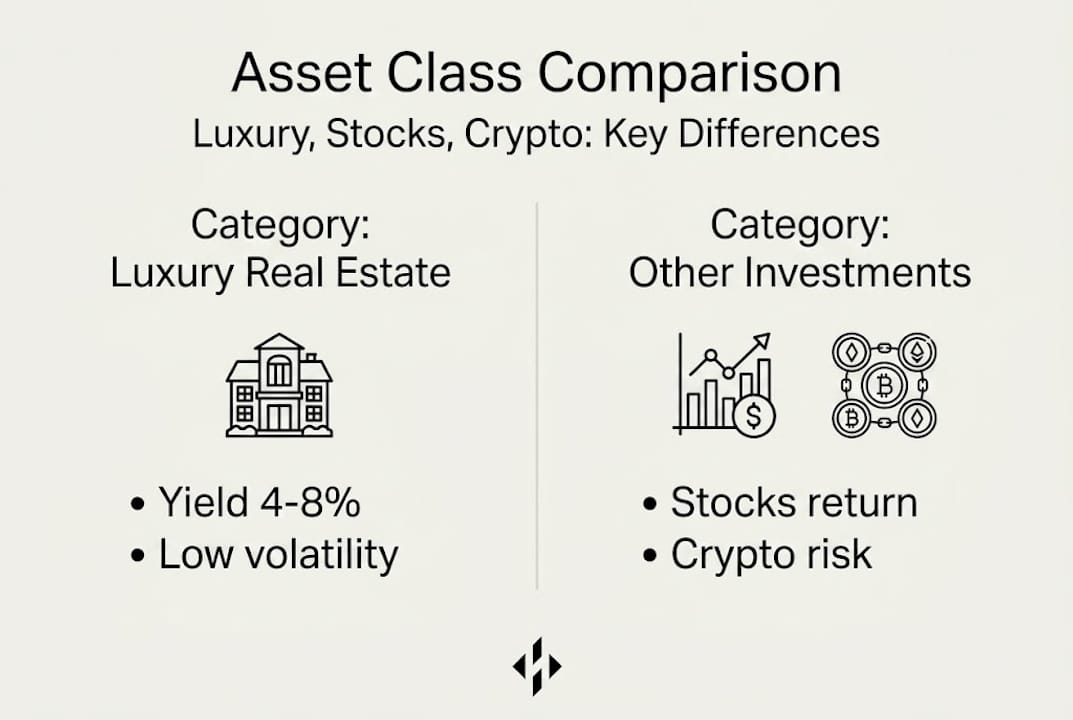
Stocks can match or beat real estate on paper returns, but they come with a volatility profile that makes many high net worth investors uncomfortable, especially when a significant portion of their net worth is already tied to business equity or concentrated positions. Luxury real estate, by contrast, is less volatile than equities and crypto, though it trades that stability for slower exit options.
Cryptocurrency sits at the opposite extreme. Returns can be extraordinary, but so can losses. For investors focused on capital preservation alongside growth, crypto rarely fits as a core holding. Luxury real estate offers something crypto never can: utility. You can live in it, lease it, or use it as collateral.
What makes luxury different from standard real estate
Standard rental properties in suburban markets typically deliver yields in the 2 to 4% range after accounting for vacancy, maintenance, and management fees. Luxury properties, particularly those in prime Southern California markets like Beverly Hills, Newport Beach, and Malibu, consistently yield 4 to 8% annually, driven by high-income tenants who pay premium rents and tend to treat properties with care.

The SoCal real estate advantages are particularly compelling. Southern California benefits from constrained land supply, year-round desirability, and a deep pool of domestic and international buyers. That combination creates a floor under luxury values that many other markets simply cannot replicate.
Here is what sets luxury apart from standard residential investing:
- Higher absolute rents that cover carrying costs more efficiently on premium properties
- Wealthier tenant pool with lower default risk and longer average tenancy
- International demand that insulates prices from purely local economic cycles
- Lifestyle utility that allows personal use without sacrificing asset value
- Scarcity premium in coastal and hillside locations with no new land supply
The illiquidity point deserves honest attention. If you need to exit a luxury position quickly, you may wait months and potentially accept a price reduction. That is a real cost, and it needs to factor into your capital allocation decisions. But for investors with a three to ten year horizon, that illiquidity is a feature, not a bug. It forces disciplined holding and captures the full appreciation cycle.
Tax benefits and financial incentives in luxury real estate
This is where luxury real estate investing separates itself most dramatically from other asset classes. The tax code in the United States is genuinely favorable toward real estate ownership, and high net worth investors who work with the right advisors can unlock benefits that make the after-tax return profile exceptional.
The core tax advantages explained
The tax advantages available to luxury real estate investors include 1031 exchanges, depreciation deductions, and cost segregation studies. Together, these strategies can generate $100,000 or more in tax savings on a single asset.
Here is how each one works:
-
1031 exchange: When you sell an investment property, you normally owe capital gains tax on the profit. A 1031 exchange lets you defer that tax entirely by reinvesting the proceeds into a similar property. You identify the replacement property within 45 days of the sale and close within 180 days. Done correctly, you can roll gains forward indefinitely, building a portfolio without the IRS taking a cut at each step.
-
Depreciation: The IRS allows you to depreciate the value of a residential property over 27.5 years. On a $3 million luxury property, that is roughly $109,000 in annual depreciation deductions, even if the property is actually appreciating in market value. That deduction offsets rental income and, in some cases, other passive income.
-
Cost segregation: This is the strategy most investors miss. A cost segregation study breaks down a property into its components and accelerates depreciation on items like appliances, flooring, landscaping, and certain structural elements. Instead of spreading all deductions over 27.5 years, you can front-load up to 30% of the property's value in year one. On a $3 million property, that could mean $900,000 in accelerated deductions in the first year alone.
-
Opportunity Zone investments: Certain Southern California zip codes qualify as Opportunity Zones, allowing investors to defer and potentially reduce capital gains taxes by reinvesting in designated areas.
-
Mortgage interest deduction: While the cap applies to loans up to $750,000 for new purchases, strategic financing structures can still generate meaningful deductions.
A real-world example
Consider a $3 million luxury property in the advantages of Los Angeles real estate market. With a cost segregation study identifying 25% of the property as eligible for accelerated depreciation, you could claim $750,000 in deductions in year one. At a 37% federal tax rate, that is $277,500 in tax savings in a single year. Add the standard depreciation on the remaining value, and the after-tax economics look dramatically better than the headline numbers suggest.
| Strategy | Property value | Potential year-one deduction | Tax savings at 37% rate |
|---|---|---|---|
| Standard depreciation | $3,000,000 | $109,090 | $40,363 |
| Cost segregation (25%) | $3,000,000 | $750,000 | $277,500 |
| Combined approach | $3,000,000 | $859,090 | $317,763 |
Pro Tip: Never attempt cost segregation or a 1031 exchange without a tax advisor who specializes in real estate. The rules are precise, the deadlines are strict, and errors can be costly. The right advisor typically pays for themselves many times over on a single transaction.
Building wealth: Appreciation and income potential
The most compelling case for luxury real estate is not any single benefit. It is the combination of appreciation and income working simultaneously over time. In Southern California, that combination has historically been powerful.
Appreciation in prime SoCal markets
Southern California's coastal and hillside luxury markets have consistently outperformed national averages over long holding periods. Limited land supply, restrictive zoning, and persistent demand from technology executives, entertainment industry professionals, and international buyers create structural appreciation pressure. Markets like Bel Air, Laguna Beach, and Palos Verdes Estates have seen values double or more over ten-year periods, even accounting for cyclical corrections.
The best SoCal locations for appreciation tend to share common characteristics: walkable or coastal locations, proximity to employment centers, strong school districts, and limited new construction. These factors do not disappear during downturns. They reassert themselves as demand recovers.
International demand plays a particularly important role in Southern California luxury. Buyers from Asia, the Middle East, and Latin America view prime Los Angeles and Orange County properties as safe stores of value, not just homes. That global buyer pool provides a demand floor that purely domestic markets lack.
Rental income and short-term rental potential
Luxury rental yields reach 4 to 8% annually in well-selected markets, with short-term rental platforms pushing that ceiling higher in tourist-heavy areas. A luxury property near the coast or in a destination neighborhood can generate $15,000 to $40,000 per month in short-term rental income during peak seasons.
Key drivers of strong luxury rental income include:
- Location near entertainment and lifestyle amenities that attract high-income short-term renters
- Premium finishes and amenities like pools, home theaters, and smart home systems that justify premium pricing
- Professional property management that maintains occupancy rates and handles high-expectation tenants
- Flexible rental strategies that blend long-term tenancy with seasonal short-term rentals for maximum yield
- Strong brand positioning through professional photography and listing optimization on premium platforms
Pro Tip: Diversify across zip codes and property types rather than concentrating in a single neighborhood. A mix of a long-term lease property in an established residential area and a short-term rental property in a coastal destination can balance steady income with peak yield potential, while spreading your risk across different demand drivers.
The wealth-building math is straightforward. A $3 million property appreciating at 5% annually gains $150,000 in value per year. Add a 5% net rental yield generating $150,000 in annual income, and the total return before tax benefits is $300,000 on a $3 million asset. That is a 10% gross return, before the tax strategies discussed earlier amplify the after-tax outcome significantly.
Risks, challenges, and what to watch out for
Transparency matters here. Luxury real estate is not a risk-free asset class, and investors who go in without clear eyes tend to make expensive mistakes. The risks are real, they are manageable, but they require honest planning.
The illiquidity problem
This is the most significant structural risk. Luxury properties sell in 50 to 108 days on average, and that timeline extends further when markets soften. Price cuts of 20.8% are not uncommon when sellers need to move quickly. If your financial situation changes and you need to liquidate a luxury position fast, you may face a painful choice between waiting for the right buyer or accepting a meaningful discount.
The practical implication is clear: never allocate capital to luxury real estate that you might need access to within 12 to 24 months. This asset class rewards patient investors and punishes those who need quick exits.
Management and maintenance costs
Luxury properties are expensive to maintain. High-end finishes, complex mechanical systems, pools, landscaping, and smart home technology all require ongoing investment. Budget for 1 to 2% of property value annually in maintenance costs, which on a $3 million property means $30,000 to $60,000 per year before any major capital expenditures.
Professional property management for luxury assets typically costs 8 to 12% of gross rental income, higher than the 6 to 8% standard for conventional rentals. The premium is justified by the complexity of managing high-expectation tenants and maintaining the property to the standard required to command luxury rents.
"The luxury market rewards investors who treat their properties as operating businesses, not passive assets. Owners who cut corners on management and maintenance consistently underperform those who invest in professional operations." This reflects a pattern seen repeatedly in high-value California markets.
Eviction complexity and tenant risk
California's tenant protection laws are among the most comprehensive in the country. Evicting a non-paying tenant, even in a luxury property, can take six months or longer and cost $5,000 to $15,000 in legal fees. Thorough tenant screening, including income verification at three times the monthly rent, credit checks, and reference verification, is essential.
The LA and OC investment tips that experienced investors follow consistently include rigorous tenant selection as a top priority. The cost of one bad tenant in a luxury property can erase a full year of rental income.
For investors considering real estate crowdfunding risks as an alternative, it is worth noting that while crowdfunding offers lower entry points and more liquidity, it also removes your direct control over property management decisions, which matters significantly in the luxury segment.
Pro Tip: Use a professional property management firm with specific luxury experience from day one. The cost is real, but the protection against management errors, tenant disputes, and maintenance failures is worth every dollar. Self-managing a luxury asset to save on fees is a false economy.
Market cycle sensitivity
While luxury real estate is less volatile than equities over long periods, it is not immune to market cycles. During the 2008 to 2010 downturn, luxury markets in Southern California saw significant price corrections before recovering strongly. Investors who entered at peak valuations with high leverage faced real stress.
The lesson is not to avoid luxury real estate. It is to enter with conservative loan-to-value ratios, maintain adequate cash reserves, and plan for a holding period long enough to ride through a full market cycle.
Our take: When luxury real estate truly shines in your portfolio
Here is the perspective that most investment articles avoid: luxury real estate is not the right move for every high net worth investor, and treating it as a guaranteed winner is how people get into trouble.
The investors we see succeed consistently with luxury real estate share a few characteristics. They have liquidity elsewhere. They are not relying on the property to fund near-term lifestyle expenses. They have a genuine ten-year or longer horizon. And they treat the investment with the same rigor they would apply to any other significant business decision.
The conventional wisdom says to buy in the best location you can afford. We would push back on that slightly. The best location for appreciation is not always the best location for yield, and the best location for short-term rentals is not always the best location for long-term tenancy. The investors who build the most resilient portfolios think about the function of each property before they buy it.
There is also something that rarely appears in financial analyses: the tangible asset argument. In periods of currency uncertainty, inflation, or geopolitical instability, hard assets with intrinsic utility hold value in ways that paper assets cannot. A well-located luxury property in Southern California is not just a financial instrument. It is a real thing, in a real place, with real demand from real people. That permanence has genuine value that does not show up in a yield calculation.
The lifestyle and legacy dimension matters too. Many of our clients are not purely optimizing for financial return. They want a property that serves their family, reflects their success, and potentially passes to the next generation with a stepped-up cost basis that eliminates capital gains for heirs. That is a legitimate and powerful reason to own luxury real estate, even if the pure financial metrics are not the absolute highest available.
The practical LA and OC advice we consistently give is this: luxury real estate should be a meaningful part of a diversified portfolio, not the entire portfolio. Pair it with liquid assets, tax-advantaged accounts, and business equity for a structure that can weather any market environment. The investors who treat luxury real estate as one powerful tool among several consistently outperform those who go all-in on any single asset class.
Start your luxury real estate journey with expert support
You now have a clear picture of what luxury real estate can deliver and what it demands in return. The next step is finding the right properties and the right guidance to act on that knowledge.

At INC Realtors, we specialize in connecting high net worth buyers and investors with curated opportunities across Los Angeles, Orange County, and the surrounding Southern California markets. Whether you are looking for single family luxury homes with strong appreciation potential, luxury condos for sale that combine yield with low maintenance, or prime vacant land for custom development, our listings are matched to the specific goals of serious investors. Irvin Nierras and the INC Realtors team bring deep local market knowledge, access to off-market opportunities, and the kind of personalized service that complex transactions require. Reach out today for a custom market analysis or property evaluation tailored to your investment goals.
Frequently asked questions
What is a 1031 exchange and how does it benefit luxury real estate investors?
A 1031 exchange defers capital gains taxes by requiring you to identify a replacement property within 45 days and close within 180 days, allowing you to reinvest the full proceeds and compound growth without an immediate tax hit.
Are luxury properties in Southern California a good hedge against market volatility?
Yes, luxury real estate is less volatile than stocks and crypto, offering meaningful price stability during economic downturns, though investors should account for the reduced liquidity that comes with that stability.
How quickly can I sell a luxury home in Southern California?
Luxury homes typically sell in 50 to 108 days on average, considerably longer than standard residential sales, which is why adequate cash reserves and a long investment horizon are essential before entering this market.
How do luxury property rental yields compare to standard rentals?
Luxury rentals yield 4 to 8% annually on average, while standard residential properties typically deliver just 2 to 4%, making luxury a stronger income play for investors who select the right markets and manage properties professionally.
What are the major risks of luxury real estate investing?
The primary risks include slow sale timelines, price cuts of 20.8% in softening markets, high ongoing maintenance costs, and the complexity of California's tenant protection laws, all of which are manageable with proper planning and professional support.