
TL;DR:
- Vetting a property involves thorough review of title records, insurance claims, easements, and disclosures beyond standard inspections.
- Failure to do so can lead to costly hidden damages, undisclosed easements, or title defects that threaten ownership and use.
Buying a home in Southern California sounds exciting until the escrow closes and you discover the property has a prescriptive easement running through the backyard, a history of water damage never disclosed, and insurance claims that should have raised every alarm during your review. One buyer in Anaheim learned this lesson the hard way after skipping a CLUE report review, inheriting a $40,000 flood remediation problem the previous owner had already filed two insurance claims on. That scenario is far more common than most listing agents will tell you. This article gives you a reliable, step-by-step process to vet listings yourself, spot red flags before you make an offer, and ask the right questions at every stage of the transaction.
Table of Contents
- What does it mean to vet a real estate listing?
- Essential documents and checks for every listing
- Evaluating red flags and warning signs in listings
- Working with professionals: maximizing your support team
- Why vetting listings often gets skipped—and the consequences
- Start your vetting journey with local experts
- Frequently asked questions
Key Takeaways
| Point | Details |
|---|---|
| Go beyond the basics | Vet listings by checking hidden records, not just agent disclosures and photos. |
| Documents are critical | Always review title, CLUE, easement, and disclosure documents before making an offer. |
| Spot the red flags | Be alert for vague listings, missing reports, or shifting prices as signs to investigate deeper. |
| Use professional help | Rely on a vetted team—realtors, inspectors, and notaries—to catch details you might miss. |
| Thoroughness beats speed | Never let urgency push you past critical vetting steps, even in hot SoCal markets. |
What does it mean to vet a real estate listing?
Most buyers believe vetting means booking a walkthrough and ordering a home inspection. That mindset is understandable because it mirrors what real estate TV shows portray, but it leaves major gaps in your knowledge before you commit hundreds of thousands of dollars.
Vetting a listing means going well beyond the online property description, the photos, and even the standard inspection report. It means pulling title records, reviewing insurance claim histories, examining easements, studying disclosure documents, checking zoning restrictions, and verifying every material fact the seller represents. In Southern California, where median home prices in cities like Pasadena, Irvine, and Long Beach routinely exceed $800,000, the stakes of incomplete vetting are enormous.
Southern California's market moves fast. Properties in desirable neighborhoods often receive multiple offers within 72 hours of hitting the MLS. That urgency creates a psychological trap where buyers feel they have to skip steps to stay competitive. But speed and diligence are not mutually exclusive. You simply need to know which checks to prioritize so you can move confidently without moving blindly.
Understanding the different real estate listing types in Southern California also matters here. An REO (real estate owned) property, a short sale, and a standard resale each carry different disclosure requirements and risk profiles. Vetting each one requires slightly different approaches.
Here is a quick comparison of what a standard viewing looks like versus a thorough vetting:
| Review element | Standard viewing | Thorough vetting |
|---|---|---|
| Property description | Read listing notes | Verify each claim independently |
| Photos | Browse gallery | Check for omissions and inconsistencies |
| Inspection | General home inspection | Specialized inspections (roof, foundation, mold) |
| Title | Basic ownership check | Full title search including easements |
| Insurance history | Not reviewed | CLUE report obtained and analyzed |
| Disclosures | Read once | Cross-referenced with physical evidence |
| Zoning | Assumed standard | Verified with county records |
| Utility records | Not reviewed | Pulled from local utility providers |
The risks of skipping thorough vetting include:
- Hidden structural damage that was patched cosmetically before listing
- Undisclosed easements that restrict how you can use the property
- Title defects that could cloud ownership for years
- Outstanding permits on unpermitted additions that become your liability
- CLUE report issues showing prior insurance claims that signal recurring problems
- Unexpected utility entitlements tied to neighboring parcels
According to hidden property records, a complete vetting process goes beyond the standard title search and inspection to include easements, utility records, and CLUE reports, especially for older properties. In SoCal, where you encounter plenty of homes built in the 1950s through 1970s, those older structures often carry the most hidden complications.
Essential documents and checks for every listing
Once you understand what vetting involves, gathering the right paperwork becomes your first action item. This is where most buyers stall because they assume the agent will handle everything. Some will. Many won't, at least not to the depth you need.

Here is a table of the core documents you should request and review for every listing you seriously consider:
| Document | What it reveals | Where to get it |
|---|---|---|
| Preliminary title report | Ownership, liens, easements | Title company |
| CLUE report | Past insurance claims on the property | LexisNexis or through your agent |
| Natural Hazard Disclosure (NHD) | Fire, flood, earthquake zone status | Seller or NHD provider |
| Transfer disclosure statement | Seller's known property defects | Seller via listing agent |
| Inspection reports | Physical condition of structure, systems | Licensed home inspector |
| Permit history | Legal status of all improvements | Local building department |
| Utility records | Average costs, any flagged issues | Utility companies |
| HOA documents | Rules, fees, pending litigation | HOA directly |
| Easement documents | Utility corridors, shared access rights | County recorder's office |
Knowing which documents to pull is only half the job. You also need to know how to use them. Here is a step-by-step process for gathering and reviewing each one:
- Request the preliminary title report first. This document lists every recorded lien, encumbrance, and easement on the property. Read the exceptions section carefully. Many buyers sign off on it without understanding the legal implications of a utility easement or a shared driveway agreement.
- Order or request the CLUE report. Sellers are not always required to provide this in California, but you can ask them to order it through their insurance carrier. A clean CLUE report gives you confidence; a report with multiple water or fire claims should trigger deeper questions.
- Pull the permit history from your local building department. In Los Angeles County, this can often be done online. Look for permits that were opened but never finaled, which signals work was done without passing inspection.
- Review all disclosure forms line by line. The Transfer Disclosure Statement and the Seller Property Questionnaire both ask specific questions. Pay attention to any "unknown" responses, as these can sometimes be a strategy to avoid liability.
- Commission specialized inspections. Beyond the standard home inspection, consider a roof inspection, sewer line camera inspection, and if the home predates 1980, a mold and asbestos assessment.
- Verify HOA health if applicable. Request the HOA's financial statements, meeting minutes from the past two years, and any reserve study. A severely underfunded HOA reserve is a strong sign of upcoming special assessments, which can cost you thousands.
Familiarizing yourself with key real estate terms will help you understand what you are reading in these documents without needing to call your agent every five minutes. Terms like "lis pendens," "beneficiary deed," and "subordination clause" appear regularly in title reports and disclosure forms.
Pro Tip: For homes built before 1980, always request off-title records in addition to the standard title search. These can include original recorded plat maps, utility easement documents from the original subdivision, and historical permit records held at the local assessor's office. This step alone has saved buyers from inheriting significant liabilities, as hidden records beyond title searches can include easements and older utility claims not captured in modern databases.
Working with a knowledgeable local agent is one of the best investments you can make at this stage. Reading about choosing a realtor can help you identify what qualities matter most when selecting someone to guide your due diligence.
Evaluating red flags and warning signs in listings
Documents only tell part of the story. A sharp buyer also knows how to read the listing itself, its photos, its pricing history, and the behavior of the listing agent for signs that something does not add up.
Some red flags are obvious. Others are subtle enough that even experienced investors walk right past them. Here is a practical list to keep on hand during your listing reviews:
- Vague or incomplete disclosures: Answers like "seller has no knowledge" on a 30-year-old property with visible water stains should raise immediate concern.
- Limited or suspiciously edited photos: Very few interior photos, or photos that seem to avoid certain rooms or corners, often mean something is being hidden from the listing gallery.
- Frequent price reductions: A home that has dropped in price two or three times within a short window suggests the market is seeing something buyers are not being told.
- Extended days on market in a hot area: If homes around it are selling in two weeks and this one has been sitting for 90 days, ask why without accepting a vague answer.
- Atypical or unexplained easements: A utility easement running through the center of the usable yard, or a shared access agreement with a neighboring commercial property, can severely limit your use of the land.
- Missing CLUE report: When a seller refuses to order or share a CLUE report, that resistance itself is informative.
- Unpermitted additions or conversions: A garage converted to a guest room or an added bathroom that does not appear on the original floor plan may carry serious liability.
- Inconsistencies between listing and physical visit: If the listing says 2,200 square feet but the floorplan feels much smaller, get an independent measurement before making an offer.
Ignoring small inconsistencies in a listing is where most expensive mistakes begin. A single vague disclosure, one missing photo angle, or one unanswered question about an easement may seem trivial in isolation. In practice, these details have a pattern. They cluster around properties with problems the seller or agent hopes you won't dig into. The buyers who pay the price are always the ones who trusted the listing at face value.
For sale by owner (FSBO) listings in particular tend to carry elevated risk in this area. Sellers without professional representation may not even know what they are legally required to disclose. Reviewing common FSBO warning signs before approaching one of these listings can save you significant trouble.
Pro Tip: Even when you are working with a well-regarded listing agent, verify claims independently. Pull the permit history yourself. Walk the property boundaries. Match the square footage to county records. The agent's job is to sell the property. Your job is to protect your investment.
Understanding the notary's role in closings is also worth a moment of your time. In California, notarized documents carry legal weight, and knowing what gets notarized, and when, helps you catch any procedural gaps in the transaction before closing day.
When you are preparing your list of concerns, having a structured set of questions for agents ready ensures you do not miss anything critical during your conversations with the listing side.
Working with professionals: maximizing your support team
At some point, vetting moves beyond what you can do alone. Documents require interpretation. Physical assessments require licenses and equipment. Legal implications require expertise you simply cannot get from a checklist. Building the right team around you is not optional; it is the difference between a confident purchase and a costly gamble.
Here is how to assemble and instruct your vetting team effectively:
- Start with a buyer's agent who specializes in your target area. Choose someone with proven local knowledge, not just a license. Ask them specifically about their due diligence process for listings. A strong agent knows which neighborhoods have historical easement issues, which building departments have spotty permit records, and which disclosures tend to be incomplete in certain property types.
- Hire a licensed home inspector you selected yourself. Do not accept the seller's preferred inspector. Choose one independently, accompany them on the inspection, and ask questions throughout. Request a written report with photos.
- Engage a title officer early. Ask your title company to flag any unusual items in the preliminary report before you finalize your offer terms. Title officers see hundreds of properties and can quickly identify red flags that would take you days to research.
- Consult a real estate attorney for complex transactions. If the property has multiple easements, a commercial component, a trust sale, or any litigation history, having a California real estate attorney review the documents before you sign is worth every dollar.
- Include a notary familiar with California closings. Beyond witnessing signatures, an experienced notary ensures all documents are properly executed and can flag procedural issues.
The specialists you want on your team for a thorough vetting process include:
- Your buyer's agent for market context, offer strategy, and document coordination
- Licensed home inspector for physical condition assessment
- Specialized inspectors for roofing, foundations, mold, and sewer lines as needed
- Title officer for ownership and encumbrance verification
- Real estate attorney for legal document review and complex transaction guidance
- Notary for proper execution of closing documents
- Local contractor for cost estimates on any disclosed repairs or deficiencies
Each of these professionals serves a different layer of the vetting process. Skipping any one of them based on cost or convenience creates a gap in your due diligence that the market will eventually expose.
Knowing the steps for finding a realtor who actively participates in due diligence, rather than just writing offers, is one of the highest-leverage decisions you will make in this process. Your agent should also be able to answer the specific questions to ask realtors that reveal their level of vetting expertise before you commit to working together.
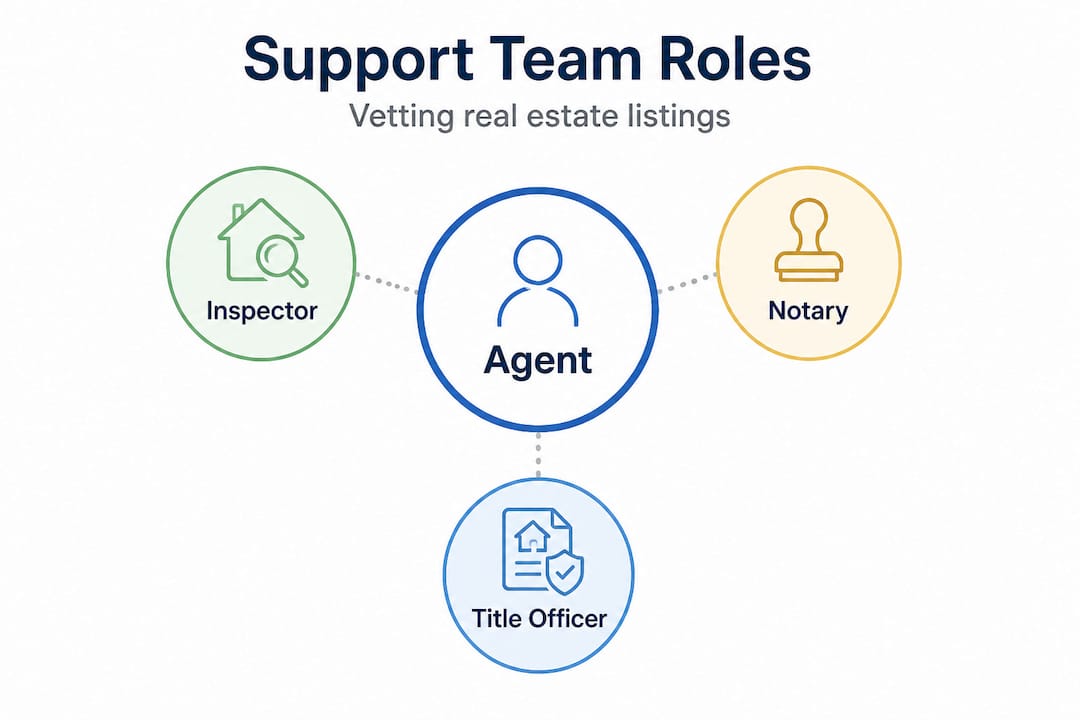
The hidden property records most likely to cause problems after closing are precisely the ones that require professional eyes, specifically easements, utility entitlements, and CLUE history that do not show up in a basic title search. Each of your team members brings a different lens to these areas.
Why vetting listings often gets skipped—and the consequences
Here is the uncomfortable truth: most buyers in Southern California skip key vetting steps not because they are lazy, but because the market punishes them for being thorough. When a desirable home in Glendale gets five offers in 48 hours, slowing down to order a CLUE report or pull permit history feels like professional suicide. Agents feel it too. There is enormous pressure to keep up or lose out.
But winning a bidding war is completely meaningless if you inherit a $60,000 foundation issue that nobody disclosed, or if you discover six months after closing that a utility easement prevents you from building the ADU you planned. The win feels hollow fast.
We have seen buyers at every experience level fall into this trap. First-time buyers do it because they trust the process. Experienced investors do it because they think they have seen enough properties to read a situation quickly. Both groups pay for that confidence when the problems surface.
The uncomfortable pattern is that serious problems almost always hide in plain sight. They show up as a slightly evasive answer in the disclosure form. A room that smells slightly musty. A price that sits just below what comparable homes are asking. An easement description in the title report that nobody explained. These are not invisible clues. They are visible ones that buyers train themselves to ignore under pressure.
The benefits of professional guidance are never more apparent than when a trusted local agent is the person who catches that evasive disclosure answer before the offer goes in. An experienced agent who has worked a specific SoCal market for years knows what typical disclosures look like and when something feels off.
Our perspective is straightforward: no matter how hot the market gets, the cost of a delayed offer is almost always lower than the cost of buying a problem property. Take the extra day. Pull the extra document. Ask the uncomfortable question. The best deals in Southern California are the ones where you knew exactly what you were buying.
Start your vetting journey with local experts
Knowing how to vet a listing is powerful. Having a local expert who does this work every day is even better. At Irvin Nierras | HomeSmart Evergreen, we work with buyers across Los Angeles, Orange County, and surrounding Southern California communities, bringing genuine diligence to every listing we evaluate together.
Whether you are searching for single family homes for sale in established neighborhoods, exploring SoCal condos for sale with strong investment potential, or simply browsing current homes for sale to understand what the market looks like right now, our listings come with local insight baked in. We do not just show you properties. We help you evaluate them. Connect with us to get personalized vetting guidance from a team that knows exactly what to look for in this market.
Frequently asked questions
What are the most overlooked issues when vetting real estate listings?
Hidden easements, CLUE reports, and utility entitlements often go unnoticed because they fall outside the standard inspection and basic title search, yet they can create major financial and legal complications after closing.
Can I rely on disclosures and inspections alone?
Disclosures and standard inspections are essential starting points, but reviewing additional records beyond inspections like CLUE reports, easements, and permit histories is what separates a thorough vetting from a surface-level review.
What role do professionals like notaries or inspectors play in the vetting process?
They verify the authenticity of records, identify structural or legal issues that sellers may not disclose, and ensure every document is properly executed before closing.
How can I check for easements or unusual restrictions on a property?
Request a full preliminary title report and read the exceptions section carefully for referenced easements and restrictions, then verify those details through the county recorder's office if anything is unclear.
Recommended
- Essential questions to ask real estate agents in SoCal
- Understand every type of real estate listing in SoCal
- Why use MLS listings: a guide for SoCal buyers and investors
- Your guide to LA real estate: smart steps for buyers and investors
- Colorado real estate checklist: maximize savings & choose wisely