
TL;DR:
- Setting a property price involves combining an AVM baseline, a local CMA, and a clear pricing strategy, verified by a licensed appraisal for high-stakes or unique homes.
- Proper valuation tools—AVMs for quick estimates, CMAs for local nuance, and appraisals for official approval—must be used at different stages of selling.
Set a defensible listing price by combining an AVM baseline, a local CMA, and a clear pricing strategy — then verify with a licensed appraisal when the property is unique or the stakes are high. You keep final control over the number, but the data is what makes buyers and lenders trust it.
Your immediate action checklist:
- Run two or three automated valuation models (Zestimate and similar tools) to get a quick baseline range
- Pull at least three comparable sales from the past 3–6 months in your neighborhood
- Request a Comparative Market Analysis from a local licensed agent
- Prepare a net-proceeds estimate so you know your real take-home amount
- Choose a pricing strategy tied to your timeline before you list
The single most important pricing principle: A listing price is not a wish — it is a documented argument. Your AVM baseline, your adjusted comps, your condition notes, and your chosen strategy together form the case that convinces buyers to offer and lenders to approve. Build the case first; set the number second.
Table of Contents
- How to price your home: AVM, CMA, and appraisal compared
- A step-by-step workflow to arrive at a listing price you can defend
- Which pricing strategy fits your situation?
- Local and macro market factors that should change your listing price
- How to calculate your expected net proceeds
- Common pricing mistakes that stall sales or reduce offers
- When should you hire an agent or order an appraisal?
- How Increaltors and Irvin Nierras help sellers set the right price
- Key Takeaways
- Pricing is a conversation with the market, not a declaration
- Ready to get your home's accurate value? Work with Increaltors
- Useful sources and further reading
How to price your home: AVM, CMA, and appraisal compared
Three tools dominate home valuation, and each one belongs at a different stage of the selling process. Understanding what each does — and where it falls short — keeps you from leaning too hard on the wrong one.
Automated Valuation Models (AVMs)
An AVM like Zillow's Zestimate pulls public records, tax assessments, and recent sales data to generate an instant estimate. It costs nothing, takes seconds, and gives you a useful ballpark. The catch: AVMs miss on-the-ground condition and neighborhood nuance entirely. A freshly renovated kitchen, a cracked foundation, or a noisy freeway behind the fence are invisible to an algorithm. Treat the Zestimate as your starting point, not your listing price.
Comparative Market Analysis (CMA)

A CMA is produced by a licensed local agent who physically reviews your home, selects genuinely comparable recent sales, and adjusts for differences in size, condition, upgrades, and location. NAR and Realtor.com both advise sellers to use an agent CMA alongside AVMs because the human layer catches what algorithms cannot. This is the industry standard for setting a listing price, and it costs you nothing when you work with a listing agent.
Professional Appraisal
A licensed appraiser produces a lender-grade valuation report, typically for $300–$600, using the same comparable-sales methodology as a CMA but with formal documentation and regulatory standards. Order one when your property is unique or high-value, when a lender disputes the contract price, or when you need an independent number for estate or legal purposes. For most standard listings, a strong CMA is sufficient.
Pro Tip: Validate any AVM by pulling two recent sold comps yourself on Realtor.com or your county assessor's site. If both comps land within 5% of the AVM figure, you have reasonable confidence in the baseline. If they diverge by more, the AVM is likely missing a local factor — this is exactly when you need a CMA fast.
| Method | Accuracy | Typical Cost | Who Provides It | Turnaround | Best Use |
|---|---|---|---|---|---|
| AVM (Zestimate) | Moderate | Free | Online platform | Instant | Quick baseline, early research |
| CMA | High | Free (with agent) | Licensed local agent | 1–3 days | Setting the listing price |
| Professional Appraisal | Highest | $300–$600 | Licensed appraiser | 1–2 weeks | Lender requirement, disputes, unique properties |
A step-by-step workflow to arrive at a listing price you can defend
Pricing your property is a process, not a guess. Follow these six steps in order and you will arrive at a number you can explain to any buyer or lender.
-
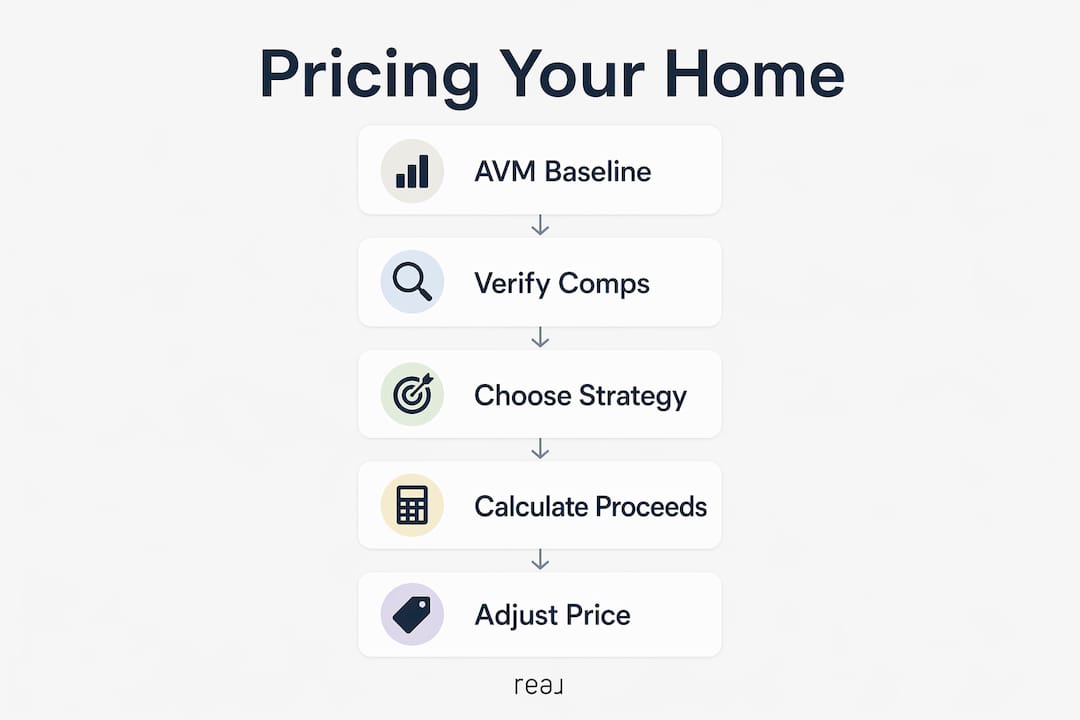
Gather baseline data. Run two or three AVMs (Zestimate, Redfin Estimate, your county assessor's tool). Pull at least three comparable sales from the past 3–6 months within a half-mile of your home. Note active listings too — they set buyer expectations even though they have not closed yet.
-
Inspect and adjust. Walk through your home with a critical eye. For each comp, list the differences and assign a dollar adjustment. A renovated kitchen in your home versus an outdated one in the comp might add $15,000–$25,000. A dated bathroom, deferred roof maintenance, or a smaller lot can subtract. Write these down — they become your CMA rationale.
-
Produce a price range. Average your adjusted comp values to get a defensible range, then identify a recommended list price within that range. A $20,000 spread is normal; where you land within it depends on your strategy (see the next section).
-
Choose a pricing strategy tied to your timeline and risk tolerance. Speed-focused sellers land near the bottom of the range; maximum-value sellers start near the top with room to negotiate.
-
Publish with search filters in mind. Listing at $300,000 instead of $300,001 is not superstition — it is visibility. Buyers set rigid min/max price filters, and crossing a round-number threshold by even one dollar can exclude your home from thousands of searches. Price to land inside the most common filter brackets.
-
Monitor and adjust. Plan your review window before you list. If showings are low or offers are absent after 7–14 days, that is market feedback. Have a pre-agreed price-reduction increment ready so you can act without emotion.
What to expect in weeks 1–4:
- Week 1: Listing goes live; expect the highest traffic volume of the entire listing period
- Week 2: Showing feedback arrives; compare offer activity to your target
- Week 3: If no offers, reassess price and marketing presentation
- Week 4: A price adjustment of 2%–3% typically resets buyer interest and restarts the clock
Which pricing strategy fits your situation?
Your pricing posture shapes everything downstream — marketing spend, staging investment, negotiation readiness, and how long you carry the property. Pick the strategy that matches your actual goals, not the one that sounds best.
Competitive/market-clearing price List at or just below the midpoint of your comp range. This approach attracts the widest buyer pool and tends to generate offers within the first two weeks. It works best when you have a firm move-out date, a relocation deadline, or financial urgency. The tradeoff: you leave less room to negotiate upward.
Aspirational/market-max price Start 3%–5% above your comp midpoint and plan for a longer listing period. This strategy suits sellers in high-demand neighborhoods with limited inventory, or those who can afford to wait. It requires patience and a willingness to reduce price in stages if the market does not respond.

Undercut/auction-style Price 2%–4% below comparable sales to generate multiple offers and a potential bidding war. This works in low-inventory markets where buyer competition is strong. The risk: if the market is softer than expected, you may simply sell below value with no competing bids. Sellers in high-demand Southern California zip codes have used this approach effectively — you can read more about fast-sale tactics in Orange County for local context.
Hybrid/staged reduction Start at the aspirational price with a pre-planned reduction schedule (for example, reduce by $10,000 every 14 days without an offer). This protects upside while limiting the stigma of a stale listing. It requires discipline — sellers who reduce too slowly or too late often end up below where a competitive price would have landed them.
Pro Tip: Strategy choice dictates staging investment. If you are pricing to sell fast, spend on photography and light staging — buyers need to act quickly and first impressions drive that. If you are pricing for maximum value, a fuller staging investment and a longer marketing runway make more sense financially.
| Strategy | Best Seller Profile | Main Risk |
|---|---|---|
| Competitive/market-clearing | Relocation, financial urgency, firm deadline | Less negotiating room |
| Aspirational/market-max | High-demand area, flexible timeline | Extended days on market |
| Undercut/auction-style | Low-inventory market, confident in buyer demand | Sells below value if market is soft |
| Hybrid/staged reduction | Wants upside but has a fallback plan | Slow reductions create listing stigma |
Local and macro market factors that should change your listing price
No pricing decision happens in a vacuum. The market you are selling into shapes what buyers can afford, how fast they act, and what they will pay. Local inventory levels, days on market, and recent sold price trends in your specific zip code are the most direct signals to watch.
Local factors to track:
- Months of supply in your zip code (under 3 months favors sellers; over 6 months favors buyers)
- Average days on market for comparable homes sold in the past 60 days
- Sale-to-list price ratio (a ratio above 100% means homes are selling over asking)
- Upcoming neighborhood developments, school district changes, or infrastructure projects
- Recent price reductions among active listings — a sign of softening demand
Macro factors that affect your pricing timeline:
- Mortgage interest rates directly reduce buyer purchasing power. Higher rates compel buyers to lower their budgets or stretch their monthly payments, which puts downward pressure on what they will offer.
- Seasonal patterns matter. Spring (March through May) historically produces the highest buyer activity in most U.S. markets. For California-specific timing, selling in the right season can meaningfully affect your final price.
- Employment and local economic conditions influence buyer confidence. A major employer announcing layoffs in your area is a pricing signal worth factoring in.
The FHFA House Price Index tracks area-level price trends using repeat-sales data and is a reliable macro reference when local comps are thin. Use it for context, not as a substitute for neighborhood-level sold data.
Weekly data checklist during your listing:
- New listings and price reductions in your zip code
- Pending sales count (rising pendings = strengthening demand)
- Mortgage rate movement (a 0.5% rate increase can shift buyer budgets by thousands)
- Showing request volume relative to week one
How to calculate your expected net proceeds
Knowing your listing price is only half the picture. What you actually take home after the sale depends on a set of deductions that most sellers underestimate until closing day.
Common line items that reduce your proceeds:
- Agent commissions (seller's agent and, in many cases, buyer's agent compensation)
- Escrow and title fees
- Transfer taxes (varies by state and county)
- Repairs requested after inspection
- Seller concessions (closing cost credits to the buyer)
- Staging and pre-listing preparation costs
- Mortgage payoff balance (including any prepayment penalties)
Seller-cost checklists from broker resources consistently highlight these deductions as the most commonly overlooked items in a seller's financial plan.
Sample net-proceeds calculation:
A $10,000 increase in your listing price does not translate to the full $10,000 more in your pocket. After commissions and selling costs on that increment, the real gain is somewhat less. That math matters when you are deciding whether to hold out for a higher offer or accept a clean, fast one.
Pro Tip: Run your net-proceeds estimate at three price points — your target price, 3% below, and 3% above — before you list. Seeing the actual dollar difference at each level helps you make rational decisions during negotiation instead of emotional ones.
Common pricing mistakes that stall sales or reduce offers
Most pricing errors are avoidable. They tend to cluster around the same few patterns, and each one has a clear corrective.
The most common mistakes:
- Overpricing based on emotional attachment. Your memories and improvements feel valuable to you; buyers price what they see, not what you feel. Pricing 10% above comps because of sentimental value is the single fastest way to generate zero offers.
- Relying on a single AVM. One Zestimate is a data point, not a valuation. Two AVMs that disagree by $40,000 tell you the algorithm is uncertain — that is when you need a CMA, not a coin flip.
- Ignoring local comps. National price trends are background noise for a seller. What matters is what three similar homes sold for in your neighborhood in the past 90 days.
- Starting high and dropping too fast. A rapid price reduction signals desperation. Buyers who were watching your listing will wait for the next drop instead of making an offer.
- Missing search-filter psychology. Listing at $505,000 when most buyers search up to $500,000 is a self-inflicted visibility problem.
- Skipping the net-proceeds estimate. Sellers who do not run the numbers sometimes reject a fair offer chasing a higher price, only to net less after carrying costs and a second round of negotiations.
Red-flag checklist for listing performance:
- Fewer than 5 showings in the first 10 days → price is likely above market; review comps immediately
- Consistent showing traffic but no offers → buyers like the home but not the price; consider a 2%–3% reduction
- Offers consistently 8%–10% below list → the market is telling you the price clearly; adjust or negotiate
- Low online clicks relative to similar listings → price may be outside the dominant search filter bracket; check threshold alignment
For practical tactics to improve offer quality alongside pricing, the 11 ways to boost home offers resource covers presentation and marketing moves that complement a well-set price.
When should you hire an agent or order an appraisal?
For most sellers, a CMA from a licensed local agent is all you need to set a defensible listing price. But there are specific situations where a professional appraisal or multiple agent consultations are worth the extra time and cost.
When a CMA is sufficient:
- Standard single-family home with at least three recent comparable sales nearby
- Property is in good condition with no unusual features
- You are working with an experienced local agent who knows your neighborhood
When to order a professional appraisal:
- Your home is unique (custom build, unusual lot, historic designation) and comps are thin
- The lender disputes the contract price and you need independent documentation
- Estate settlement, divorce, or litigation requires a formal valuation
- You are selling a very high-value property and want a second opinion before listing
Practical triggers to call a pro immediately:
- You have not sold a home in more than five years and the market has shifted significantly
- You have made major structural changes (addition, ADU, full gut renovation) that AVMs cannot price accurately
- Your listing deadline is firm and you cannot afford to reprice after launch
- Title or ownership complications exist that could affect marketability
Questions to ask a listing agent:
- How many homes have you sold in this zip code in the past 12 months?
- Can you show me the three comps you would use for my CMA and explain your adjustments?
- What is your recommended pricing strategy given current inventory levels?
- What is your plan if the home does not receive offers in the first two weeks?
Questions to ask a licensed appraiser:
- Are you familiar with this neighborhood and property type?
- What is your turnaround time and fee?
- Will you walk me through your comp selection methodology?
How Increaltors and Irvin Nierras help sellers set the right price
Increaltors, led by agent Irvin Nierras, delivers a structured, data-driven pricing process for sellers across Los Angeles, Orange County, and surrounding Southern California markets. The process is built around the same methodology this article describes — but with local expertise and on-the-ground knowledge that no algorithm can replicate.
What the Increaltors pricing process looks like:
- Local market analysis: Irvin pulls current inventory data, recent sold comps, and neighborhood-level trends specific to your zip code — not county-wide averages
- On-site visit: A physical walkthrough to assess condition, upgrades, and any features that require positive or negative adjustments to the comp baseline
- Tailored CMA: A written comparative market analysis with documented adjustments, a recommended price range, and a single suggested list price with rationale
- Pricing strategy recommendation: Based on your timeline, financial goals, and current market conditions, Irvin recommends the strategy (competitive, aspirational, or hybrid) that fits your situation
- Marketing plan alignment: The chosen price point shapes the marketing approach — photography, staging guidance, listing platform selection, and open house timing
Sellers who request a free home valuation from Increaltors receive a CMA report, a net-proceeds estimate, and a suggested listing timeline — all before signing any agreement. You can also review the current market snapshot to see where your neighborhood stands right now.
What sellers consistently find: Pricing confidence comes from having a documented rationale, not just a number. When you can explain to a buyer exactly why your home is priced where it is — and back it with three adjusted comps and a local agent's analysis — negotiations become far less stressful and far more productive.
The first meeting with Irvin typically covers your goals, a review of the preliminary CMA, a net-proceeds walkthrough, and a Q&A on strategy. You leave with a clear picture of your price range and a plan — not a vague estimate.
Key Takeaways
A defensible listing price combines an AVM baseline, at least three adjusted comparable sales, a clear pricing strategy, and a net-proceeds estimate calculated before you list.
| Point | Details |
|---|---|
| Start with AVMs, then verify | Use two or three automated estimates as a baseline, then validate with local sold comps from the past 3–6 months. |
| A CMA is the pricing standard | A licensed agent's Comparative Market Analysis accounts for condition and local nuance that AVMs cannot capture. |
| Strategy drives the number | Choose competitive, aspirational, or hybrid pricing based on your timeline and risk tolerance before setting the list price. |
| Net proceeds matter more than list price | Calculate commissions, closing costs, repairs, and mortgage payoff to know your real take-home before you negotiate. |
| Increaltors delivers the full process | Irvin Nierras provides a free CMA, net-proceeds estimate, and pricing strategy for sellers in Los Angeles and Orange County. |
Pricing is a conversation with the market, not a declaration
Most sellers treat the listing price as a statement of what they believe their home is worth. The market treats it as an opening bid in a conversation it has already been having without you.
What I find most sellers underestimate is how quickly the market forms an opinion. The first 10 days of a listing generate a disproportionate share of total showing activity. If the price is wrong, the market does not send a polite note — it simply moves on to the next listing. By the time a seller notices the silence and adjusts, the initial momentum is gone and the price reduction itself becomes a signal that something was wrong.
The sellers who price well are not the ones who guess right on the first try. They are the ones who build a documented rationale before listing, choose a strategy that matches their actual timeline, and commit to a review window with a pre-agreed adjustment plan. Pricing is iterative by design. The goal is not a perfect number on day one — it is a number you can defend, adjust quickly if needed, and ultimately close on with confidence.
Ready to get your home's accurate value? Work with Increaltors
Knowing the right price for your home is the difference between a fast, profitable sale and months of frustration. Increaltors gives Southern California sellers a free, agent-prepared CMA with no obligation — so you walk into your listing with a price backed by real local data, not guesswork from an algorithm.

Irvin Nierras personally handles every valuation request, covering Los Angeles, Orange County, and nearby Southern California communities. Before your appointment, gather your most recent mortgage statement, a list of upgrades completed in the past five years, and any prior appraisal reports. The CMA report is typically ready within one to three business days after the on-site visit.
From there, the path is straightforward: schedule your free valuation, meet with Irvin, receive your CMA and net-proceeds estimate, and decide whether to move forward with a listing. No pressure, no commitment required. Browse current listings to see how Increaltors markets priced-right homes, or request your free valuation today and get a number you can actually use.
Useful sources and further reading
- National Association of REALTORS® Consumer Guide: Pricing Your Home — Covers the factors agents evaluate when recommending a listing price, including size, condition, location, and market conditions.
- Realtor.com: How Much Is My House Worth? — Practical guidance on using AVMs, CMAs, and comps to determine home value, with seller-cost checklists.
- NerdWallet: How to Determine Home Value — Consumer finance perspective on triangulating AVM, CMA, and appraisal estimates for a reliable baseline.
- FHFA House Price Index — Tracks area-level price trends using repeat-sales data; useful for macro context when local comps are sparse.
- Investopedia: Factors Affecting the Real Estate Market — Explains how interest rates, employment, and economic conditions influence buyer purchasing power and home prices.
- Increaltors Free Home Valuation — Request a free, agent-prepared CMA and net-proceeds estimate from Irvin Nierras for Southern California properties.
- Increaltors Market Snapshot — Updated local market data for Los Angeles, Orange County, and surrounding areas to inform your pricing decision.