
TL;DR:
- The house closing process involves transferring property ownership through legal documents, payments, and recording the deed. Most closings take 30 to 45 days, with delays caused by underwriting, appraisals, or title issues. Buyers should prepare documents early, respond quickly to lender requests, and verify wiring instructions to avoid delays and fraud.
The house closing process is the final legal transfer of property ownership from seller to buyer, completed through signed documents, verified payments, and a recorded deed. Most closings take place 30–45 days after offer acceptance, involving the buyer, seller, lender, title company, and a settlement agent who coordinates the legal recording. For first-time homebuyers and real estate investors alike, understanding each phase before it arrives is the difference between a smooth transaction and a costly delay. This guide covers every step, from required documents to closing day procedures, so you walk in prepared.
What is the house closing process, step by step?
The real estate closing process is more than a single appointment. It is a sequence of coordinated legal, financial, and administrative steps that culminate in the official transfer of title. The settlement agent plays a central role, ensuring the deed is properly executed and recorded with the county. Without that recording, ownership does not legally change hands.
Most buyers are surprised by how many parties are involved. The lender, title company, escrow officer, buyer's agent, seller's agent, and sometimes a real estate attorney all have defined roles. Each party depends on the others to deliver documents, funds, or approvals on time. A delay from any one party can push the entire closing date back.
The typical timeline runs 30–45 days from accepted offer to closing day. Cash purchases can close faster, sometimes in as few as 10–14 days. Transactions involving FHA or VA loans tend to run closer to the 45-day mark due to additional underwriting requirements.

What documents and funds do you need before closing?
Preparation is the single biggest factor in a smooth closing. Buyers and sellers who gather their paperwork early avoid the last-minute scramble that causes most delays.
Key buyer documents
- Purchase agreement: The signed contract between buyer and seller
- Closing Disclosure: A five-page form detailing all loan terms, monthly payments, and closing costs, delivered at least three business days before closing
- Loan documents: Promissory note, deed of trust, and any lender-required addenda
- Proof of homeowners insurance: Active policy with the lender listed as mortgagee
- Government-issued photo ID: Passport or driver's license for identity verification
- Proof of funds: Bank statements or wire transfer confirmation for the down payment and closing costs
Key seller documents
- Deed: The legal instrument transferring title to the buyer
- Seller disclosures: Written statements about known property defects or material facts
- Payoff statement: Confirmation from the seller's lender of the exact mortgage balance to be paid off at closing
- Repair receipts: Documentation of agreed repairs completed after inspection
Understanding closing costs
Closing costs typically range from 2% to 5% of the home purchase price. On a $600,000 home, that means $12,000 to $30,000 in fees covering lender charges, title insurance, prepaid property taxes, and homeowners insurance escrow. Budget for this amount separately from your down payment.
| Cost Category | What It Covers |
|---|---|
| Lender fees | Origination, underwriting, and processing charges |
| Title fees | Title search, title insurance, and settlement agent fees |
| Prepaid items | Homeowners insurance premium, prepaid interest, property tax escrow |
| Government fees | Recording fees and transfer taxes |
| Earnest money deposit | Applied toward down payment or closing costs at closing |
Pro Tip: Request your Closing Disclosure as soon as it is available and compare every line item against your Loan Estimate. Discrepancies in fees are easier to resolve before closing day than during it.
A title search clears the property of any liens, ownership disputes, or unpaid taxes before the deed transfers. Title insurance protects both the lender and the buyer against any claims that surface after closing. In Southern California, buying homes in Orange County and other high-value markets makes title insurance especially critical given the complexity of local property histories.
How does the closing timeline unfold from offer to keys?
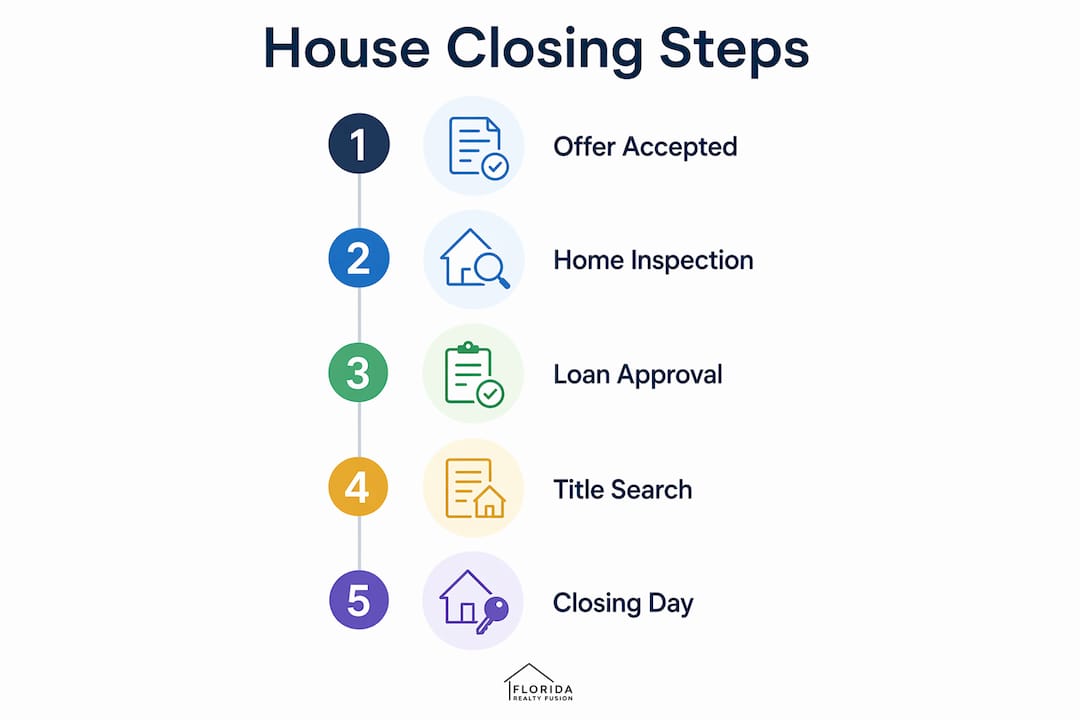
The closing timeline has eight distinct phases. Each one builds on the last, and a delay in any phase shifts everything that follows.
-
Open escrow and deposit earnest money. Within one to three days of offer acceptance, the escrow company opens an account and the buyer deposits earnest money, typically 1% to 3% of the purchase price. This deposit signals serious intent and is applied to the buyer's costs at closing.
-
Submit mortgage application and respond to underwriting. The buyer submits a full mortgage application within days of the accepted offer. Underwriting is the most frequent cause of closing delays, with lenders often requesting last-minute documentation. Respond to every lender request within 24 hours to keep the timeline intact.
-
Schedule and complete the home inspection. A licensed inspector examines the property's structure, roof, plumbing, electrical, and HVAC systems. The inspection report gives the buyer leverage to request repairs or credits. Negotiate repair terms in writing and get receipts before closing.
-
Order the appraisal. The lender orders an independent appraisal to confirm the home's market value supports the loan amount. If the appraisal comes in low, the buyer can renegotiate the price, pay the difference in cash, or walk away if the contract includes an appraisal contingency.
-
Complete the title search and order title insurance. The title company searches public records for liens, easements, or ownership gaps. Any title defects must be cleared before the deed can transfer. Both lender's title insurance and owner's title insurance are ordered at this stage.
-
Review the Closing Disclosure. Federal law requires the lender to deliver the Closing Disclosure at least three business days before closing. Read every line. Confirm the interest rate, loan amount, monthly payment, and all fees match what was previously quoted.
-
Conduct the final walk-through. The final walk-through verifies that the home is in the agreed condition, not a substitute for the original inspection. Check that all negotiated repairs are complete, appliances work, and nothing has been damaged or removed. Do this within 24 hours of closing.
-
Close, fund, and record. On closing day, all parties sign documents, the lender funds the loan, and the deed is recorded with the county. Once recording is confirmed, the buyer receives the keys.
Pro Tip: If you are using a wire transfer for your cash to close, initiate it at least 24 hours before your scheduled closing time. Wire transfers can take several hours to process, and a late wire can push your closing to the next business day.
For first-time buyers in Southern California, understanding tips for first-time buyers specific to the local market can prevent surprises during the underwriting and appraisal phases.
What happens on closing day?
Closing day is a structured appointment, not a casual meeting. A typical closing appointment lasts between 30 to 90 minutes and involves signing 50 to 100 pages of documents. Buyers should plan for the longer end of that range on their first purchase.
Where closings happen
Closings typically take place at the title company's office, a real estate attorney's office, or the escrow company's location. Remote and hybrid closings using a notary and digital signing platforms are increasingly common, particularly in California.
Who attends
- Buyer and co-buyer (if applicable)
- Seller and co-seller (if applicable)
- Buyer's real estate agent
- Seller's real estate agent
- Closing agent or escrow officer
- Notary public (sometimes the same as the closing agent)
- Lender representative (sometimes present, sometimes not)
What you sign
Closing day involves signing the mortgage note, deed of trust, and Closing Disclosure, confirming funds, and the lender funding the loan before deed recording. The mortgage note is your personal promise to repay the loan. The deed of trust gives the lender a security interest in the property until the loan is paid off.
What to bring
- Valid government-issued photo ID (two forms recommended)
- Proof of homeowners insurance
- Cashier's check or wire transfer confirmation for cash to close
- Any outstanding documents requested by the lender
Wire fraud is a serious and growing threat in real estate transactions. Before transferring any closing funds, verify wiring instructions by calling your escrow officer directly using a phone number you looked up independently. Never rely on email instructions alone, even if the email appears to come from a trusted contact.
Pro Tip: Bring a personal check as a backup for any small adjustments to your cash-to-close amount. Wires are exact; minor last-minute changes happen, and a personal check covers the gap.
After all documents are signed and the lender confirms funding, the deed is sent for recording. Once the county records the deed, the transaction is complete and you receive the keys. Understanding what a closing agent does in Southern California helps buyers know exactly who to contact if questions arise during this final stage.
What are the most common closing delays and how do you avoid them?
28% of real estate closings in 2024 experienced at least one delay, mostly due to financing hurdles and appraisal issues. That means more than one in four transactions hit a snag before the finish line.
The most frequent problems fall into five categories:
- Underwriting conditions: Lenders issue conditions after reviewing your file, requesting updated pay stubs, bank statements, or letters of explanation. Slow responses push the closing date back. Treat every lender request as urgent.
- Appraisal gaps: When the appraised value falls short of the purchase price, the deal stalls while buyer and seller renegotiate. Buyers in competitive markets should have a plan for this scenario before making an offer.
- Title defects: Unpaid liens, boundary disputes, or errors in public records can delay or block recording. The title company works to clear these, but some issues take weeks to resolve.
- Buyer financial changes: Opening new credit accounts, making large purchases, or changing jobs before closing can trigger a new round of underwriting. Avoid any financial changes from offer acceptance through the day of recording.
- Document errors: A wrong name, incorrect address, or mismatched number on any closing document requires a correction before signing. Review your Closing Disclosure carefully as soon as you receive it.
Pro Tip: Create a dedicated folder, physical or digital, for every document related to your transaction. Label each file clearly and keep it updated. When a lender or title company requests something, you can respond within hours instead of days.
Working with a buyer's agent who knows the local market and the closing process reduces the risk of delays caused by missed deadlines or miscommunication between parties.
Wire fraud deserves its own warning. Criminals intercept email communications and send fake wiring instructions that appear legitimate. Always call your escrow officer on a verified number before sending any funds. This one step prevents a loss that cannot be reversed once the wire clears.
Key Takeaways
The house closing process succeeds when buyers prepare documents early, respond to lender requests fast, and verify all financial instructions before transferring funds.
| Point | Details |
|---|---|
| Closing costs add up fast | Budget 2%–5% of the purchase price for fees beyond your down payment. |
| Underwriting drives delays | Respond to every lender document request within 24 hours to stay on schedule. |
| Final walk-through is not optional | Verify all repairs and home condition within 24 hours before closing day. |
| Wire fraud is a real risk | Always call your escrow officer on a verified number before sending closing funds. |
| Closing Disclosure review matters | Read every line of your Closing Disclosure as soon as it arrives, at least three days before closing. |
What I've learned from watching closings go sideways
Most closing problems are not surprises. They are predictable failures that happen when buyers treat closing as a finish line instead of an active process.
The buyers I work with who close on time share one habit: they treat every lender request like it is the most urgent thing on their calendar. Underwriting conditions do not wait. A lender who asks for a bank statement on a Tuesday needs it by Wednesday morning, not Friday afternoon. I have seen closings pushed back a full week because a buyer waited two days to upload a single document.
The other pattern I see constantly is buyers who stop paying attention after the inspection. They negotiate repairs, get the credits, and then mentally check out until closing day. That is exactly when the title search is running, the appraisal is being reviewed, and the Closing Disclosure is being prepared. These are the stages where errors get locked in if nobody is watching.
My honest advice: assign yourself the role of project manager for your own transaction. You are not just waiting for agents and lenders to do their jobs. You are tracking every open item, following up proactively, and reading every document before you sign it. The real estate offer process sets the terms, but the closing process is where those terms become legally binding. Treat it with the same attention you gave to finding the right home.
One more thing: do not let closing day feel like a formality. You are signing 50 to 100 pages of documents that govern your finances for the next 15 to 30 years. Ask questions. Slow down on anything you do not understand. A good closing agent will not rush you.
— Irvin Nierras
Increaltors is here when you are ready to close
Closing on a home in Southern California requires local knowledge, reliable contacts, and an agent who stays on top of every moving part.

Increaltors, led by agent Irvin Nierras of HomeSmart Evergreen Realty, guides buyers and investors through every phase of the transaction, from offer to recorded deed. Whether you are searching for single-family homes for sale in Los Angeles or exploring condos for sale in Orange County, Increaltors provides personalized support, document guidance, and negotiation expertise at every step. Contact Increaltors today to connect with an agent who knows the Southern California market and will keep your closing on track.
FAQ
What is the house closing process?
The house closing process is the final legal transfer of property ownership from seller to buyer, completed through signed documents, verified payments, and a recorded deed. It typically takes 30–45 days from offer acceptance and involves the buyer, seller, lender, title company, and a settlement agent.
What are closing costs and how much should I budget?
Closing costs cover lender fees, title fees, prepaid taxes, and insurance, and typically range from 2% to 5% of the home purchase price. On a $600,000 purchase, expect to budget between $12,000 and $30,000 on top of your down payment.
How long does closing day take?
A typical closing appointment lasts between 30 to 90 minutes and involves signing 50 to 100 pages of documents. First-time buyers should plan for the full 90 minutes and bring all required identification and payment documentation.
What causes closing delays?
The most common causes of closing delays are underwriting conditions, appraisal gaps, and title defects. Responding to lender requests within 24 hours and avoiding financial changes before closing significantly reduces delay risk.
How do I protect myself from wire fraud at closing?
Always call your escrow officer directly on a phone number you have independently verified before transferring any closing funds. Never follow wiring instructions sent only by email, even if the message appears to come from a trusted contact.