

"Homestead real estate" refers to two different things in the U.S. market, and mixing them up costs buyers money. The first is a marketing label: a property with acreage, outbuildings, and features suited to small-scale self-sufficiency. The second is a legal status: a homestead exemption that protects your primary residence from certain creditors and can reduce your property-tax bill. Your immediate next step depends on which you're after.
Before you call an agent or click a listing, verify three things quickly:
- Primary residence status — legal homestead protections apply only to your principal dwelling, not investment land.
- Acreage and use restrictions — zoning and deed restrictions may limit farming, livestock, or outbuildings.
- Water and septic access — a parcel without a confirmed well, water rights, or septic approval can be nearly unusable.
If you're searching for homestead-style listings in Southern California, Irvin Nierras at INC Real Estate (Increaltors) can pull region-specific inventory and walk you through local rules from day one.
Key Takeaways
Buying homestead real estate requires verifying legal status, water access, and septic viability before committing, because marketing labels and legal protections are two entirely different things.
| Point | Details |
|---|---|
| Two meanings, one word | "Homestead" in a listing is a marketing label; legal homestead status requires a separate state filing. |
| Water rights are separate in the West | In Western states, water rights can be severed from land; confirm they're conveyed in the deed before closing. |
| Budget for surprises | Well, septic, and outbuilding repairs in year one routinely exceed buyer estimates; build a repair buffer before closing. |
| Use all three search channels | Combine MLS filters, county delinquent tax lists, and off-market outreach to find the best homestead land for sale. |
| Increaltors for Southern California | Irvin Nierras at Increaltors offers rural and acreage listings, local vendor referrals, and contingency-focused guidance for SoCal buyers. |
Table of Contents
- What does "homestead" actually mean in U.S. real estate?
- What sellers usually mean when they list a "homestead" property
- What are the real costs of homestead living?
- How do you find homestead land for sale?
- Due-diligence checklist before you buy homestead land
- Financing, property taxes, and how long closing takes
- How does a specialist agent help you buy a homestead property?
- What I've seen buyers get wrong about homestead properties
- Find your homestead property with Increaltors
- Sources
What does "homestead" actually mean in U.S. real estate?
The word carries two distinct meanings, and listing agents use them interchangeably, which creates real confusion.
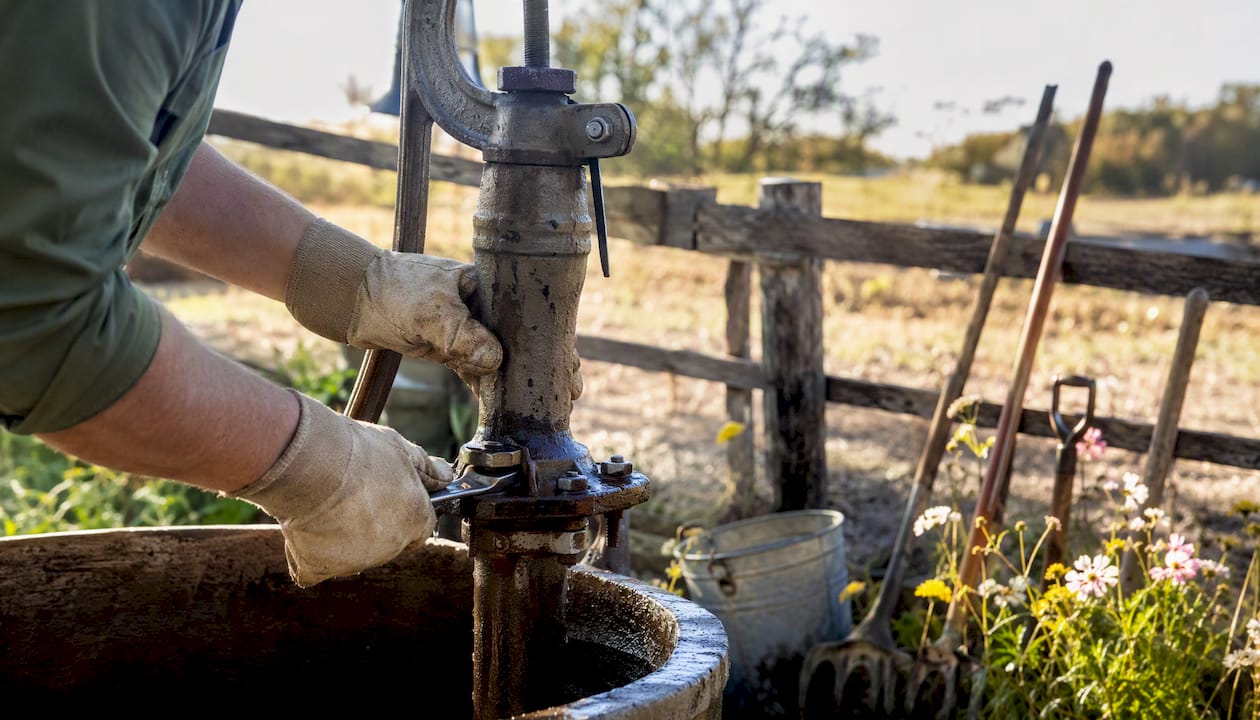
Legal homestead status is a formal protection granted by state law. According to LegalClarity, it delivers two separate benefits: creditor protection (shielding home equity from most unsecured creditors) and property-tax reduction (lowering the taxable assessed value of your primary residence). States vary enormously. Texas and Florida offer uncapped equity protection; California's protection is capped and tiered. Some states grant protection automatically; others require you to file a declaration with the county recorder.
Vernacular homestead is simply a marketing descriptor. A listing agent calling a property a "homestead" usually means it has acreage, a barn or outbuildings, a garden area, and some capacity for self-sufficient living. No legal status is implied.
Why the distinction matters: A buyer who purchases a rural parcel labeled "homestead" in the MLS does not automatically receive a tax exemption. You must apply separately, meet your state's primary-residence requirement, and in many states file by a specific deadline.
Investopedia explains that exemptions work by subtracting a fixed dollar amount or a percentage from your home's assessed value before the tax rate is applied. Some states also cap annual assessment increases or allow portability, letting you transfer accumulated benefits to a new primary residence.
One critical limit: Wikipedia's homestead exemption overview notes that these protections do not block foreclosure by a mortgage lender or a government tax lien. The IRS can still reach a primary residence under specific procedures. Treat the exemption as a meaningful shield, not an absolute one.
- Exemption amounts range from a few thousand dollars of assessed-value reduction to unlimited equity protection, depending on the state.
- Filing deadlines vary: missing them by even one day can cost you a full year of savings.
- Always confirm your state's current rules with the county assessor or recorder, not a national summary page.
What sellers usually mean when they list a "homestead" property
When a listing description uses the word "homestead," expect some combination of these physical features:
- Acreage — typically 2–100+ acres, though micro-homesteads on 1–2 acres exist.
- Outbuildings — barns, sheds, chicken coops, or workshops.
- Water infrastructure — a private well, irrigation rights, or a pond.
- Fenced pasture or garden beds — evidence of prior agricultural use.
- Off-grid or partial off-grid features — solar panels, propane systems, rainwater collection.
Listing photos tell part of the story, but they rarely show soil quality, well depth, or road condition in wet weather. Ask your agent for the well log, any prior perc test results, and the county's parcel map before scheduling a showing.
Red flags to watch for:
- "Water rights included" with no documentation of what those rights actually are.
- "As-is" disclaimers on older outbuildings (often means deferred structural repairs).
- No survey on file, or a survey older than 10–15 years on a parcel with fencing disputes.
- Vague acreage descriptions ("approximately 40 acres") without a recorded plat.
Pro Tip: Ask the listing agent for the property's parcel ID, then pull the county assessor record yourself. You'll see the legal acreage, current tax status, and whether any exemptions are already applied — in about five minutes, for free.
What are the real costs of homestead living?
The lifestyle looks affordable on paper. Business Insider's practitioner account tells a different story: raising your own eggs and produce often costs more per unit than buying at a grocery store once you factor in feed, housing, vet care, and your own labor.
Ongoing costs that buyers routinely underestimate:
- Property taxes — rural parcels can carry surprisingly high tax bills, especially after a sale triggers reassessment.
- Well and pump maintenance — pump replacements, pressure tank failures, and water-quality testing add up annually.
- Septic system upkeep — pumping every 3–5 years, plus the risk of field failure on older systems.
- Equipment and fencing repairs — tractors, ATVs, and perimeter fencing all require steady maintenance budgets.
- Utility costs — propane, generator fuel, and internet service in rural areas often cost more than urban equivalents.
Everyday Homesteading's practitioner guide recommends building a dedicated emergency repair buffer before closing, because the first year on a new property almost always surfaces a surprise: a failing well pump, a leaking roof on the barn, or a septic system that needs immediate attention.
Most successful homesteaders keep an outside income stream. Expecting a small parcel to fully replace a salary is a plan that rarely works in practice.
How do you find homestead land for sale?
You have three main channels, and the best results usually come from working all three at once.
- MLS and land platforms. Filter for acreage minimums, agricultural zoning, and keywords like "barn," "well," or "pasture." Platforms that aggregate rural listings can surface parcels that never appear on general real estate portals.
- County tax-delinquent lists. The county treasurer or auditor publishes lists of properties with overdue taxes. These owners are often motivated. LegalClarity's acquisition guide confirms that county tax foreclosures and land banks are reliable sources of rural parcels at below-market prices.
- Off-market outreach. The Land Geek's 12-channel playbook describes a repeatable weekly workflow: pull the county delinquent list, mail neighbors of target parcels, run EDDM (Every Door Direct Mail) campaigns in target zip codes, and aim for roughly 20 qualifying conversations per week. GIS tools help you screen parcels for road access and utility proximity before you spend time on outreach.
For government-owned land, the Bureau of Land Management (BLM) and GSA both hold periodic sales of surplus parcels. These differ from private transactions: bidding is often competitive, financing contingencies may not be accepted, and due diligence windows can be short.
Pro Tip: Set saved searches on two or three platforms simultaneously, and pair them with a weekly pull of your target county's delinquent tax roll. The combination catches both fresh MLS listings and distressed off-market parcels before other buyers find them.
County assessor and recorder records are your fastest path to confirming ownership on any parcel that looks abandoned or neglected. Start with the assessor for the owner's name and parcel details, then cross-check with the recorder's deed records.
Due-diligence checklist before you buy homestead land
Rural parcels carry risks that a standard home inspection won't catch. Structure your offer around these contingencies:
- Well log and flow test — confirm gallons-per-minute yield and water quality (test for bacteria, nitrates, and any local contaminants).
- Septic or perc test — a failed perc test can make a parcel unbuildable; always make this a named contingency.
- Soil test — fertility and heavy-metal screening matter if you plan to grow food.
- Wetlands and floodplain check — FEMA flood maps and Army Corps wetland delineations can restrict use significantly.
- Survey — confirm boundary lines, especially on older rural parcels where fences rarely match legal descriptions.
- Title search and title insurance — rural parcels often carry old easements, mineral reservations, or heir-property complications. A deep title search (going back 40–60 years) is worth the extra cost.
Water rights deserve special attention in the West. Swan Land Co. explains that in Western states, water rights can be legally severed from the land and carry seniority dates that determine priority during drought. If the deed doesn't explicitly convey water rights, assume they're not included and budget for a water-rights attorney to verify.
For properties with tangled ownership histories, the inherited property guide from Increaltors covers probate and heir-title issues that commonly surface on rural parcels.
Pro Tip: Write your offer with four named contingencies: survey, septic/perc, well flow and quality, and clear title. Each should have its own inspection period and termination right. A seller who won't accept these on a rural parcel is telling you something.
For California sellers considering the tax impact of a future sale, the home sale tax implications guide explains how assessment caps and exemption portability work at the state level.
Financing, property taxes, and how long closing takes
Raw land and rural acreage don't qualify for standard 30-year conventional mortgages. Expect these financing shapes instead:
- Land loans — typically require 20–50% down, carry higher interest rates, and have shorter terms (10–15 years).
- Construction loans — if you plan to build, a construction-to-permanent loan rolls land acquisition and building costs into one instrument.
- USDA loans — for qualifying rural properties and buyers, USDA programs offer favorable terms and lower down payments.
- Seller financing — more common on rural parcels than in suburban markets; negotiate carefully on interest rate, balloon payment, and default terms.
On the tax side, a sale triggers reassessment in most states, which can significantly increase the annual tax bill from what the prior owner paid. If the parcel qualifies for agricultural-use valuation (often called "ag exemption" or "greenbelt" status), apply immediately after closing. Missing that window means paying full market-rate taxes until the next assessment cycle.
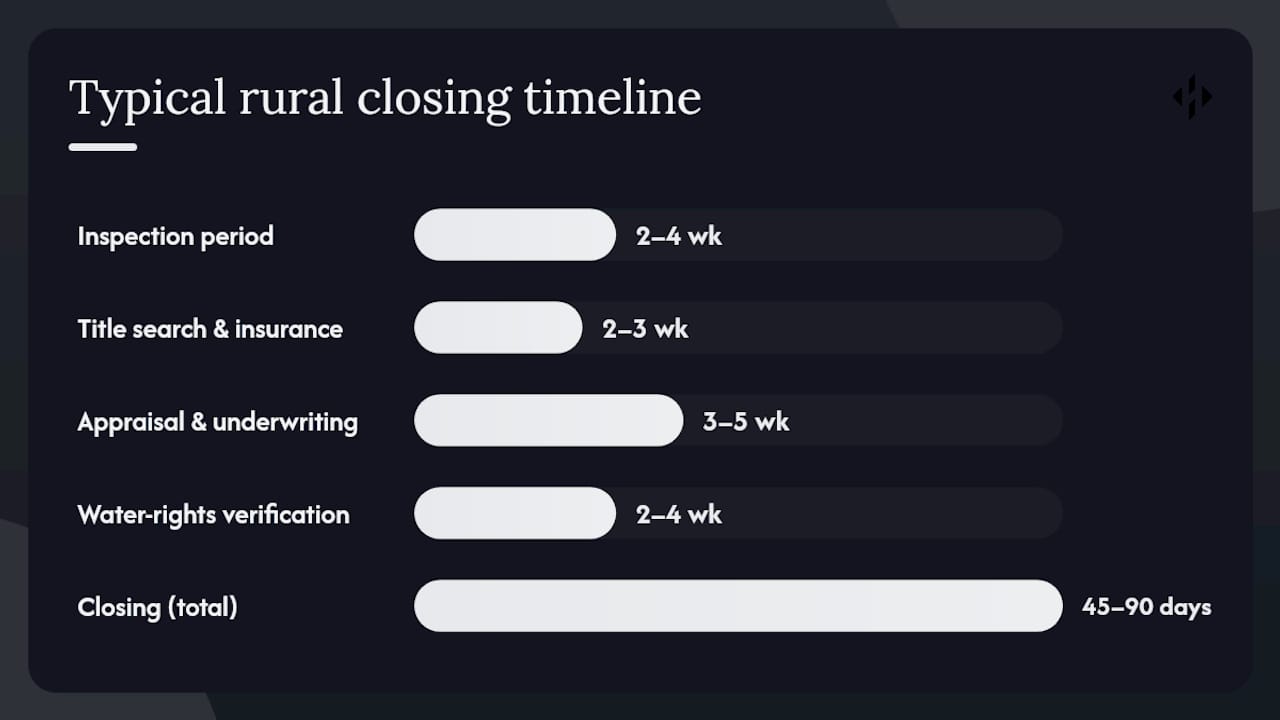
Typical timeline for a rural or acreage purchase:
- Accepted offer
- Inspection period (well, septic/perc, soil, survey): 2–4 weeks
- Title search and insurance commitment: 2–3 weeks
- Lender appraisal and underwriting: 3–5 weeks
- Closing: 45–90 days total, often longer if perc fails or title defects surface
Water-rights verification in Western states can add 2–4 weeks on its own. Budget time, not just money.
How does a specialist agent help you buy a homestead property?
A generalist agent can write an offer. A specialist agent knows which questions to ask before you write one.
What a rural-specialist agent brings to the table:
- Local vendor network — trusted surveyors, well drillers, septic engineers, and soil testers who work rural parcels in the target county.
- Off-market sourcing — relationships with landowners, county officials, and land banks that surface deals before they hit the MLS.
- Contingency experience — knowing how to write a perc contingency that actually protects you, not just a generic inspection clause.
- Zoning and use knowledge — understanding what a parcel's zoning actually permits for livestock, outbuildings, short-term rentals, or commercial farming.
When interviewing agents, ask these questions directly:
- How many rural or acreage transactions have you closed in the past 12 months?
- Have you worked with septic/perc failures, and how did you handle them?
- Do you have experience with water-rights verification in this county?
- Can you provide references from buyers of rural or land parcels?
For Southern California searches, local expertise matters. The advantages of buying in Los Angeles include access to a deep agent network with county-level knowledge that out-of-area agents simply don't have.
Pro Tip: Ask any prospective agent for a recent comparable sale on a rural parcel, not just a suburban home. If they can't produce one, they're learning on your transaction.
What I've seen buyers get wrong about homestead properties
Buyers come to me with a clear picture: land, fresh air, a garden, and lower costs. The dream is real. The math sometimes isn't.
The most common mistake I see is treating a "homestead" listing as a turnkey lifestyle purchase. It rarely is. The well might be marginal, the septic might be at end of life, and the outbuildings might need more work than the house. None of that shows up in listing photos.
What actually protects buyers is the contingency structure. A well-written offer with named contingencies for water, septic, survey, and title gives you the information you need before you're committed. Buyers who skip those contingencies to "win" in a competitive situation often spend the first two years of ownership fixing problems they could have negotiated into the price.
Start smaller than you think you need to. A 5-acre parcel with good water and a working septic system will teach you more in year one than 40 acres of raw land with no infrastructure. Verify the basics first. The dream scales up from there.
Find your homestead property with Increaltors
Searching for the right rural or homestead-style property takes local knowledge, the right listing filters, and a vendor network you can trust. Increaltors, through agent Irvin Nierras at HomeSmart Evergreen, connects buyers in Southern California with vacant land and acreage listings, single-family homestead-style properties, and the hands-on guidance that rural transactions require.

Irvin brings county-level knowledge of the Southern California market, a trusted network of surveyors, well drillers, and title specialists, and the contingency experience to protect your offer from day one. Check the current market snapshot for up-to-date local data, or get a free home valuation if you're selling a current property to fund your next purchase. Ready to see what's available? Browse active listings and reach out directly to schedule a consultation.
Sources
These resources give you the primary-source depth that national summaries can't match.
- What Is a Homestead: Tax and Creditor Protections - LegalClarity
- I Thought Homesteading Would Save Us Money, but I Was Wrong - Business Insider
- What Is a Homestead Exemption? - Investopedia
- How to find off-market land deals in 2025 — The 12-channel playbook - The Land Geek
- Why Homesteading Is Not Always Cheaper (And What to Do About It) - Everyday Homesteading
- Homestead exemption - Wikipedia