
TL;DR:
- Choosing in Brea depends on your goals, with neighborhoods offering diverse home types, pricing, and rental regulations.
- Patience and local expertise are essential to navigate shifting policies, especially for short-term rental investments.
Choosing among the many homes for sale in Brea California is harder than it looks. The city spans less than 12 square miles, yet it packs in a surprising range of neighborhoods, home types, price points, and buyer profiles. First-time buyers chasing good schools, investors sizing up rental yields, and move-up buyers hunting for a quieter alternative to Anaheim or Fullerton all land in Brea's market with different priorities and, often, the same sense of information overload. This guide cuts through that noise with a structured look at what actually matters when you buy here.
Table of Contents
- How to evaluate homes for sale in Brea: key criteria for buyers and investors
- Top 5 neighborhoods for homes for sale in Brea: characteristics and opportunities
- Comparison of home types and prices in Brea neighborhoods
- How Brea's short-term rental pilot shapes investment opportunities
- Which homes for sale in Brea suit your goals? Buyer and investor recommendations
- A fresh perspective: navigating Brea's evolving market with savvy and patience
- Explore homes for sale in Brea with expert guidance
- Frequently asked questions
Key Takeaways
| Point | Details |
|---|---|
| Evaluate key criteria | Focus on location, property type, price, and local rules when choosing homes in Brea. |
| Neighborhood variety | Top Brea neighborhoods vary in style, price, and amenities suitable for different buyers. |
| STR regulations matter | Brea’s short-term rental pilot imposes caps, fees, and inspections impacting investments. |
| Tailor your choice | Align your purchase with your goals, whether primary residence or rental income. |
| Work with experts | Local agents and resources help navigate market complexities and regulatory changes. |
How to evaluate homes for sale in Brea: key criteria for buyers and investors
Before you tour a single property, build your evaluation framework. The details that make one Brea home a great buy can make another one a money pit, depending entirely on what you need from the purchase.
Location specifics matter more than the zip code. Within Brea's 91709 and 91765 zip codes, proximity to Brea Olinda Unified School District campuses like Brea Olinda High School moves prices meaningfully. Buyers with school-age children should map school boundaries before falling in love with a listing. Similarly, walkability to Brea Mall, Carbon Canyon Regional Park, and the Downtown Brea corridor adds real lifestyle value that justifies premium pricing in adjacent streets.
Home type shapes your options immediately. Single-family detached homes dominate Brea's resale market and carry the widest price range. Condos and townhomes offer a lower entry point, typically with HOA fees that require careful scrutiny. Planned communities with shared amenities attract both owner-occupants and long-term rental tenants, but deed restrictions can limit how you use the property.
Key criteria buyers and investors should evaluate:
- Schools and district boundaries. Brea Olinda USD consistently ranks in the top tier for Orange County, which sustains demand even in soft markets.
- Commute access. Proximity to the 57 Freeway and the 90 Metrolink corridor matters to a large slice of Brea's working population.
- HOA obligations. Many Brea communities carry HOAs ranging from under $200 to over $600 per month. That number changes your effective purchase price.
- Property age and condition. Brea's older hillside homes (built in the 1960s and 1970s) often need updated electrical and plumbing, costs that rarely show up in the listing price.
- Short-term rental viability. If rental income is part of your plan, Brea's regulatory environment requires separate analysis. Investors should factor licensing caps, fees, and inspection requirements into their underwriting before making an offer.
For broader context on what makes a rental property pencil out in California, the investment properties in California guide covers the state-level framework you need. And if this is your first purchase, these first-time home buyer tips for Southern California will give you a grounding in the process before you start negotiating.
Having set the evaluation framework, we now explore top neighborhoods offering attractive homes for sale in Brea.
Top 5 neighborhoods for homes for sale in Brea: characteristics and opportunities
Brea divides roughly into five distinct residential areas, each with its own feel, price band, and investor calculus. Here is what you actually need to know about each one.
1. Downtown Brea and the Birch Street corridor. This walkable pocket draws buyers who want urban convenience without Los Angeles density. Condos and townhomes dominate, with prices typically ranging from the low $500,000s to the mid $700,000s depending on square footage and finishes. The area benefits from proximity to restaurants, the Brea Improv comedy club, and boutique retail, which keeps long-term rental demand stable. HOAs are present on most buildings, so budget accordingly.
2. North Brea hillside homes. Built largely between the 1960s and 1980s, these single-family homes sit on larger lots with canyon and hillside views. Prices start around $750,000 and can push past $1.2 million for remodeled properties with usable outdoor space. Buyers here tend to be owner-occupants prioritizing privacy and views. Investors targeting long-term rentals find good demand from families, but the older construction means higher maintenance reserves.
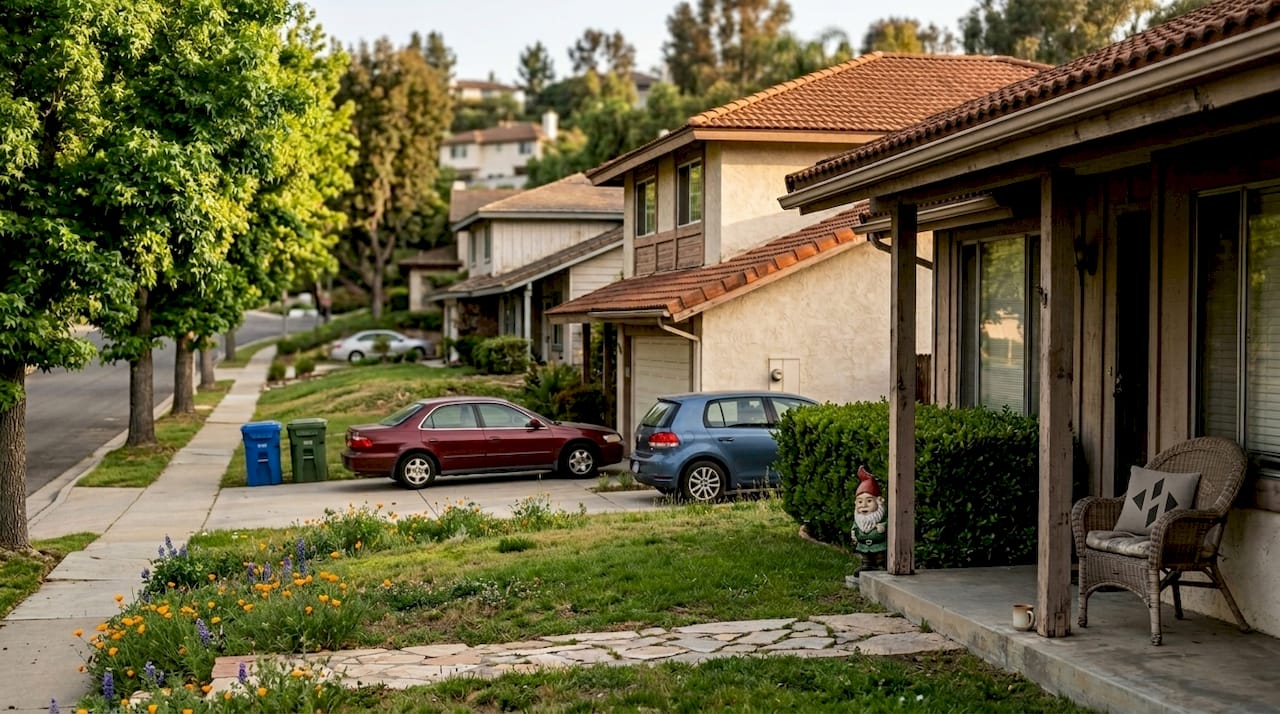
3. Carbon Canyon adjacent. Homes near Carbon Canyon Regional Park attract buyers who prioritize nature access over nightlife. Lots are generous, and the neighborhood has a distinctly quieter character than central Brea. Pricing is competitive relative to the square footage you get, generally landing in the $650,000 to $950,000 range for well-maintained single-family homes. The trade-off is limited walkability and longer commute distances to major employment centers.
4. Brea planned communities (Shadow Hills, Olinda Ranch). These newer master-planned communities offer turnkey properties built since the late 1990s. HOAs fund community pools, maintained greenbelts, and often private security. Entry prices hover around $800,000, with larger floor plans pushing into the $1.1 to $1.4 million range. Rental demand is steady because the lifestyle appeal attracts relocating families, but deed restrictions in some communities limit rental terms.
5. Central Brea mid-century neighborhoods. The bread-and-butter inventory for buyers who want solid bones, established trees, and reasonable prices. Three-bedroom homes on standard lots list between $600,000 and $850,000. These neighborhoods offer the most flexibility in terms of use and renovation, making them attractive for both owner-occupants and investors running long-term rentals.
For a broader look at how Brea compares to neighboring Orange County and Los Angeles communities, the homes near LA and OC guide gives useful regional context. The LA OC real estate guide for 2026 also covers macro market factors shaping pricing in Brea's peer cities this year.
With neighborhood details in mind, let's compare these options side-by-side to clarify choice trade-offs.
Comparison of home types and prices in Brea neighborhoods
The table below reflects current 2026 market conditions based on active and recent listings across Brea. Use it as a starting reference, not a final appraisal, since individual properties vary considerably.
| Neighborhood | Home type | Approx. price range | HOA likely? | Best suited for |
|---|---|---|---|---|
| Downtown / Birch St. | Condo / townhome | $500K to $750K | Yes | First-time buyers, long-term rentals |
| North Brea hillside | Single-family | $750K to $1.2M | Occasionally | Owner-occupants, move-up buyers |
| Carbon Canyon area | Single-family | $650K to $950K | Rarely | Nature seekers, family buyers |
| Shadow Hills / Olinda Ranch | Single-family / townhome | $800K to $1.4M | Yes | Families, long-term rental investors |
| Central Brea mid-century | Single-family | $600K to $850K | Rarely | Flexible use, investors, first-time buyers |
A few things jump out from this comparison. Central Brea mid-century homes offer the most flexible investment structure because they rarely carry HOAs or deed restrictions that limit rental use. Downtown condos carry the lowest dollar entry but the highest ongoing costs per dollar of value when HOAs are factored in. Planned communities offer the most predictable tenant profiles but require careful review of CC&Rs (Covenants, Conditions, and Restrictions) before you close.
The SoCal real estate trends for 2026 report shows that Orange County inventory remains historically tight, which keeps upward pressure on Brea prices across all these categories. That dynamic rewards buyers who move decisively when the right property appears.
Now that we have compared neighborhoods and home types, let's review specific opportunities shaped by local market conditions including regulations.
How Brea's short-term rental pilot shapes investment opportunities
In April 2026, Brea launched a formal short-term rental pilot program, and it changes the math for every investor eyeing Brea CA real estate with STR income in mind. Here is what the program actually involves.
The core details of the pilot:
- License cap: The city limits STR licenses to 100 applications, with a $1,000 base application fee plus separate building and safety code fees.
- Mandatory home inspection: Every property must pass a city inspection before the license is issued. Budget time for repairs if your target property has deferred maintenance.
- Operational cap: STR use is limited to 30 nights per year when the owner is not present. That is a hard ceiling that significantly limits gross rental income for absentee operators.
- Ongoing compliance: Hosts must collect and remit Transient Occupancy Tax, maintain liability insurance at city-specified minimums, and comply with noise and parking rules.
"The city's STR pilot is structured to test the concept at limited scale — 100 licenses is a tight cap for a city with thousands of residential properties. Investors banking on Airbnb-style income need to understand this is a pilot, not a permanent policy, and it can be revised, suspended, or expanded at any point after the pilot period."
Pro Tip: If STR income is central to your investment thesis, apply for a license as early as possible once the program opens each cycle. The 100-application cap means latecomers simply do not get access, regardless of how good their property is.
For investors who want a broader view of how rental regulations affect returns across LA and OC, these real estate investment tips for LA and OC outline what experienced investors track when local rules shift.
Understanding regulatory impacts leads naturally to a focused comparison and recommendations for different buyer and investor profiles.
Which homes for sale in Brea suit your goals? Buyer and investor recommendations
Use this step-by-step guide to match your goal with the right property type and neighborhood in Brea.
-
Define your primary use case first. Are you buying a primary residence, pursuing long-term rental income, or targeting STR income? Each path requires a different filter applied to Brea properties for sale.
-
Set your real budget before you look at listings. Add HOA fees, property taxes (Brea's effective rate runs close to 1.1% annually), and any STR licensing costs to your monthly payment calculation. A $750,000 home in a planned community with a $450/month HOA has a very different cash flow profile than a $750,000 mid-century home with no HOA.
-
Match neighborhood to goal. Primary residence buyers with families should prioritize North Brea hillside or Shadow Hills / Olinda Ranch for school access and community stability. Long-term rental investors get the most flexibility from Central Brea mid-century homes. STR investors should focus on Downtown Brea condos or central single-family homes without restrictive CC&Rs, then factor in the pilot program's 100-license cap.
-
Inspect before you fall in love. Older Brea homes have character, but pre-offer inspections on properties built before 1985 frequently uncover foundation, electrical, and roof issues that are non-trivial to repair.
-
Time your offer with market awareness. Brea real estate listings typically thin out between Thanksgiving and January, which creates a window where motivated sellers face less competition from other buyers.
-
Work with a local specialist. Brea has specific nuances, from hillside geological review requirements to STR pilot dynamics, that a generalist agent may miss. Local knowledge here is genuinely worth more than brand recognition.
Pro Tip: First-time buyers in Brea should read this first-time buyer guide for LA before making offers. The negotiation tactics and inspection contingency strategies covered there apply directly to the Brea market. Investors looking for a macro-level argument for this region should check the case for why SoCal real estate in 2026 still rewards patient capital.
With clear insight into goals and options, here is our perspective on navigating the Brea housing market for maximum benefit.
A fresh perspective: navigating Brea's evolving market with savvy and patience
Most articles about buying homes in Brea will tell you the schools are great, the location is convenient, and the market is competitive. All true. But here is the part those articles skip.
The single biggest mistake we see buyers and investors make in Brea is treating the market as more stable and predictable than it actually is. Brea is a small city with a fluid regulatory environment. The STR pilot launched in 2026 is the clearest recent example. Many investors were already underwriting deals with Airbnb income built into their projections before the city formalized any rules. When the pilot launched with a hard 100-license cap and a 30-night unoccupied ceiling, those projections needed immediate revision. As the STR rules remain unstable, regulatory delays and policy shifts can overshadow even optimistic rental price forecasts.
The "set and forget" STR model is particularly dangerous in a city running a pilot program. Pilots get modified. Caps get lowered. Fees get raised. Investors who build a 12-month income projection assuming full STR access from day one often find themselves in a compliance queue waiting months before they see a single booking.
What actually works here is patience combined with local expertise. Buyers who take six weeks to understand Brea's specific neighborhood dynamics, HOA structures, and regulatory calendar before making an offer consistently make better decisions than buyers who move fast on incomplete information. That is not a platitude. We have seen the difference play out repeatedly in markets like this one.
For investors, the most durable play in Brea right now is the long-term rental model in mid-century Central Brea homes. No HOA restrictions, solid tenant demand from families and professionals commuting on the 57, and a price point that still makes the numbers work without STR income. It is not the flashiest approach. But in a city where the regulatory ground is still shifting, boring and reliable beats exciting and fragile. If you want to review the broader prime investment properties in California landscape, Brea fits a specific niche that rewards local knowledge over market timing.
Explore homes for sale in Brea with expert guidance
Finding the right property in Brea takes more than browsing listings. It requires current market data, neighborhood-level knowledge, and an understanding of how regulations like the STR pilot affect your actual returns.

At IN Realtors, we specialize in connecting buyers and investors with the right Brea California homes for their specific goals. Whether you are looking for single-family homes in Brea with space for a growing family, condos in Brea that offer a lower-maintenance lifestyle, or want to browse the full range of current Brea home listings across all price points, our team brings the local knowledge and personalized attention that makes the difference in a competitive market. Reach out to start your search with an expert who knows Brea's market from the inside.
Frequently asked questions
What are the main regulations affecting short-term rentals in Brea?
Brea's STR pilot limits licenses to 100 applications with a $1,000 application fee plus building and safety code fees, requires a mandatory home inspection, and caps unoccupied STR use at 30 nights per year.
Which Brea neighborhoods are best for first-time homebuyers?
Central Brea mid-century neighborhoods and the Downtown Birch Street corridor offer the most accessible price points, with starter home guidance for Southern California buyers applicable directly to these areas.
How does Brea's market compare to broader Southern California real estate trends?
Brea follows SoCal's steady demand and upward price pressure, but its small inventory, specific HOA structures, and active STR pilot create local conditions that differ meaningfully from regional averages.
What should investors consider before buying rental properties in Brea?
Investors must factor in regulatory fees and caps from Brea's STR pilot, including the 100-license ceiling, inspection timelines, and the 30-night unoccupied cap, all of which directly affect cash flow projections and deal timelines.