
TL;DR:
- Automated home value estimates in Temecula can deviate over 10% from actual sale prices due to local market nuances. Combining multiple AVMs, recent closed sales, and expert CMA analysis provides the most reliable valuation for buyers and sellers. Market factors like neighborhood differences, condition, upgrades, and timing significantly influence accurate pricing beyond algorithm predictions.
If you've typed "home value estimator Temecula" into a search bar and landed on a Zestimate or automated number, you've already made a common mistake. That number is a starting point, not an answer. Temecula's housing market has enough local variation, neighborhood quirks, and price sensitivity that a generic algorithm can miss your home's true value by tens of thousands of dollars. This guide breaks down how valuation tools actually work, where they fall short in Temecula specifically, and what steps you can take to get a number you can actually act on.
Table of Contents
- Key Takeaways
- Temecula housing market trends right now
- How home value estimation methods actually work
- Local factors that throw off Temecula estimates
- Steps to get a precise home value estimate
- Riverside County property tax assessments and appeals
- My honest take on valuing homes in Temecula
- Get your accurate Temecula home valuation from Increaltors
- FAQ
Key Takeaways
| Point | Details |
|---|---|
| AVMs have real limits | Automated estimators can deviate 10% or more from actual sale prices, especially on off-market homes. |
| Temecula prices are softening | Home values declined about 2.6% year-over-year, making data currency critical for sellers and buyers. |
| Closed sales beat listing prices | Anchoring your expectations to recent closed sales gives you a far more accurate picture than active listings. |
| Combine tools with expert input | Pairing automated tools with a local agent's comparative market analysis produces the most reliable estimate. |
| Tax assessments can be appealed | If your Riverside County assessed value exceeds current market value, you have grounds to file a formal appeal. |
Temecula housing market trends right now
Before you can evaluate any home value estimate, you need to understand the market context behind it. Temecula's real estate climate in 2026 is nuanced. It is not a buyer's free-for-all, but it is no longer the frenzied seller's market of recent years either.
Recent data shows home values declined roughly 2.6% over the past 12 months, with typical homes selling near $750,000. Listing prices, however, have often been running several percent higher than that, creating a gap that frustrates sellers who price based on hope rather than data. That disconnect is exactly where valuation errors happen.
Here is a snapshot of key market indicators to frame your expectations:
| Metric | Current figure |
|---|---|
| Typical recent sale price | ~$750,000 |
| Typical asking price (median listing) | ~$897,000 |
| Months of supply | ~2.3 months |
| Average days on market (well-priced homes) | ~19 days |
| Year-over-year value change | -2.6% |
A few things stand out from that table. The spread between listing prices and actual sale prices is significant. Sellers who anchor their price to optimistic listing comps rather than closed sales are setting themselves up for a slow start and eventual price cuts.
The supply picture tells another story. At roughly 2.3 months of inventory, Temecula still technically sits in seller's market territory. Demand hasn't evaporated. What has changed is buyer sensitivity to overpricing. Well-priced homes still attract offers close to asking price (about 99.3%) and sell within 19 days. Poorly priced homes sit, accumulate days on market, and lose leverage fast.
For buyers, this means you need to know what "fair value" looks like before you make an offer. For sellers, it means your pricing strategy has to be grounded in what buyers are actually paying, not what your neighbor listed for.
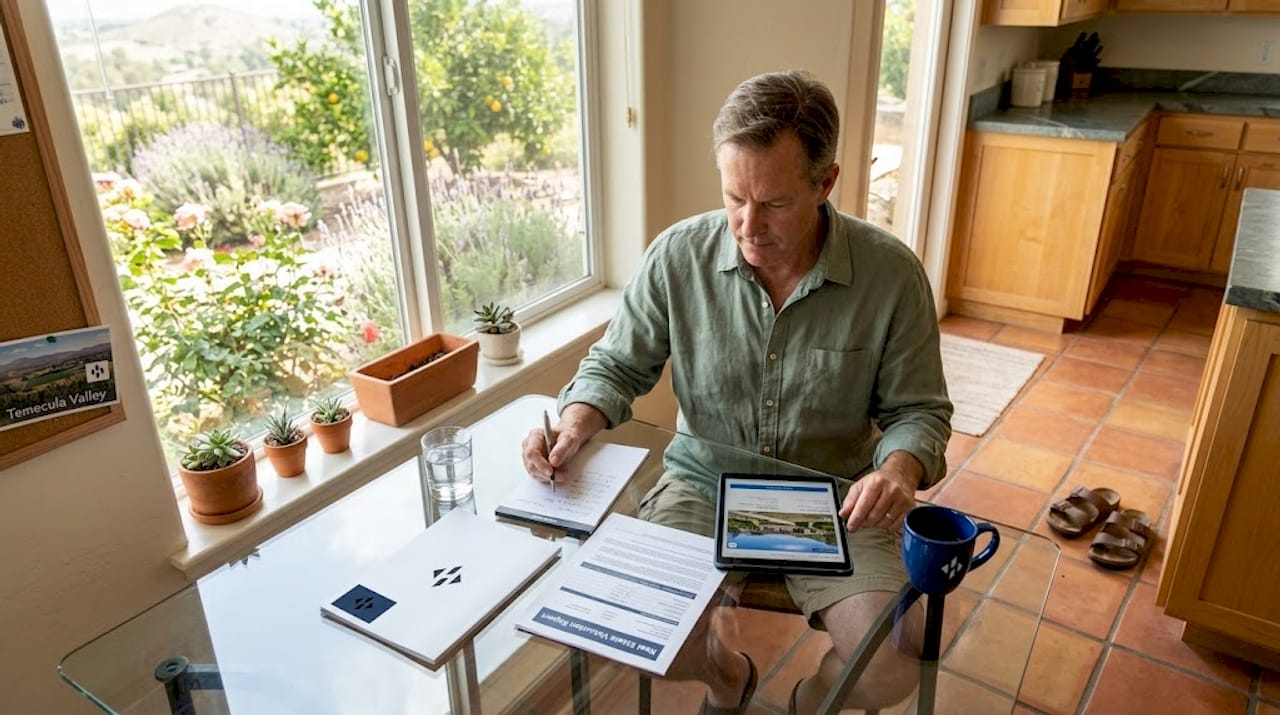
Understanding these SoCal real estate trends is the foundation for any valuation conversation you have with an agent, lender, or appraiser.
How home value estimation methods actually work
There are three primary ways to estimate what a home is worth: Automated Valuation Models (AVMs), Comparative Market Analyses (CMAs), and professional appraisals. Each has a different purpose, a different level of accuracy, and a different cost. Understanding the difference matters enormously in a market like Temecula.
Automated valuation models
AVMs are algorithm-based tools that pull publicly available data including tax records, recent sales, and square footage to generate an estimated value. They are fast, free, and widely used. The problem is they rely entirely on data that has been recorded and filed. They cannot see your upgraded kitchen, your freshly landscaped backyard, or the fact that your home backs up to a noisy arterial road.
The Zillow Zestimate median error for on-market homes is about 1.83%, which sounds reassuring. For off-market homes, that error rate jumps to 7.01%. And for unique or recently remodeled homes, accuracy drops further still. Across AVM platforms generally, valuation deviations of 10%+ are not unusual when key property conditions are missing from the database.
On a $750,000 Temecula home, a 7% error equals $52,500 in either direction. That is not a rounding error. That is a real financial decision.
Comparative market analysis
A CMA is prepared by a licensed real estate agent. It reviews recently closed sales of comparable homes in the same area, adjusting for differences in size, condition, upgrades, and location. A strong CMA accounts for factors an algorithm cannot quantify. An agent who has physically toured homes in your neighborhood knows that the two-car garage on Ynez Road fetches more than the one-car garage three streets over. That kind of judgment does not fit into a formula.
Professional appraisals
A licensed appraiser produces the most formally credible valuation. Lenders require them for mortgages. They follow strict methodology, involve a physical inspection, and carry legal weight. When you are in a dispute, an estate situation, or need documentation for a refinance, a professional home appraisal is the right tool. They typically cost $400 to $700 in Southern California and take one to two weeks.
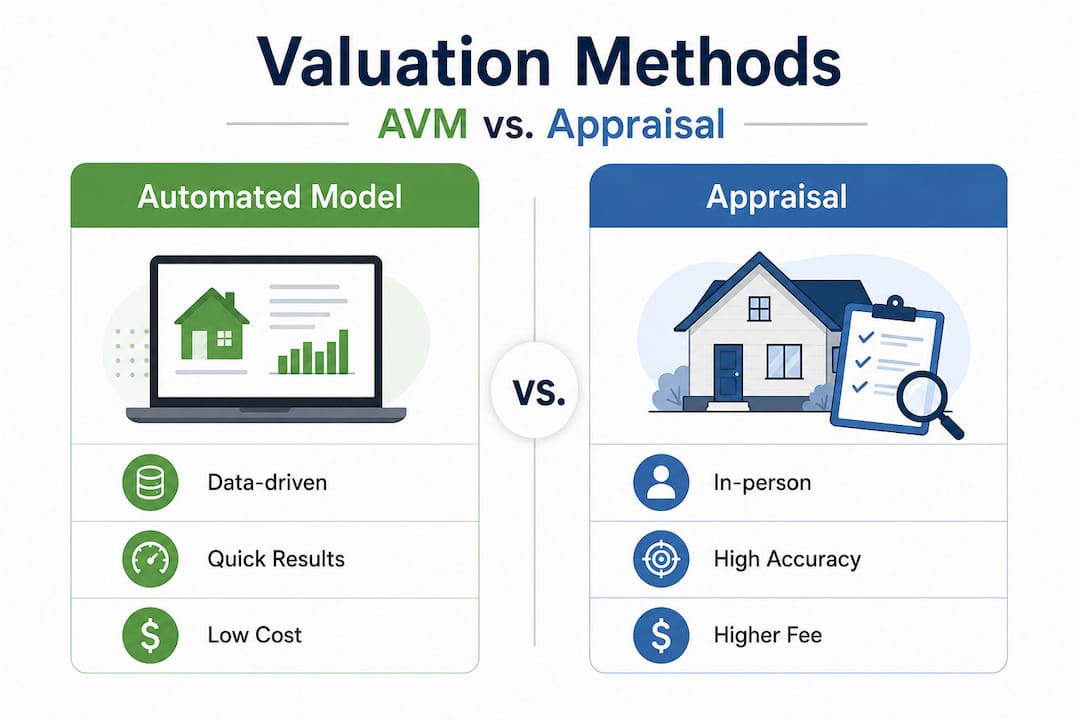
Here is how the three methods compare at a glance:
| Method | Cost | Speed | Accuracy | Best use case |
|---|---|---|---|---|
| AVM (Zestimate, etc.) | Free | Instant | Moderate (varies widely) | Quick baseline only |
| CMA from agent | Free | 1-3 days | High (local expertise) | Pricing decisions |
| Professional appraisal | $400-$700 | 1-2 weeks | Highest (formal standard) | Loans, disputes, estates |
Pro Tip: Never use an AVM number alone to set a listing price or make a purchase offer. Treat it as a rough compass heading, not a destination. Follow up with a CMA from an agent who knows Temecula's neighborhoods.
Homeowners who combine automated tools with professional local agent knowledge consistently get the most reliable estimates. That combination is not optional in a market where the gap between listing and sale price can run $150,000.
Local factors that throw off Temecula estimates
Temecula is not a uniform market. It has distinct pockets, and understanding them is what separates a realistic valuation from a dangerous one.
The city ranges from newer master-planned communities in the southwest to older, more eclectic neighborhoods near Old Town. A home in Wolf Creek does not comp the same as a similar-sized home near Redhawk, even when square footage and age look identical on paper. School district boundaries, HOA fees, proximity to the wine country corridor, and even views of the Santa Rosa Plateau all affect buyer willingness to pay.
Here is where automated estimators consistently fall short in Temecula:
- Recent remodels: A newly renovated kitchen or a bathroom gut job adds real value that databases do not capture until the home sells. Off-market AVM errors rise sharply when subjective quality factors like finishes and upgrades are not recorded.
- Curb appeal and condition: A home with excellent staging, fresh paint, and manicured landscaping will attract higher offers than an identical floor plan in tired condition. No algorithm prices that.
- Off-market status: Homes that have not been listed recently lack fresh comparable data, which makes automated estimates less reliable.
- HOA impact: High monthly HOA fees in some Temecula communities reduce effective purchasing power, which suppresses comparable sale prices in those areas.
"Anchoring to optimistic online estimates without checking closed sales is one of the most expensive mistakes Temecula sellers make. The market tells you what it will pay. You don't tell the market."
The data supports this warning. Temecula sellers who overprice relative to recent closed sales face buyer resistance and often end up taking less than they would have with a realistic launch price. A home priced at $897,000 in a neighborhood where recent sales closed at $737,500 will not see that gap close through negotiation. It will see it close through price reductions and accumulated days on market, both of which signal weakness to future buyers.
Seasonal patterns add another layer. Spring and early summer are peak buyer seasons in Temecula. Homes listed in February through May tend to attract more competing offers than identical homes listed in October or November. Timing matters, and a smart pricing strategy accounts for it. You can read more about when to list your California home for maximum results.
Steps to get a precise home value estimate
Getting a number you can actually trust takes a few deliberate steps. Here is a practical sequence that works for both homeowners preparing to sell and buyers evaluating a purchase.
-
Start with two or three AVM tools. Run your address through multiple platforms and note the range. If tools produce estimates that vary by more than 5-8%, that spread itself tells you something. It means data is thin, the property is unusual, or recent sales are sparse in that submarket. Do not average them and call it done.
-
Pull recent closed sales yourself. County records are public. Look for homes that sold within the last 90 days within a half-mile radius. Prioritize homes with similar square footage, bedroom and bathroom count, and lot size. This exercise grounds you in what buyers have actually paid, not what sellers have hoped for.
-
Request a CMA from a local agent. A good agent will walk you through the comps, explain the adjustments made for condition and upgrades, and give you a defensible price range. This is free and carries no obligation. It is also the fastest way to translate raw data into a real pricing decision.
-
Order a professional appraisal when the stakes are high. If you are refinancing, settling an estate, contesting a tax assessment, or selling a property with unusual features, a formal appraisal is worth every dollar. Home appraisers in SoCal bring methodological rigor that no algorithm or agent opinion can fully replace in formal contexts.
-
Adjust for condition honestly. Look at your home the way a buyer will. Deferred maintenance, dated interiors, or functional issues all reduce value. A buyer making an offer on your home will credit themselves for every repair they anticipate. Getting ahead of that math with honest condition adjustments prevents pricing surprises.
-
Revisit your estimate every 60-90 days. In a shifting market, a valuation from six months ago is already stale. Temecula's price softening means a number that was accurate last spring may be overstated today.
Pro Tip: Ask your agent to show you only closed sales, not active listings or pending sales, when preparing your CMA. Active listings are asking prices, not evidence of what the market will pay. Pending sales are directional but not final.
One more thing worth noting. If you want to understand your home's value in the context of long-term investment potential, reviewing a Temecula real estate ROI guide can help you frame your equity position and future pricing expectations against broader market cycles.
Riverside County property tax assessments and appeals
Your property tax bill is based on an assessed value, not your home's current market value. Under California's Proposition 13, assessed value increases are capped at 2% per year after your initial purchase assessment, regardless of how much prices rise. That is genuinely valuable protection when markets run hot.
The flip side applies when markets cool. If your home's current market value drops below its assessed value, Proposition 8 allows a temporary reduction. The Riverside County Assessor's office can adjust your assessed value downward to match current market conditions. But they will not do it automatically. You have to request it.
The Riverside County effective tax rate sits around 0.95%, which translates to roughly $5,035 annually on a $530,000 assessed value. On a $750,000 home, that math climbs quickly.
Key points about the appeal process:
- Appeals must generally be filed between July 2 and November 30 of the tax year in question.
- You can request an informal review from the Assessor's office before filing a formal appeal.
- Supporting documentation strengthens your case significantly. Gather recent closed sale comparables, a licensed appraisal if available, and any evidence of property condition issues the assessor may have missed.
- Mass appraisal models used by the assessor's office frequently miss home-specific factors, making individual appeals both common and often successful.
| Appeal step | Action required |
|---|---|
| Review your assessment notice | Confirm assessed value against current market comps |
| Request informal review | Contact Riverside County Assessor directly |
| File formal appeal | Submit application July 2 through November 30 |
| Gather supporting documents | Closed sales comps, appraisal, condition evidence |
My honest take on valuing homes in Temecula
I've been working with buyers and sellers across Southern California for years, and Temecula continues to be one of the markets where I see the most preventable pricing mistakes. They almost always trace back to one thing: people trust the number on their screen more than the data in their neighborhood.
I've watched sellers price at $870,000 because that is what a popular home price estimator suggested, only to sit on the market for 60 days while identical homes priced at $749,000 closed in under three weeks. The math is not complicated. But emotionally, it is hard to accept that your home is worth less than an algorithm told you.
What I've learned from working this market is that Temecula buyers are informed. They are running their own comps. They know what closed two streets over last month. When your price is out of alignment with recent sales, they do not negotiate you down. They move on to the next listing.
The strategy that consistently produces the best outcomes is pricing just below where competing homes are listed, based entirely on what buyers have actually paid in the last 90 days. That approach generates early activity, competing interest, and often a final sale price that meets or beats what an overpriced home eventually settles for after weeks of reductions.
My take on Temecula home valuation tools specifically: use them for context, not conclusions. A property value calculator gives you a range to think about. A real agent conversation, grounded in current closed data, gives you a price you can defend and sell at. Those are two very different things. Understanding the difference is worth a lot of money in this market.
For sellers who want to get ahead of slow starts, reading through proven Temecula selling strategies can sharpen your approach before you list.
— Irvin
Get your accurate Temecula home valuation from Increaltors
If you've been asking "what is my home worth in Temecula" and you want more than an automated guess, Increaltors offers a free, personalized home evaluation backed by current market data and local expertise.

Irvin Nierras and the Increaltors team provide detailed valuation reports that account for your home's specific condition, neighborhood comparables, and current buyer demand. You can get your free home value report directly through the site with no obligation. For buyers, browse current single-family listings to see real-world pricing across Temecula's neighborhoods. For sellers ready to move forward, the full homes for sale inventory provides the market context your pricing strategy needs. Reach out to Irvin directly to schedule a consultation and get pricing clarity before you make your next move.
FAQ
How accurate are home value estimators for Temecula?
Automated estimators have median error rates between 2% and 7%, but off-market or recently remodeled homes in Temecula can see deviations exceeding 10%. Always supplement any online estimate with a local agent's comparative market analysis.
What is my home worth in Temecula right now?
Typical homes in Temecula have been selling near $750,000, though values vary significantly by neighborhood, condition, and upgrades. A free personalized evaluation from a local agent gives you the most reliable answer for your specific property.
How do I appeal my Riverside County property tax assessment?
You can file a formal appeal with the Riverside County Assessment Appeals Board between July 2 and November 30. Supporting your case with recent closed sale comparables and, if needed, a professional appraisal significantly improves your odds of a reduction.
When should I order a professional home appraisal in Temecula?
Order a professional appraisal when you are refinancing, settling an estate, disputing a tax assessment, or selling a home with unusual features that automated tools and agent CMAs may not capture accurately.
Why is there such a big gap between listing prices and sale prices in Temecula?
Sellers frequently overprice by anchoring to optimistic listing comps rather than recent closed sales. In Temecula, recent closed sales have been running well below typical asking prices, making it critical to base any valuation on what buyers have actually paid, not what other sellers are currently asking.