

TL;DR:
- California homeowners face complex tax rules when selling, which can significantly reduce their net proceeds.
- Proper planning and documentation are essential to maximize exemptions and minimize liabilities for both homeowners and investors.
Selling a home in California triggers both federal and state tax obligations that can significantly reduce your net proceeds if you are not prepared. The standard industry term for what most homeowners search for is "capital gains tax on home sale," and this home sale tax implications guide covers every layer of that liability. Under IRS Section 121, single filers can exclude up to $250,000 of capital gains, and married couples filing jointly can exclude up to $500,000, provided they meet the ownership and use tests. California adds its own complexity: the Franchise Tax Board taxes capital gains as ordinary income, with no preferential rate for long-term gains. Understanding both federal and California rules before you list is the difference between keeping your profit and writing a large check to the government.
What is the home sale tax implications guide for California?
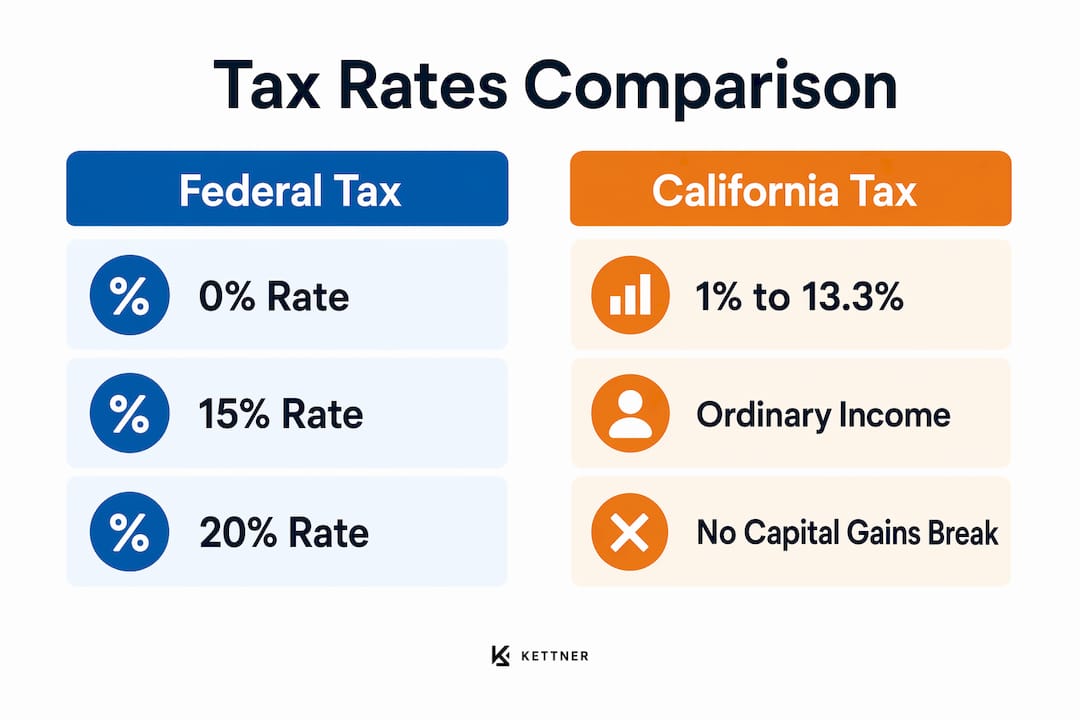
Federal capital gains tax on a home sale falls into three brackets: 0%, 15%, or 20%, depending on your taxable income. High earners also owe the Net Investment Income Tax, or NIIT, at 3.8% on top of the federal rate. That combination alone can reach 23.8% before California touches a dollar of your gain.

California makes the picture significantly more expensive. The state taxes capital gains as ordinary income at rates from 1% to 13.3%, with no separate, lower rate for long-term gains the way the federal code provides. A California homeowner in the top bracket faces a combined federal and state marginal rate that can exceed 37–40% on a taxable gain. That is not a hypothetical. It is the real math for many Southern California sellers with appreciated properties.
Depreciation recapture adds another layer for anyone who has ever rented out their home or a portion of it. Federally, depreciation recapture is taxed at up to 25%. California taxes that same recapture at full ordinary income rates, with no cap. The table below shows how these layers stack for a high-income California seller.
| Tax Component | Federal Rate | California Rate |
|---|---|---|
| Long-term capital gains | 0%, 15%, or 20% | Up to 13.3% (ordinary income) |
| Net Investment Income Tax (NIIT) | 3.8% | Not applicable |
| Depreciation recapture | Up to 25% | Up to 13.3% (ordinary income) |
| Combined top marginal rate | Up to 23.8% | Up to 13.3% added on top |
The practical takeaway: a high-income California seller who has taken depreciation deductions on a rental property can face an effective combined rate approaching 40% on the recaptured amount. That figure should drive every tax planning conversation you have before signing a listing agreement.
Pro Tip: Time your sale to fall in a year when your taxable income is lower, such as after a job change or retirement, to drop into a lower federal capital gains bracket and reduce your California ordinary income rate simultaneously.
How does the primary residence exclusion work and who qualifies?
The Section 121 exclusion is the most significant tax benefit available to California homeowners selling their primary residence. It is also the most frequently misunderstood. The exclusion does not apply automatically. You must actively claim it on your federal and California tax returns, and missing the requirements can expose you to full capital gains taxation on the entire profit.
Qualifying requires meeting two tests. First, you must have owned the home for at least two of the five years before the sale date. Second, you must have used the home as your primary residence for at least two of those same five years. The two years do not need to be consecutive, but they must fall within the five-year window preceding the sale.
The steps to confirm your eligibility and document your claim:
- Verify ownership dates. Pull your deed, closing disclosure, and title records to confirm you have owned the property for at least 24 months within the past five years.
- Confirm residency. Gather documents that prove the home was your primary residence: tax returns filed with the property address, voter registration records, utility bills, and driver's license records.
- Check prior exclusion use. You cannot claim the Section 121 exclusion if you used it on another home sale within the two years before your current sale date.
- Calculate your gain. Subtract your adjusted basis (purchase price plus capital improvements) from your net sale price. The exclusion applies to the gain, not the sale price.
- Report on your return. File IRS Form 8949 and Schedule D, and report the sale on your California Schedule D (540). Claim the exclusion explicitly.
Partial exclusions exist for sellers who do not fully meet the two-year tests due to unforeseen circumstances such as a job relocation, health event, or divorce. The IRS allows a prorated exclusion based on how many months of the two-year requirement you did satisfy. That partial benefit can still save tens of thousands of dollars in taxes, so do not assume you qualify for nothing if your timeline falls short.
Pro Tip: Keep a dedicated folder with every document that proves your primary residency: utility bills, bank statements, and medical records tied to your home address. The IRS and California Franchise Tax Board can audit exclusion claims years after the sale.
What tax rules apply to investment or rental property sales in California?
Investment and rental properties receive no Section 121 exclusion. Every dollar of gain is taxable, and the tax layers compound quickly. Federal long-term capital gains tax applies, plus the 3.8% NIIT for high earners, plus depreciation recapture taxed at up to 25% federally. California then taxes the entire gain, including recapture, at ordinary income rates up to 13.3%. For high earners, combined rates can approach 40% on a rental property sale.
One tool that California investors use to defer this tax burden is the 1031 like-kind exchange. A properly executed 1031 exchange lets you sell an investment property and reinvest the proceeds into a replacement property of equal or greater value, deferring all capital gains and recapture taxes. The rules are strict: you must identify a replacement property within 45 days of closing and complete the purchase within 180 days. A qualified intermediary must hold the proceeds. You cannot touch the money yourself.
California adds a rule that most investors outside the state do not know about. When you complete a 1031 exchange and later sell the replacement property in a different state, California still claims its share of the original deferred gain. The California 1031 clawback rule requires you to file Form 3840 every year after the exchange to report the deferred gain. Failing to file triggers penalties and accelerated gain recognition, meaning California can assess back taxes on gains you thought you had deferred indefinitely.
Key tax considerations for California investment property sellers:
- Depreciation recapture applies to all depreciation claimed or allowable during the holding period, even if you did not actually take the deductions.
- Suspended passive losses from rental activities are released in the year you fully dispose of the property in a taxable sale to an unrelated party. These losses offset gains first, then other passive income, and finally active income if any remain.
- Bonus depreciation taken under recent federal tax law accelerates deductions but also increases the recapture amount at sale, raising your California tax exposure.
- Cost segregation studies reclassify building components into shorter depreciation schedules, which can generate large upfront deductions but create proportionally larger recapture liabilities at sale.
For California investors interested in passive income from real estate, understanding these layered tax obligations before purchasing is as important as understanding them before selling.
| Scenario | Primary Residence | Investment/Rental Property |
|---|---|---|
| Section 121 exclusion | Up to $500,000 (married) | Not available |
| Federal capital gains rate | 0% on excluded gain | 0%, 15%, or 20% |
| NIIT (3.8%) | Not on excluded gain | Applies to net investment income |
| Depreciation recapture | Generally not applicable | Up to 25% federal, full CA rate |
| California tax | Up to 13.3% on taxable gain | Up to 13.3% on full gain |
What are effective tax planning strategies when selling a home or investment property?
Proactive tax planning 12–24 months before a sale gives you the most options. Waiting until you have already signed a purchase agreement eliminates most of the strategies that actually move the needle on your tax bill.
The most effective steps California homeowners and investors can take:
- Document every capital improvement. Additions, renovations, and major repairs that extend the useful life of your home increase your adjusted basis. A higher basis means a smaller taxable gain. Keep receipts, permits, and contractor invoices for every project you have completed since purchase.
- Time the sale around your income. Federal capital gains brackets are tied to your total taxable income. Selling in a year when your income is lower, such as after retirement or between jobs, can drop you from the 20% bracket to the 15% or even 0% bracket. California rates follow the same income, so the savings compound.
- Use an installment sale for large gains. If you sell to a buyer who finances part of the purchase directly from you, you can spread the gain recognition over multiple years. This keeps each year's income lower, potentially reducing both federal and California tax rates. Installment sales require careful structuring with a tax attorney.
- Claim real estate professional status if you qualify. California and federal tax law allow taxpayers who spend more than 750 hours per year in real estate activities, and for whom real estate is their primary occupation, to deduct rental losses against ordinary income without passive activity limits. This status can dramatically reduce taxable income in the year of sale.
- Sequence investment property sales to release passive losses. If you hold multiple rental properties with suspended passive losses, selling the property with the largest accumulated losses first releases those losses to offset gains from subsequent sales. Sequencing sales strategically is one of the most overlooked tools in a California investor's exit plan.
- Execute a 1031 exchange before selling. If you are selling an investment property and plan to stay in real estate, a 1031 exchange defers your entire tax liability into the next property. Understand the California clawback rule and commit to filing Form 3840 annually.
- Avoid misclassifying property use. Converting a rental to a primary residence before sale does not immediately qualify you for the Section 121 exclusion. You must meet the two-out-of-five-year use test based on actual primary residence use, not just a change of address.
Proper timing is not just about the real estate market. It is equally about aligning your sale date with your tax situation. The two decisions should happen together, not separately.
Pro Tip: Ask your CPA to run a tax projection for the sale at least one year out. A projection costs a few hundred dollars and can save you tens of thousands by identifying which strategies you still have time to implement.
Key Takeaways
California homeowners and investors who understand the Section 121 exclusion, state-specific capital gains rules, and proactive planning strategies can substantially reduce their tax liability before and at the point of sale.
| Point | Details |
|---|---|
| Section 121 exclusion | Single filers exclude up to $250,000; married couples up to $500,000, but you must actively claim it. |
| California taxes all gains as ordinary income | No preferential long-term rate exists in California; top combined rates can exceed 37–40%. |
| Investment properties face layered taxes | Depreciation recapture, NIIT, and California ordinary income rates stack on top of federal capital gains. |
| 1031 exchanges defer but do not eliminate California tax | Form 3840 must be filed annually or California can accelerate gain recognition and assess penalties. |
| Planning 12–24 months out maximizes options | Installment sales, passive loss sequencing, and income timing all require lead time to execute properly. |
What I have learned about California home sale taxes after years in this market
The single biggest mistake I see California homeowners make is treating the Section 121 exclusion as automatic. They assume that because they lived in the house, the gain is tax-free. Then they get a letter from the Franchise Tax Board and realize they never filed the right forms, or they sold too soon after a previous exclusion claim, or they rented the property for a period that disqualified part of the gain. The exclusion is real and powerful, but it requires documentation and deliberate action.
For investors, the surprise is almost always depreciation recapture. People take the deductions every year because their CPA tells them to, and then they forget that every dollar of depreciation claimed creates a future tax liability at sale. When you sell a rental property you have held for 15 years, the recapture amount can be substantial, and California taxes every dollar of it at ordinary income rates. There is no cap, no preferential treatment, and no way to avoid it after the fact.
What actually works is starting the conversation with a tax professional 18 months before you plan to sell. That window gives you time to convert a rental to a primary residence if the timeline allows, to execute a 1031 exchange if you want to stay in real estate, or to structure an installment sale if you want to spread the gain. Waiting until you have a buyer removes every option except writing the check.
The California tax environment is not getting simpler. Legislative trends at the state level consistently push toward higher rates and fewer exclusions for high-income earners. The homeowners and investors who come out ahead are the ones who treat tax planning as part of the sale process, not an afterthought.
— Irvin Nierras
California properties worth knowing about before you sell or buy
Selling a California property is a financial decision with significant tax consequences. Buying the right replacement property is equally consequential. Increaltors works with homeowners and investors across Los Angeles, Orange County, and surrounding Southern California markets to match clients with properties that fit both their lifestyle and their financial goals.

Whether you are looking at single-family homes in established neighborhoods or condos in high-demand urban corridors, Increaltors provides current listings alongside the local market knowledge that makes a real difference in your outcome. Agent Irvin Nierras brings hands-on experience with Southern California transactions and can connect you with the right tax and legal professionals as part of the process. Browse the full California property listings or request a free home valuation to understand your current equity position before you make any decisions.
FAQ
What is the capital gains exclusion for a California home sale?
Single filers can exclude up to $250,000 of capital gains, and married couples filing jointly can exclude up to $500,000, provided they meet the IRS Section 121 ownership and use tests requiring two years of residency within the five years before the sale.
Does California offer a lower tax rate for long-term capital gains?
No. California taxes all capital gains, including long-term gains from home sales, as ordinary income at rates from 1% to 13.3%, with no preferential rate for assets held longer than one year.
What happens if I do not meet the two-year residency requirement?
You may still qualify for a partial Section 121 exclusion if the sale was triggered by an unforeseen circumstance such as a job relocation, health issue, or divorce. The partial exclusion is prorated based on the number of months you did satisfy the residency requirement.
How does a 1031 exchange affect my California taxes?
A 1031 exchange defers your capital gains tax but does not eliminate California's claim on the deferred gain. California requires annual filing of Form 3840 after the exchange, and failure to file can result in penalties and accelerated tax assessment, even if you have moved out of state.
Can suspended passive losses reduce my tax bill when I sell a rental property?
Yes. Suspended passive losses from rental activities are fully released in the year you sell the property in a completely taxable transaction to an unrelated party. Those losses offset your gain first, then other passive income, and then active income if any remain, making them a meaningful tax planning tool at the point of sale.