

TL;DR:
- California real estate investors succeed by understanding financing, permitting, and licensing complexities unique to the state.
- Proper planning, licensed contractors, and early permit acquisition are crucial for profitable flips amidst strict regulations and legal reforms.
California real estate has always attracted fix and flip properties California investors for good reason. The state offers some of the highest potential resale margins in the country. But here's what separates the investors who profit from those who barely break even: understanding that flipping in California is not simply a matter of buying low, renovating, and selling high. The state layers on financing complexity, strict permitting requirements, contractor licensing laws, and evolving legislation that most out-of-state guides completely ignore. This article covers all of it so you can plan your next flip with clear eyes and a realistic budget.
Table of Contents
- Key Takeaways
- Fix and flip financing options in California
- California permitting requirements for flips
- California contractor licensing requirements
- Legal reforms and market factors affecting California flips
- Practical project management for California flips
- My take on California fix and flip reality
- Work with Increaltors on your next California flip
- FAQ
Key Takeaways
| Point | Details |
|---|---|
| Financing is ARV-based | Fix and flip loans in California use after-repair value, not income, and can close in as few as 5 days. |
| Permits protect your profit | Skipping permits risks fines, stop-work orders, and up to a 20% reduction in resale value. |
| Contractor licensing is non-negotiable | Any project over $500 requires a licensed contractor; violations carry fines up to $15,000. |
| AB 1903 shifts liability | New construction-defect reform emphasizes repair-first claims, reducing costly litigation risk for flippers. |
| Project timing controls profit | Short loan terms of 6 to 18 months mean every permitting delay directly increases your holding costs. |
Fix and flip financing options in California
Most California flippers quickly discover that traditional bank loans are not built for this business model. Fix and flip loans operate on a completely different logic. Lenders underwrite based on after-repair value, not your income or credit score, which means the projected post-renovation value of the property determines how much you can borrow.
The typical loan term runs from 6 to 18 months, with some lenders closing in as little as 5 to 14 days. Programs exist that lend up to 90% of the purchase price and 100% of renovation costs, though these come with higher interest rates and fees that you need to account for in your pro forma from day one. Understanding ARV-based loan structures is critical before you commit to any deal.
How draw schedules work
One feature that catches first-time flippers off guard is the draw schedule. Rather than receiving all renovation funds upfront, lenders release money in stages tied to completed renovation milestones. A lender sends an inspector to verify progress before releasing each draw. This protects the lender, but it also creates a rhythm you need to plan around.
| Loan Feature | Typical Range in California |
|---|---|
| Loan term | 6 to 18 months |
| Purchase LTV | Up to 90% |
| Renovation funding | Up to 100% of costs |
| Closing time | 5 to 14 business days |
| Interest rate (2026 avg.) | 9% to 13% annually |
Cross-collateralization: the zero-down strategy
Experienced investors use cross-collateralization to execute zero-down flips. The concept is straightforward: you pledge equity in another property you already own as additional collateral, which allows the lender to fund the new acquisition without requiring cash at closing. If you own a rental property with significant equity, you can leverage that position to acquire multiple flips simultaneously.

This strategy amplifies both upside and risk. A deal that goes sideways can put your collateral property in jeopardy. Use cross-collateralization only when your renovation scope and exit timeline are tightly controlled.
Pro Tip: Lock in your financing structure before making an offer. Sellers in California's competitive markets will not wait while you shop for a lender, and the speed of your close is often what wins the deal.
California permitting requirements for flips
This is where most flippers in California get hurt. Not on the renovation budget. On permits. California requires permits for structural changes, electrical work, plumbing, HVAC installation, additions, kitchen and bathroom remodels that affect systems, and many other common renovation categories. If your flip involves any of these elements, and most do, a permit is not optional.
Projects that typically do not require permits include cosmetic updates like painting, flooring replacement, cabinet swaps, and fixture replacements that do not involve rewiring. Once you cross into anything touching the structure, systems, or square footage of the home, you are in permit territory.
What happens when you skip the permit
The risks are not theoretical. Unpermitted work carries fines starting at $350 to $600 per violation, escalating from there. You can receive stop-work orders that freeze your entire project. In serious cases, the city can require forced demolition of unpermitted structures. Your insurance carrier can deny claims tied to unpermitted work. And the biggest financial hit: unpermitted work can reduce resale value by 10% to 20%. On a $700,000 sale, that is $70,000 to $140,000 gone before the buyer even negotiates.
The retroactive permitting process is even more punishing. Retroactive permits cost 2 to 4 times the standard fee, require as-built drawings, and often mean reopening finished walls, ceilings, and floors so inspectors can verify the work behind them. Total retroactive costs frequently run $5,000 to $25,000 or more, not counting the delay to your project timeline.
Pro Tip: Build permit review and pull timelines into your project schedule before you close on the property. In some California jurisdictions, permit approvals can take 4 to 8 weeks. That time costs you money if your loan clock is already running.
Here is a clear sequence to manage permitting on a flip:
- Get your contractor to identify every scope item requiring a permit during your pre-acquisition walkthrough.
- Submit permit applications as early as possible, ideally before or immediately at close of escrow.
- Schedule contractor work so permitted elements are completed and inspected before non-permitted cosmetic work layers over them.
- Keep detailed inspection records for every permitted phase. These documents support your resale disclosure and buyer confidence.
- If you inherit unpermitted work from a prior owner, investigate retroactive permitting costs before your offer is final. Price it into the deal.
Permitting is not red tape to work around. It is risk management that protects your investment, your buyer, and your resale value. Every successful California flipper treats the permit office as a project partner, not an obstacle.
California contractor licensing requirements
California does not leave contractor licensing to interpretation. The Contractors State License Board enforces compliance strictly, and the rules apply to every project your flip involves. Any construction work valued at over $500, including labor and materials, requires a licensed California contractor.
Here is what a valid California contractor license requires:
- Minimum age of 18 and proof of legal work authorization
- At least four years of journeyman-level experience in the trade
- Passing a written examination covering trade knowledge and business law
- A $25,000 contractor license bond filed with CSLB
- Active liability insurance and workers' compensation coverage for employees
- A valid CSLB license number displayed on all contracts and advertising
California issues several license types relevant to residential flips. A Class B general building contractor handles most structural and remodeling work. Specialty licenses (Class C) cover electrical, plumbing, HVAC, roofing, and similar trades. If your general contractor subs out electrical or plumbing work, verify that each subcontractor holds the appropriate specialty license.
What happens when a contractor works unlicensed
The consequences are severe on both sides. For the contractor, working unlicensed on projects over $500 carries fines up to $15,000 and potential misdemeanor charges. For you as the property owner and investor, the risks are less obvious but equally damaging. Unlicensed contractors frequently cannot pull permits in their own name, which pushes you toward unpermitted work. When problems arise, unlicensed contractors have no bond or insurance to cover corrections, leaving you with the bill. Courts have also ruled that contracts with unlicensed contractors are unenforceable, meaning you may have no legal recourse to recover money for substandard work.
Before hiring any contractor, verify their license status directly at the CSLB website. It takes two minutes and protects your entire investment. Ask to see their license number, certificate of insurance, and workers' comp policy. A legitimate contractor will provide all three without hesitation.
Legal reforms and market factors affecting California flips
California's legal environment for real estate investors shifted meaningfully in 2026 with the introduction of AB 1903. This legislation reforms construction-defect litigation by raising claim thresholds and requiring that defects cause appreciable physical damage before a lawsuit can proceed. The bill also emphasizes a repair-first approach, meaning builders and sellers get the opportunity to fix identified defects before litigation is allowed.
For fix and flip investors, this matters in two ways. First, it reduces the speculative litigation risk that previously made buyers and their attorneys aggressive about suing over minor cosmetic imperfections. Second, it affects how title insurance and homeowner insurance are priced, as insurers recalibrate their exposure under the new framework.
Construction-defect reform like AB 1903 shifts liability in ways that directly impact how investors evaluate risk and structure exit strategies. A repair-first mandate means documented quality control during your renovation is now both a legal protection and a marketing advantage when selling.
The broader California property market in 2026 continues to favor well-renovated homes in supply-constrained markets. Southern California cities including Los Angeles, Long Beach, Pomona, and parts of the Inland Empire consistently appear among the best cities for flipping houses in national data, largely because demand outpaces inventory and buyers pay significant premiums for move-in-ready homes.
When evaluating your exit strategy, research both the median days on market and the sale-to-list price ratio for renovated homes in your specific zip code. A flip that works in Pomona may not pencil in Santa Monica due to acquisition cost differences, even if both cities show strong buyer demand.
Practical project management for California flips
The difference between a profitable flip and a break-even project in California often comes down to project management. You can buy the right property, secure good financing, and hire licensed contractors, and still lose money if your schedule falls apart.
- Integrate permit timelines on day one. The financing structure creates direct pressure to match remodeling and permitting cycles with loan terms. Map your permit pull, review, and inspection dates onto your construction schedule before work begins.
- Sequence contractor work around inspections. Do not let finish work cover structural, electrical, or plumbing that has not been inspected. The cost of reopening finished work far exceeds the cost of waiting one week for an inspection.
- Budget for scope creep explicitly. Reserve at least 15% of your renovation budget for items uncovered during demolition. Older California homes frequently reveal deferred maintenance, galvanized pipe, or knob-and-tube wiring once walls open up.
- Align your exit with your loan maturity. Know your loan payoff date at the start of the project, and work backward to set hard deadlines for permit close, final inspection, listing, and close of escrow.
- Plan your resale strategy before you buy. Whether you are selling to an owner-occupant or another investor changes your renovation priorities. Owner-occupants pay premiums for kitchens, baths, and curb appeal. Investors care about systems, permits, and cost basis.
Pro Tip: Request draw inspections through your lender the moment a phase is complete, not when you are ready for the next phase. Draw delays cost you time and interest. Treating draw requests as urgent administrative tasks keeps your cash flowing and your project moving.
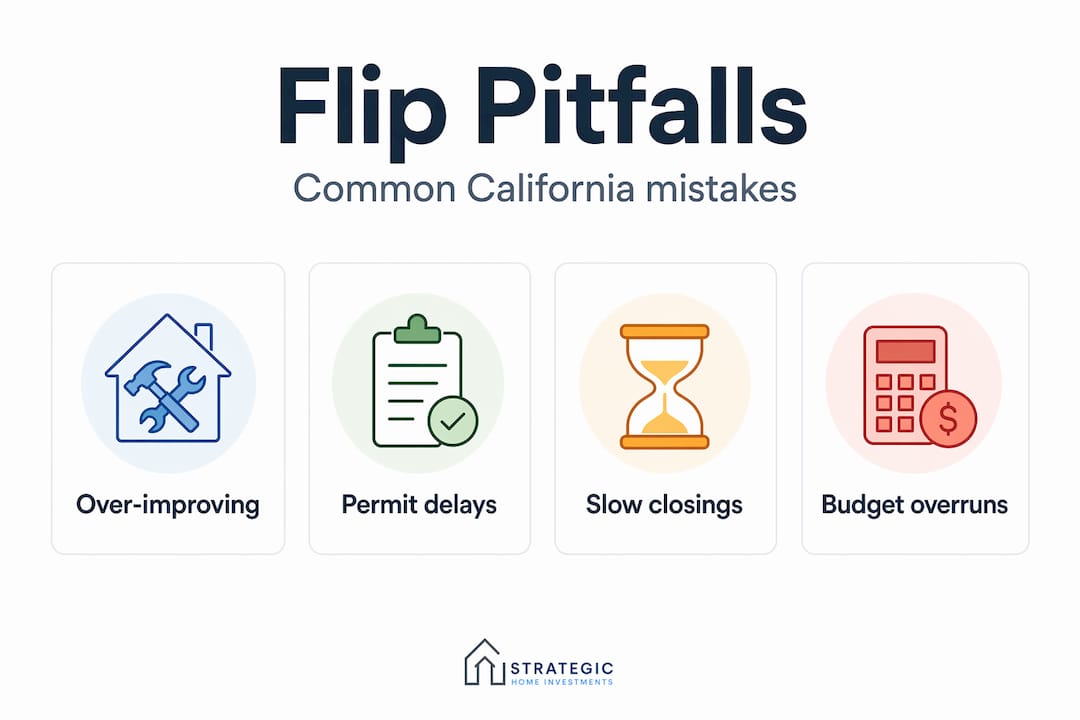
Common pitfalls to avoid on California flips include over-improving for the neighborhood, underestimating the time to close permits in dense urban jurisdictions, and using contractors who offer low bids but lack the license or insurance coverage to do the work legally. All three are predictable and avoidable with the right preparation.
My take on California fix and flip reality
I have worked with enough California fix and flip investors to say this plainly: the deals that go sideways almost never fail because of the renovation itself. They fail because someone skipped the permit conversation during due diligence, or hired a contractor who looked capable but turned out to be unlicensed, or underestimated how much a six-week permitting delay would cost them in loan interest.
In my experience, the investors who consistently profit are the ones who treat permitting as a financial model input, not an afterthought. When I see a flip budget that does not include permit fees, inspection scheduling, or contingency for retroactive corrections, I know that investor is working from an incomplete picture.
Cross-collateralization is one of the most powerful tools available to experienced flippers, but I have also seen it destroy investors who used it before they understood how quickly a delayed project can cascade. The moment your collateral property is on the line, the stakes change. Use that structure after you have executed at least a few successful flips under normal financing.
The construction-defect reform brought by AB 1903 is genuinely good news for flippers who do their work properly. The repair-first mandate rewards documented quality. If you have permits, licensed contractors, and inspection records, you are in a strong position under the new framework. If you do not, that reform does not protect you.
My honest advice: do one well-planned, fully permitted, licensed-contractor flip before you worry about volume. The discipline you build on that first project is what makes the second and third profitable.
— Irvin
Work with Increaltors on your next California flip
Finding the right property at the right price is the first decision that determines whether your flip succeeds. Increaltors specializes in the Los Angeles, Orange County, and surrounding Southern California markets, with direct access to listings that match the profile fix and flip investors need.

Whether you are evaluating your first fixer-upper or expanding an active portfolio, Increaltors offers tools and expertise to support your decisions. Start with a free home valuation report to understand current market value before you commit to a deal. Browse available property listings across Southern California to identify opportunities that fit your renovation budget and target margins. You can also check the latest market data snapshot to see current price trends in the neighborhoods where you are considering a flip. Contact Irvin Nierras directly to get personalized guidance on acquisition, pricing, and selling your completed flip for maximum return.
FAQ
What loan terms should I expect for a California fix and flip?
Fix and flip loans in California typically run 6 to 18 months, lend up to 90% of the purchase price and 100% of renovation costs, and can close in as few as 5 to 14 days based on after-repair value rather than borrower income.
Do I always need permits for California renovation work?
Permits are required for structural, electrical, plumbing, HVAC, and most remodel projects in California. Cosmetic updates like painting, flooring, and cabinet swaps typically do not require permits, but any work touching systems or structure does.
What are the risks of skipping permits on a flip?
Unpermitted work in California risks fines starting at $350 to $600 per violation, stop-work orders, potential forced demolition, insurance claim denials, and a resale value reduction of 10% to 20%.
When is a licensed contractor required in California?
Any construction project valued at over $500 in labor and materials requires a contractor licensed by the California Contractors State License Board, with a valid $25,000 bond and active liability and workers' compensation insurance.
How does AB 1903 affect California house flipping?
AB 1903 reforms construction-defect litigation by requiring proof of appreciable physical damage and prioritizing repair before lawsuits proceed, which reduces speculative litigation risk for flippers who document their renovation work properly.