

Your earnest money deposit in California is refundable — but only under the right conditions. If you cancel within an active contingency period and follow the written cancellation procedure, you get every dollar back. If you remove your contingencies and then walk away, the seller can keep the deposit. On a $1,000,000 purchase, that range becomes $10,000–$30,000. The stakes are real, and the rules are specific.
Three things to do right now if you are in contract:
- Deliver your deposit to the escrow company within 3 business days of contract acceptance — not to your agent, not to the listing office.
- Write down every contingency deadline from your CAR Residential Purchase Agreement and set calendar reminders at least 48 hours before each one.
- Keep copies of every signed form, escrow receipt, inspection report, and written communication related to the transaction.
Key Takeaways
In California, your earnest money deposit is fully refundable when you cancel within an active contingency period in writing — and at serious risk of forfeiture the moment you remove those contingencies without a valid reason to walk away.
| Point | Details |
|---|---|
| Deliver to escrow within 3 business days | Send funds directly to the licensed escrow company, not your agent, and get a written receipt. |
| Contingency cancellations must be in writing | Use the CAR CR or contingency removal form; verbal cancellations do not protect your deposit. |
| Liquidated damages cap at 3% | Under Civil Code §1675, the seller's recovery is presumptively capped at 3% of the purchase price when the clause is properly initialed. |
| Seller refusal triggers Civil Code §1057.3 | A written demand starts a 30-day clock; failure to execute release documents can expose the seller to damages and attorney fees. |
| Increaltors guides buyers through every step | From escrow coordination to contingency deadline tracking, Increaltors provides personalized buyer representation across Southern California. |
Table of Contents
- What is earnest money and why do sellers require it?
- How much earnest money do California buyers typically put down?
- Who holds earnest money in California and when must you deliver it?
- When will you get your earnest money back? Contingency refund paths explained
- When can a seller keep your deposit? Liquidated damages in California
- How escrow releases funds and what to do when the seller won't cooperate
- Practical checklist to protect your earnest money from day one
- What I tell every buyer before they sign
- Work with Increaltors to protect your deposit from the start
- Sources
What is earnest money and why do sellers require it?
Earnest money, formally called the "initial deposit" or "good-faith deposit" in California contracts, is a sum the buyer places into escrow shortly after an offer is accepted. It is not a separate fee — it applies directly toward your purchase price at closing.
Sellers require it for a straightforward reason: when they accept your offer, they take the property off the market. If you back out without cause, they lose time and potential buyers. The deposit compensates them for that risk and signals that your offer is serious.
Here is how it moves through the transaction:
- You and the seller sign the CAR Residential Purchase Agreement (RPA), which designates an escrow holder and specifies the deposit amount.
- You wire or deliver the funds to escrow within 3 business days of acceptance.
- The escrow company holds the funds in a neutral trust account throughout the transaction.
- At closing, the deposit is credited toward your down payment or purchase price.
- If the deal falls apart under a valid contingency, escrow returns the funds to you per the release instructions.
The deposit never goes directly to the seller while the transaction is open. That neutrality is one of the most important protections California law builds into the process.
How much earnest money do California buyers typically put down?
California law does not set a minimum deposit amount. The typical range runs from 1% to 3% of the purchase price, though competitive markets regularly push that higher.
On a $1,000,000 home, the same range is $10,000–$30,000.
A few factors that shape how much to offer:
- Market competitiveness. In a seller's market with multiple offers, a higher deposit signals conviction. In a slower market, 1%–2% is often sufficient.
- Your contingency plan. If you intend to keep all contingencies active, a larger deposit carries less risk — you can still cancel and recover it. If you are waiving contingencies, think carefully before offering more than you can afford to lose.
- Seller expectations. Some sellers, particularly in luxury markets, expect deposits closer to 3% as a baseline. Your agent will know the local custom.
- No legal mandate. There is no California statute requiring a specific deposit percentage. The amount is negotiated between buyer and seller.
Who holds earnest money in California and when must you deliver it?
In California, your earnest money goes to a licensed escrow company, not your agent or the listing broker. Escrow companies operating in California are regulated under California Financial Code Section 17000, which requires them to hold funds in neutral trust accounts and release them only on joint written instruction from both parties or by court order.
The CAR RPA requires delivery within 3 business days of contract acceptance. Business days exclude Saturdays, Sundays, and California legal holidays. If your offer is accepted on a Friday, your 3-day clock typically starts Monday.
A common mistake: buyers hand a check to their agent or the listing agent, assuming it will be forwarded. That creates a procedural gap. The California Department of Real Estate (DRE) reference materials make clear that escrow handling and deposit timing are procedural responsibilities buyers should confirm directly with the escrow officer early in the transaction. Broker trust accounts are rare and generally discouraged for this purpose.
Practical delivery guidance:
- Wire transfers are preferred — they create a traceable record and arrive faster than checks.
- Always request a written escrow receipt confirming the funds were received and deposited.
- Confirm the escrow officer's name, escrow number, and wire instructions in writing before sending any funds.
- Never send money based on verbal instructions alone — wire fraud targeting real estate transactions is a documented risk.
Pro Tip: Before wiring, call the escrow officer directly using a phone number you independently verified — not one from an email — to confirm the wire instructions. One confirmation call can prevent a costly fraud.
When will you get your earnest money back? Contingency refund paths explained
Your clearest path to a full refund is canceling within an active contingency period, in writing, using the correct CAR form. California buyers who cancel within a valid contingency period are generally entitled to a full refund — provided they follow the contract's written cancellation procedure.
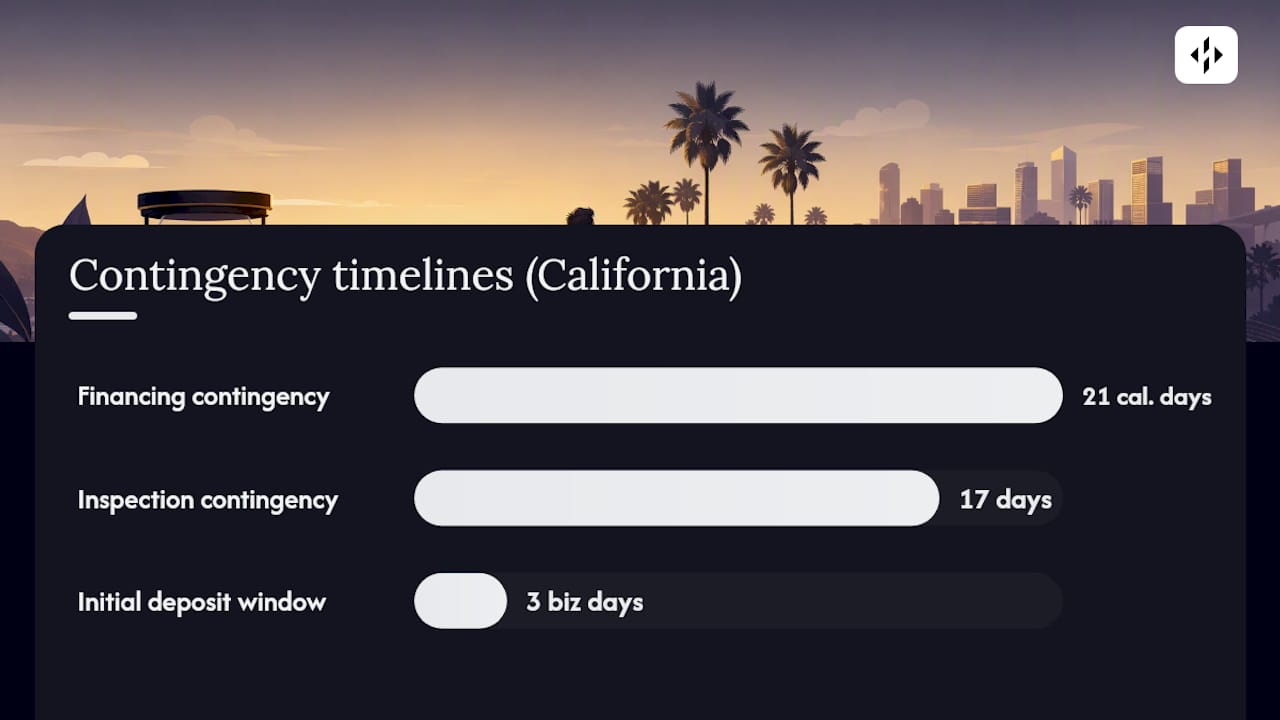
The CAR RPA establishes default timelines for the primary contingencies, all of which can be modified by agreement; buyers often use an ARV calculator California tool to estimate after-repair values that influence contingency planning.
A few critical points about how these timelines work:
- Timelines run from the date of contract acceptance, not the date you receive documents.
- The CAR RPA does not let contingencies expire automatically. You must actively remove them in writing using the CAR contingency removal form, or cancel using the CAR CR form.
- Missing a deadline by even one day can shift your position from protected to exposed.
Scenario A (protected): Your inspection reveals foundation issues on day 14 of a 17-day window. You submit a written cancellation using the CAR CR form on day 15. Escrow returns your deposit in full.
Scenario B (at risk): Your inspection window closes on day 17 and you forget to remove or cancel in writing. The seller sends a Notice to Perform. You now face potential forfeiture exposure even if you later discover a problem.
Counting business days versus calendar days matters here. The financing contingency default of 21 days is calendar days in the standard CAR RPA. The delivery window for the initial deposit is 3 business days. Read your contract carefully, or ask your agent to walk through each deadline with you. For a step-by-step view of how these timelines fit the broader purchase process, the Southern California home buying steps guide is a useful reference.
When can a seller keep your deposit? Liquidated damages in California
A seller can legitimately retain your earnest money when you breach the contract without a valid contractual basis. The most common scenarios:
- You remove all contingencies in writing, then refuse to close without a valid reason.
- You miss a material deadline and the seller properly terminates the contract.
- You misrepresent your financial qualifications in a way that induces the seller to accept your offer.
- You simply change your mind after your contingency periods have passed.
The Notice to Perform is the seller's procedural tool. Before terminating, the seller typically serves a Notice to Perform giving you a short window (usually 2 business days) to cure the default. Failing to respond or perform can lead to contract termination and a claim on the deposit.
How California's liquidated damages framework limits the seller's recovery
California Civil Code Section 1675 creates a rebuttable presumption that a liquidated-damages clause is valid in a residential real estate contract when the amount does not exceed 3% of the purchase price. Section 1677 requires the clause to be separately initialed by both buyer and seller and formatted in a specific way to be enforceable.
Key figure: The 3% cap under Civil Code §1675 means a seller's deposit claim on a $500,000 home is presumptively limited to $15,000 — even if their actual losses were higher — when the clause is properly initialed.
What this means in practice:
- The liquidated-damages clause is optional. If neither party initials it, the seller may pursue actual damages rather than being capped at 3%.
- If the clause is properly initialed, it generally caps the seller's recovery at the deposit amount (up to 3% of the purchase price).
- Most California transactions use the CAR RPA's optional liquidated-damages clause, which caps recovery at 3% when properly initialed.
- Buyers should verify that the clause is present and correctly formatted before removing contingencies — because that is the moment the cap becomes most relevant.
How escrow releases funds and what to do when the seller won't cooperate
Escrow is strictly neutral. It will not decide who deserves the deposit. Under California Financial Code Section 17000, the escrow holder releases funds only when both parties sign a written release or a court orders it.
The release document is the CAR CR form (Cancellation of Contract, Release of Deposit and Joint Escrow Instructions). Both buyer and seller must sign it. If the seller refuses, the funds stay frozen in escrow until the dispute is resolved.
Here is the step-by-step path when you are entitled to a refund but the seller resists:
- Confirm your documentation. Gather your signed CR form request, inspection reports, financing denial letter, appraisal report, and all escrow receipts.
- Request the CR form from escrow. Ask the escrow officer to send the release form to both parties. Escrow will typically hold funds and wait for signatures.
- Send a written demand. Under California Civil Code Section 1057.3, if a party fails to execute the escrow release documents within 30 days of a written demand, they may be liable for damages and attorney fees — unless a good-faith dispute exists. A demand letter citing this statute often prompts cooperation.
- Pursue mediation or arbitration. The CAR RPA includes a mediation clause. Mediation is faster and cheaper than court, and many contested deposits settle there rather than in litigation.
- Consider interpleader. If neither party budges, escrow can file an interpleader action, depositing the funds with the court and letting a judge decide. This removes escrow from the middle but adds legal cost and time.
- Small claims or civil court. For deposits up to $12,500, small claims court is an accessible option. Larger amounts require civil court and typically warrant an attorney.
Documents to assemble before any dispute:
- Signed and dated CR form (or your written cancellation request)
- Inspection report with date and findings
- Lender denial letter or loan condition documentation
- Appraisal report
- All escrow wire receipts and confirmation emails
- Any written communications with the seller or listing agent
Practical checklist to protect your earnest money from day one
Protecting your deposit is mostly about process discipline. Here is a prioritized checklist drawn from practitioner experience:
- Deliver to escrow within 3 business days. Confirm the escrow company name, officer, and wire instructions in writing before sending funds.
- Get your escrow receipt. Do not assume the funds arrived — request written confirmation.
- Calendar every contingency deadline. Set reminders 48 hours before each one. Use the actual contract dates, not estimates.
- Remove or cancel contingencies in writing only. Verbal agreements do not protect you. Use the CAR contingency removal form or CR form for every action.
- Avoid waiving contingencies unless your finances are solid. In competitive markets, waiving the inspection or financing contingency feels necessary — but it transfers real risk to you. Consult your agent before doing so.
- Check the liquidated-damages clause. Confirm it is present, properly formatted, and initialed by both parties if you want the 3% cap to apply.
- Keep a transaction folder. Store every signed document, email, and receipt in one place throughout the process.
- Coordinate with your escrow officer early. Confirm withholding-notice requirements and any state tax obligations that may affect your closing per DRE guidance on escrow procedures.
For buyers navigating their first purchase, the first-time home buyer tips for Southern California resource covers broader process context that pairs well with this checklist.
Pro Tip: Ask your agent to walk through the contingency calendar with you on the day you sign the contract — not a week later. Agents and escrow officers who coordinate early catch delivery and deadline errors before they become disputes.
What I tell every buyer before they sign
There is a pattern I see repeatedly in California transactions: buyers focus intensely on the offer price and almost not at all on the contingency calendar. Then, two weeks into escrow, they realize they missed a removal deadline or never confirmed their deposit arrived. By that point, the leverage has shifted.
The deposit itself is rarely the problem. The real danger is missing a contingency removal deadline — that is the moment a refundable deposit becomes a contested one. I always tell buyers: the CAR RPA is your protection, but only if you use it correctly. Every contingency removal must be in writing. Every cancellation must use the right form. And if a seller refuses to sign the CR form after a legitimate cancellation, Civil Code §1057.3 gives you a statutory path to recover funds and potentially attorney fees.
When the deposit is substantial — anything above $20,000 — and the seller is resisting a legitimate refund, consulting a California real estate attorney before escalating is money well spent. Mediation resolves most disputes faster and cheaper than court, but you need to know your position before you sit down at that table.
Work with Increaltors to protect your deposit from the start
Knowing the rules is one thing. Having an experienced agent in your corner to apply them is another. Increaltors works with buyers across Los Angeles, Orange County, and surrounding Southern California markets to handle the details that protect deposits: negotiating contingency windows, coordinating directly with escrow on delivery and deadlines, reviewing CAR RPA terms before you sign, and tracking every removal date so nothing slips.

When you work with Increaltors, you get personalized buyer representation from an agent who knows Southern California's competitive market conditions and the contract mechanics that keep your money safe. Whether you are searching for a single-family home or ready to browse all available listings, the team is ready to guide you through every step with clarity and care. Reach out for a free consultation and start your search with confidence.
Sources
Primary authorities every California buyer should know:
- California Code, CIV 1675.
- C.A.R. Residential Purchase Agreement (RPA) contract (PDF)
- 20. Basic Contract Provisions and Disclosures in a Residential Real Estate Transaction
- California Earnest Money: Escrow Rules, Contingency · Quill
For procedural questions (delivery timing, escrow receipts, form routing), your escrow officer is the right first call. For legal disputes (seller refusing to sign the CR form, contested forfeiture, breach claims), consult a California real estate attorney before escalating. Your agent bridges both — and should be your first call when any deadline or dispute question arises.
This article provides general information about California real estate deposit practices and is not a substitute for legal advice. Consult a licensed California real estate attorney or your escrow officer to confirm current rules and how they apply to your specific transaction.