
An appraisal is the document your lender requires. A CMA is the tool your agent uses to price your home. That's the core of the CMA vs appraisal question, and getting it backward can cost you money or delay your closing.
A comparative market analysis (CMA) is an agent's professional estimate of value, built from recent comps, and it's usually free. An appraisal is a formal, legally recognized report prepared by a state-licensed appraiser under USPAP standards, and lenders require one for most mortgage approvals under federal Title XI rules. One shapes your strategy. The other determines whether your loan closes.
Here's what to do with that right now:
- If you're listing your home, ask your agent for a CMA before you set a price.
- If you're buying with financing, expect your lender to order an appraisal, not accept a CMA.
- If the two numbers disagree, don't panic. There's a process for that, and we'll walk through it below.
TL;DR:
- A CMA is an agent's estimate based on recent sales data, while an appraisal is a formal, licensed valuation required by lenders.
- CMAs are usually free and prepared before listing, whereas appraisals are paid, often cost several hundred dollars, and happen after a sale agreement.
- When a low appraisal occurs, quickly gather comparable sales and factual corrections to submit a Reconsideration of Value to the lender.
- Lenders can exempt transactions under $400,000 from mandatory appraisals, but they still have the option to require one.
- Both documents serve different purposes and follow distinct rules, so understanding their differences helps avoid valuation surprises in real estate transactions.
Table of Contents
- CMA Meaning in Real Estate vs Appraisal Meaning: The Basic Definitions
- CMA vs Appraisal Differences That Actually Affect Your Transaction
- When to Use a CMA vs When You Need an Appraisal
- Who Prepares and Legal Weight: Why a CMA Isn't a Substitute
- Cost and Timing: What to Budget For
- What to Do If Your Appraisal Comes in Low
- How We Use CMAs and Appraisals With Our Clients
- Key Takeaways
- An Editorial Take on Getting This Right
- Sources
CMA Meaning in Real Estate vs Appraisal Meaning: The Basic Definitions
A CMA is an agent-prepared pricing report. It pulls recently sold homes, active listings, and pending sales in your area, then adjusts for square footage, condition, upgrades, and lot size to land on a probable sales price or a price range. Rocket Mortgage describes it as a comparison of comparable properties used specifically to guide pricing decisions, not to establish official market value. Most agents provide CMAs at no cost as part of their listing service, and the output is a working number, not a certified one.
An appraisal is different in almost every way that matters legally. It's:
- Prepared exclusively by a state-licensed or state-certified appraiser.
- Governed by the Uniform Standards of Professional Appraisal Practice (USPAP), which sets ethical and methodological rules for the profession.
- Delivered as a formal written opinion of value, with supporting comps, adjustments, and, for unusual properties, a highest-and-best-use analysis covering zoning and development potential.
- Treated by lenders as the defensible valuation required for underwriting.
Two variants sit in between. Broker Price Opinions (BPOs) are more formal than a standard CMA but less rigorous than a full appraisal, and lenders sometimes order them for distressed properties or portfolio reviews. Desktop and hybrid appraisals skip the full in-person walkthrough, relying instead on data and, in hybrid cases, a third-party inspection, while a licensed appraiser still signs off on the final value.
CMA vs Appraisal Differences That Actually Affect Your Transaction
The gap between these two documents isn't cosmetic. It shows up in who's accountable, what weight the number carries, and how much you'll pay.
- Who prepares it: A real estate agent builds the CMA using MLS data and market knowledge. Only a licensed appraiser can legally produce an appraisal.
- Independence: Your listing agent has a stake in the sale, so a CMA is inherently a strategic tool. An appraiser works independently of both buyer and seller, hired through the lender or an appraisal management company specifically to remove that conflict.
- Legal standing: A CMA carries no regulatory weight and isn't acceptable for lending, litigation, or tax proceedings. An appraisal, governed by USPAP and backed by FIRREA's Title XI requirements, is the standard financial institutions and courts rely on.
- Timing: A CMA typically appears before you list, shaping your asking price. An appraisal shows up after you're under contract, usually ordered once the lender begins underwriting.
- Cost: CMAs are commonly free from a listing agent. Appraisals typically cost a moderate amount and are typically paid by the buyer as part of closing costs, though this varies by loan type and local custom.
None of this means a CMA is worthless. It just means the two documents answer different questions at different points in the deal.
When to Use a CMA vs When You Need an Appraisal
Match the document to the moment. Here's how that breaks down in practice.
Reach for a CMA when:
- You're setting a listing price and want a realistic range based on current competition.
- You're evaluating whether an offer is fair before countering.
- You're in early-stage negotiations and need a quick, no-cost read on value.
Expect an appraisal when:
- You're buying or refinancing with a mortgage; the lender orders it as a condition of the loan.
- You're involved in litigation, an estate settlement, or a tax dispute that requires a legally defensible value.
- The property has unusual zoning or development potential where a highest-and-best-use analysis actually changes the number.
Regulatory exceptions matter here too. Since 2019, federal banking regulators have exempted many residential transactions valued at $400,000 or less from the Title XI appraisal mandate, though individual lenders can still require one based on their own risk policies.
Pro Tip: Ask your loan officer early whether your transaction qualifies for a desktop or hybrid appraisal. It won't change the legal weight of the report, but it can shave days off your closing timeline.

Who Prepares and Legal Weight: Why a CMA Isn't a Substitute
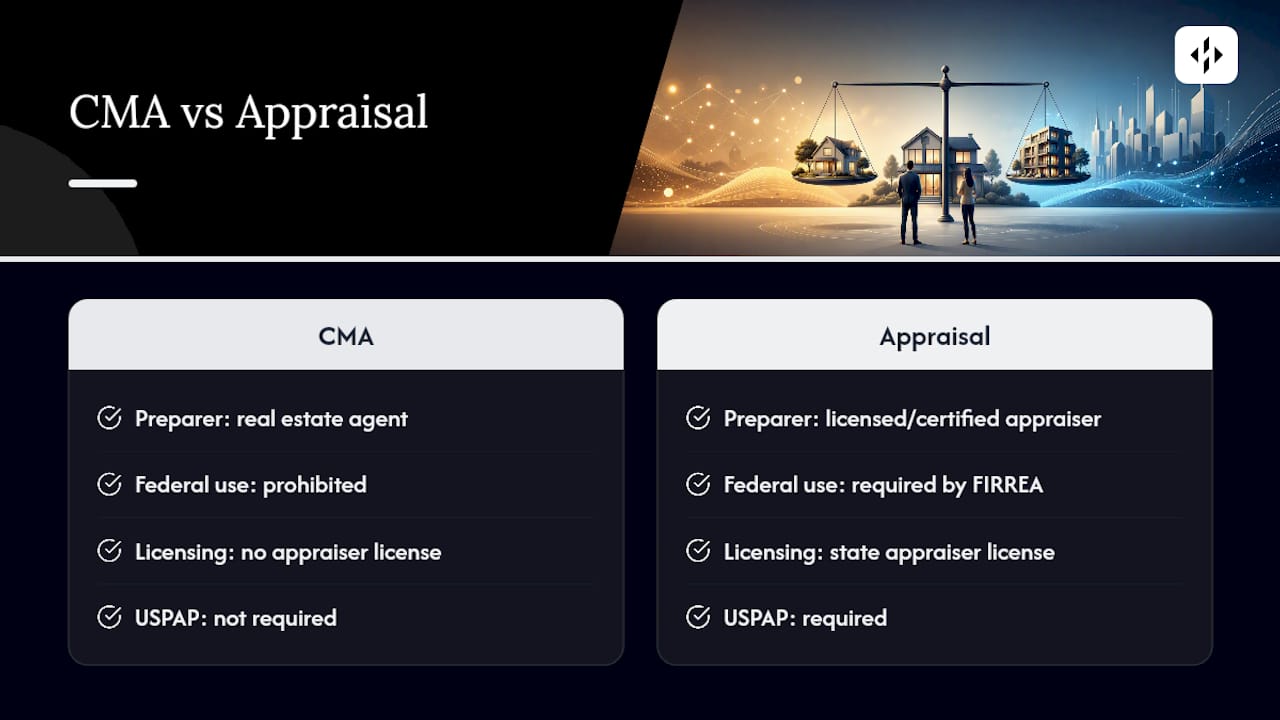
The line between a CMA and an appraisal isn't a matter of custom, it's federal law. The Financial Institutions Reform, Recovery, and Enforcement Act (FIRREA), through its Title XI provisions, requires that federally related mortgage transactions use a valuation from a licensed or certified appraiser. Real estate agents, no matter how experienced, cannot legally perform appraisals, and USPAP compliance is what separates a licensed opinion of value from an agent's estimate.
State licensing boards enforce this distinction, and rules on labeling vary by state. Agents must describe their CMA output as a "probable sales price," not "market value," to avoid crossing into appraisal territory. If comparables are chosen in a way that raises fair-housing concerns, HUD's fair housing guidance applies regardless of which document produced the estimate.
Cost and Timing: What to Budget For
Most CMAs cost nothing. Your listing agent builds one as a normal part of preparing your home for sale, and a paid Broker Price Opinion, when one is ordered instead, usually runs less than a full appraisal.
Appraisals cost more and take longer:
- Standard appraisals typically run a moderate cost paid by the buyer at closing in most conventional transactions.
- Turnaround runs anywhere from a few days to two weeks, depending on appraiser availability and property complexity.
- Desktop and hybrid appraisals cut both cost and turnaround since they rely on data and remote review instead of a full in-person walkthrough, though they still require a licensed appraiser's sign-off.
What to Do If Your Appraisal Comes in Low
A low appraisal doesn't have to kill your deal, but you have to move fast and with the right evidence.
- Pull genuinely comparable sales your agent believes the appraiser missed, focusing on recent, nearby, similar-condition properties rather than aspirational comps.
- Check for factual errors in the report, wrong square footage, missed upgrades, or an incorrect lot size are common and correctable.
- Submit a formal Reconsideration of Value (ROV) through the lender, including your evidence in writing.
- Request an appraisal review or a second appraisal if the ROV doesn't move the number and the gap still threatens financing.
A well-documented ROV using comparable sales the appraiser overlooked can sometimes shift the outcome, though the appraiser isn't obligated to change the opinion. Appraisers generally accept factual corrections and legitimate comps; they won't accept pressure to hit a number.
Pro Tip: Have your agent prepare the ROV comps the same day the low appraisal comes in. Momentum matters, and appraisers are more responsive to a tight, specific challenge than a delayed, generic one.

How We Use CMAs and Appraisals With Our Clients
At Increaltors, we treat the CMA as the starting conversation, not the final word. We build one for every listing using active, pending, and closed comps across Los Angeles and Orange County, and we're upfront with sellers about where that number is a strategic estimate rather than a guarantee of what a lender's appraiser will find.
When a buyer's appraisal comes in under contract price, the first thing we do is go back to our original CMA and see what changed. Sometimes the market shifted. Sometimes the appraiser missed a comp we already had on file. Either way, having that groundwork ready from day one is what makes the reconsideration conversation move fast instead of stalling the whole transaction.
If you're weighing a listing price or preparing for a lender-ordered appraisal, our home valuation report gives you a real starting number backed by current local data, not a generic online estimate.
Key Takeaways
An appraisal is the lender's legally required valuation under USPAP and FIRREA, while a CMA is an agent's free pricing tool with no legal standing in lending or litigation.
| Point | Details |
|---|---|
| Know which document you need | Use a CMA for pricing strategy; expect an appraisal whenever a lender is financing the deal. |
| Understand the legal gap | Only licensed appraisers can produce USPAP-compliant reports; agents cannot legally perform appraisals. |
| Budget accordingly | CMAs are typically free; appraisals cost several hundred dollars and are usually paid by the buyer. |
| Act fast on a low appraisal | Compile comps and factual corrections immediately, then file a Reconsideration of Value with the lender. |
| Ask about exemptions | Transactions at $400,000 or below may qualify for a Title XI appraisal exemption, though lenders can still require one. |
An Editorial Take on Getting This Right
The conventional advice on CMA vs appraisal treats them as competing numbers, which is the wrong frame entirely. They're not competing. They're sequential, and most of the frustration I see in transactions comes from someone expecting one document to do the other's job.
Sellers who get burned usually priced their home off a CMA they treated as gospel, then panicked when the appraisal landed differently. Buyers who get burned usually assumed a strong CMA from their agent would automatically match what a lender's appraiser finds. Neither assumption holds up, because the two reports answer different questions under different rules.
What actually matters is preparation on both ends: a rigorous, honestly-labeled CMA before you list, and a comp file ready to go the moment an appraisal comes back low. If your agent can't explain the difference between "probable sales price" and "market value" without pausing, that's worth noticing before you sign anything.
— Irvin Nierras
Sources
- Comparative Market Analysis vs Appraisal — LicensePrep
- Do real estate agents do appraisals or just CMAs? — LegalClarity
- Comparative market analysis — Rocket Mortgage