
California real estate commission rates are fully negotiable. There is no state law that sets a fixed percentage, and the California Department of Real Estate does not regulate market prices or commission amounts. What you pay is determined by private agreement between you and a licensed broker. Survey data from industry sources indicates that the typical combined commission in California is generally around the mid-single-digit percentage of the sale price, with many transactions commonly centered near a midpoint rate when both sides are represented. Two things you should do right now: verify your agent's license at the DRE's consumer portal, and ask whether a written buyer representation agreement will be required before any showings.
- Commissions are negotiable. No statute mandates a specific rate.
- Typical combined range: roughly 4%–6%, with a median near 5% in many California markets.
- Verify the license using the DRE's consumer resources before signing anything.
- Ask about written buyer representation agreements upfront. Since August 17, 2024, these agreements are standard practice before showings.
Pro Tip: Before your first meeting with any agent, pull their license record on the DRE website. Check the brokerage affiliation, license status, and any disciplinary history. It takes two minutes and tells you a great deal.
Key Takeaways
| Point | Details |
|---|---|
| Commissions are negotiable | No California law sets a fixed rate; all fees are agreed upon privately between parties and brokers. |
| Typical combined rate | Industry surveys place the statewide median near 5%, with regional variation in LA and OC markets. |
| 2024 practice changes | Written buyer representation agreements are now required before showings; MLS compensation fields are no longer mandatory. |
| Verify before you sign | Use the DRE's public license portal to check status, brokerage, and any disciplinary history before hiring any agent. |
| Increaltors for SoCal | Increaltors provides listings, valuations, and negotiation support across Los Angeles and Orange County markets. |
Table of Contents
- How is a California real estate commission calculated?
- What are current commission rates in California?
- What changed with the NAR settlement and 2024 practice rules?
- How can you negotiate or reduce your commission?
- How do you verify an agent's license and file a DRE complaint?
- A local perspective on Southern California commissions
- Ready to buy or sell in Southern California? Increaltors is here to help.
- Sources
How is a California real estate commission calculated?
Commission is negotiated in the listing agreement and paid through a licensed broker at the close of escrow. California law is clear on this: agents cannot accept payment directly from clients. The escrow or title company disburses funds to the brokerages per written instructions, and each broker then pays their agent according to a separate split arrangement.
Here is how the money typically flows:
- Seller and listing broker agree on a total commission percentage in the listing agreement.
- Listing broker offers a portion of that total to the buyer's broker, either through the MLS or through direct negotiation in the purchase contract. Since August 2024, this is no longer a mandatory MLS field.
- Each broker then pays their agent based on an internal split, which varies widely by brokerage, experience level, and any cap or bonus structure in place.
- Commissions are paid at close of escrow, not before. If the sale does not close, agents are typically not paid.
Agents are generally independent contractors paid through their sponsoring broker, not employees. That distinction matters for how splits are structured and why rates can vary so much from one brokerage to the next.
Worked commission examples at common rates
The table below shows total commission and per-side amounts at two typical percentage splits across three sale prices common in California markets.
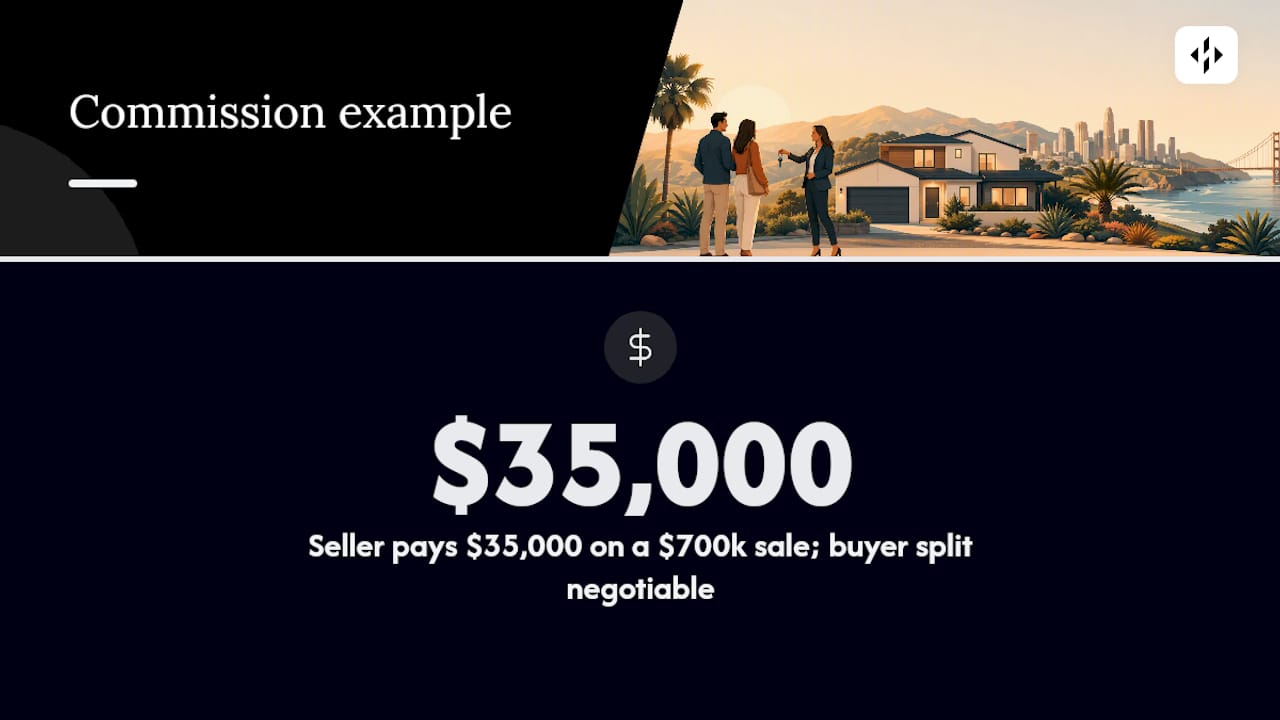
On a $700,000 home at 5%, the seller pays $35,000 at closing. Whether any of that goes to the buyer's agent depends on what was negotiated in the purchase contract. That flexibility is new, and it changes how both sides approach the offer process. For a deeper look at how listing agreements set these terms, the listing agents guide for Southern California walks through the mechanics in detail.
What are current commission rates in California?
California's average combined commission has shown some recent downward movement. Industry surveys indicate a typical statewide rate around the midpoint of low to mid-single digits, lower than the higher end ranges that were common before the 2024 practice changes. Buyer-side fees in particular have seen modest compression in competitive markets, where sellers in high-demand areas sometimes decline to offer buyer-agent compensation at all, shifting that negotiation to the purchase offer.

Regional variation is real. In high-price markets like Los Angeles, Orange County, and the Bay Area, listing agents sometimes accept lower percentage rates because the absolute dollar amount is still substantial. In slower or lower-price markets, agents are less likely to discount because the dollar floor matters more.
Lower-fee options worth knowing
If a full-service commission feels like too much, you have real alternatives. Each comes with trade-offs:
- Discount brokerages: Offer full or near-full service at a reduced listing-side rate, often 1%–1.5%. Trade-off: agent availability and local market depth can vary.
- Flat-fee MLS services: You pay a one-time fee (typically a few hundred dollars) to list on the MLS, then handle showings, negotiations, and paperwork yourself. Best for experienced sellers who know their market.
- Unbundled or a la carte services: You pay only for specific tasks (pricing analysis, contract review, negotiation coaching). Useful if you want professional support without full representation.
- For Sale By Owner (FSBO): No listing commission, but you still need to decide whether to offer buyer-agent compensation. FSBO homes statistically sell for less and take longer, though in a hot market the gap narrows.
The right choice depends on your comfort level, your market, and how much time you can invest. A buyer's agent guide for Southern California explains what full representation actually covers, which helps you judge what you'd be giving up.
What changed with the NAR settlement and 2024 practice rules?
The most significant shift in how California real estate commissions work came from a combination of litigation and industry policy changes, not from the state legislature or the DRE.
The short timeline:
- March 2024: NAR announced a settlement agreement resolving antitrust litigation over buyer-agent compensation practices. The Los Angeles Times reported on the practical effects for buyers and sellers, including how compensation visibility and negotiation timing shifted.
- August 17, 2024: New practice rules took effect nationwide. MLS platforms were no longer required to include buyer-agent compensation fields in listings. Written buyer representation agreements became required before agents could show homes to buyers.
- 2025–2026: NAR's professional standards updates documented ongoing code and standards amendments aligning with these practice changes. Industry analysis confirmed that the settlement reinforces the 2024 practice changes rather than introducing new day-to-day rules.
What this means in practice
Local California markets felt the changes immediately. Buyers now sign a written representation agreement before touring homes, and that agreement spells out what the buyer's agent will be paid and by whom. If the seller does not offer buyer-agent compensation, the buyer may need to cover it directly or negotiate it into the purchase price.
The DRE's role here is worth clarifying. The department enforces licensing rules and handles consumer protection, but it does not set commission rates or police NAR policy compliance. If your dispute involves a license violation, the DRE is your first call. If it is a contractual disagreement about compensation terms, that is a civil matter.
Some questions fall outside the DRE's scope entirely. The DRE's "Who Do You Call?" resource points consumers toward federal agencies like the CFPB for RESPA and TILA questions, which is useful to know before you start making calls.
Pro Tip: As a seller, your decision on whether to offer buyer-agent compensation should be driven by your market. In a seller's market, you have more room to negotiate or decline. Ask your agent for data on what competing listings are offering locally before you decide.
How can you negotiate or reduce your commission?
Negotiation is not just possible, it is expected. Here is a practical checklist before you sign a listing agreement or hire a buyer's agent.
Before listing:
- Research what agents in your ZIP code are charging. Ask three agents for their commission structure before committing to one.
- Know your home's value. A clear sense of comparable sales in your area gives you leverage when discussing pricing and fees.
- Ask specifically: "Is your commission rate negotiable?" Most agents will say yes, at least partially.
Negotiation scripts that work:
For sellers: "I've spoken with a few agents, and I'd like to discuss your commission. I'm committed to working with someone who can demonstrate strong local results. Would you consider [X]% given the price point and the current market?"
For buyers: "I'd like to include a seller concession toward buyer-agent compensation in my offer. Can we structure the offer to reflect that?"
When flat-fee or limited-service makes sense:
If you are selling a well-priced home in a strong market and you are comfortable handling showings and negotiations, a flat-fee MLS listing can save you thousands. The trade-off is time and expertise. For most sellers, the value a skilled agent brings in pricing strategy, negotiation, and transaction management more than covers the commission cost.
Pro Tip: Do not evaluate commission in isolation. An agent who prices your home accurately and negotiates a higher final sale price will often net you more money than a discount agent who saves you 1% but leaves money on the table. Ask agents for their average list-to-sale price ratio, not just their rate.
How do you verify an agent's license and file a DRE complaint?
The DRE's primary mission is consumer protection through licensure, regulation, education, and enforcement. That means you have real tools available if something goes wrong.
Step-by-step: verifying a license
- Go to the DRE's eLicensing public portal at dre.ca.gov.
- Search by the agent's name or license number.
- Review the license record: check the license type (salesperson vs. broker), the sponsoring brokerage, the expiration date, and any disciplinary actions or license conditions.
- If the record shows a suspension, revocation, or pending action, that is a serious red flag. Do not proceed without asking direct questions or consulting an attorney.
For additional guidance on using DRE resources, the DRE alternatives guide for SoCal buyers covers practical steps for verifying credentials and what to do if the public portal does not return the result you expect.
How to file a complaint with the DRE
The DRE's Enforcement Section handles complaints involving licensed real estate professionals. Here is what the process looks like:
- Complete the RE 519 complaint form, available on the DRE website.
- Submit it to your regional DRE district office or use the Enforcement Online Complaint System on the DRE site.
- Include all supporting documentation.
- The DRE will review the complaint and determine whether a license-law violation occurred. It cannot award damages or resolve contract disputes, but it can discipline or revoke a license.
The DRE Consumer Recovery Account provides a financial remedy of last resort for consumers who have suffered a monetary loss due to a licensee's fraudulent, willful, or dishonest conduct. There are eligibility requirements and caps, so review the DRE's published guidelines before counting on it as a recovery path.
Documentation checklist before filing:
- Signed listing agreement or buyer representation agreement
- All written communications (emails, texts, letters)
- Escrow instructions and closing disclosure
- Any receipts, invoices, or financial records related to the transaction
- A clear written timeline of events
If your issue involves deceptive pricing practices rather than a licensing violation, California's consumer protection framework may also apply. The Javitch Law Office overview of California's price-rule enforcement is a useful primer on how state law addresses deceptive pricing, which can overlap with real estate marketing disputes.
A local perspective on Southern California commissions
Southern California is a different animal. Los Angeles and Orange County home prices are among the highest in the country, which changes the commission math in ways that buyers and sellers from other markets do not always anticipate.
That dollar figure tends to make both sides more willing to negotiate than they might be in, say, a $250,000 transaction in a mid-tier market. Buyers, meanwhile, are increasingly asking sellers to cover their agent's fee as part of the offer, particularly in markets where inventory is tight and sellers want clean, competitive offers.
What actually moves the needle locally is pricing accuracy and speed. A well-priced home in a supply-constrained LA neighborhood can generate multiple offers within days. In that environment, the agent's ability to price correctly and manage the offer process is worth far more than the half-point you might save by going with a discount service. Orange County sellers in particular tend to see strong returns from full-service representation because the buyer pool is sophisticated and the negotiation window is narrow.
For buyers, the written representation agreement is now your starting point for every conversation. Read it carefully before you sign. It should specify the compensation amount or rate, who pays it, and what happens if the seller does not offer that amount. Knowing those terms before you walk into a showing puts you in a much stronger position.
Ready to buy or sell in Southern California? Increaltors is here to help.
Navigating California real estate commissions, representation agreements, and local market dynamics is a lot to manage on your own. Increaltors offers personalized listing services, home valuations, and negotiation support across Los Angeles, Orange County, and nearby Southern California markets. Whether you are pricing a home to sell or trying to understand what buyer-agent compensation means for your offer, you get direct access to local expertise without the guesswork that comes with going it alone.

Sellers can request a free home evaluation to understand their net proceeds after commissions before they commit to anything. Buyers ready to explore active inventory can browse current listings across property types and neighborhoods. When you are ready to talk strategy, Increaltors is a trusted partner who knows these markets and will work with you to get the outcome you deserve.
Sources
These are the primary sources behind this guide. Regulatory links go directly to DRE pages; industry and news links cover the NAR practice changes and their California effects.
Regulatory (DRE):
- Licensee fees - DRE
- What Does NAR's New Settlement Mean To Real Estate Professionals? | Inman Real Estate News
- 2026 summary of key professional standards changes - NAR
- Realtor rules just changed dramatically. Here’s what buyers and sellers can expect - Los Angeles Times
- How Real Estate Agents Get Paid in California | Premier Courses
Industry and policy:
News coverage:
Practitioner resources:
This article is general information, not a substitute for advice from a qualified financial advisor. Consult a qualified financial professional about your own circumstances before acting on anything here.