
Yes, bridge loans are available across California in 2026, through banks, institutional debt funds, and private lenders, with headline rates for most deals running from the high single digits to low double digits depending on leverage and exit quality. That range holds whether you're financing a buy-before-you-sell move in Orange County or a fast acquisition in the San Fernando Valley. The right fit depends on how fast you need cash and how clean your exit plan is.
Bridge financing tends to work best for three situations:
- Buying your next home before your current one sells, so you're not stuck making two payments or losing your dream house to a contingent offer
- Closing a purchase fast enough to beat competing cash buyers in a hot SoCal micro-market
- Funding a short value-add hold, like a light renovation, before refinancing into permanent debt or selling
Key Takeaways
A California bridge loan in 2026 typically costs 8% to 11% in interest plus points and fees, and pricing depends more on the strength of your exit strategy than on your personal income.
| Point | Details |
|---|---|
| Rate expectations | Budget for 8% to 11% on most deals, with institutional loans priced as SOFR plus a spread. |
| Exit strategy drives pricing | A signed sale contract or verified refinance path lowers your spread more than credit score alone. |
| Speed varies by lender type | Private lenders can close in 7 to 14 business days; institutional funds need 4 to 6 weeks. |
| Document prep saves time | Entity docs, bank statements, a project budget, and a written exit plan speed up underwriting. |
| Compare all-in cost, not rate alone | Points, prepaid interest, and fees can outweigh a lower headline rate. |
Table of Contents
- How Bridge Loans Work in California: Lenders, Terms, and Local Underwriting
- What Do Bridge Loan Rates and Fees Actually Cost in California?
- Who Qualifies for a Bridge Loan in California?
- How Long Does a California Bridge Loan Take to Close?
- How Do You Compare and Choose a Bridge Lender?
- Are There Alternatives to a Bridge Loan in California?
- How Increaltors Helps California Buyers Coordinate Bridge Financing
- The Real Lesson From California's 2026 Bridge Market
- Sources
How Bridge Loans Work in California: Lenders, Terms, and Local Underwriting
Three lender types dominate the California bridge market, and each trades speed for cost differently.
- Banks offer the lowest rates but the slowest underwriting, often weeks longer than a private lender, and they lean heavily on personal income and credit depth.
- Debt funds (institutional lenders) price off SOFR plus a spread, close in roughly four to six weeks, and suit larger, well-documented deals where the borrower can wait a bit longer for better pricing.
- Private or hard money lenders close fastest, often inside two weeks, and focus almost entirely on the deal itself rather than the borrower's W-2 history.
Most California bridge loans run 12 to 36 months, interest-only, with loan-to-value bands between 65% and 75% of as-is value. Some private lenders will fund a higher share of total project cost, including rehab, when the exit is strong. California adds a few wrinkles you won't see in every state. Properties with a high probable maximum loss (PML) score under seismic review can trigger earthquake insurance or retrofit conditions that change your budget mid-deal, a point covered in detail in the California Bridge Loans 2026 guide. Rent-controlled units in cities like Los Angeles and Santa Monica can also limit how quickly you can reposition a property, which lenders factor into their exit analysis. Add California's transfer taxes, which vary by county and city, into your closing cost math from the start.
What Do Bridge Loan Rates and Fees Actually Cost in California?

Rate quotes alone don't tell you what a bridge loan costs. The spread between a "good" deal and an expensive one usually comes down to points, prepaid interest, and how the lender indexes its rate, not just the number on the term sheet.
Market data for 2026 puts most California bridge loans between roughly 8% and 11%, with institutional deals commonly priced as SOFR plus a spread of several hundred basis points, according to California Bridge Loans 2026: Rates and Requirements. Private lenders can run higher on rate but lower on time-to-close, while bank bridge programs sometimes dip toward the mid-6% range for the strongest borrowers, per analysis from Commercial Mortgage Broker.
By the Numbers: California bridge loans in 2026 usually price within a range reported by California Bridge Loans 2026: Rates and Requirements, with institutional lenders quoting SOFR plus a spread instead of a flat rate.
Beyond the rate, expect origination points (often 1 to 3 points), prepaid interest reserves, appraisal fees, title and escrow charges, and sometimes an extension fee if you need extra runway. North Coast Financial's published rate and fee ranges give a useful benchmark for how these line items stack up in practice.
| Cost Item | Typical Range | Notes |
|---|---|---|
| Interest rate | 8% to 11% (market-dependent) | Institutional loans often float over SOFR |
| Origination points | 1 to 3 points | Charged at closing, upfront |
| Appraisal, title, escrow | Varies by county | Bundle these into your all-in estimate |
| Prepaid interest reserve | 1 to 3 months | Lender-held, released or applied at payoff |
On a $500,000, 12-month bridge loan at 9.5% with two points, you'd pay roughly $47,500 in interest over the year plus $10,000 in points, before appraisal, title, and escrow costs. That's why comparing offers on note rate alone almost always misleads you.
Who Qualifies for a Bridge Loan in California?
Bridge lenders care less about your paycheck and more about your way out. Many California bridge lenders underwrite the exit strategy and project viability more heavily than personal income, treating a credible refinance or sale plan as the real collateral behind the loan.
That shift in priorities changes what you need to assemble before you apply:
- Loan-to-value expectations: most lenders cap at 65% to 75% of current value, though a strong exit can push that higher
- Liquidity reserves: lenders typically want to see several months of payments in reserve, not just enough to close
- Credit score guidance: private lenders will work with scores in the 600s if the deal is strong; banks usually want 680 or higher
- Sponsor experience: investors with a track record of completed flips or refinances get better pricing than first-timers
A verifiable refinance path or a signed sales contract materially lowers your spread, according to market analysis from CLS Commercial Real Estate, because it removes the lender's biggest question mark.
Pro Tip: Build your document file before you shop lenders, not after. Entity formation documents, two to three months of bank statements, a project budget, and a written exit plan can shave real time off underwriting and often improve your quote.
How Long Does a California Bridge Loan Take to Close?
Timelines vary sharply by lender type, and knowing which bucket you're in sets realistic expectations. Private lenders close fastest, often in 7 to 14 business days, while institutional debt funds typically need four to six weeks, and traditional banks can run longer still, according to California Hard Money Lender's timing analysis.
Three bottlenecks show up again and again:
- Appraisal delays. Ordering early, or paying for a rush appraisal, is often the single fastest way to compress your timeline, a tactic covered further in our real estate appraisal guide for LA and OC buyers.
- Title issues. Old liens, boundary questions, or unresolved probate matters can stall closing for weeks if you don't clear title early.
- Borrower response time. Slow document turnaround on your end is the most preventable delay in the entire process.
Designating a single point of contact, either you or your agent, to field lender requests keeps the file moving instead of stalling in an inbox.
How Do You Compare and Choose a Bridge Lender?
The lowest headline rate isn't always the best deal. Certainty of close, all-in net proceeds, and documentation burden matter just as much as the number on page one of the term sheet, an approach echoed in North Coast Financial's guidance on comparing bridge quotes.
Watch for red flags like vague extension terms, undisclosed junk fees, or a lender who won't commit to a close date in writing. Before signing anything, ask these questions on your first call:
- What's your median time to close on deals like mine?
- What happens if I need an extension, and what does it cost?
- Is this loan recourse or non-recourse?
- What reserves do you require me to hold post-closing?
- Do you lend on this property type and in this county?
- What's included in your points versus separate fees?
- Can I get a written term sheet before ordering an appraisal?
- Who services the loan after closing?
- What triggers a default under your loan documents?
- Have you closed a deal like this in the last 90 days?
| Comparison Factor | What to Ask For |
|---|---|
| Certainty of close | A written term sheet and recent closed-deal references |
| All-in cost | Full fee schedule, not just the note rate |
| Documentation burden | A checklist of exactly what underwriting requires upfront |
Are There Alternatives to a Bridge Loan in California?
A bridge loan isn't always the cheapest or fastest path. Depending on your equity position and timeline, one of these alternatives might serve you better:
- HELOC. Cheaper than most bridge products if you already have significant equity and time to get it approved, though funding usually takes longer than a private bridge loan.
- Cash reserves. The lowest-cost option if you have it, since you skip interest and fees entirely, but it ties up liquidity you might want elsewhere.
- Private margin lines or portfolio loans. Useful for investors with a brokerage or real estate portfolio to borrow against, often at lower cost than a bridge loan.
- Sale-timing strategies, like a rent-back agreement or an extended closing to eliminate the need for temporary financing altogether, an approach worth exploring in our guide on what a short sale means for buyers and sellers.
Weigh cost against speed and risk: cash is cheapest, a bridge loan is fastest, and everything else falls somewhere between.
How Increaltors Helps California Buyers Coordinate Bridge Financing
Timing a bridge loan around a sale or purchase works best with local guidance. Irvin Nierras and the Increaltors team regularly help Los Angeles and Orange County clients coordinate valuations, lender introductions, and closing calendars so financing and moving day actually line up.
- We help you get a realistic home valuation before you approach a lender
- We coordinate timing between your sale and purchase to shrink your bridge period
- We connect you with local financing contacts who understand SoCal underwriting
Pro Tip: Reach out for a valuation before you shop bridge lenders. Knowing your true equity position first changes what rate and leverage you'll actually qualify for.
Ready to see what's available in your target neighborhood? Browse current homes for sale across Los Angeles and Orange County, or get a free home valuation report to understand your equity position before you talk to a single lender. If you're weighing a buy-before-you-sell move, contact Increaltors to coordinate your sale timeline with your next purchase.
The Real Lesson From California's 2026 Bridge Market
Most bridge loan advice treats rate shopping as the whole game. It isn't. The lenders I see delivering the best outcomes for California buyers and investors are the ones who nail their exit strategy before they ever request a term sheet, not the ones who spend three weeks chasing an extra quarter point.
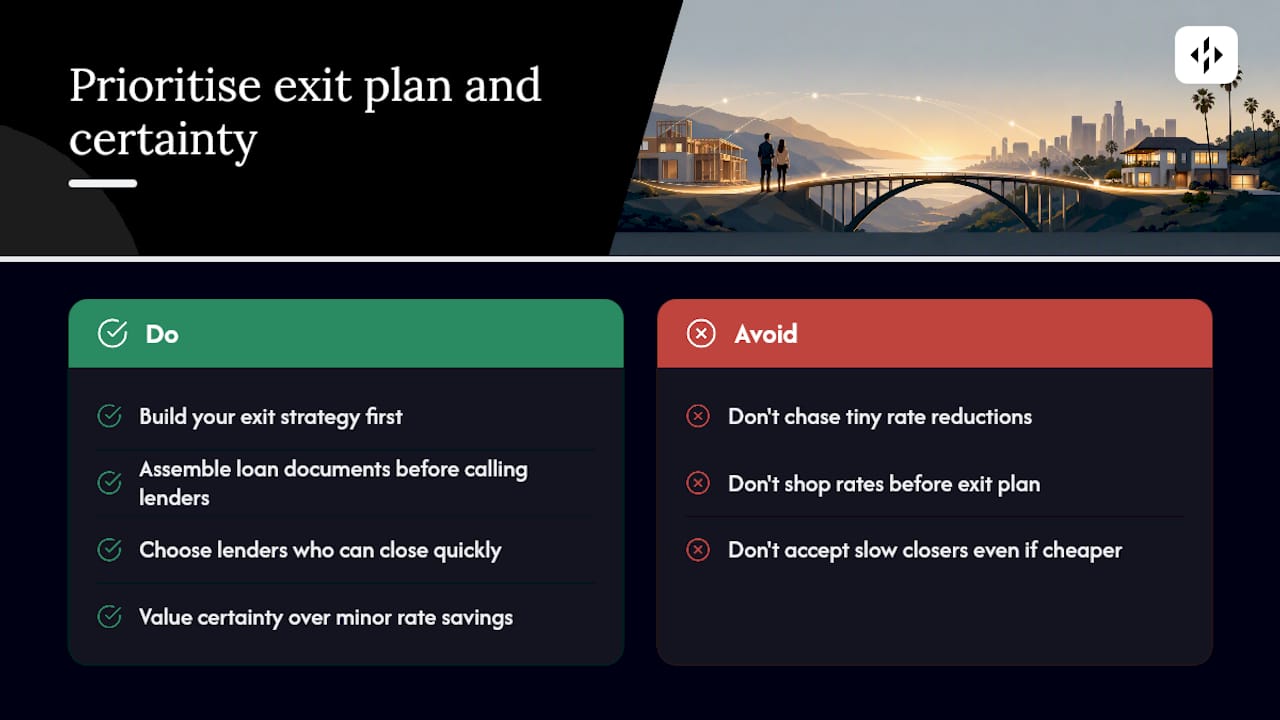
The conventional wisdom says shop five lenders and take the lowest rate. In practice, a slightly higher rate from a lender who closes in ten days beats a cheaper quote that drags for six weeks and costs you a deal. Certainty of close is worth more than most borrowers give it credit for, especially in competitive SoCal markets where a delayed close can mean losing the property entirely.
If you take one thing from this: build your exit plan and your document file before you call a single lender. That preparation, more than your credit score, is what actually moves your pricing and your timeline. Everything else, from choosing between a debt fund and a private lender to negotiating extension terms, flows from having that foundation solid first.
— Irvin Nierras
This article is general information, not a substitute for advice from a qualified financial advisor. Consult a qualified financial professional about your own circumstances before acting on anything here.
Sources
- California Bridge Loans 2026: Rates (8-11%) & Requirements
- California Bridge Loan Rates in 2026: What You’ll Really Pay, and How to Qualify