

TL;DR:
- Passive income in Southern California involves careful management of tax rules, market conditions, and operational effort. Investors should understand the IRS passive activity classifications, the regional market differences, and California's unique tax regulations to optimize returns. Successful long-term investors treat their properties as businesses, leveraging professional management, strategic planning, and detailed market analysis.
Many investors picture rental property as a mailbox money machine, a simple formula where you buy a place, find a tenant, and watch deposits roll in every month. That picture is appealing, but in Southern California it skips several chapters. Between the IRS definition of "passive," California's unique tax rules, and a rental market that behaves very differently in Los Angeles versus Orange County, the path to truly passive income is paved with details that can make or break your returns. This guide unpacks every layer so you can build a strategy that actually works in 2026.
Table of Contents
- Understanding passive income in real estate: What it really means
- Southern California rental market: Your passive income hunting grounds
- Tax realities: How California rules shape your 'passive' profit
- Making it truly passive: Smart strategies for less effort, more income
- The uncomfortable truth about 'passive' income from SoCal real estate
- Ready to start or level up your California passive income real estate journey?
- Frequently asked questions
Key Takeaways
| Point | Details |
|---|---|
| Passive income isn't always passive | True passivity in rental real estate requires limited involvement and strategic delegation. |
| Market data drives strategy | Understanding LA and OC vacancy and rent trends is key for targeting resilient passive income. |
| California tax rules impact returns | Passive activity loss limits and depreciation rules can delay or reduce your rental income profit. |
| Smart management reduces effort | Using professional managers and the right structures can make rental income closer to hands-off. |
Understanding passive income in real estate: What it really means
With the expectation of hands-off income set, let's clarify exactly what "passive" income means for California real estate investors.
When most people call rental income "passive," they mean it requires less effort than a regular job. That is true in spirit. But the IRS defines passive income with surgical precision, and the difference has enormous tax consequences.
The IRS definition treats rental activity as passive by default. However, if you materially participate in managing your property, the IRS may reclassify your income and limit certain deductions. "Material participation" is measured by hours. More than 500 hours per year spent on real estate activities can qualify you as a real estate professional, which unlocks loss deductions that ordinary investors cannot touch. Below that threshold, most investors are locked into the passive category, which sounds convenient until losses come into play.
Here is what the IRS considers passive rental income for most investors:
- Collecting rent from a long-term residential tenant
- Receiving distributions from a real estate limited partnership
- Earning returns from a real estate investment trust (REIT)
- Receiving payouts from a real estate crowdfunding platform, which you can learn more about through real estate crowdfunding
"Rental income is often not truly passive unless management is delegated and effort is minimal."
REITs and crowdfunding platforms sit at the far end of the passivity spectrum. You invest capital, someone else handles everything, and you receive periodic distributions. The tradeoff is reduced control and, in most cases, lower total returns than direct ownership. But for investors who genuinely want zero operational headaches, these vehicles deserve serious consideration.
Professional property management sits in the middle ground. A good manager handles leasing, maintenance coordination, rent collection, and tenant communications. Your day-to-day involvement drops dramatically. However, you still need to review monthly statements, approve major repairs, oversee the manager's performance, and make strategic decisions about the property. As any experienced landlord will tell you, even great management does not make your investment entirely brainless.
Pro Tip: Interview at least three property management companies before signing a contract. Ask specifically how they handle maintenance emergencies, how quickly they fill vacancies, and what their average days-on-market looks like for their current portfolio. A bad manager can turn a promising passive investment into a full-time headache.
The operational reality for most SoCal investors falls somewhere between fully active and fully passive. Understanding where you land on that spectrum before you buy will shape every decision you make, from financing to property type to location.
Southern California rental market: Your passive income hunting grounds
Once you grasp what makes income truly passive, the next crucial question is: which markets actually support it right now?
Southern California contains multiple distinct rental markets, and treating them as one monolithic region is a mistake. Los Angeles and Orange County behave quite differently in 2026, and those differences have direct implications for passive income investors.
LA vs. OC: The numbers in Q1 2026
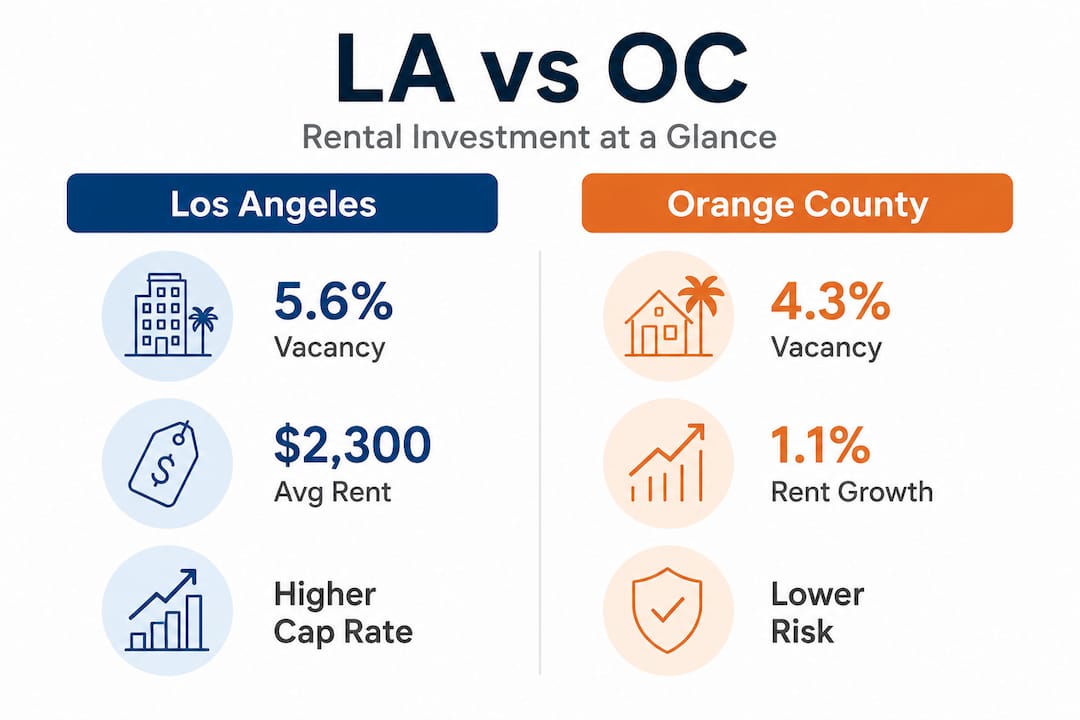
Here is how the two markets compare based on current multifamily data:
| Metric | Los Angeles | Orange County |
|---|---|---|
| Vacancy rate | 5.6% | 4.3% |
| Rent growth | Flat | 1.1% |
| Average asking rent | $2,300/unit | $2,800/unit |
| Cap rate | 5.1% | 4.5% |
Los Angeles posted a vacancy rate of 5.6%, flat rent growth, and average asking rents around $2,300 per unit in Q1 2026, with a cap rate of roughly 5.1%. Orange County, by contrast, showed lower vacancy at 4.3%, positive rent growth of 1.1%, higher average asking rents near $2,800 per unit, and a slightly lower cap rate of 4.5%.

What does this mean in plain language? Orange County has tighter supply, stronger demand, and more consistent rent momentum. Los Angeles has more inventory, more concessions (think one month of free rent or reduced deposits), and softer rent growth because developers added significant supply in recent years. For a passive income investor, Orange County's lower vacancy directly translates to fewer empty months and more predictable monthly cash flow.
That said, Los Angeles offers a higher cap rate, which means you get more income relative to purchase price. This can work in your favor if you are comfortable managing the vacancy risk or if you buy in specific LA submarkets with stronger fundamentals. Neighborhoods in the San Fernando Valley, for example, often behave differently than downtown LA or Hollywood corridors.
Understanding SoCal 2026 real estate trends before selecting your target market is essential. Broad regional data gives you a baseline, but drilling down into specific zip codes and property classes reveals where passive income opportunities are most durable.
What to look for when reading SoCal market signals:
- Track vacancy trends quarter over quarter, not just point-in-time snapshots
- Watch concession activity because widespread landlord concessions signal softening demand
- Monitor new supply pipelines because new units coming online in your submarket directly pressure your rents
- Pay attention to absorption rates, which measure how quickly newly available units get leased
- Analyze median household income growth in the target area because income drives rent capacity
Affordability pressure is a real constraint in Southern California. Tenants are already stretched thin. The gap between what renters can realistically pay and what investors need to charge for positive cash flow is narrower here than in most other U.S. markets. This is not a reason to avoid SoCal, but it is a reason to analyze deals with precision rather than optimism.
Exploring best SoCal investment locations in 2026 helps you pinpoint where income stability and tenant demand converge. Additionally, if you are specifically targeting Orange County, reviewing Orange County real estate benefits provides a deeper look at why this market consistently attracts investors seeking reliable rental performance.
Tax realities: How California rules shape your 'passive' profit
After market analysis, understanding what you keep after taxes is just as critical for sustainable passive income.
California is one of the most tax-complex states for real estate investors. The rules at the state level diverge significantly from federal rules, and those divergences cost investors real money every year.
Passive activity loss (PAL) rules: The basics
When your rental property expenses exceed your rental income, you have a rental loss. Most investors assume they can deduct that loss against their W-2 wages or other income. That assumption is often wrong. The IRS passive activity loss rules say that rental losses can only offset passive income, not active income, unless you meet specific thresholds.
There are two key exceptions:
-
The $25,000 allowance: If your adjusted gross income (AGI) is under $100,000, you can deduct up to $25,000 in rental losses against ordinary income. This allowance phases out completely between $100,000 and $150,000 AGI. Given SoCal income levels, many investors here earn too much to use this deduction at all.
-
Real estate professional status: If you spend more than 750 hours per year on real estate activities and that represents more than half of your working time, you qualify as a real estate professional. This unlocks full loss deductibility. For a busy professional with a day job, this status is nearly impossible to achieve.
If you cannot use your losses currently, they carry forward to future years or can be released when you sell the property. Tracking these carryforward amounts is essential for tax planning.
California's unique tax hurdles
California adds another layer of complexity. Here is how federal and state treatment differ:
| Tax rule | Federal | California |
|---|---|---|
| Bonus depreciation | Allowed (100% in prior years, phasing down) | Not conformed, not allowed |
| Passive activity loss rules | Standard PAL rules | Largely mirrors federal, but with separate tracking |
| Depreciation tracking | Single schedule | Separate federal and state schedules required |
| Capital gains tax rate | 0%, 15%, or 20% depending on income | Taxed as ordinary income, up to 13.3% |
California does not conform to federal bonus depreciation, which means you must track two entirely separate depreciation schedules for every property. What you deduct federally may differ from what California allows. This creates complexity at tax time and surprises for investors who file without a California-savvy CPA.
Common investor tax surprises in SoCal:
- Assuming state and federal returns will mirror each other, then discovering large California adjustments
- Not accounting for California's top marginal income tax rate of 13.3%, which applies to rental income above certain thresholds
- Failing to track passive loss carryforwards across tax years, leading to missed deductions at sale
- Overlooking depreciation recapture, which California taxes as ordinary income
Pro Tip: Hire a CPA who specializes specifically in California real estate before you close on your first investment property. The cost of their expertise is almost always recovered through better tax planning. Generic tax preparers frequently miss California-specific deductions and tracking requirements.
Understanding your after-tax return is foundational to knowing whether a deal actually works for your goals. A property with solid gross rents and a respectable cap rate can still underperform once you factor California's tax friction into the equation. For deeper insight into deal-level numbers, reviewing how to calculate real estate ROI in SoCal will help you model realistic expectations before committing capital.
Making it truly passive: Smart strategies for less effort, more income
Once you know the rules, how can you actually design a rental portfolio or explore alternatives that fits a hands-off, passive lifestyle?
The good news is that investors who are strategic about how they structure their rental activities can get remarkably close to true passivity. It requires upfront work and deliberate choices, but the payoff is income that flows without daily involvement.
Steps to make rental income as passive as possible
-
Choose properties with low maintenance profiles. Newer construction or recently renovated properties generate fewer repair calls. Single-family homes in newer suburban neighborhoods often beat older urban multifamily buildings on maintenance frequency. Condos can work well because the HOA typically handles exterior and common area upkeep.
-
Hire a licensed property management company. This is the single most impactful step. Expect to pay 8% to 12% of monthly rent for a full-service manager in the SoCal market. Factor this cost into your underwriting before you buy, not after. As noted earlier, even with management in place, operational passivity depends on how much you delegate and how capable your manager is.
-
Set up automated systems. Use digital rent collection platforms so payments arrive directly in your account. Require renters insurance from all tenants. Establish a maintenance reserve account so your manager can handle repairs under a set dollar amount without calling you.
-
Vet tenants rigorously upfront. A high-quality tenant dramatically reduces ongoing involvement. Screen thoroughly for income, credit, and rental history. Tenant turnover is the biggest destroyer of passive income because it combines vacancy loss, cleaning costs, make-ready expenses, and leasing fees all at once.
-
Consider long-term rental structures. Short-term rentals (like vacation rentals) generate higher gross income but require far more management attention. For genuine passivity, long-term residential leases typically win.
Alternative vehicles for truly hands-off investing
If direct ownership still feels too operationally intensive, several alternative structures offer exposure to SoCal real estate without day-to-day responsibilities:
-
REITs (Real Estate Investment Trusts): Publicly traded or private, REITs let you own fractional interests in large commercial or residential portfolios. Fully passive, highly liquid for public REITs, but returns are often lower than direct ownership.
-
Real estate syndications: Private deals where an experienced operator (the general partner) manages a large property and investors (limited partners) provide capital. You invest, receive quarterly distributions, and participate in profits at sale. Minimum investments typically range from $25,000 to $100,000.
-
Real estate partnerships: Teaming with an active partner who handles operations while you provide capital is another path. This structure works well when roles and profit splits are clearly defined in writing from day one.
Pitfalls to avoid in hands-off investing:
- Choosing a property manager based on price rather than track record
- Not requiring detailed monthly reporting from your manager
- Ignoring a property for extended periods, which can lead to deferred maintenance and code violations
- Entering a syndication without thoroughly reviewing the sponsor's prior deals and investor returns
- Failing to maintain adequate cash reserves for unexpected capital expenditures
For LA and OC-specific strategy guidance, exploring LA and OC investment tips provides actionable frameworks for navigating both markets based on local market dynamics.
Pro Tip: When evaluating a property management company, ask for references from three current clients who own similar property types. Call those references and ask directly: "If you had to do it again, would you hire this same company?" The answer will tell you everything.
The uncomfortable truth about 'passive' income from SoCal real estate
With a roadmap to passive income in hand, it is essential to hear a real-world take on what truly sets successful investors apart.
Most guides about passive income in real estate are written for the best-case scenario. Buy a solid property, hire a good manager, collect checks. In some markets, that simplicity is achievable. In Southern California, it rarely is, and investors who learn this the hard way often find out at the worst possible moment.
Here is what we have observed working with investors across Los Angeles and Orange County. The investors who thrive long-term are not necessarily the ones who found the best properties. They are the ones who understood from the start that "passive" in everyday use differs greatly from the IRS or tax meaning, and who planned accordingly for the compliance overhead, the occasional active decision, and the unexpected costs that inevitably arise.
California's regulatory environment adds friction that investors from other states genuinely underestimate. Eviction processes here are among the most tenant-protective in the country. Rent control applies to many properties in Los Angeles under AB 1482 and local ordinances. Required disclosures, habitability standards, and remodeling restrictions on controlled units can all create situations where your "passive" investment demands very active responses.
The investors who consistently see why investing in Southern California real estate in 2026 remains compelling are those who go in clear-eyed about the responsibilities. They build generous maintenance reserves, at least 5% to 8% of gross rents annually. They budget for professional management, a CPA who knows California property tax rules, and occasional legal consultation. They do not expect perfection from the market, and they are not rattled when a quarter of flat rent growth interrupts their projections.
There is also a psychological dimension that first-time investors frequently underestimate. When a tenant reports a plumbing emergency at 10 p.m., your property manager handles the call. But you are still the owner, and if that repair reveals a larger systemic issue, you will be the one making an expensive capital decision. The distance between you and the problem is greater with a manager. It is never infinite.
Successful SoCal passive income investors treat their rental properties the way a good business owner treats a company they have promoted a capable manager to run. You trust the day-to-day to your team, but you review the financials, you ask hard questions quarterly, and you stay informed about the market. That is not a burden. That is ownership.
Ready to start or level up your California passive income real estate journey?
If you are ready to explore opportunities or get expert market insight, here is where you can take the next step.
Navigating the Southern California rental market with passive income goals requires more than good intentions. It takes current market data, local expertise, and access to the right properties. At IN Realtors, we work specifically with investors in Los Angeles, Orange County, and surrounding SoCal communities who want to build income-producing portfolios with realistic, data-backed expectations.

Whether you are looking at your first rental property or expanding an existing portfolio, our listings span a range of investment-friendly options. You can browse single family homes for sale that offer strong rental demand in suburban markets, or explore condos for sale in communities where HOA management reduces your operational burden. For a real-time read on local conditions, our market snapshot gives you current pricing and trend data for the specific neighborhoods you are targeting. Our team brings the local knowledge and investor focus to help you find properties that genuinely support your passive income goals.
Frequently asked questions
What makes rental income "passive" in California?
Rental income is only considered truly passive when you limit your participation and, in most cases, delegate management to a professional. The IRS and tax definition differs from the common understanding, so investors who stay hands-on may face different tax treatment than they expect.
Can I deduct all my rental losses on my taxes as a California investor?
No. Most investors are subject to passive activity loss rules, which restrict rental loss deductions against ordinary income. California passive activity loss rules mirror much of the federal structure but may force you to carry losses forward until you have offsetting passive income or sell the property.
How do LA and Orange County compare for new passive income property investment?
Orange County had lower vacancy and higher rent growth than Los Angeles in Q1 2026, which generally supports more consistent cash flow for passive income investors. Los Angeles offers higher cap rates but carries more vacancy risk due to increased new supply in recent years.
Does California follow the same depreciation rules as federal for rental real estate?
No. California does not conform to federal bonus depreciation and requires investors to maintain separate federal and state depreciation schedules for each property, adding meaningful complexity to annual tax filings.